
For adults under 60, a blood pressure reading of 140/90 mmHg or higher should be repeated and reviewed. For adults aged 60 and older, systolic pressure of 150 mmHg or higher, or diastolic pressure of 90 mmHg or higher, is the practical trigger for follow-up.
That threshold matters in Dubai because high blood pressure isn't limited to older patients. A UAE-specific May Measurement Month screening analysis found hypertension in 30.2% of participants, while earlier community estimates placed age-standardised prevalence at 33%. Only 49% were aware, 47% were receiving treatment, and 19% had controlled blood pressure, according to the same analysis (UAE May Measurement Month screening analysis). A useful جدول ضغط الدم حسب العمر therefore needs to do more than display reassuring colours. It should help a home-care clinician decide whether to repeat a measurement, review the patient's routine, or arrange clinical assessment.
Table of Contents
- Why an Age-Based Blood Pressure Table Matters
- How to Read a Blood Pressure Number
- جدول ضغط الدم حسب العمر in Practical Ranges
- Blood Pressure Categories and What They Mean
- Measuring Blood Pressure Correctly at Home
- Turning the Chart into Daily Decisions
- When to Book a Home or Hotel Doctor Visit
- Common Age-Based Myths Worth Retiring
- Reviews and References Behind the Numbers
- Quick Reference and Frequently Asked Questions
Why an Age-Based Blood Pressure Table Matters
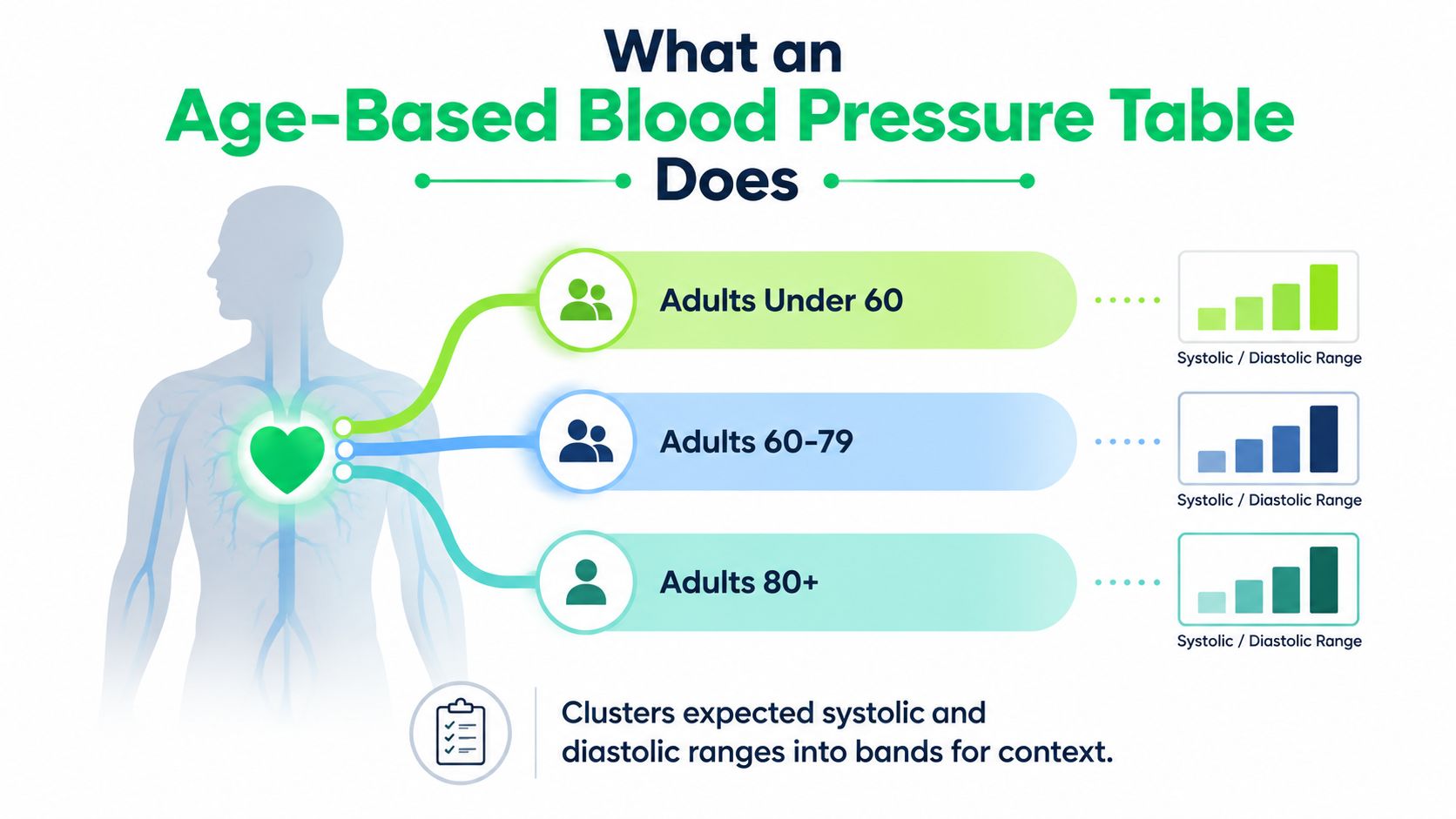
An age-based table groups expected systolic and diastolic readings into practical age bands. It gives context to a number, but it doesn't diagnose hypertension from one measurement. Blood pressure changes with activity, stress, posture, medication timing, sleep, hydration, and the conditions in which the reading was taken.
The UAE data explain why this context matters. In the same screening analysis, 63% of participants were under 40, with a mean age of 36.8 years, showing that monitoring shouldn't wait until retirement or old age (UAE screening findings). In one UAE dataset summarised in a Middle East cardiovascular presentation, hypertension prevalence was 10.2% at ages 18 to 29, 18.1% at ages 30 to 49, 57.7% at ages 50 to 69, and 54.8% above 70 (UAE cardiovascular evidence presentation).
Use the chart as a triage tool
During a Dubai home visit, I'd use the table in this order:
- Check the age band. A target used for a younger adult may not be the same as the practical treatment threshold for an older adult.
- Look at both numbers. A high systolic or high diastolic value can change the next step.
- Repeat correctly. A second reading taken after quiet rest is more useful than an anxious first result.
- Assess the pattern. Repeated morning readings carry more weight than an isolated result after exertion or distress.
- Escalate when the pattern or symptoms justify it.
Dubai guidance states that adults without hypertension should have their blood pressure checked at least once every five years, while an initial reading above 140/90 should lead to repeat readings or structured home monitoring over one week (Dubai adult hypertension standards). Readers who need ongoing support can also review high blood pressure care with doctor support as one home-care option.
How to Read a Blood Pressure Number
A blood pressure result has two figures, written as systolic over diastolic. Systolic pressure is the force against artery walls when the heart contracts. Diastolic pressure is the pressure remaining while the heart relaxes between beats. The unit is mmHg, meaning millimetres of mercury.
A simple hose analogy helps. Systolic pressure is like the surge when water is pushed through the hose. Diastolic pressure is the background pressure while the pump pauses. If the hose becomes less flexible, the surge can become stronger even when the resting pressure changes less predictably.
Age affects that pattern. Arteries commonly become stiffer over time, which can push systolic pressure upwards. Diastolic pressure may rise earlier in adult life and later drift down, so an older person can have a wide gap between the two values. That difference is one reason a single “normal for everyone” line can mislead.
Separate the number from the circumstances
The cuff belongs on a bare upper arm, with the arm supported at heart level. A cuff that's too small can produce a falsely high result, while a poorly positioned cuff can make the reading difficult to interpret. The person should sit rather than talking, walking, or checking the result immediately after climbing stairs.
A reading taken during a stressful phone call on a hot Dubai afternoon isn't equivalent to three calm morning readings above the person's review threshold. The first may be a temporary spike. The second pattern suggests a repeatable problem that deserves organised follow-up.
Clinical perspective: The useful question isn't “Is this one number normal?” It's “Does this number remain high when the measurement conditions are controlled?”
The table restores that missing context. It helps the reader identify what to repeat and what to document, while a clinician decides whether the pattern represents hypertension, medication-related change, or another issue.
جدول ضغط الدم حسب العمر in Practical Ranges
The table below is a home-monitoring reference, not a diagnostic chart. The “typical” ranges are practical orientation bands. The repeat-and-review threshold reflects the Dubai adult guidance supplied for this article, especially its use of 140/90 as a trigger for repeat readings in adults and its age-adjusted treatment thresholds (Dubai high blood pressure guidance).
| Age Band | Typical Systolic (mmHg) | Typical Diastolic (mmHg) | Repeat-and-Review Threshold | Clinical Reference |
|---|---|---|---|---|
| Children and teens, 12 to 17 | Individual assessment required | Individual assessment required | Repeat any unexpected elevated reading and seek paediatric advice | Teen readings need age, sex, height, and clinical context |
| Young adults, 18 to 39 | Around the adult healthy range | Around the adult healthy range | 140 or higher, or 90 or higher | UAE data show meaningful hypertension in younger adults |
| Midlife adults, 40 to 59 | Around the adult healthy range | Around the adult healthy range | 140 or higher, or 90 or higher | UAE prevalence rises substantially through midlife |
| Older adults, 60 to 79 | Below the older-adult treatment threshold | Below the older-adult treatment threshold | Systolic 150 or higher, or diastolic 90 or higher | Dubai guidance uses age-adjusted treatment thresholds |
| Elderly adults, 80+ | Individualised clinical target | Individualised clinical target | Repeat high readings promptly and arrange clinician review | Frailty, symptoms, medicines, and function affect decisions |
What the UAE evidence adds
Younger adults shouldn't dismiss repeated readings. One UAE analysis reported 23% prevalence among people aged 40 or younger, and 27% among Emirati nationals. The same paper reported that applying the ACC/AHA 2017 definition would classify hypertension in 40.8% rather than 76.3% of adults, with medication eligibility changing from 32.1% to 62.5% (UAE hypertension classification analysis). These differing classifications show why the chosen guideline changes the label, while repeated measurement and clinical context remain essential.
For older adults, the table doesn't mean that a systolic result below the treatment threshold is automatically safe, or that a result above it is an emergency. The Dubai guidance uses 150 mmHg systolic or 90 mmHg diastolic as the treatment-start reference for adults aged 60 and older, with targets below those thresholds. Medication, dizziness, falls, kidney disease, and frailty can alter the plan.
The practical sequence is simple: measure, repeat, record, then review. The labels in the next table help translate the result into an appropriate response.
Blood Pressure Categories and What They Mean
Clinical categories are useful only after readings have been confirmed across repeated measurements. A single result can be distorted by movement, pain, anxiety, caffeine, nicotine, a full bladder, or an incorrectly fitted cuff.
The following cut points use the conventional adult categories requested for this guide. They should be read alongside Dubai's age-adjusted treatment approach, not as a replacement for it.
| Category | Systolic (mmHg) | Diastolic (mmHg) | What It Means | Typical Response |
|---|---|---|---|---|
| Normal | Below 120 | Below 80 | The reading is within a generally healthy adult range | Maintain routine checks and healthy habits |
| Elevated | 120 to 129 | Below 80 | Systolic pressure is above the preferred range without meeting hypertension criteria | Repeat under calm conditions and review lifestyle factors |
| Stage 1 hypertension | 130 to 139 | 80 to 89 | The reading is above the preferred range and may represent early hypertension if sustained | Keep a structured log and arrange clinician review |
| Stage 2 hypertension | 140 or higher | 90 or higher | The reading meets the common adult threshold for hypertension when confirmed | Arrange timely assessment, including a DHA-licensed home visit when appropriate |
| Hypertensive crisis | 180 or higher | 120 or higher | This is a potentially dangerous reading, particularly with symptoms | Repeat promptly and seek urgent medical assessment |
The label isn't the diagnosis
A person aged over 60 may have a reading that falls into a different category under a general chart while remaining below Dubai's practical treatment threshold. That doesn't make the result irrelevant. It means the clinician must weigh age, medicines, symptoms, kidney function, cardiovascular risk, and repeated readings together.
For patients managing long-term conditions, chronic disease management with doctor support in Dubai can be considered alongside clinic follow-up. The useful service is the one that reviews the trend, checks technique, reconciles medicines, and gives a clear escalation plan.
Stage 1 readings usually call for organisation rather than panic. Stage 2 readings need prompt clinical attention, especially when they recur. Crisis-level readings require a higher level of urgency, and symptoms such as chest pain, breathlessness, weakness, confusion, or visual change should never be managed by waiting for a convenient appointment.
Measuring Blood Pressure Correctly at Home
A reliable home reading depends more on technique than on the monitor alone. Before measuring, avoid exercise, caffeine, and nicotine for a suitable rest period, empty your bladder, and sit without talking. Dubai's air conditioning is not a problem, but shivering, rushing, or measuring straight after a stressful event can change the result.
A dependable measurement routine
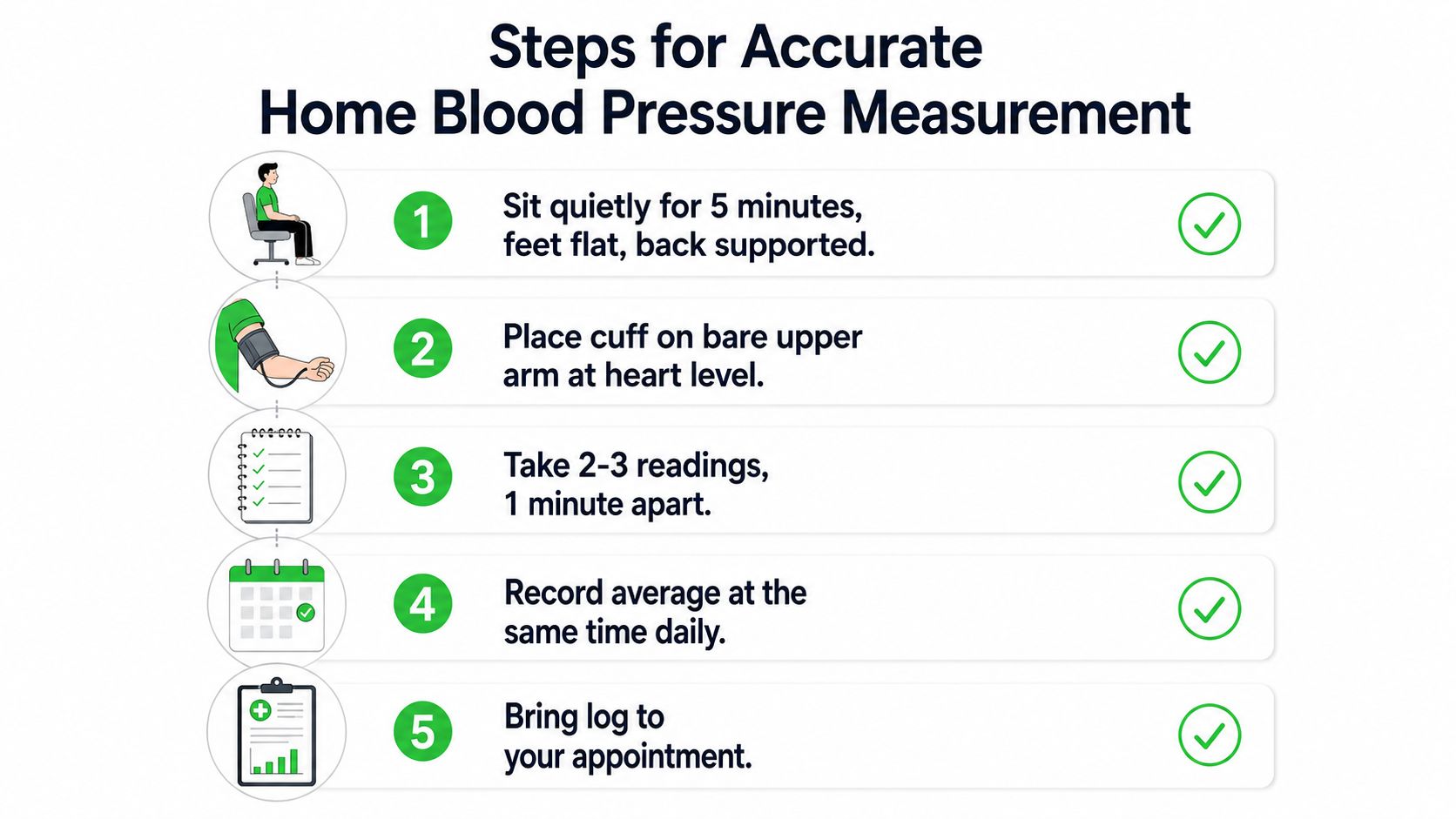
- Rest first. Sit for five minutes, with your back supported and both feet flat on the floor.
- Position the cuff. Use a correctly sized cuff on the bare upper arm, keeping the arm supported at heart level.
- Take paired readings. Measure twice, approximately one minute apart, and record both values, including an unusually high first result.
- Keep timing consistent. Morning readings before medication and evening readings make comparisons more useful.
- Bring the log. A DHA-licensed clinician can review the readings alongside symptoms, medicines, and recent illness.
Use an upper-arm device where possible. Wrist monitors are more sensitive to position, and a small change in height can affect the result. The cuff must fit the arm correctly, not merely fasten around it. If the monitor repeatedly differs from a clinic measurement, take it to an appointment for comparison.
Several readings taken under similar conditions show the pattern more clearly. Do not delete an outlier after a difficult conversation. Mark what happened, repeat the measurement after quiet rest, and let the clinician decide whether it changes the overall assessment. Check device accuracy against a clinic reading every six to twelve months.
For people combining blood pressure checks with other home diagnostics, guidance on arranging home blood sampling can help organise the wider assessment.
Turning the Chart into Daily Decisions
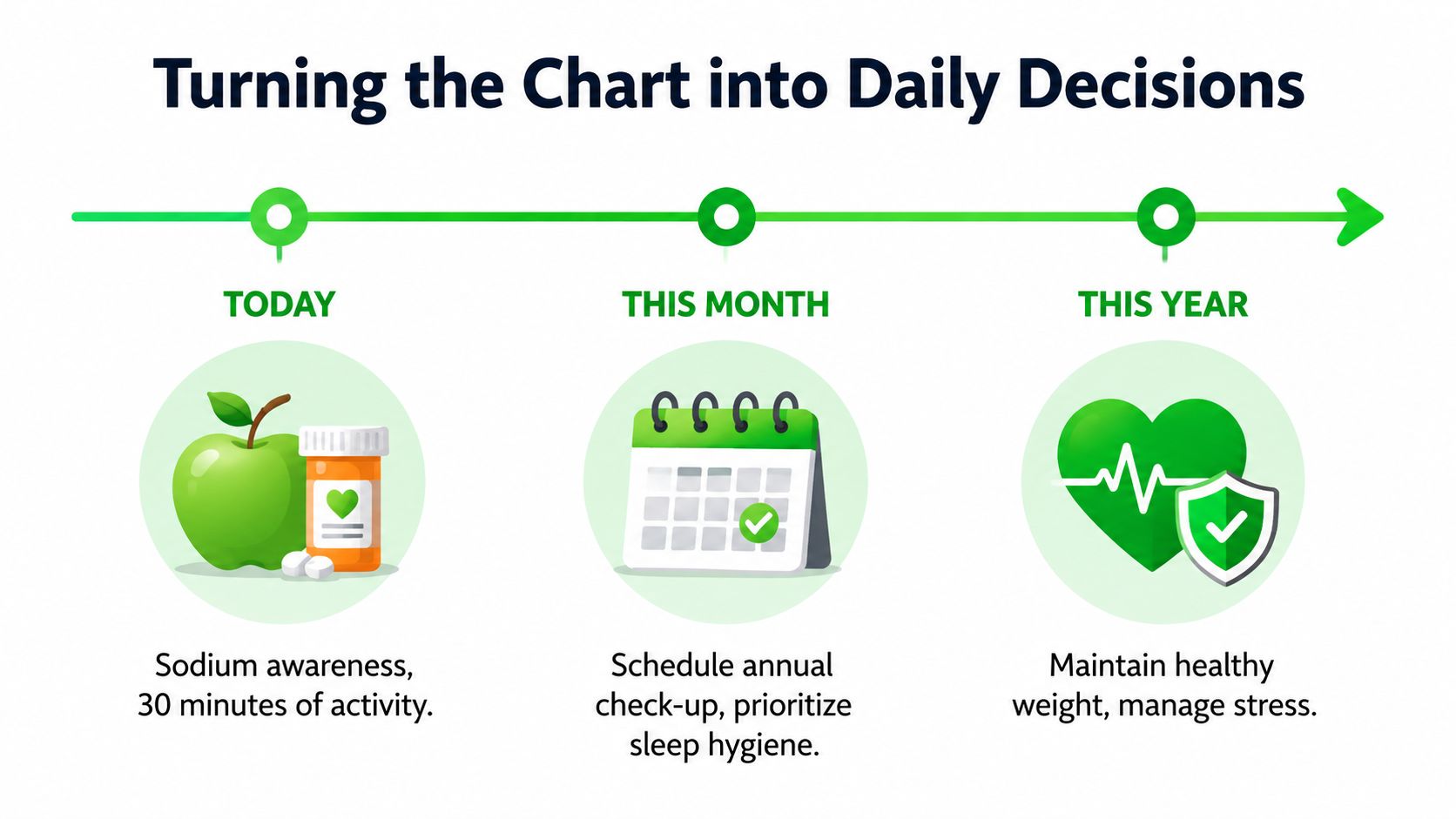
A chart becomes useful when it changes what happens next. For an adult under 60 with readings in the preferred range, today's task is simple: measure correctly when due, keep sodium awareness in daily meals, protect sleep, and include moderate activity most days. This year's goal is continuity, not constant checking.
Match the response to the pattern
For higher or Stage 1 readings, use a structured plan rather than reacting to every result. Take morning and evening readings for two weeks, note food and sodium patterns, and book a clinician review. If travel, mobility, or clinic waiting makes attendance difficult, a DHA-licensed home visit can provide an assessment in the patient's normal environment.
Stage 2 readings deserve prompt assessment. Document the values, the time, symptoms, medication timing, and whether the patient had rested. The visiting clinician needs the original record, not only a verbal summary.
A straightforward log can use five columns:
- Date and time
- Systolic and diastolic readings
- Pulse, if displayed
- Medication and meal timing
- Symptoms or relevant events
Think in time horizons
Today, repeat a concerning reading after quiet rest and check for symptoms. This month, arrange review if the pattern remains above the age-appropriate threshold. This year, preserve the record and make routine monitoring part of the health calendar, especially where a family history or established condition exists.
If blood tests or related monitoring are needed at home, booking a blood test at home in Dubai may reduce the practical barrier to completing follow-up. The chart should support a decision, not become a substitute for one.
When to Book a Home or Hotel Doctor Visit
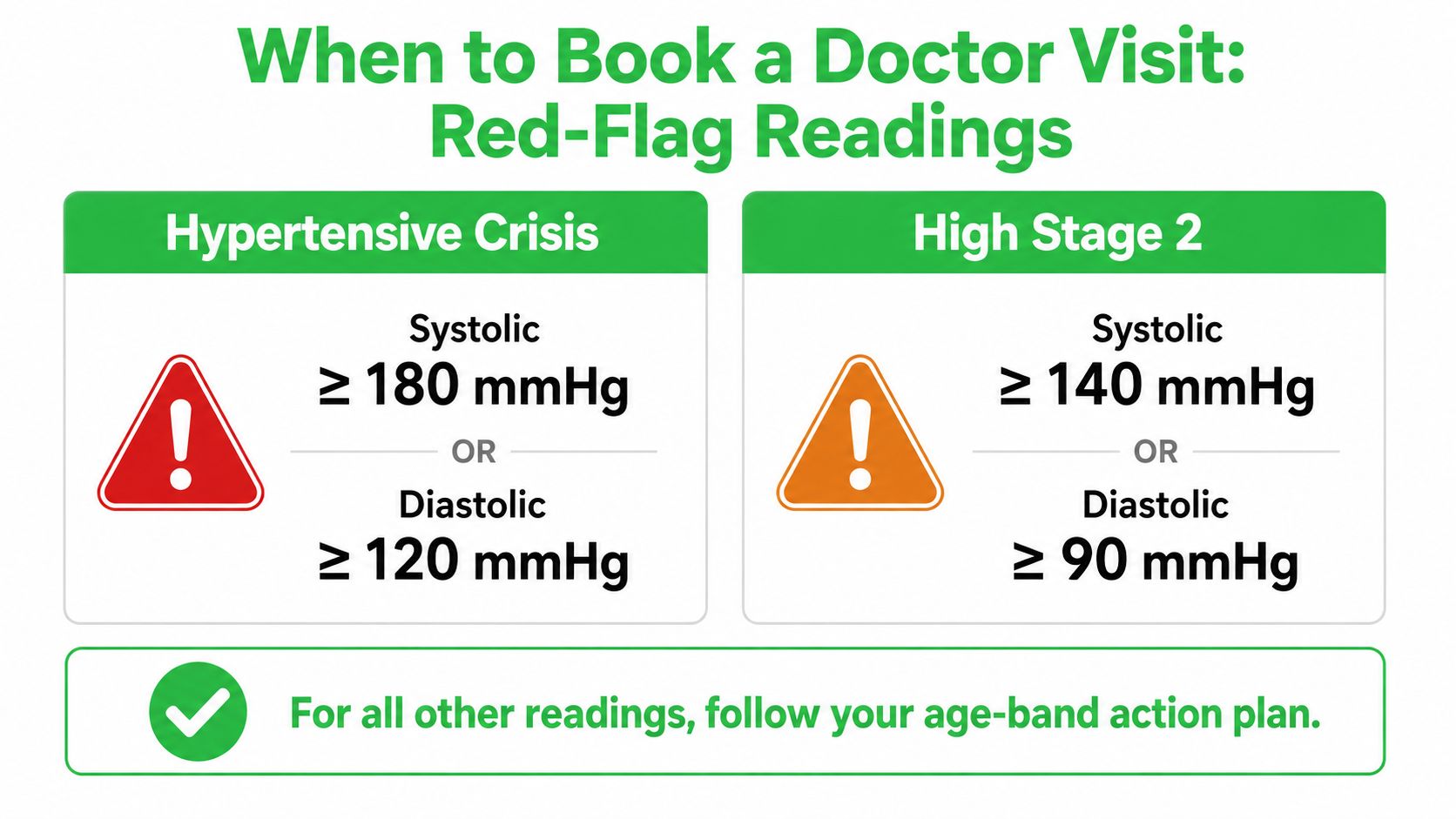
Book a same-day clinical assessment for a reading of 180 mmHg systolic or higher, or 120 mmHg diastolic or higher, particularly if a repeat reading remains at that level. This is crisis territory, and symptoms matter as much as the display.
For adults under 60, persistent readings at or above 140/90 after two properly performed repeat sessions warrant review. For adults aged 60 and older, repeated systolic readings at or above 150, or diastolic readings at or above 90, should prompt clinician assessment under the Dubai guidance.
Symptoms change the urgency
Don't wait for a routine booking if high readings occur with:
- Chest pain or breathlessness
- One-sided weakness, confusion, or fainting
- Severe headache or a sudden vision change
- Palpitations with marked weakness
- Pregnancy alongside readings at or above 140/90
- Post-COVID fatigue paired with persistently high readings
A DHA-licensed doctor at home can be practical for a Dubai resident with limited mobility, a hotel guest unfamiliar with local routing, or a patient who needs assessment outside clinic hours. A home or hotel visit should still lead to emergency referral when the clinician identifies a serious risk.
Prepare the monitor, recent log, medication list, and previous records. The Dubai home and hotel doctor service is one option for arranging an in-person assessment where the patient is staying.
Common Age-Based Myths Worth Retiring
Myth one, higher readings are normal with age. Arterial stiffness can raise systolic pressure, but persistent hypertension remains a medical problem rather than an unavoidable part of ageing. Dubai guidance still uses treatment thresholds and targets for older adults.
Myth two, young adults can't have high blood pressure. UAE screening included many younger participants, and the analysis found hypertension was present in 30.2% overall, with 63% under 40 (UAE screening analysis). A young adult with repeated high readings shouldn't dismiss them because of age.
Myth three, low readings are always safe. A low result can be concerning when it causes dizziness, fainting, weakness, falls, or confusion. Older adults taking medicines that lower pressure may need a medication review rather than reassurance based on the number alone.
Myth four, one reading decides everything. A single result is a prompt to check technique and repeat. A consistent log taken in calm conditions provides stronger evidence than a lone clinic or home reading.
Myth five, medication fixes blood pressure permanently. Treatment can lower pressure while it's taken, but the plan still needs monitoring. Diet, activity, sleep, weight management, alcohol intake, tobacco exposure, and follow-up all influence whether control continues.
The UAE systematic review and meta-analysis found pooled hypertension prevalence of 31%, with only about one in five people achieving control (UAE hypertension systematic review and meta-analysis). That finding supports a practical approach: identify the pattern, address the causes that can be changed, and review treatment rather than assuming the problem has disappeared.
Reviews and References Behind the Numbers
Use this reference index to understand what supports the table and where interpretation requires care.
- NESH-UAE screening study: its preliminary phase reported hypertension prevalence of 36.6% among citizens aged 18 to 75 (NESH-UAE screening study).
- Dubai adult hypertension standards: treatment decisions are age-adjusted, so clinicians do not rely on one universal “normal” value.
- 2017 ACC/AHA hypertension guideline: provides an international framework for classifying readings and considering treatment.
- 2023 ESH/ESC hypertension management guideline: offers a separate framework, which may label the same reading differently.
- World Health Organization HEARTS technical package: supports structured cardiovascular risk assessment and practical blood-pressure management.
- Measurement reviews: evidence on home and office readings, cuff placement, and systolic pressure in older adults informs how a result should be collected and interpreted.
- UAE systematic review and meta-analysis: supplies a national pooled estimate for hypertension and its control.
- UAE classification analysis: shows that changing definitions can alter who receives a hypertension label and who may be considered for medication.
These sources serve different purposes. Prevalence studies describe the UAE population, guidelines shape thresholds and treatment decisions, and measurement research helps assess whether a home reading is dependable. Before starting, stopping, or changing medication, confirm current recommendations with a qualified clinician. In Dubai, repeated or concerning readings should be reviewed with a DHA-licensed clinician, including through a home visit when travel is difficult.
Quick Reference and Frequently Asked Questions
| Age Band | Systolic (mmHg) | Diastolic (mmHg) | Action Trigger |
|---|---|---|---|
| 12 to 17 | Individual assessment | Individual assessment | Repeat and seek paediatric advice |
| 18 to 39 | Adult reference range | Adult reference range | Repeat and review at 140 or 90 |
| 40 to 59 | Adult reference range | Adult reference range | Repeat and review at 140 or 90 |
| 60 to 79 | Below 150 | Below 90 | Repeat and review at 150 or 90 |
| 80+ | Individualised | Individualised | Prompt review of repeated elevation |
Do morning readings matter more? Morning readings are useful because they can be taken consistently before medication and daily activity. Evening readings still matter, particularly when they reveal a repeated pattern.
Can anxiety raise one reading? Yes, stress can affect a single result. Rest, repeat, and record the circumstance instead of treating one anxious measurement as a diagnosis.
Does caffeine or air conditioning change the result? Caffeine, nicotine, recent exertion, and cold-related shivering can influence a reading. Keep the room comfortable and measure after quiet rest.
Do athletes use different thresholds? Fitness can affect resting physiology, but it doesn't create a separate safety threshold for a persistently high reading. Repeated elevation still deserves review.
How soon should I retest a borderline result? Repeat after quiet rest, then follow a structured log over the period advised by your clinician. Dubai guidance uses home monitoring over one week when an initial reading exceeds 140/90.
Does this chart apply to teenagers? Not in the same way as adults. Ages 12 to 17 require age, sex, height, and paediatric context rather than an adult treatment rule.
If your Dubai readings keep crossing the age-appropriate review threshold, Vitals Healthcare Doctor On Call offers DHA-licensed doctor visits at home, hotels, and offices, including vital-sign assessment and hypertension monitoring. Arrange an assessment with your blood pressure log, monitor, medication list, and previous records so the clinician can review the pattern safely.