
You're probably here because a manager, HR lead, or even you personally needs a first aid course in Dubai that counts for something. The wrong choice is easy to make: a quick booking, a neat certificate, and zero confidence when someone collapses, chokes, or needs an AED in the world. In Dubai, that's not good enough, because first aid sits inside a legal and workplace compliance framework, not just a nice-to-have training category.
The right course does two jobs at once. It helps a company satisfy Administrative Resolution No. (7) of 2022, and it prepares ordinary people to act fast before EMS arrives. If you're comparing providers, don't buy the prettiest brochure. Buy the course that matches your site risks, your renewal obligations, and the actual emergencies your team is likely to face.
Table of Contents
- The Regulatory Reality of First Aid in Dubai
- Curriculum and Hazard-Specific Training
- Understanding Accreditation and Certification
- Course Durations and Cost Breakdown
- The Importance of Practical Assessment
- Choosing the Right Training Provider
- Managing Certification Renewal and Records
The Regulatory Reality of First Aid in Dubai
Dubai does not treat first aid as decorative training. Administrative Resolution No. (7) of 2022 approved a workplace first-aid manual for the emirate, which puts first aid inside a formal compliance structure instead of leaving it as an optional wellness extra. A Dubai report also said the emirate was preparing a law to make certified first-aid personnel mandatory in every company, and it noted that UAE labour law requires one first-aid box for every 100 workers, controlled by someone specialised in first aid. That combination makes the compliance logic obvious, businesses need trained responders, working equipment, and a documented system, not a one-off certificate. See the legal record for the governing resolution and manual at Dubai's legislation portal entry for Administrative Resolution No. 7 of 2022.
What that means for business owners
If you run an office, clinic, hotel, warehouse, or retail site, your first aid plan needs to sit inside your safety system. The point is not to collect certificates and hope for the best. It's to make sure the right people are on site, the right equipment is available, and the response is documented well enough to stand up during inspection.
Practical rule: if your workplace can't name the trained responders and locate the first-aid box in seconds, your compliance setup is weak.
The same reporting also stated that training institutes would need accreditation from Dubai's ambulance authority and internationally reputed organisations. That's not marketing fluff, it tells you where the market is heading. Providers that can't show real recognition are a poor bet if your goal is corporate compliance, not just personal knowledge. For a service-business perspective on medical access in Dubai, this guide to what to do when you need a doctor for work-related concerns is a useful reminder that emergencies rarely happen on your timetable.
Why compliance changes the buying decision
A generic safety class may teach a few basics, but Dubai's framework pushes you toward certified, recognised training. That matters because HR teams are often the ones who have to answer the awkward question later, who trained this person, under what standard, and when does the credential expire? If the answer is vague, the organisation has a gap.
The safest interpretation is simple. In Dubai, a first aid course is part of your workplace governance, not an optional staff perk. Choose accordingly.
Curriculum and Hazard-Specific Training
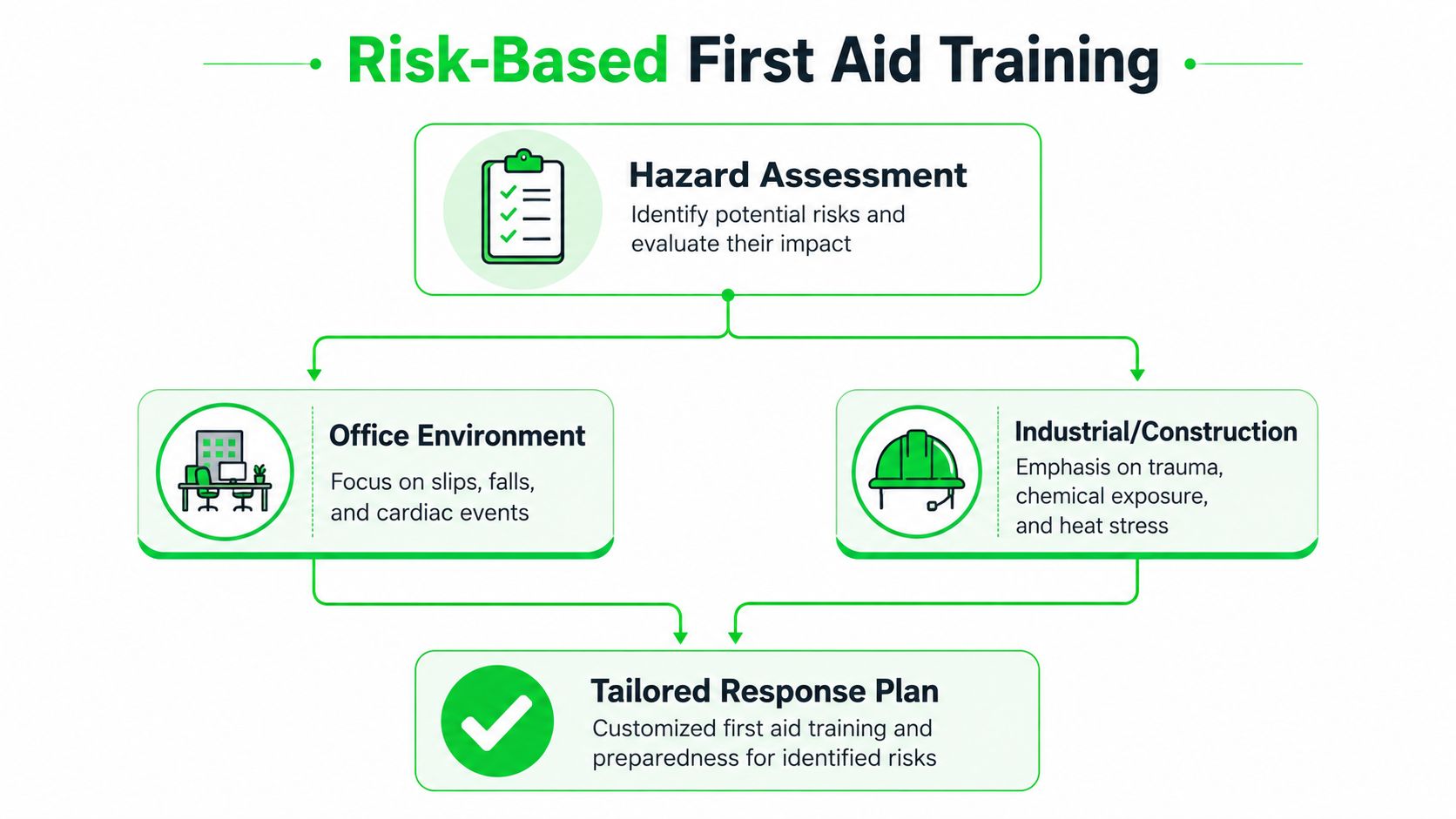
A decent first aid course in Dubai starts with the environment, not the syllabus template. The UAE's occupational safety guidance is clear on that point. OSHAD requires first-aid training to match workplace hazards, and Sharjah's code lists the core lifesaving skills that matter in practical settings, including CPR, AED use, burns, choking, bleeding, seizures, shock, and unresponsive-person management. That is the right model for Dubai businesses too, because the risk profile of an office is nothing like a construction site or a hotel kitchen. See the occupational safety code at OSHAD first-aid code guidance.
Match the course to the workplace
For an office, the syllabus should prioritise choking response, fainting, shock, AED use, and basic CPR. Those are the events most likely to demand immediate scene control before ambulance crews arrive. For hospitality, industrial, or construction settings, bleeding control and trauma response move higher on the list because the hazards are harsher and the first aider may face delayed access, heavier injuries, or heat-related stress.
The point is not to memorise a universal curriculum. The point is to train for the incidents your team is likely to see. That's how you shorten time to intervention, which is the value of first aid.
What a serious syllabus should contain
A provider worth your time should be able to explain exactly how its content maps to your site risks. If it can't, walk away.
- Hazard assessment first: the course should start by identifying what can go wrong in your actual workplace, not in an imaginary one.
- Office response priorities: choking, collapse, AED deployment, and basic CPR should be front and centre.
- Higher-risk site modules: bleeding control, trauma handling, and scene safety matter more in industrial and hospitality settings.
- Emergency activation: trainees should know how to contact ambulance services quickly and clearly.
- Working memory over theory: the best courses keep repeating the actions until people can do them under pressure.
A provider that offers one syllabus to everyone is selling convenience, not competence. For course selection in real settings, the practical question is whether the training reflects the hazards on your floor. A useful reference point is the Dubai emergency-care and AED context discussed in this AED emergency care guide.
Understanding Accreditation and Certification
A certificate only matters if someone accepts it. In Dubai, the market points toward two things: local recognition and provider credibility. The reporting around workplace first aid in the emirate said training institutes would need accreditation from Dubai's ambulance authority and internationally reputed organisations, and that is exactly the standard buyers should look for. If a provider can't show recognition tied to Dubai practice, the document may look neat but still be weak for corporate use. The practical employer question is simple, will this hold up when a company asks for proof?
Local recognition versus broad reputation
Dubai Corporation for Ambulance Services offers practical and theoretical first-aid training for individuals and businesses, and its training page lists an Emergency First Aid Course priced at AED 300 with attendance, ID verification, and both theoretical and practical assessments required. That combination matters because it shows the city's preference for verified competence, not passive attendance. For a provider that works in clinical settings and uses service quality controls, see how Vitals Healthcare frames treatment quality.
Dubai Heart Safe City also signals what the market values. Its approach emphasises hands-only CPR, AED use, theoretical learning, practical assessment, and DHA-approved certification registration. That tells you where to focus, because the region is not rewarding course length alone. It rewards competence, recognition, and renewal.
If the provider cannot show who recognises the certificate, treat the certificate as unproven.
How to verify a provider before booking
Ask for the issuing body first. Then ask what agency recognises the course, whether the certificate is meant for workplace compliance, and whether the training includes live assessment. If the answers are vague, the provider is probably optimised for volume rather than serious training.
For employers, the safest route is usually a provider that can explain its accreditation path clearly and connect it to Dubai compliance. For individuals, the better route is the same, because a recognised certificate is more useful if you later move jobs, shift sectors, or need your employer to file records. In Dubai, first aid is not a vanity credential. It's a document that has to function in the world.
Course Durations and Cost Breakdown
Dubai's first aid market is compact, and that's useful. You don't need a month-long commitment to get competent enough for immediate response. Dubai Corporation for Ambulance Services lists an emergency first aid option at AED 300, while other UAE providers in the Dubai market advertise one-day courses and DHA-accepted certification. Another Dubai Level 3 first-aid course page says the qualification certificate is valid for 3 years and the course duration is 5 to 6 hours, while a different Dubai page says an advanced first-aid certificate expires after 3 years from completion. That mix shows a clear pattern of short, competency-based courses with renewal built in. For a practical service comparison mindset, see this guide to home doctor visit pricing and value in Dubai.
Typical First Aid Course Profiles in Dubai
| Course Type | Duration | Estimated Cost (AED) | Target Audience |
|---|---|---|---|
| Emergency First Aid Course | Short, competency-based session | 300 | Employees, supervisors, individual learners |
| Level 3 First Aid Course | 5 to 6 hours | Not stated | Workplace responders, higher-responsibility staff |
| One-day DHA-accepted course | One day | Not stated | Individuals and corporate teams |
| Advanced first aid course | Not stated | Not stated | Staff needing broader emergency coverage |
The table shows the main truth. Cost is only one part of value. You're also paying for assessment, recognition, and the time your team can spend away from work.
What's usually included
A proper course fee should cover more than a lecture. Look for ID verification, theory, hands-on practice, and a pass/fail or competency-based practical assessment. If a provider quotes a low price but gives you only slides and attendance, you're probably not buying usable response skills.
The 60-day validity of booking sessions on one Dubai course listing is also worth noting, because it affects operational planning for HR and supervisors. Book too early, and you risk schedule waste. Book too late, and you can end up scrambling to meet compliance deadlines. Good course planning is about aligning renewal timing with staffing reality, not just finding the cheapest slot.
The Importance of Practical Assessment
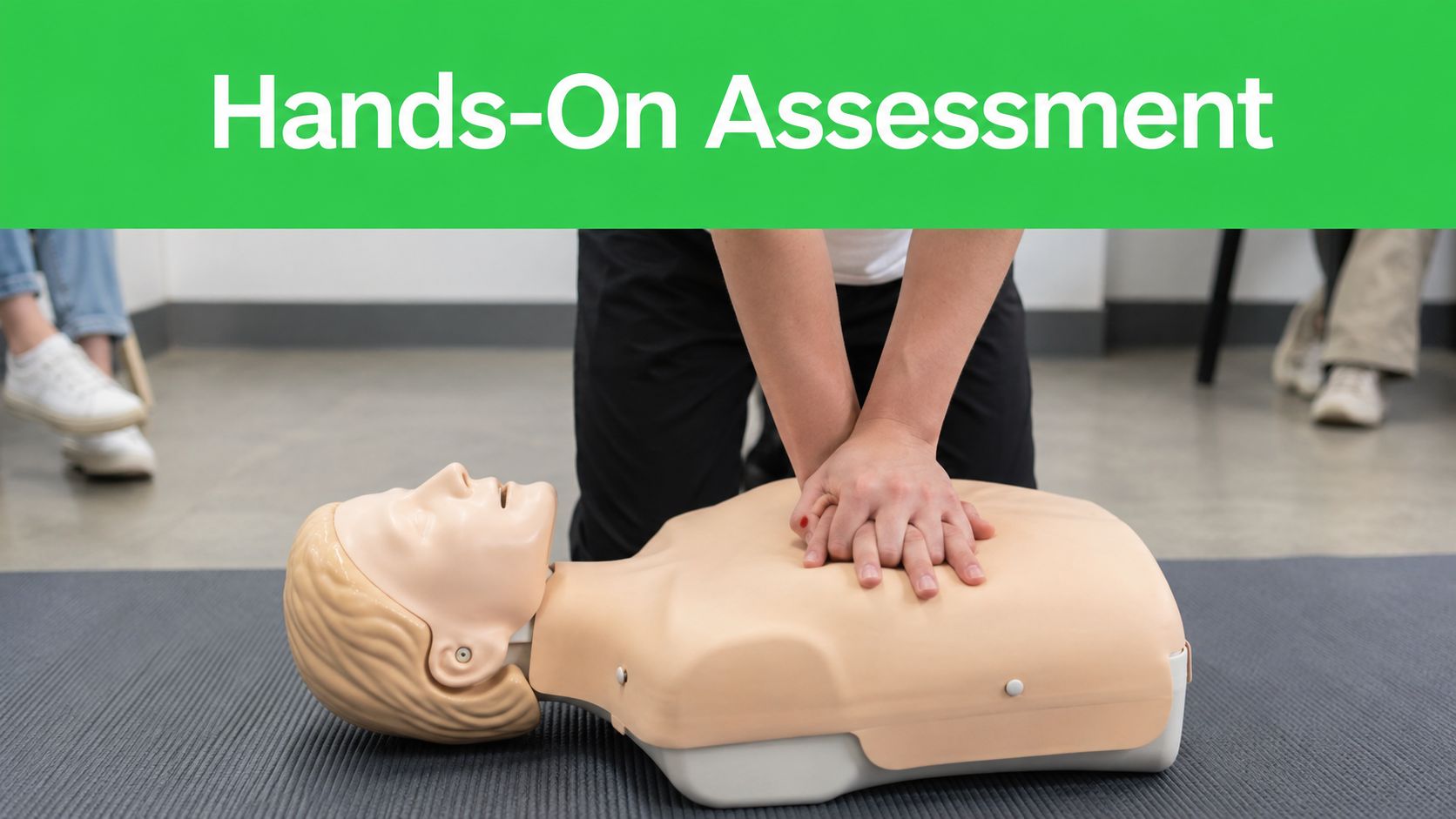
Theory helps people understand the steps. Practical assessment is what makes them usable in an emergency. Dubai's ambulance authority training page is explicit about that, it requires attendance, ID verification, and both theoretical and practical assessments for its emergency first aid training. That is the right model, because a certificate should mean someone can compress, attach, and act under pressure, not just remember a slide deck. See the training structure at Dubai Corporation for Ambulance Services training course.
What good practical assessment looks like
A serious course puts people through scenarios, not just questions. Trainees should demonstrate CPR technique, AED deployment, and correct emergency activation until the actions become automatic enough to repeat under stress. If the trainer never watches hand position, compression rhythm, scene safety, or device use, the course is too soft.
That matters because emergencies are messy. People freeze, step back, or overtalk the incident. A practical assessment corrects that by forcing a response, then correcting it in real time.
Rule of thumb: if nobody touches a mannequin, handles an AED trainer, or works through a live scenario, the course is incomplete.
Why lecture-only training fails
Lecture-based training creates recognition, not readiness. A participant may leave feeling informed, but that feeling doesn't guarantee action when a colleague goes unresponsive. Dubai businesses should avoid providers that sell classroom attendance as if it were operational competence.
If you want a course that leads to usable confidence, choose one with repeated skills practice and a visible assessment standard. For individuals who may end up alone during a medical incident, this guide on handling a medical emergency when alone is a good reminder that decisive action starts before the ambulance door opens.
Choosing the Right Training Provider
A first aid course in Dubai should hold up under local compliance, not just look polished on a website. Administrative Resolution No. 7 of 2022 puts real pressure on employers to choose training that prepares staff for workplace incidents, so the provider has to teach skills people can use under stress.
Start with reviews for references. Real feedback shows whether a provider teaches usable skills or just moves people through a room. Look for comments on instructor clarity, scenario realism, and whether learners felt ready to act. If the reviews sound vague, repetitive, or scripted, walk away.
What to check before you book
- Read independent reviews: focus on hands-on quality, not only convenience or price.
- Verify instructor credentials: ask who teaches, what experience they bring, and whether they run practical drills.
- Confirm recognition: make sure the certificate is accepted for Dubai workplace use and fits local authority expectations.
- Ask about practical time: a strong course spends time on CPR, AED handling, and scenario response, not only theory.
- Compare content by hazard: office, hospitality, and industrial teams should not get the same syllabus.
On-site corporate training makes sense if your team faces site-specific risks. Public scheduled classes suit individuals or small teams, but they are weaker when your workplace hazards are unique. On-site delivery lets the trainer work around your actual layout, equipment, and response chain.
That difference matters. A standard classroom can teach the right skills in the wrong setting, and people still hesitate when the event starts. For teams that work across homes, hotels, and offices, a service like Vitals Healthcare Doctor On Call fits into broader emergency-care planning when you need regulated medical support beyond first-aid training.
Managing Certification Renewal and Records
A first aid certificate in Dubai is a working document, not a shelf item. Employers must keep first aiders trained by approved providers, and the Dubai Healthcare City first-aid policy, supported by OSHAD guidance, requires refresher training for life-threatening emergencies at least annually and for non-life-threatening refresher training at least every two years, unless the provider sets a shorter validity period. Training and personnel records also have to be kept on file. Many companies ignore that until an audit or incident exposes the gap. The policy basis is set out in Dubai Healthcare City's first aid policy.
How a sensible renewal system works
An office manager books refresher training before the certificate expires. HR updates the trained-personnel list. The safety lead checks that AED, CPR, and emergency-contact knowledge is still current. That cycle should run on schedule, not memory.
Higher-risk sites need tighter control because the hazards are tougher and skills fade faster. Lower-risk offices still need the same record discipline, because compliance does not disappear just because the workplace is quiet.
Keep the records where you can find them fast, not buried in a folder no one opens.
Set reminder dates before expiry, not after. That keeps the business covered and avoids last-minute course hunting. It also helps staff stay employable, because a current certificate carries more weight than one that has already lapsed.
If you want to stop guessing, book a first aid course that matches your workplace risk, includes real assessment, and meets Dubai's compliance expectations. For broader medical support beyond training, Vitals Healthcare Doctor On Call can fit into a practical response plan for office care and home visits.