
Your father is home after surgery, the discharge papers are on the kitchen table, and the family is working out who can stay overnight. One missed dose or unsafe trip to the bathroom could derail recovery. Twenty-four-hour nursing care at home can provide continuous clinical coverage, but in Dubai it should be treated as a regulated healthcare service, not a helper staying in the house.
Before you book, get clear on the care plan, staffing model, licensing, handovers and full cost. The hourly rate matters, but the quality of overnight monitoring and escalation matters more.
Table of Contents
- What 24 Hour Nursing Care at Home Really Means in Dubai
- Who 24 Hour Home Nursing Is Actually For
- Clinical Services a 24 Hour Home Nurse Delivers
- Shift Models and How the Care Is Actually Staffed
- DHA Licensing and Safety Standards You Should Verify
- Pricing, Insurance and Real Cost of 24 Hour Home Nursing
- How to Arrange 24 Hour Care With Rapid Citywide Response
- Measuring Safety, Value and When to Change Providers
What 24 Hour Nursing Care at Home Really Means in Dubai
A parent returns home after a knee replacement. They need prescribed medicines on schedule, help moving safely, and someone able to notice a change in their condition while the family sleeps. A domestic helper may assist with household routines, but that role isn't a substitute for a licensed nurse providing clinical care.
In Dubai, 24-hour nursing care at home means continuous nursing coverage arranged around a patient's clinical needs. It may involve a nurse living in the home or several nurses rotating through shifts. That's different from intermittent home-health visits, where a clinician attends at scheduled times and the family manages the hours between visits.
The distinction affects safety. If a patient needs medication administration, wound care, close observation or prompt escalation when symptoms change, the provider must explain who is responsible at every hour, how staff hand over care, and how a supervising clinician is contacted. Continuous coverage doesn't mean every patient needs the same intensity of care, or that a nurse should perform tasks outside their authorised scope.

Families comparing how home nursing is organised in other settings may find Nursing Assessment Australia home nursing useful for understanding the general distinction between clinical support and everyday assistance. For a Dubai arrangement, however, use the local provider's DHA authorisation and care plan as your reference point.
Vitals Healthcare On-Call Doctor offers nursing care at home alongside on-call doctor services. Ask any provider, including Vitals, to explain its assessment process, clinical pathway and overnight escalation arrangements before agreeing to care.
Who 24 Hour Home Nursing Is Actually For
Continuous nursing is for patients whose clinical needs or safety risks can't be managed reliably through occasional visits and family support alone. The right question isn't whether someone is elderly or recovering. It's whether a nurse needs to assess, monitor or intervene throughout the day and night.
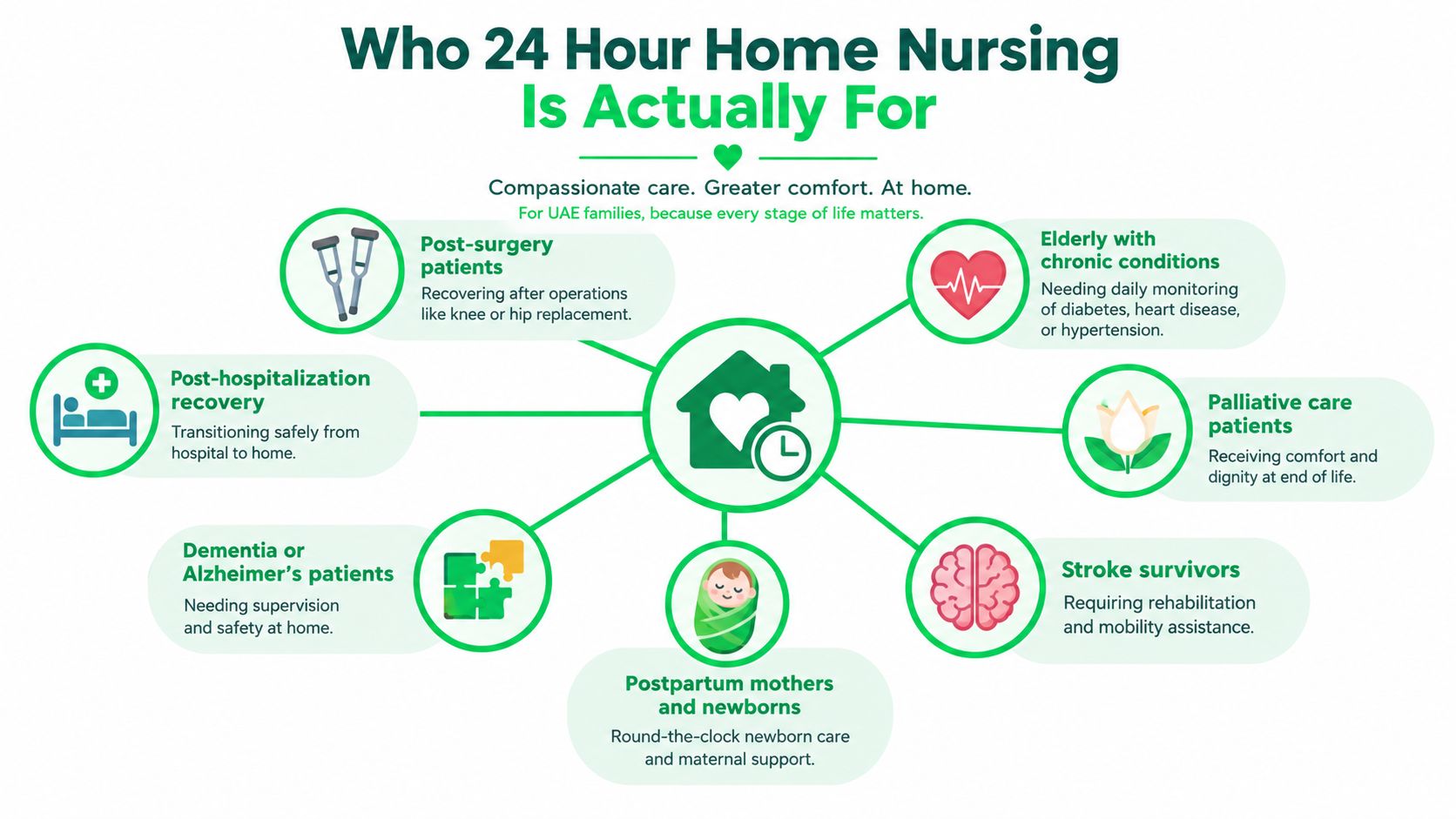
Common situations include:
- Post-operative recovery: A person returning home after hip or knee surgery may need temporary nursing while mobility is limited and the care team monitors recovery.
- Chronic disease: Someone whose condition requires regular clinical observation or complex treatment may need sustained support. The care plan should identify what the nurse monitors and which changes require escalation.
- Frailty or dementia: A patient who is unsafe alone overnight, wanders, or needs clinical assistance may benefit from continuous coverage. A domestic caregiver and a nurse aren't interchangeable.
- Palliative and end-of-life care: Nursing may support comfort and clinical needs at home. Families should clarify the agreed goals of care and who to call if symptoms change.
- Complex paediatric needs: Children who need skilled clinical support at home require a nurse with appropriate competence for their specific care plan.
- Disability and rehabilitation: A patient may need help with recovery and clinical support alongside rehabilitation. Ask how nursing responsibilities coordinate with physiotherapy.
- Hotel or visitor situations: A visitor recovering away from home may need nursing support while staying in Dubai. Confirm what the provider can safely deliver at the accommodation.
Some households face overlapping needs, such as an older patient recovering from surgery while managing a chronic condition. Vitals Healthcare On-Call Doctor is one provider families can ask about when they need both bedside nursing and a route for doctor escalation under a coordinated plan. For a broader comparison of home support and facility care, see this guide to choosing a care path.
Families may also find it useful to review Total Family Care products when considering practical support around a household's care routine. Keep the clinical decision separate: a product or domestic-care arrangement can't replace a licensed nurse when the patient needs skilled nursing.
Clinical Services a 24 Hour Home Nurse Delivers
The care plan should translate a diagnosis into specific bedside responsibilities. Don't accept a vague promise of “full care.” Ask what the nurse will do, what they'll document, and which tasks require a doctor's direction or assessment.
Agree the clinical tasks before the first shift
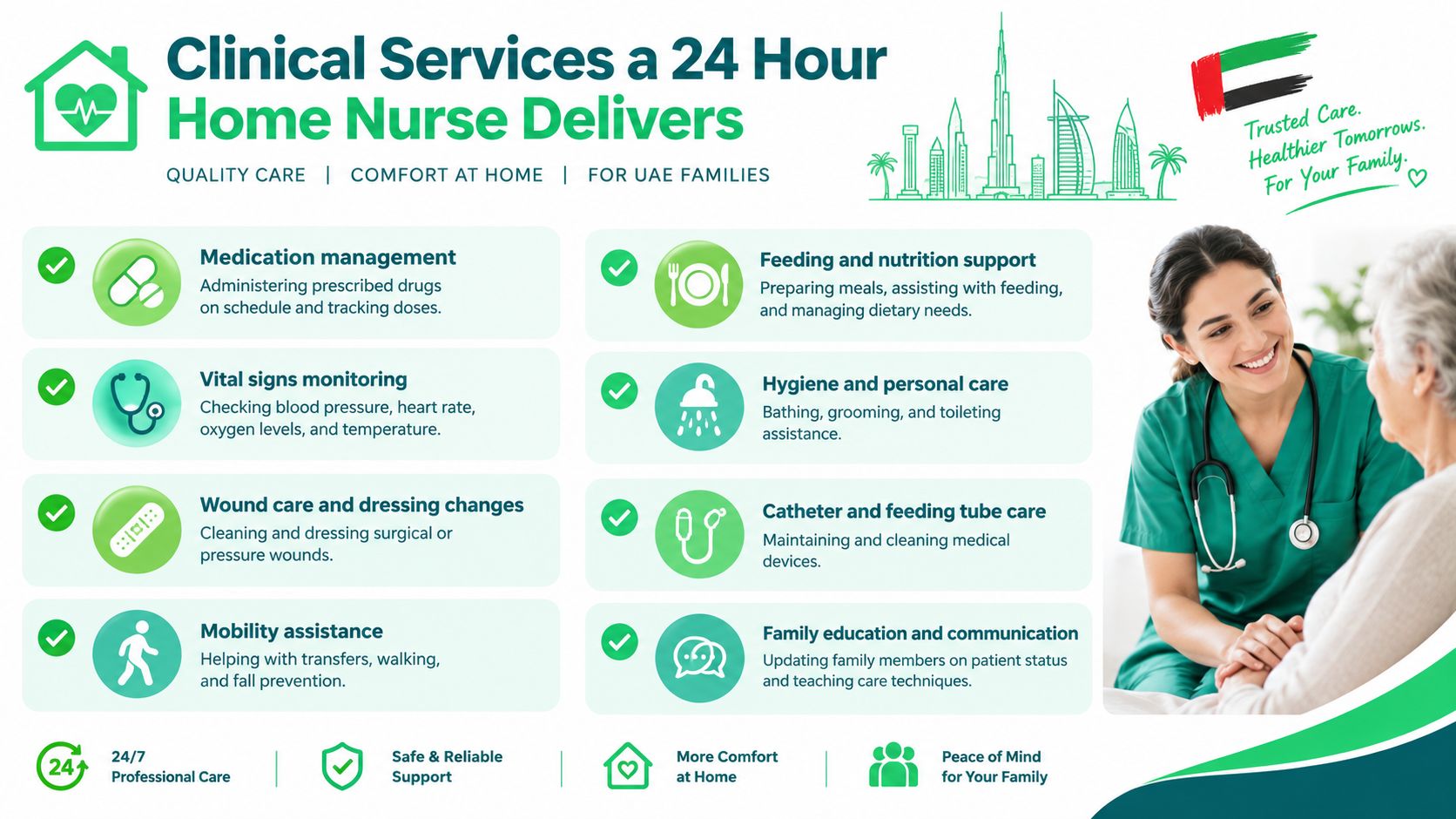
A written plan commonly needs to address:
- Medicines: The nurse follows the authorised medication plan, records each administration and flags discrepancies. Families should ask how the provider handles a missed dose or a medicine that isn't available.
- Wounds and dressings: A post-operative patient may need wound observation and dressing changes as prescribed. The nurse should document the site and report concerns through the agreed pathway.
- Injections and prescribed treatment: Confirm the nurse is authorised and competent to deliver the specific treatment. The provider should state what orders or documentation are required.
- Observations and escalation: The care plan should specify which observations are needed and the thresholds for contacting the supervising clinician. A change during the night shouldn't depend on a family member guessing what to do.
- Catheter, ostomy or device support: Where included and within the nurse's scope, the plan should set out routine care, what to record and how to report a problem.
- Mobility and fall prevention: The nurse can assist with transfers and follow the patient's mobility plan. Families should ask how the home environment and patient-specific risks are assessed.
- Nutrition, hydration and personal care: Define what support is clinical, what is personal care, and what the household or another caregiver remains responsible for.
Vitals Healthcare On-Call Doctor provides home nursing that includes services such as injections, wound care and medication support. For post-operative needs, families can also review this guide to home nursing after surgery in Dubai.
Set boundaries before booking: Heavy housekeeping, full-time babysitting and general companionship aren't automatically part of a nursing shift. Put each responsibility in writing so the nurse can focus on the agreed care plan.
Shift Models and How the Care Is Actually Staffed
The staffing model determines who is awake, how often the patient sees a new nurse, and how information moves between shifts. Don't let a provider use “24-hour care” without explaining whether the nurse is expected to sleep during a live-in arrangement or remain alert through a rotating shift.
| Model | Typical Coverage | Continuity | Best Fit | Indicative Price Band |
|---|---|---|---|---|
| Live-in | One nurse stays in the home, with rest arrangements defined by the provider | Stronger familiarity, but clarify coverage during rest periods | Patients who need an in-home nursing presence and whose plan allows rest periods | Provider quote required |
| Split-shift | Two nurses cover separate portions of the day, often with a handover between them | Shared responsibility; handover quality is essential | Patients needing coverage across day and night with a defined shift change | Provider quote required |
| Rotating shifts | A team provides continuous coverage, with written handovers | More staff changes, requiring disciplined records and communication | Patients who need an alert nurse available throughout the night | Provider quote required |
Live-in coverage can support continuity, but the contract must state rest periods and who responds if the patient needs assistance while the nurse is resting. Split shifts create a clear changeover, but families should listen for a structured handover rather than an informal chat. Rotating shifts can provide alert coverage, yet each incoming nurse needs an up-to-date care plan and reliable notes.
A quiet, complete handover is a practical sign of an organised service. It should cover the patient's current condition, medicines, recent observations, pending tasks and escalation instructions. Vitals Healthcare On-Call Doctor can be asked how bedside nursing and doctor escalation are coordinated; families should confirm the actual process, not assume a doctor is automatically present in the home.
For a useful perspective on organising staff reminders and shift coordination, consult this guide for HR leaders in healthcare. Families arranging temporary relief for a regular caregiver can also explore this Dubai respite-care guide.
DHA Licensing and Safety Standards You Should Verify
Dubai's framework makes home healthcare a clinical service with defined accountability. Before booking, verify the provider's authority to deliver home healthcare and confirm that each clinician has an active DHA licence for the work they'll perform. Ask who the medical director is and how that person supervises care delivered in the home.
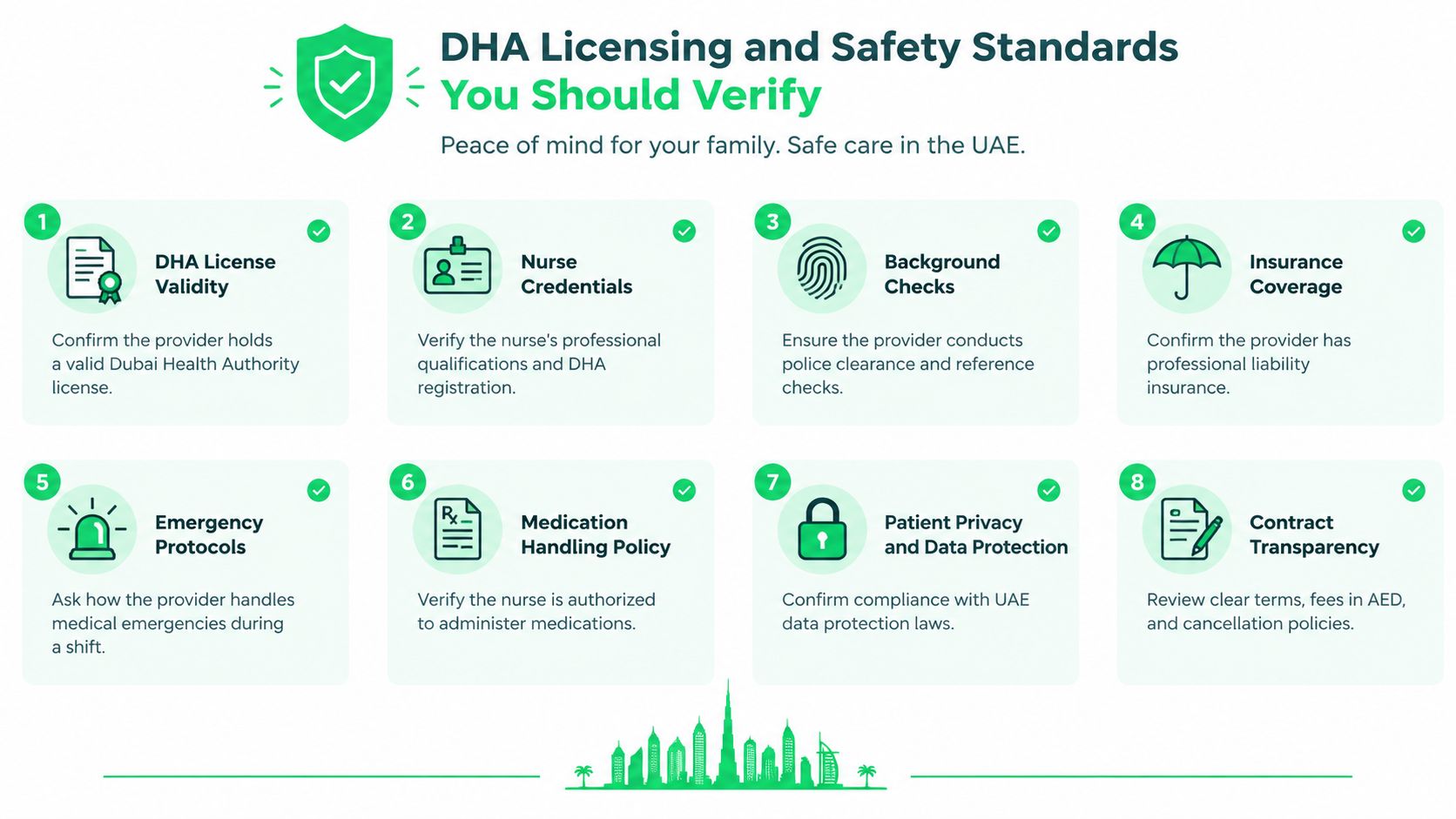
DHA's home-healthcare framework also requires nurses to complete 20 continuing-professional-development hours annually for licence renewal. That supports ongoing competency, but families should still ask how the provider assesses a nurse's readiness for the patient's specific needs. Read the DHA Home Healthcare Services standards and ask the provider to explain how its supervision and documentation arrangements meet the framework.
Request evidence, not reassurance
DHA inspection requirements include minimum clinical staffing, adequate staffing for home and facility demand, emergency readiness, patient identity and consent checks, and medicine records each time medicines are administered. Equipment used for home healthcare must be approved by the UAE Ministry of Health and Prevention. The provider must document and review emergency incidents.
Ask to see or confirm:
- Provider authorisation and nurse registration: Check the service and the individual clinician.
- Medical oversight: Get the medical director's name and the route for contacting the supervising clinician.
- Medication records: Request a sample medication-administration record, with personal information removed.
- Emergency procedures: Ask how incidents are recorded, reviewed and acted on.
- Staffing cover: Confirm the replacement plan if a nurse can't attend a shift.
Use the DHA home-healthcare inspection checklist to frame your questions. For a family-friendly list of issues to discuss before hiring, see this home-nurse hiring guide.
Pricing, Insurance and Real Cost of 24 Hour Home Nursing
There's no verified Dubai price range in the available information for live-in or rotating-shift nursing, so a responsible guide shouldn't invent one. Ask providers for a written quote based on the patient's assessment, then compare the full cost of the coverage model rather than choosing by an hourly figure alone.
The quote should identify its assumptions and explain how these factors affect the total:
- Clinical acuity: A patient needing frequent intervention or complex monitoring may require a different staffing plan from someone with stable needs.
- Nurse qualifications and language: Ask which credentials and communication capabilities are included in the proposed rate.
- Location and access: Confirm whether travel, building access or other logistical requirements affect the quote.
- Specialised care: State clearly if the patient needs support with complex devices or treatment. The provider must assess whether it can safely deliver that care.
- Supervision and backup: Ask whether the quote includes clinical oversight, replacement staffing and doctor escalation.
Then check the items that often sit outside a headline rate: consumables, transport arrangements, additional visits, weekend or holiday charges, and any deposit or cancellation terms. Don't assume a quoted hourly rate is the final bill. Request an itemised estimate and ask the provider to show the expected cost under the proposed roster.
For insurance, ask whether the provider can issue an itemised invoice and what documentation the insurer may require. Reimbursement depends on the policy, so confirm directly with the insurer before relying on coverage. Self-pay families should request clear invoices, payment terms and a written explanation of any extra charges.
Vitals Healthcare On-Call Doctor states that it offers multiple payment options and invoices for insurance claims. Families should confirm which service is being billed and what supporting documents are available. This guide to planning for long-term elderly care can help households prepare questions about affordability and ongoing care arrangements.
How to Arrange 24 Hour Care With Rapid Citywide Response
A fast start still needs a proper assessment. Give the provider enough information to decide whether it can safely meet the patient's needs and how quickly it can arrange the right nurse. Vitals Healthcare On-Call Doctor coordinates requests by phone and WhatsApp, with digital coordination and follow-up guidance available.
Prepare the information for intake
Have the discharge summary or current medical instructions ready, along with the patient's diagnosis, medicines, allergies, mobility needs, equipment and preferred start time. Explain what happens overnight and what would count as an urgent change. The provider should assess the home situation, clarify the proposed care plan and obtain consent before care begins.
Confirm who will attend, what documentation the nurse will use, and how the family will receive updates. If the patient's needs exceed the provider's available scope or staffing, the provider should say so rather than promise coverage it can't deliver.
Plan the first shifts, not just the arrival
At the start, the nurse should receive the care plan, confirm patient identity and consent, check the agreed medicines and equipment, and establish the handover and escalation routine. During the initial period, the family and provider should review whether the staffing model matches the patient's actual needs. Agree who reviews reports and how changes to the plan are authorised.
Vitals reports citywide service coverage that includes Dubai Marina, JLT, Downtown, Palm Jumeirah, Business Bay, Jumeirah Village Circle, Umm Suqeim, Al Garhoud and Arabian Ranches. Its typical arrival is approximately 30 minutes, subject to location and demand. That's a service-response estimate, not a guarantee for every situation; peak traffic, school-pickup periods or major events can affect arrival.
Ask what “rapid response” means for your specific request. A doctor visit, a nursing shift and an emergency response aren't the same service. For an immediate medical emergency, use the appropriate emergency services rather than waiting for a scheduled home-health visit.
Measuring Safety, Value and When to Change Providers
A low quote isn't good value if the provider can't show that care is organised, documented and reviewed. Dubai's long-term-care standards identify outcomes families can ask about, including unplanned hospital admissions, newly acquired or worsening stage-II-or-higher pressure injuries, falls causing injury, infection events and worsening mental-health symptoms. The DHA long-term-care standards also require internal quality monitoring that covers clinical outcomes, operational efficiency and resident satisfaction.
Ask the provider how it reviews incidents and trends, not just whether it has a policy. If a fall or medication issue occurs, the family should understand how the provider records it, informs the right people and adjusts the care plan.
Check the shift record
A useful shift record should let the next nurse and family understand what happened and what needs attention. It should include:
- Clinical status: Relevant observations and the thresholds that require escalation.
- Medicines: What was administered and any missed or changed dose requiring follow-up.
- Nutrition and hydration: Intake or concerns identified under the patient's care plan.
- Skin and mobility: Skin checks, fall-risk concerns and any change in movement or assistance required.
- Handover and communication: Updates shared with the family, outstanding tasks and any escalation documented.
A provider that gives vague updates, can't explain who supervises care, or repeatedly leaves gaps in shift records isn't offering dependable continuous nursing. Families should ask every prospective provider how it measures outcomes and acts on incidents before signing. Regulated home healthcare is a clinical expectation, not a luxury add-on, and providers such as Vitals Healthcare On-Call Doctor should be assessed against the same practical standards as any other option.
Vitals Healthcare Doctor On Call offers 24/7 doctor visits, home nursing and related clinical services delivered by DHA-licensed clinicians across Dubai. If you're arranging continuous nursing, visit Vitals Healthcare Doctor On Call to discuss the patient's needs, assessment and care coordination before choosing a provider.