

It's 2 a.m. in Dubai Marina, and someone in your room has fever, chills, and a stomach that's turned against them. Or your child in Arabian Ranches has suddenly broken out in hives, and you're trying to decide whether to wait it out, drive across town, or get a clinician to your door now. That decision is the primary reason people look for Doctor On Call in Dubai, not just convenience. It's about getting the right level of care in the right place, without wasting time on the wrong one.
In a city built around long commutes, late working hours, hotel stays, and family schedules that rarely run on time, home medical care fills a practical gap. People do not always need a hospital, but they often need more than a casual phone suggestion. They need a clinician who can assess the situation in person, rule out obvious danger, start treatment when appropriate, and explain what happens next in plain language.
This guide walks through what doctor-on-call services in Dubai actually include, how a home visit works, when blood testing at home makes sense, and who benefits most from booking a visit instead of going to a clinic.
Table of Contents
- What Doctor On Call Really Means in Dubai
- How a Doctor On Call Visit Actually Works
- Common Blood Test Panels and What They Actually Show
- At-Home Blood Testing Versus Visiting a Lab
- How to Choose the Right Blood Test Package
- Who Doctor On Call Actually Helps Most
- Booking a Doctor On Call in Dubai Tonight
What Doctor On Call Really Means in Dubai
A good Dubai house-call service isn't a fancy concierge with a thermometer. It's a licensed clinical visit delivered to the patient's location, under DHA oversight, with proper documentation, clinical standards, and escalation pathways built in. That matters because the service has to do more than arrive quickly. It has to decide, on the spot, whether you can safely stay home, need tests, or need hospital care.
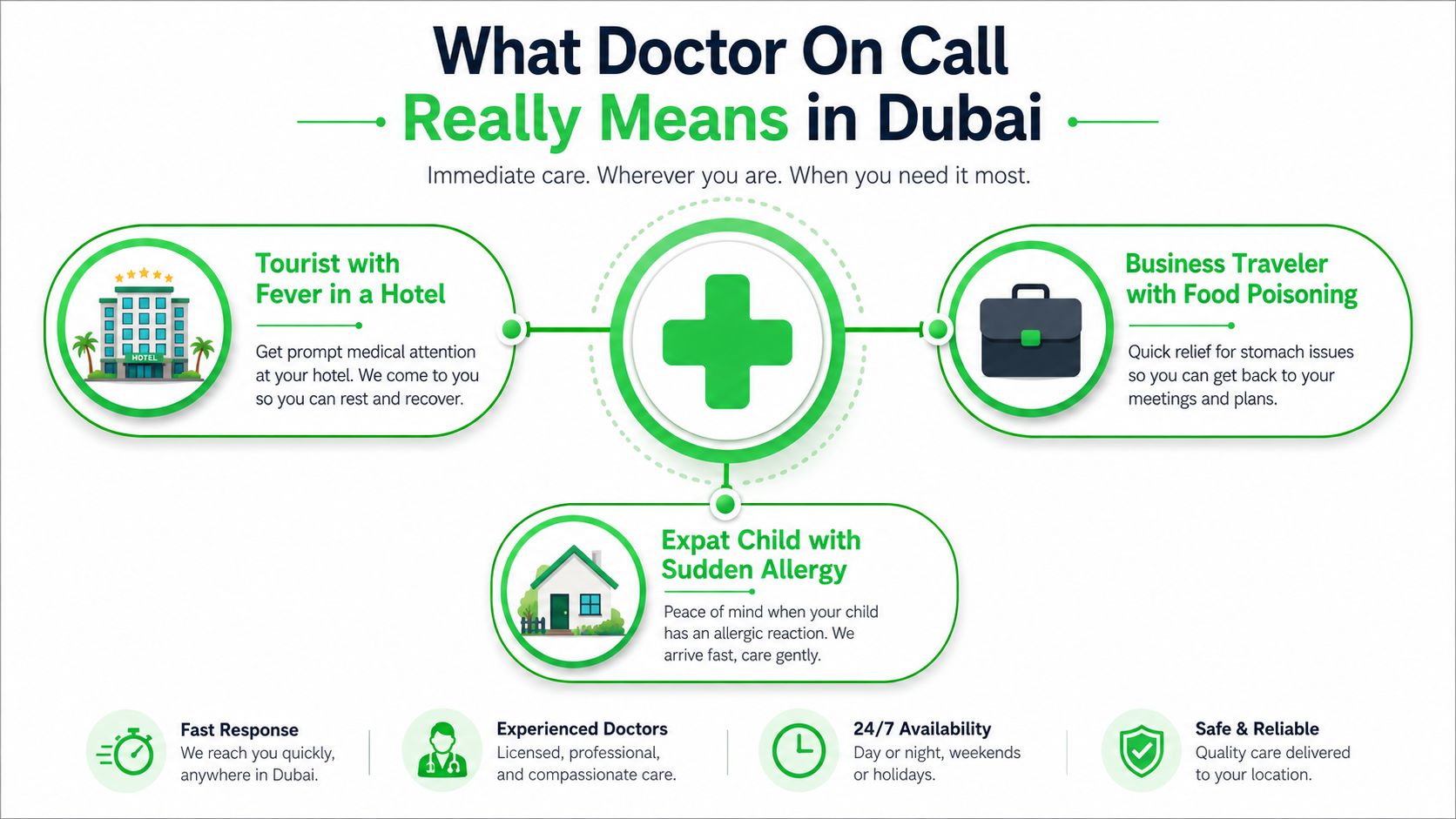
A tourist with fever in a Marina hotel needs a different response from an office manager whose colleague is dehydrated in Downtown Dubai. A parent with a sick child doesn't want a lecture, they want a clinician who can assess, treat, and tell them whether the child can stay home or needs the emergency department. That is the core product of Doctor On Call, structured triage at the patient's location.
In practice, that triage can cover a wide range of common situations. A patient with vomiting and weakness may need an examination, hydration advice, anti-nausea treatment, and a decision about whether blood work is needed. A child with fever may need a full review of breathing, throat, ears, rash, and hydration status before anyone can say whether home care is reasonable. An older adult with dizziness may need medication review, blood pressure checks, glucose assessment, and a judgment about fall risk before a safe plan can be made.
Practical rule: if the main problem is uncertainty, a home visit makes sense. If the main problem is instability, a home visit is too slow.
A visitor in Dubai often books because they need privacy, fast access, or they don't want to spend a night in an unfamiliar clinic waiting room. Residents book for the same reasons, plus the obvious ones, like avoiding transport with a sick child or an elderly parent. House-call care has become durable because convenience is only half the story. The other half is location flexibility and rapid triage confidence, especially for people who need a clear answer about what can be managed in-room.
The practical way to think about it is simple. A routine home consultation is for assessment and management of common problems. An urgent visit is for symptoms that need prompt attention but are still stable enough for home review. A mobile lab draw is for samples collected at home, then processed and reported later. If your symptoms sound like chest pain, severe breathing trouble, stroke signs, heavy bleeding, or major trauma, skip the home visit and go straight to the emergency department.
It also helps to understand what a home doctor is not. It is not a replacement for a trauma unit, a heart attack response team, or a stroke service. If someone is confused, collapsing, turning blue, unable to speak properly, or bleeding heavily, the issue is no longer about convenience or privacy. It is about immediate emergency support.
Home Visit vs Clinic vs Emergency Room
| Care Option | Best For | Typical Examples | Main Advantage | Main Limitation |
|---|---|---|---|---|
| Home Visit | Stable patients who need prompt in-person assessment at home, in a hotel, or at the office | Fever, vomiting, mild to moderate dehydration, rash, sore throat, sick child assessment, medication review, follow-up after discharge | Convenience, bedside assessment, privacy, easier access for families, tourists, and elderly patients | Not suitable for severe instability, major trauma, or emergencies needing imaging or hospital procedures |
| Clinic Visit | Mobile patients with non-emergency symptoms who can travel safely | Mild infections, follow-up visits, routine reviews, prescription renewals, chronic condition checks | Access to standard in-clinic examination and follow-up, usually suitable for straightforward cases | Travel, waiting time, and less practical for sick children, hotel guests, or mobility-limited patients |
| Emergency Room | Unstable, high-risk, or rapidly worsening cases | Chest pain, severe breathing trouble, stroke signs, seizures, collapse, major injury, heavy bleeding | Immediate access to emergency teams, imaging, monitoring, and hospital treatment | Longer waits for minor issues, higher intensity setting than many stable patients actually need |
A simple way to use this table is to think about stability first. If the patient is stable but needs a doctor soon, a home visit may be the cleanest option. If the issue is mild and the patient can travel comfortably, a clinic often makes sense. If there is any sign of serious instability, the emergency room is the right destination.
For readers comparing providers, one useful overview is this guide to doctor home visits in Dubai and how access works. You can also review service details directly at https://vitalshealthcare.ae. Keep the standard high. In Dubai, the right question isn't “Can someone come fast?” It's “Can they make the right call once they're there?”
How a Doctor On Call Visit Actually Works
The process should feel structured, not improvised. First comes the call or WhatsApp message, then a symptom screen, then dispatch of a clinician who is licensed to work within Dubai's healthcare framework. After that, the doctor arrives, examines the patient bedside, treats what can be treated safely, and decides whether home management is enough or whether escalation is needed.
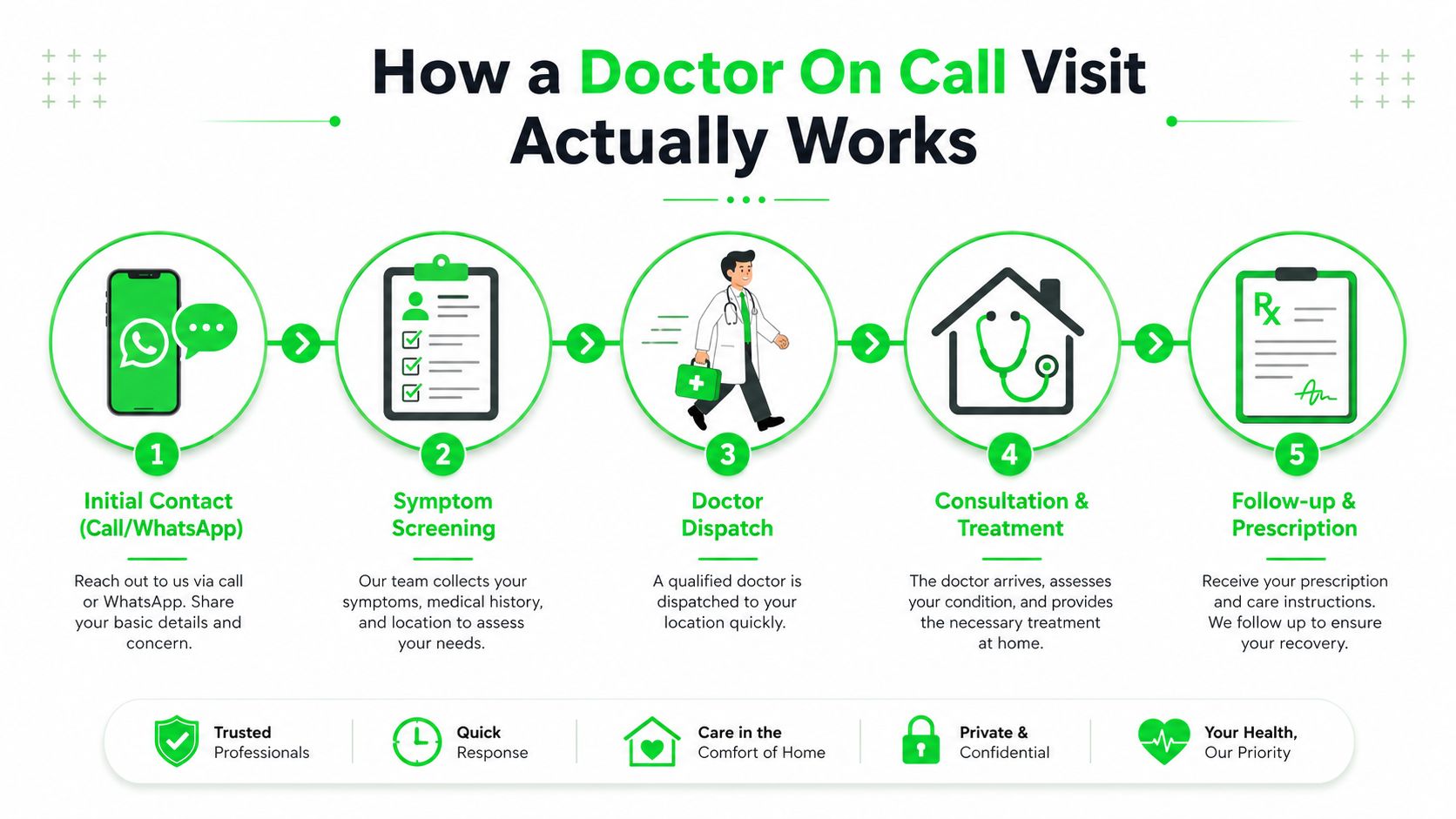
A well-run visit often follows a simple rhythm. The service confirms the location and main complaint. The clinician arrives with the tools needed for an examination and basic treatment. Vital signs are checked, the patient is examined, immediate red flags are assessed, and a care plan is made. That plan may include medication, advice, home observation, testing, or referral onward.
For example, if an adult has fever, body aches, and cough, the doctor may assess oxygen level, temperature, breathing effort, hydration, and chest findings before deciding whether this looks like a self-limiting viral illness or something that needs imaging or hospital review. If a child has abdominal pain, the home visit may help identify whether this seems mild and manageable or whether the child needs urgent imaging and paediatric evaluation.
The booking call should do the sorting, not the patient
You should not have to diagnose yourself before booking. A competent service asks about the main symptom, how long it's been going on, current medications, allergies, and whether the patient is stable enough to wait at home. That screening is the first layer of safety, because it helps separate a sore throat from a possible airway problem, or ordinary stomach upset from dehydration that needs escalation.
The booking process should also clarify details that matter later. Is the patient a child, an elderly adult, a hotel guest, or someone with a chronic illness? Is there vomiting, fainting, rash, wheeze, or confusion? Has anything already been tried, such as fever medicine, inhalers, or oral rehydration? Those details help the service decide how urgent the case is and what kind of clinician or support is appropriate.
A 24-hour on-call model is designed for nights, weekends, and holidays, because the service usually runs in shifts that extend beyond normal clinic hours. That is why it works for late arrivals, hotel guests, and families dealing with a child who worsens after dark. The point is not just to answer the phone. It is to route the right clinician to the right address, fast enough to be useful.
A good booking call should also tell you if home care is the wrong path. If the patient sounds unstable, the safest service is the one that says so quickly. Recommending emergency care is not a failure of the home-visit model. It is proof that the screening process is doing its job.
What you should receive after the visit
At minimum, a patient should leave with a clear assessment, advice, any medicines that are appropriate, and a record they can keep or share. If tests are done, the results should be documented digitally. If the doctor thinks the case is beyond home care, the next step should be spelled out plainly, not left to guesswork.
That record matters more than many people realize. A tourist may need documentation for travel or insurance. A parent may need instructions on dosing, hydration, and warning signs overnight. A patient with diabetes or high blood pressure may need notes that help their regular physician understand what was found during the urgent review.
A proper after-visit plan usually answers four questions clearly:
- What does the clinician think is going on?
- What treatment was given or advised?
- What changes should make you seek help again?
- Does the patient need follow-up, testing, or escalation?
Good home care ends with clarity. You should know what was found, what was done, what to watch for, and when to seek more care.
For visitors and families who want a practical read on after-hours access, this Dubai guide to urgent doctor-at-home visits at night is worth a look. If you want to review the broader service offering first, visit https://vitalshealthcare.ae. Just remember the standard: a home visit is only useful if the clinician can triage well, treat appropriately, and escalate without hesitation.
Common Blood Test Panels and What They Actually Show
Blood work should never be ordered like a shopping cart. Each panel answers a specific question, and if you don't know the question, you'll end up paying for data you can't use. In home-visit care, mobile lab tests are most helpful when they're matched to symptoms, not when they're bundled into a vague “full check-up” just because it sounds thorough.
Patients often assume more tests mean better care. Sometimes the opposite is true. The more unrelated numbers you collect, the more likely you are to find small abnormalities that create confusion without explaining the actual problem. Good testing is focused. It starts with the story, not the brochure.
Start with the panel, then match it to the symptom
A Complete Blood Count, or CBC, looks at red cells, white cells, and platelets. I use it when someone has fever, repeated infections, tiredness, or pallor, because it can point toward anaemia or an active inflammatory pattern. A CBC alone won't tell you the cause of every problem, but it gives a sharp first look at whether the body is fighting infection or struggling with low blood counts.
For example, a patient who has felt drained for weeks, looks pale, and gets short of breath on stairs may need a CBC before anything else. A different patient with three days of fever and body aches may also benefit from a CBC, but for a different reason, to see whether the pattern supports infection or whether the illness is likely to remain a clinical diagnosis without extensive work-up.
A Basic Metabolic Panel helps screen kidney function and electrolytes, while a Comprehensive Metabolic Panel goes further and includes liver-related information. These are the right tests when someone is dehydrated, vomiting, weak, or taking medicines that need renal or hepatic awareness. If the patient is confused, significantly unwell, or not keeping fluids down, those are not “wait and see” symptoms. They need clinical review, and sometimes a higher level of care.
A useful real-world example is the patient with food poisoning symptoms who has been vomiting for most of the day. If that person is still alert, able to speak normally, and stable, a home doctor may assess hydration and decide whether a metabolic panel is useful. If the same person is drowsy, not passing urine, or unable to keep anything down, the balance shifts toward hospital care.
A Lipid Profile is for cardiovascular risk discussion, not for explaining a fever or a short-lived stomach bug. A Thyroid Panel with TSH, T3, and T4 is more relevant when fatigue, weight changes, palpitations, or temperature intolerance are the complaint. HbA1c helps assess longer-term glucose control, so it belongs in diabetes screening and follow-up, not in every acute illness work-up.
That distinction matters. If someone feels exhausted after a week of viral illness, a thyroid panel may be irrelevant in the moment. If someone has had months of fatigue, constipation, dry skin, and weight gain, thyroid testing becomes much more sensible.
For general readers, this overview of common at-home lab tests in Dubai is a useful companion. Patients who want to explore available services can also check https://vitalshealthcare.ae. Use it as a reference, not a substitute for judgment.
A quick way to choose the right test
Iron studies are useful when tiredness, hair shedding, or reduced exercise tolerance raises concern for iron deficiency. Vitamin D is often added when bone pain, low sunlight exposure, or general deficiency concerns are part of the picture. CRP and ESR are inflammatory markers, which can help when the question is whether the body has ongoing inflammation rather than just a short-lived viral illness.
These tests work best when the story supports them. Iron studies make sense in someone with heavy menstrual bleeding, restricted diet, or unexplained fatigue. CRP or ESR can be more useful when symptoms have persisted for weeks, such as prolonged joint pain, lingering fever, or an illness that does not fit a short, simple viral pattern.
Rule of thumb: the right blood panel answers one clinical question clearly. The wrong package gives you a stack of numbers and no direction.
| Panel | What It Screens | Common Trigger Symptoms |
|---|---|---|
| CBC | Infection, anaemia, blood cell abnormalities | Fever, fatigue, pallor, repeated infections |
| Basic Metabolic Panel | Kidney function, electrolytes | Vomiting, dehydration, weakness |
| Comprehensive Metabolic Panel | Kidney and liver-related function, electrolytes | Ongoing illness, medication monitoring, poor intake |
| Lipid Profile | Cardiovascular risk | Routine risk review, family history concerns |
| Thyroid Panel | Thyroid overactivity or underactivity | Fatigue, weight change, palpitations |
| HbA1c | Long-term glucose control | Diabetes screening or follow-up |
| Iron Studies | Iron deficiency or overload patterns | Fatigue, hair shedding, reduced stamina |
| Vitamin D | Deficiency screening | Bone discomfort, low exposure, general deficiency concern |
| CRP and ESR | Inflammation | Persistent symptoms, possible inflammatory illness |
The common mistake is ordering everything. That is expensive, noisy, and often unhelpful. Order the panel that fits the symptom, then add targeted tests only when the story supports them.
Another simple way to think about testing is this: if the result would not change the next clinical decision, it may not be worth ordering yet. A useful test either narrows the diagnosis, guides treatment, or helps decide whether the patient can stay at home safely.
At-Home Blood Testing Versus Visiting a Lab
At-home sample collection wins on privacy and convenience. A nurse or phlebotomist comes to you, takes the sample, and you avoid traffic, parking, and waiting rooms. For many Dubai residents, that alone makes it the better option, especially if the patient is elderly, recovering, or managing work and family at the same time.
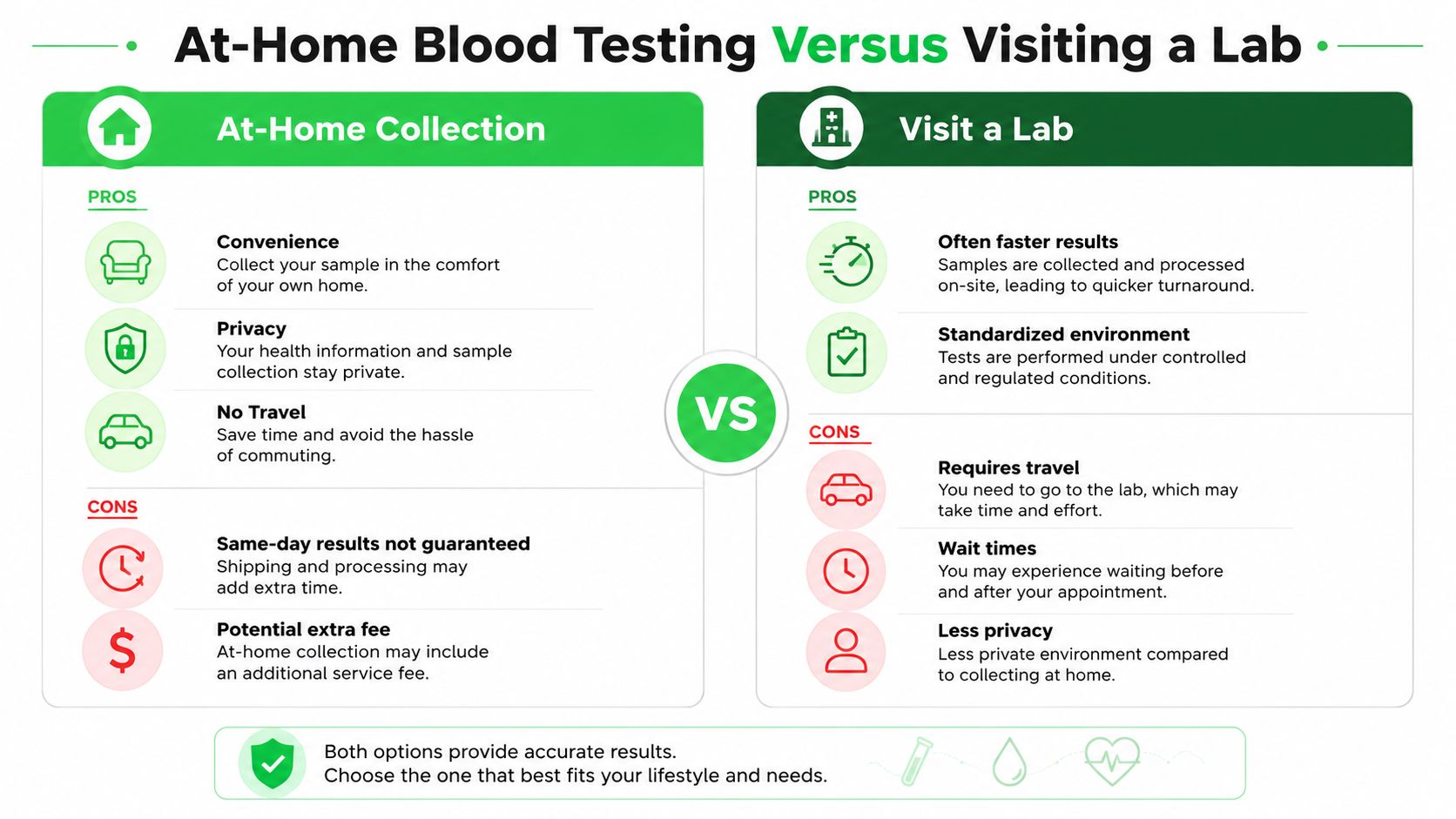
Convenience, however, should not be confused with sameness. Home collection and lab collection can both be clinically sound, but they serve slightly different needs. The best choice depends on the test, the patient's condition, and how complicated the work-up is likely to become.
Where home collection is strong
Home draws work well for routine panels, fasting bloods, and patients who dislike clinics. The sample is collected bedside, labelled properly, and transported for processing. In good hands, the workflow is professional and efficient, with digital reporting shared later.
This model is especially helpful for parents with young children, older adults with mobility limits, professionals working long hours, and patients who simply want to avoid spending half a day getting a straightforward test done. A fasting morning blood draw at home can be much easier than coordinating traffic, parking, registration, and waiting.
That said, home collection is not magic. Some tests need stricter handling than others, and some patients are difficult draws because of dehydration, small veins, or repeated prior phlebotomy. A skilled mobile team can still manage many of these cases, but not every sample should be forced into a home setting just because it's possible.
A practical example is a stable adult booking annual blood work before work hours. Home collection is a strong fit there. Another example is a post-discharge patient who needs repeat monitoring but is still too weak for easy travel. Again, home testing can remove unnecessary friction without lowering quality.
When a lab visit is the smarter move
A lab can be the better choice if the patient needs a specialised assay, complex work-up, or a setting where the reference process is more straightforward. If you already know the sample is likely to be difficult, or the test requires tight coordination with a hospital consultant, a lab may save time in the long run. The cleanest option is the one that gets you a usable result without repeat attempts.
For instance, if a physician suspects the patient may need same-day imaging, multiple specialist discussions, or urgent repeat testing depending on the first result, the lab or hospital route may be cleaner. Similarly, if a patient has a history of failed blood draws, severe dehydration, or fainting during phlebotomy, a more controlled setting may be preferable.
Home testing is often shared as a convenience service, but it should also be treated as a logistics service. Fasting requirements still matter. Transport still matters. Temperature handling still matters. The patient doesn't need to know the cold-chain details, but they do need to know that a professional service pays attention to them.
My take: choose home testing for comfort, privacy, and practicality. Choose a lab when the test or the clinical context is too complex for convenience to be the main factor.
For readers comparing service models, this Dubai guide to at-home lab convenience is a sensible benchmark. Use it to decide based on the test, not the marketing.
How to Choose the Right Blood Test Package
Don't buy a panel because it looks complete. Buy it because it answers the question in front of you. In practice, individuals typically fall into one of three groups, and each group needs a different level of testing.
One reason people overspend on testing is anxiety. They want certainty, so they choose the biggest package available. But large packages often include markers that are irrelevant, hard to interpret alone, or unlikely to affect care. The better approach is focused testing with a reason behind each item.
The worried-well annual check
If you're generally well and just want a baseline, keep it lean. A CBC, metabolic panel, and a small set of risk-focused tests usually make more sense than a giant package with markers you won't act on. Add HbA1c if you want a diabetes screen, and consider a lipid profile if you're reviewing cardiovascular risk with your doctor.
This approach works well for healthy adults who want a snapshot of general health without turning a routine review into a fishing expedition. If you are sleeping well, exercising, and have no major symptoms, the goal is sensible screening, not maximum data.
A good example is a 35-year-old professional booking an annual check after putting it off for two years. In that case, a modest baseline panel is usually far more useful than an oversized package filled with niche markers that create follow-up questions but no action.
The symptomatic patient
If the issue is fatigue, headaches, weight change, or poor recovery from a recent illness, test selection should follow the symptom story. CBC, thyroid testing, iron studies, and selected metabolic markers are the usual starting points. Vitamin D can be reasonable when deficiency is plausible, but it shouldn't crowd out more relevant tests.
The key idea is that symptoms create priorities. A person with fatigue and hair shedding may need CBC and iron studies first. A person with palpitations, tremor, and heat intolerance may need thyroid-focused testing. A patient with vomiting, dizziness, and poor intake may need electrolyte and kidney-related review before anything else.
Testing should not be built around what sounds popular. It should be built around what best explains the complaint.
The chronic-condition patient
If you already live with diabetes, hypertension, or thyroid disease, your package should track the condition you have. HbA1c belongs in diabetes follow-up. Thyroid markers belong in thyroid management. Kidney and liver-related markers become more relevant when medicines, hydration, or longer-term monitoring are in play.
This is where generic wellness packages often fail. A patient with diabetes may care much more about HbA1c, kidney-related markers, and medication impact than about a wide collection of low-value extras. A patient on long-term treatment may need repeat testing that is narrow but clinically important.
A good family doctor doesn't just read the report, they connect it to the next decision. That might mean a follow-up home visit, a clinic appointment, or simple reassurance with no change in treatment. The point is to avoid collecting data that doesn't alter care.
For one practical option in Dubai, Vitals Healthcare Doctor On Call provides home visits and mobile lab support, which can make it easier to pair assessment with testing when the symptom story calls for both. That kind of setup works only when the tests are chosen properly and the results are reviewed in context, not in isolation.
Simple filter: if you can't say why you're ordering the test, don't order it yet.
Who Doctor On Call Actually Helps Most
The strongest cases are not the smallest sniffles. They're the situations where mobility, privacy, timing, or continuity matter enough that a clinic visit becomes awkward, risky, or just plain inefficient. That's where a home doctor earns the call.
A useful way to judge fit is to ask one question: does seeing the patient where they are make care better, safer, or faster? If the answer is yes, a home visit may be the right model.
The patients who genuinely benefit
Tourists and business travellers often need one clear answer, fast, especially if they're not already settled into a UAE insurer network. They may need documentation, a prescription, or a triage decision that tells them whether they can rest in the hotel or need the emergency department.
For them, the value is not just speed. It is also simplicity. They may not know which clinics are open, which area they are in relative to a hospital, or how long an unfamiliar visit will take. A doctor coming to the hotel removes that uncertainty.
Older adults and people with limited mobility are another clear fit. They need monitoring, medication review, wound care, and sometimes physiotherapy or nursing support at home. A rushed clinic visit can be exhausting for them, and in some cases it adds risk without adding value.
Families caring for elderly relatives also benefit because continuity matters. A home visit lets the doctor see the environment, the medicines on the table, and the practical barriers that never show up on a phone call. Post-hospital patients often need that same continuity after discharge, especially when they're still weak or uncertain about what counts as normal recovery.
There are also practical lifestyle cases where doctor-on-call makes sense. A parent alone with two small children may not be able to leave the house easily with a sick toddler. A patient with significant anxiety may cope far better with assessment at home than in a crowded waiting room. A business traveller with fever before an early flight may need quick clinical advice and documentation more than a long clinic process.
Who should probably not book a home visit
A healthy adult with a mild, self-limiting sore throat can usually go to a clinic, or even wait and monitor at home. If the problem is straightforward and the patient is fully mobile, a house call may cost more effort than it saves. The same applies when the issue is clearly escalating and already meets emergency criteria.
The wrong use of Doctor On Call is treating it like a shortcut for every symptom. It isn't. It works best when the question is, “Can this be handled safely here?” not “Can someone come because I don't want to leave the house?”
A few examples help draw the line. Mild cold symptoms in an otherwise healthy adult often do not need a house call. Sudden severe chest pain absolutely should not wait for one. Severe shortness of breath, major injury, new weakness on one side, seizures, and heavy bleeding all sit outside the safe home-visit zone.
If you're a tourist and you want a better grasp of the decision points, this Dubai doctor-on-call guide for travellers is a useful reference. The key takeaway is the same. The value is triage confidence, not just speed.
Booking a Doctor On Call in Dubai Tonight
If the patient has chest pain, severe breathing difficulty, stroke signs, heavy bleeding, or major trauma, stop reading and go to the emergency department. A home visit is not the right answer for an unstable patient. If the symptoms are serious but not an emergency, get the history straight first.
Have the Emirates ID or passport ready, list current medicines and allergies, and note when the symptoms started and how they've changed. If you might need labs, ask for a mobile sample draw in the same visit so the clinician can keep the plan tight. That saves time and avoids duplicate scheduling.
It also helps to prepare a short summary before you call or message. What is the main symptom? When did it begin? Is the patient eating, drinking, passing urine, breathing comfortably, and staying alert? Has there been fever, rash, vomiting, diarrhoea, or fainting? A clear booking summary helps the service make better decisions before the doctor even leaves.
For hotel guests, include the hotel name, room details, and any access instructions. For families, keep recent medication doses nearby, especially if a child has already had paracetamol, ibuprofen, antihistamines, or inhalers. For older adults, have a list of regular medicines ready because that can change the clinical picture quickly.
For a DHA-licensed visit in Dubai, you can call +971581310801 or send a WhatsApp message to the same number. Coverage includes major districts such as Dubai Marina, Downtown, Palm Jumeirah, JLT, and Arabian Ranches, so you're not limited to one corner of the city.
Best practice: book with a clear symptom summary. A good booking note makes the doctor's triage better before they even leave.
If the case is about fever, dehydration, minor injury, medication review, or a blood test package that needs to be matched properly to symptoms, a home visit is often the cleanest move. If the case is unstable, don't wait for a car to arrive. Use the emergency department.
Another practical point is expectations. A strong home-visit service can assess, treat many common conditions, arrange testing, and guide next steps. It cannot replace every hospital function. The best outcome usually comes when patients use it for the right level of problem.
Why Choose Vitals Healthcare
If you are comparing providers, the main question is not simply who can arrive first. It is who can assess properly, explain clearly, and guide the next step without wasting time. That is where Vitals Healthcare stands out for many Dubai patients.
A strong provider should combine DHA-licensed home visits, clear triage, mobile lab support, and practical follow-up in one pathway. Vitals Healthcare brings those pieces together for patients at home, in hotels, or at the office, which makes the service more useful when the case needs both assessment and action. You can review the service at https://vitalshealthcare.ae.
Patients also tend to value three things in urgent home care: fast communication, straightforward documentation, and a care plan that makes sense after the doctor leaves. Whether the issue is fever, dehydration, a sick child, medication review, or blood testing at home, the goal is not just convenience. The goal is confidence that the case is being handled sensibly from first contact to follow-up.
Frequently Asked Questions
How quickly can a doctor on call usually reach me in Dubai?
Arrival time depends on the area, time of day, traffic conditions, and the urgency of the case. In central areas such as Dubai Marina, Downtown, JLT, or Palm Jumeirah, response can be relatively fast when a clinician is already covering that zone. In outer residential communities or during peak traffic periods, it may take longer. The important point is not just speed, but whether the booking team has screened the case properly and sent the right clinician.
What conditions can a doctor on call treat at home?
Home visits are well suited to stable but urgent problems such as fever, sore throat, flu-like symptoms, vomiting, diarrhoea, dehydration that is still mild to moderate, allergic rashes without airway compromise, minor injuries, dizziness, medication review, and general assessment of a sick child or older adult. They are also useful for follow-up after hospital discharge, routine review for mobility-limited patients, and situations where testing at home makes the process easier.
When should I skip a home visit and go straight to the emergency department?
Do not wait for a house call if the patient has chest pain, severe shortness of breath, blue lips, stroke signs, heavy bleeding, seizures, major trauma, collapse, severe confusion, or signs of a rapidly worsening emergency. In those cases, the safest decision is emergency care immediately. A doctor on call works best for stable patients who need assessment soon, not for patients who may need resuscitation, imaging, or specialist intervention without delay.
Can a doctor on call prescribe medication during the visit?
In many cases, yes. If the assessment supports treatment at home, the clinician may prescribe appropriate medication and explain how to use it safely. That might include treatment for fever, infection when clinically justified, nausea, allergy symptoms, or other common problems. The exact options depend on the clinician's assessment, the patient's medical history, allergies, and Dubai healthcare regulations.
Can I book blood tests at home with the same visit?
Often, yes. If the doctor thinks blood work will help answer the main clinical question, a mobile sample collection can sometimes be arranged as part of the same care pathway. That is especially useful for patients with fatigue, suspected dehydration, diabetes follow-up needs, thyroid concerns, or routine monitoring after illness. It is still important that the tests are chosen for a reason, not simply added as a generic package.
Is doctor-on-call care suitable for children?
Yes, in many situations. Parents commonly book home visits for fever, cough, rash, vomiting, stomach pain, or reduced feeding when the child is uncomfortable but still stable enough for home assessment. A home review can be especially helpful late at night, when transport is difficult, or when parents need a clearer sense of whether the child can safely remain at home. If the child is struggling to breathe, difficult to wake, having a seizure, or showing signs of severe dehydration, emergency care is the better route.
Is a home doctor visit useful for tourists and hotel guests?
Very often. Tourists and business travellers benefit because they may not know which clinics are open, how local healthcare access works, or whether their symptoms are serious enough to disrupt travel plans. A home visit to a hotel can provide examination, treatment, documentation, and a clearer decision about whether rest is enough or hospital care is needed.
Are at-home lab tests as reliable as going to a lab?
They can be, provided the collection, labelling, transport, and processing are handled properly. Routine panels such as CBC, metabolic testing, HbA1c, thyroid markers, and lipid profiles are commonly suited to home collection. Some specialised tests or difficult clinical situations are still better handled in a lab or hospital setting, especially if repeat sampling, urgent imaging, or complex same-day coordination may be needed.
What should I prepare before the doctor arrives?
Keep identification ready, along with a short symptom timeline, a list of current medicines, known allergies, and any relevant medical history. If the patient is a child, note recent doses of paracetamol, ibuprofen, antihistamines, or inhalers. If the patient is elderly or has chronic illness, keep recent reports or medication lists nearby. The clearer the information, the easier it is for the doctor to assess the situation quickly and safely.
Is doctor-on-call care more about convenience or clinical need?
It is both, but the real value is not luxury. It is targeted access to in-person assessment when a clinic visit is difficult, slow, or unnecessarily stressful. The best use of the service is when location improves care, such as with sick children, elderly patients, hotel guests, post-discharge reviews, or stable urgent symptoms that need a clinician's judgment soon.
If you want a straight answer tonight, Vitals Healthcare Doctor On Call can bring DHA-licensed assessment, testing, and follow-up to your home, hotel, or office in Dubai. Visit Vitals Healthcare Doctor On Call to arrange a visit, compare service options, and book care that matches the symptom, not just the clock.