
Most advice about choosing a family medicine doctor in Dubai starts with the wrong question. It explains what family doctors treat, then assumes you can easily find one who knows your history, remains available, and coordinates care when your needs cross clinic boundaries.
Dubai residents face a more practical problem: continuous primary care is difficult to maintain in a mobile, expatriate-heavy, insurance-driven system. Patients move between clinics, hospitals, urgent-care services, and private doctors. Each visit may solve the immediate complaint while leaving the wider health picture fragmented.
A reliable family doctor should be more than a convenient appointment. This clinician should become the central point for prevention, acute assessment, chronic disease follow-up, medication review, and referral decisions. In Dubai, home visits can make that relationship easier to sustain, especially when travel, mobility, work schedules, or a sick child would otherwise delay care.
Table of Contents
- Primary Care Access in Dubai
- Core Responsibilities of a Family Medicine Doctor
- When to Call a Family Doctor Versus a Specialist
- The Clinical and Logistical Benefits of Home Visits
- Building Continuity of Care for Chronic Conditions
- How Vitals Healthcare Delivers Family Medicine at Home
Primary Care Access in Dubai
Getting a doctor for one complaint is easier than establishing dependable primary care. A walk-in clinic can assess a sore throat, a specialist can address one symptom, and an emergency department can manage serious deterioration. None automatically provides the organised, longitudinal oversight expected from family medicine.
Dubai's primary-care challenge is access to the same clinician over time. Residents move between clinics, hospitals, urgent-care services, and private doctors. Insurance networks change, clinicians relocate, and medical records may remain divided between providers. The result is often competent episodic treatment without one doctor who can connect symptoms, medications, prevention, and referral decisions.
The UAE has an established family medicine training system. Formal residency training began in 1993, starting in Dubai before expanding to Al Ain, Abu Dhabi, and other emirates, according to the UAE family medicine overview. The country has 34 Arab Board-accredited family medicine training centres, including 10 in Dubai, and residency programmes graduate about 16 physicians each year. That pipeline supports the system, but it remains limited for a growing primary-care population.
Why episodic care becomes the default
Dubai's licensed workforce includes about 1,089 to 1,100 family medicine doctors in 2026, distributed across 228 healthcare facilities, according to Dubai family medicine workforce data. The same dataset records 24,186 physicians overall and 99,520 licensed healthcare professionals. Family medicine is widely represented, yet facility distribution does not guarantee timely access to one familiar doctor.
Dubai also relies heavily on expatriate clinicians. The UAE family medicine review reports that 85% or more of the healthcare workforce is expatriate, alongside ongoing shortages of qualified physicians. Workforce mobility can interrupt follow-up, particularly when patients change employers, insurance networks, or residential areas.
Practical rule: Choose a family doctor for continuity, not simply for the earliest available appointment.
The Dubai Clinical Services Capacity Plan places primary care at the patient's entry point and presents it as a way to reduce unnecessary downstream treatment. If that entry point is inconvenient, residents may go directly to specialists or hospitals, increasing duplicated assessments and weakening coordination.
Before choosing a provider, check appointment availability, language compatibility, record sharing, home-visit capability, insurance administration, and escalation procedures. Use this guide to finding a good doctor in Dubai to structure the assessment. Reliable documentation also supports continuity, and AIDictation for medical professionals demonstrates how structured dictation can help clinicians record consultations accurately and consistently.
Core Responsibilities of a Family Medicine Doctor
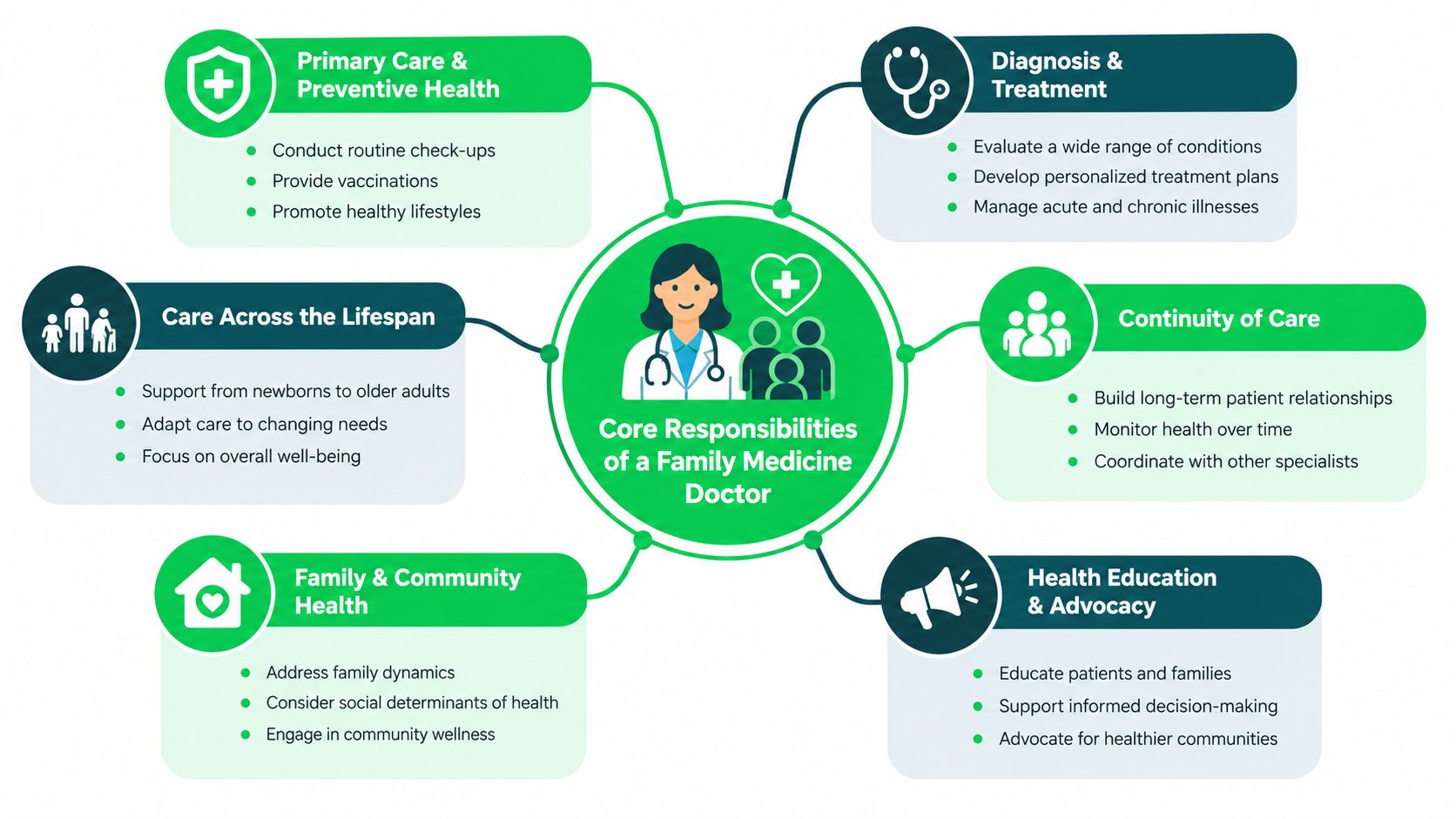
A family medicine doctor is responsible for the patient's overall care, not one body system. The role includes assessing acute illness, preventing disease, managing long-term noncommunicable conditions, checking medication safety, and coordinating care with other clinicians. A doctor may treat several people in one household, yet the defining responsibility is continuity across ages, conditions, and changing care needs.
For Dubai residents, this breadth matters because access to primary care can be fragmented. A home visit gives the family doctor a direct view of the patient's symptoms, medicines, mobility, and household circumstances. The UAE primary-care costing report describes 131 governmental primary healthcare facilities delivering services that include noncommunicable disease management and control. Family doctors therefore support prevention and long-term monitoring, rather than serving only as a first telephone contact.
What happens during a proper primary-care assessment
The consultation begins by defining the problem, its urgency, and the safest setting for care. For an acute respiratory infection, the doctor may review symptoms, temperature, breathing, current medicines, and examination findings that indicate escalation. For diabetes or hypertension, the assessment should connect current findings with earlier readings, adherence, side effects, diet, renal risk, and planned monitoring.
Medication reconciliation often prevents avoidable problems. Patients may receive prescriptions from several providers, use over-the-counter products, or change doses without updating every record. The family physician checks for duplication, interactions, missed medicines, and treatment gaps before changing therapy or contacting a specialist.
The doctor also arranges investigations and follow-up. Depending on the patient's condition, this may involve mobile sample collection, laboratory review, documentation of a working diagnosis, treatment instructions, and a defined review point. A home appointment changes the location of care, not the standard of clinical judgement. A doctor must still identify red flags and send the patient to urgent or emergency care when needed.
| Family medicine function | What the patient should expect |
|---|---|
| Acute assessment | Diagnosis and treatment for common illnesses, with safety-net advice |
| Chronic care | Monitoring, medication adjustment, adherence support, and planned reviews |
| Prevention | Risk assessment, screening discussions, and health counselling |
| Coordination | Referrals, investigation review, and communication across providers |
| Family-centred care | Care adapted to age, household context, language, and practical needs |
How this differs from urgent care and specialist care
Urgent care prioritises rapid assessment of a defined complaint. A specialist manages a particular organ system, disease, or procedure. Family medicine combines broad assessment with responsibility for the patient's care plan, follow-up, and referral pathway.
That responsibility depends on clear clinical notes, accurate coding, appointment tracking, and dependable billing processes. Practices reviewing their administration can use trusted billing by Happy Billing as a reference when assessing small-practice workflows.
A family doctor will not replace every specialist. The doctor determines when specialist input is needed, prepares the relevant clinical information, and helps maintain primary-care follow-up after specialist treatment. For Dubai households using home visits, that coordination is the practical value of family medicine.
When to Call a Family Doctor Versus a Specialist
The safest default is to call a family medicine doctor when the diagnosis is unclear, the symptoms involve more than one system, or the patient needs a plan rather than a single procedure. Family doctors are particularly useful for preventive reviews, common infections, medication questions, early chronic-disease changes, and problems affecting several members of a household.
A specialist becomes the right choice when the diagnosis is already established and requires focused expertise, advanced procedures, or treatment that falls outside routine primary care. An emergency department is appropriate when delay could threaten life, organ function, or immediate safety.
Primary Care vs Specialist Care Decision Matrix
| Condition / Scenario | Family Medicine Doctor | Specialist / Emergency |
|---|---|---|
| New cough, fever, sore throat, or mild breathing complaint | Assess severity, examine the patient, treat likely uncomplicated illness, and provide safety-net instructions | Emergency assessment for severe breathing difficulty, blue lips, collapse, confusion, or rapidly worsening symptoms |
| Blood pressure or glucose readings rising | Review readings, adherence, medicines, diet, symptoms, and arrange testing or follow-up | Specialist referral when control remains difficult, complications appear, or a defined organ problem requires focused care |
| Several symptoms across different systems | Take the full history, prioritise risks, examine, and coordinate investigations | Specialist referral after the likely system or diagnosis becomes clear, emergency care for acute instability |
| Preventive screening and health review | Assess risk, discuss appropriate screening, review vaccinations and lifestyle, and arrange follow-up | Specialist involvement when screening identifies an abnormality requiring focused investigation |
| Medication side effects or conflicting prescriptions | Reconcile medicines, assess harm, and contact the prescribing clinician when needed | Emergency care for severe allergic reaction, overdose, chest pain, collapse, or other dangerous symptoms |
| Known specialist-managed condition that is stable | Support routine monitoring, general health, and communication with the specialist | Continue specialist care for disease-specific treatment, procedures, or complex deterioration |
| Child or older adult with a new, non-severe complaint | Assess the person in context, including existing conditions and household exposure | Specialist or emergency escalation when red flags, severe dehydration, neurological change, or rapid deterioration occurs |
Insurance rules can complicate this pathway. Some policies allow direct specialist access, while others require primary-care documentation or authorisation. Even where a referral isn't mandatory administratively, beginning with a family doctor often produces a clearer clinical route and reduces repeated assessments.
Red flags override convenience
Don't book a routine home visit for severe chest pressure, major trauma, sudden weakness on one side, severe breathlessness, uncontrolled bleeding, new confusion, or collapse. Call emergency services. A family doctor can triage many uncertain symptoms, but no home-care model should delay emergency treatment.
For non-emergency needs, use a doctor home visit in Dubai when the patient is too unwell, immobile, contagious, exhausted, or logistically constrained to travel safely. Tell the service the key symptoms, known conditions, medicines, location, and any red flags before the clinician arrives.
The Clinical and Logistical Benefits of Home Visits
Home-based family medicine is not merely a convenience upgrade. For the right patient, it removes barriers that cause delayed assessment, incomplete histories, and poor follow-through. The clinician sees the patient in the environment where medicines are stored, carers provide support, mobility limitations become visible, and practical treatment obstacles are easier to identify.
This matters in Dubai, where a short clinical appointment can require traffic planning, parking, waiting-room time, childcare, or time away from work. Patients with fever, respiratory symptoms, limited mobility, recent surgery, or frailty may also find travel physically difficult or clinically unwise.

What a home assessment should include
A serious home visit starts with the same discipline as a clinic consultation. The clinician reviews symptoms, medical history, allergies, current medicines, and previous diagnoses, then performs a bedside assessment appropriate to the complaint. Where indicated, the service may arrange mobile laboratory collection, share reports, and provide follow-up guidance.
The home setting adds useful information. A doctor can ask to see inhalers, insulin storage, pill boxes, wound dressings, mobility aids, or the patient's usual sleeping area. A relative or carer can explain changes that the patient may minimise or forget.
Home care is especially practical for:
- Acute but stable illness: Assessment and treatment can begin without moving a febrile or uncomfortable patient through a crowded clinic.
- Post-operative monitoring: The clinician can review pain, wounds, hydration, mobility, and medicine use while identifying signs that require the surgical team.
- Older adults and limited mobility: Reduced transfers and travel can make assessment safer and less exhausting.
- Laboratory needs: Home sample collection can fit around work, family responsibilities, and mobility limitations.
- Nursing support: Injections, wound care, medication assistance, and other prescribed tasks can continue between doctor reviews.
- Physiotherapy and rehabilitation: A therapist can assess movement in the patient's actual home environment rather than relying only on a clinic description.
Home visits also suit hotel guests, business travellers, and families caring for someone who shouldn't travel. The right service can provide assessment at a home, hotel, or office while keeping the referral threshold clear.
Where home care stops
Home treatment has boundaries. A doctor may need imaging, hospital observation, advanced respiratory support, emergency surgery, or specialist intervention. The clinician should explain the concern, document the escalation, and help the patient move promptly to the appropriate facility.
Use a complete guide to home-care options in Dubai to compare doctor visits with nursing, physiotherapy, laboratory collection, and other in-home services. Convenience should support timely care, not become a reason to manage a dangerous condition outside hospital.
Building Continuity of Care for Chronic Conditions
Chronic disease management breaks down when each appointment starts from zero. One clinician sees a high reading, another hears about a missed dose, and neither has the full pattern. A consistent family doctor can place those events in context, spot deterioration earlier, and make measured treatment changes.
Dubai's expatriate-heavy healthcare system makes that consistency difficult. Patients may move between clinics, insurance networks, and specialists, while primary-care staffing remains limited. Earlier workforce reporting cited around 16 physicians each year from one source, while the later workforce estimate of about 25 family physicians graduating each year comes from a different report. These figures use different scopes and should not be treated as a single measure of annual output. The practical point is clear: reliable continuity requires patients to choose and maintain a defined primary-care relationship.
A workable continuity process
Select one primary clinician or service for routine reviews. Keep an updated record of diagnoses, medicines, allergies, recent results, home readings, and specialist letters. Share it at every appointment, particularly when care crosses clinics or insurance networks.
Use this follow-up cycle:
- Establish the baseline. Record symptoms, examination findings, current treatment, adherence barriers, and relevant home measurements.
- Set the next clinical question. Decide what must be checked before review, such as blood-pressure trends, glucose readings, respiratory symptoms, wound healing, or medicine tolerance.
- Review patterns, not isolated readings. One result may require attention, but repeated measurements and symptom changes support safer decisions.
- Adjust deliberately. Change treatment when indicated, explain the reason, and identify side effects or warning symptoms that require earlier contact.
- Close the loop. Return results, referrals, and specialist recommendations to the family doctor so the overall plan remains coherent.
Continuity is a clinical intervention. A complete history reduces repeated work and helps the next clinician detect meaningful change.
Home visits can make this process practical for patients who struggle with travel. The doctor can check blood-pressure technique, inspect medicine storage, confirm that a carer understands the plan, and arrange home testing when clinically appropriate. These details often decide whether treatment works beyond the consultation room.
For diabetes, hypertension, asthma, recurrent infections, frailty, or recovery after surgery, follow a structured guide to managing chronic conditions at home instead of booking disconnected appointments. Confirm who reviews results, who changes medicines, how urgent concerns are handled, and when specialist escalation is required.
Keep prevention in the same record. A family doctor can identify overdue screening, vaccination needs, lifestyle risks, and symptoms requiring investigation. The aim is not to turn every visit into a checklist. It is to stop urgent complaints from permanently displacing preventive care between illnesses.
How Vitals Healthcare Delivers Family Medicine at Home
Dubai needs more than definitions of primary care. It needs access models that let patients obtain a broad assessment without waiting for a perfect clinic appointment. A home service can fill part of that gap when it combines qualified clinicians, clear escalation rules, mobile diagnostics, and reliable follow-up.
Vitals Healthcare provides doctor-on-call visits for homes, hotels, and offices across Dubai. Its doctors, nurses, and physiotherapists are DHA-licensed, and the service operates 24/7, with typical arrival in approximately 30 minutes, subject to location and demand. Coverage includes Dubai Marina, Jumeirah Lakes Towers, Downtown, Palm Jumeirah, Business Bay, Jumeirah Village Circle, Umm Suqeim, Al Garhoud, and Arabian Ranches.
What the service can coordinate
Requests can be arranged by phone or WhatsApp. During a visit, clinicians can perform an on-site assessment and bedside evaluation when indicated, then provide treatment, follow-up guidance, or escalation advice. Mobile laboratory collection, report sharing, nursing support, physiotherapy, and IV therapy can extend the care plan beyond the initial consultation.
The model suits several practical situations:
- Same-day illness: A clinician assesses stable acute symptoms at the patient's location.
- Chronic-care support: The doctor reviews current symptoms, medicines, and available home readings.
- Post-operative needs: Nursing and medical reviews support wound care, medication use, and recovery monitoring.
- Travel and hotel problems: Visitors can request discreet in-room assessment without navigating an unfamiliar facility.
- Family logistics: Older adults, children, and carers can receive care without arranging transport for every appointment.
Vitals Healthcare also provides multiple payment options and invoices for insurance claims. Patients should still confirm policy requirements, referral rules, exclusions, and reimbursement procedures before assuming a visit will be covered.
Administrative coordination matters in any fragmented system. Clinics and home-care providers increasingly rely on organised scheduling, documentation, and patient communication, and a Medical virtual assistant can be relevant when healthcare teams evaluate support for those non-clinical workflows.
Vitals Healthcare's home medical services in Dubai should be viewed as one route into family-medicine-style care, not as a replacement for emergency departments or every specialist service. The key question is whether the clinician can assess the problem safely, create a clear plan, maintain follow-up, and escalate without delay when the patient's needs exceed home care.
Vitals Healthcare Doctor On Call offers DHA-licensed doctor visits at home, in hotels, and at offices across Dubai, alongside mobile lab testing, nursing, physiotherapy, and IV therapy. If travel or fragmented appointments are delaying primary care, visit Vitals Healthcare Doctor On Call to arrange an assessment and choose the appropriate next step.