
You're in a Dubai hotel lobby, your child is asleep upstairs, or a colleague is finishing a meeting in a glass-walled office. Someone suddenly slumps, doesn't respond, and the room goes quiet. In that moment, first aid and AED knowledge stops being theory and becomes the bridge between panic and a real chance of survival.
That bridge matters because cardiac arrest moves fast. In out-of-hospital cardiac arrest, every minute of delay in CPR and defibrillation cuts survival by about 10%, and immediate CPR can triple the chance of survival (Red Cross CPR facts and statistics). The challenge in Dubai is not only knowing what to do, it's also knowing where the AED is, who can bring it, and how to keep acting while help is still on the way.
Table of Contents
- Why First Aid and AED Skills Matter in Everyday Settings
- The Chain of Survival Explained Simply
- CPR and AED Steps Anyone Can Follow
- Why Minutes Matter and AEDs Change the Odds
- Going Beyond AEDs Core First Aid Skills Everyone Should Know
- Training Confidence and the UAE's Language and Access Gap
- AED Readiness in Dubai Homes Hotels and Offices
- Turning Awareness into Action a Final Word
Why First Aid and AED Skills Matter in Everyday Settings
A man collapses near the reception desk in a Downtown hotel. A housekeeper notices first. The nearest manager is across the building, and the lift takes time. In that gap, first aid and an AED matter because the first response starts before the ambulance reaches the scene. If the person on the floor is in cardiac arrest, the first few minutes shape whether the outcome becomes a rescue or a loss.
The same applies in homes and offices. A parent cannot always wait for a doctor to arrive, a facilities team cannot assume medical staff are already downstairs, and a visitor may not know the building layout at all. In Dubai, that reality shows up in high-rise apartments, serviced hotels, and office towers, where help may be in the building but not yet at the room or floor where the emergency is happening. That is why AED access and basic first-aid training matter in public venues and workplaces, and why even routine home safety habits, like the ones covered in this practical guide on treating common health issues at home in Dubai, sit alongside emergency planning.
Practical rule: if the scene looks like a sudden collapse, treat it as time-sensitive until proven otherwise. Call for help, bring the AED, and do not wait for the situation to settle on its own.
A small amount of training changes what bystanders can do under pressure. It helps them recognize the difference between a person who can be monitored at home and a person who may need immediate resuscitation, and it gives them a simple order of action instead of hesitation. When someone knows how to start CPR, send for the AED, and keep the area clear for responders, the building's response becomes faster and calmer.
The Chain of Survival Explained Simply
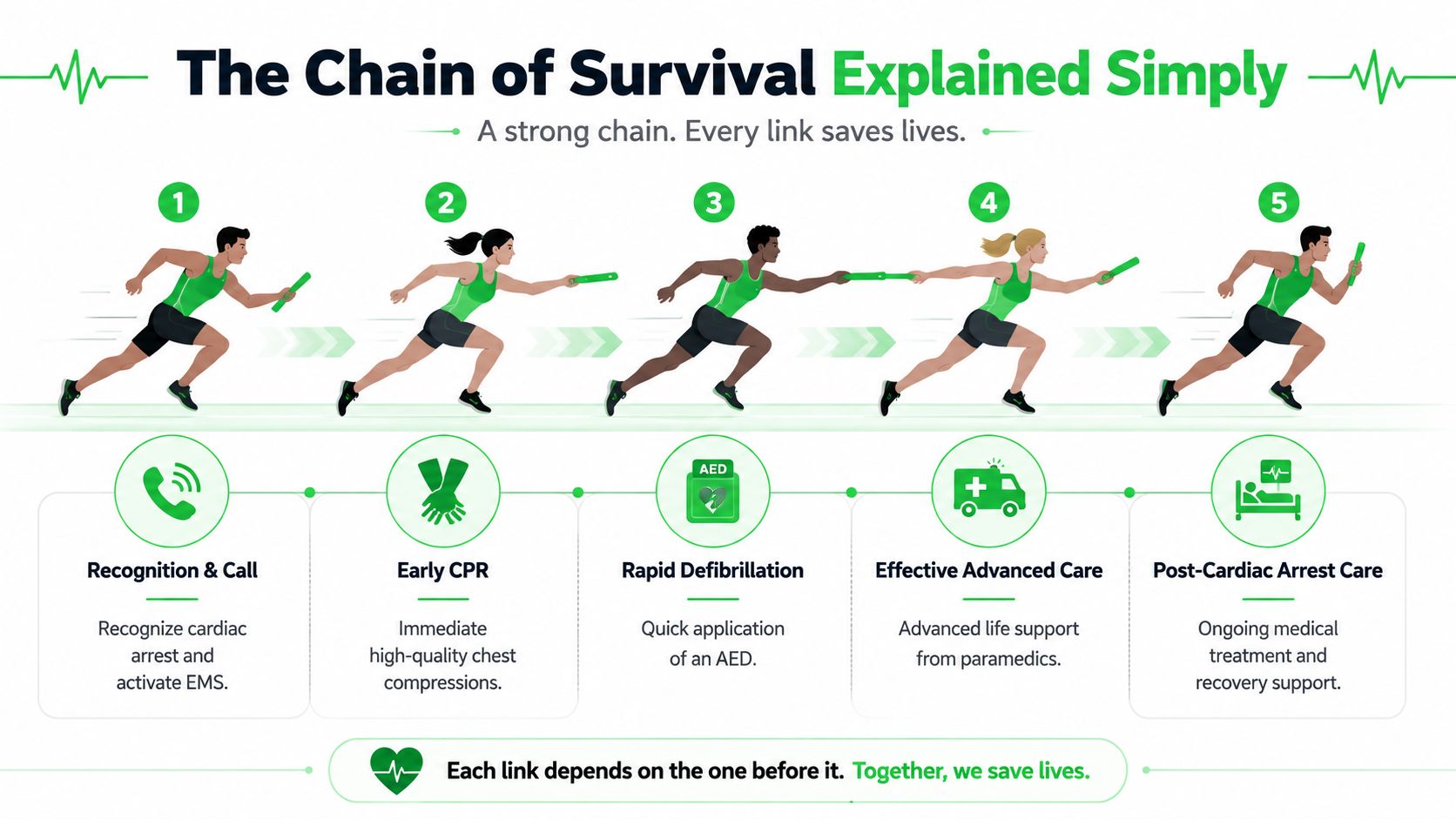
Cardiac arrest response can be compared to a relay race. Each runner has to hand over cleanly, because the baton only reaches the finish if every step happens in order. The same is true for the chain of survival, where recognition, calling for help, CPR, defibrillation, advanced care, and recovery each support the next step.
The first links are about speed
The first link is recognition and call, which means noticing that someone is unresponsive and alerting emergency services immediately. The second is early CPR, which keeps blood moving to the brain and heart while help travels. The third is rapid defibrillation, where the AED matters because it can reset a shockable rhythm when used quickly.
The fourth and fifth links are effective advanced care and post-cardiac arrest care. Paramedics and hospital teams take over after the bystander's first response, then continue treatment and monitoring. If one link is slow, the whole chain slows with it, which is why the first minutes before the ambulance arrives matter so much in a home, hotel, or office tower.
Why the AED sits at the turning point
The AED is the handoff point where CPR alone becomes CPR plus a lifesaving shock. In a building with security, concierge staff, or office reception, that means somebody has to know where the unit is, how to fetch it fast, and who keeps compressions going while it is being brought over. If the device is on a different floor, behind a locked desk, or known only to one person, the chain loses time right when speed matters most.
The baton only matters if someone keeps passing it.
For families and facilities teams, guidance on preparing for an AED emergency is available in Vitals Healthcare's AED emergency care guidance, because readiness is not only about the device itself. It also depends on the people, the building layout, and whether responders can act quickly even when language or role confusion slows the first call.
CPR and AED Steps Anyone Can Follow
A cardiac arrest can begin in a living room, hotel lobby, or office corridor with very little warning. The first person on scene does not need medical training to start the right sequence. The official order is simple, check responsiveness, call for help, assess breathing, apply the AED, and start CPR or rescue breathing as appropriate. That sequence is explained in the AHA and Red Cross update, and it is built for ordinary people, not only clinicians.
What to do in the first minute
If the person does not respond, call out immediately so nearby people know help is needed. In Dubai, dial 999 and ask someone specific to bring the AED, because delays often happen when everyone assumes another person has already acted. If the person is not breathing normally, begin chest compressions while another person goes for the device.
Once the AED arrives, turn it on and follow the spoken prompts. The machine gives one instruction at a time, which matters because stress can make even simple steps feel confusing. The pads go on the chest, the AED checks the heart rhythm, and everyone must stand clear when it tells them to do so.
What the AED is doing while you stand back
The AED checks whether a shock is needed, then tells you whether to press the button or go back to CPR. The pause is short, but it still interrupts compressions, so the goal is to stay calm and follow the voice prompts exactly. If a shock is delivered, resume compressions as soon as the AED tells you to continue.
For children, the workflow changes when pediatric electrodes are detected. The Indian public-sector technical specification describes automatic adult and pediatric dosing, with 100-200-300-360 J for adult use and 15-30-50 J for pediatric use, plus audible and visual prompts and a shock-to-shock cycle typically under 20 seconds. That built-in adjustment is one reason AEDs are designed to guide lay responders, not just clinicians.
Calm rule: if the AED is talking, listen, keep people clear, and keep compressions going when told.
If you are alone at home or in a hotel room, guidance for handling a medical emergency when alone can help you think through the first few minutes before help arrives. The same pressure points come up in real buildings across Dubai, where language differences, security desks, concierge teams, and floor layouts can slow the first response if nobody has practised the handoff.
Why Minutes Matter and AEDs Change the Odds
A collapsed person in a lobby, corridor, or office floor changes the room in seconds. One person starts chest compressions, another goes for the AED, and a third clears space for the responder. That sequence matters because in cardiac arrest, the clock is working against the brain and the heart at the same time.
The difference between CPR alone and CPR plus an AED is not abstract. In a large peer-reviewed study of public access defibrillation, survival to hospital discharge was 9% with bystander CPR alone, 24% when an AED was applied before EMS arrival, and 38% when the AED delivered a shock (public access defibrillation study). In plain terms, CPR keeps blood moving, while the AED addresses the rhythm problem that CPR cannot correct on its own.
The first shock is the turning point
A Circulation study reported neurologically intact survival rising from 14.3% without an AED to 49.6% with an onsite AED, while time to first shock fell from 11 minutes to 4 minutes (same study summary). That matters because each passing minute reduces the chance of a good recovery. The faster the shock, the wider the window for a meaningful outcome.
A public-location arrest adds another layer of urgency. More than 17.5% of out-of-hospital cardiac arrests occur in public places, but bystander AED use in public-location arrests remains low at 13.9% (Red Cross CPR facts and statistics). The gap is not about whether the device exists. It is about whether someone can find it, open it, and use it without losing time.
What those numbers mean in Dubai buildings
A locked cabinet in a hotel corridor does not help if no one knows the code or key. An office AED on paper does not help if staff do not know which floor stores it. In homes, the problem can be simpler but just as real, family members may know where the device is, yet freeze when they hear the alarm or cannot describe the next step in the same language as the AED prompts.
The practical lesson is simple. If the first shock happens quickly, the odds improve sharply. That is why readiness plans must be built around retrieval time, clear signage, and a short handoff between the person calling for help and the person bringing the device.
For building teams thinking about what happens after the immediate response, information on managing high blood pressure is a useful reminder that urgent symptoms often need clinician follow-up once the first crisis has been stabilised.
Going Beyond AEDs Core First Aid Skills Everyone Should Know
AEDs draw attention because cardiac arrest is sudden and visible, but first aid for everyday injuries still matters just as much. A receptionist with a burn, a child with a bite, or a visitor with bleeding after a fall needs someone who can stay calm and act before the doctor arrives. In that moment, the aim is to limit harm until professional care takes over.
A few high-value skills make a real difference
For thermal burns, the American Heart Association guideline says to cool the burn with cool or cold potable water as soon as possible and for at least 10 minutes. For human and animal bites, the same guideline recommends copious amounts of water for irrigation (AHA guideline). Those steps are easy to overlook because they look basic, yet basic care is often the part that prevents a worse problem later.
Bleeding control, choking response, and fainting management follow the same logic. Use steady pressure for bleeding, pay close attention if the airway is involved, and do not keep moving someone who may need help where they are. If the situation is more than a quick fix, call for escalation and keep the person as stable as possible while help is coming.
Good first aid limits harm while help is on the way
Good first aid does not replace medical care. It limits harm while help is coming. In a Dubai apartment, that may mean cooling a kitchen burn straight away instead of waiting to “see how it goes”. In an office, it may mean pressing on a wound until it stops bleeding through clothing and becomes harder to manage.
Useful mindset: the first three minutes are for containing danger, not for perfect diagnosis.
For clinics, homes, and hotel rooms where a nurse or doctor may need to be called after the initial response, Vitals Healthcare's doctor-at-hotel service in Dubai fits the kind of follow-up path many families and guests need.
Training Confidence and the UAE's Language and Access Gap
A fallen guest in a hotel corridor, a colleague clutching their chest in an office pantry, or a family member collapsing at home all create the same test. The steps may be simple on paper, yet people often freeze when the room is loud, the phone is ringing, and everyone is looking at them for the next move.
A lot of first-aid content assumes that once someone finishes a course, they will respond confidently under pressure. That is too optimistic. Reviews on emergency care in underserved populations note that first-aid education and task shifting to lay responders may reduce morbidity and mortality and improve community capacity, but the evidence quality is often weak, and implementation barriers remain substantial (review of underserved populations).
Knowledge is not the same as usable response
In a multicultural city, language comprehension matters as much as technique. A housekeeper, security guard, front-desk agent, or family member may know the words “CPR” and “AED” but still hesitate if the instructions are not in the language they understand best. The problem is not interest, it is whether the response can be carried out under stress.
Refresher design matters for the same reason. People do not just need a certificate, they need roles, prompts, and repetition that make the response feel familiar when the room is noisy and the clock is running. A one-time course can build awareness, but confidence fades if nobody practises the handoff, the call, and the AED retrieval.
A 2025 international survey is expected to highlight major barriers to life-saving skills training access globally, which is a useful reminder that training gaps are about access and follow-through as much as willingness (international survey overview). In the UAE, that points to multilingual refresher cards, simple building instructions, and a named responder for each shift or household routine.
AED Readiness in Dubai Homes Hotels and Offices
A cardiac emergency in Dubai often unfolds in a place with distance, noise, and routine barriers, a tower apartment, a resort corridor, or a busy office floor. The question is not whether an AED helps. The question is whether someone can reach it, understand it, and use it before the first minutes slip away.
What readiness looks like in practice
For hot-climate settings, AED engineering specs focus on heat tolerance, battery life, and self-testing. A Gulf-region supply specification lists operating conditions of 0°C to 50°C with up to 95% humidity and a minimum 4-year standby battery life, while another AED specification lists daily, weekly, and monthly self-tests, a 200-J maximum output, and storage temperatures up to 55°C (AED environmental specification). In Dubai, that is not an abstract detail, because heat and humidity can affect whether the device is ready the moment it is needed.
Readiness also depends on human roles. A device in a home, hotel, or office should sit in a place people can see, with a route to it that is obvious even under stress. In a Dubai household, one adult may call emergency services while another brings the AED. In a hotel, security or concierge should know the cabinet location and the handoff order. In an office tower, reception and facilities teams should practise the same pattern until it feels familiar.
AED Readiness Checklist for Dubai Settings
| Readiness Item | Home | Hotel | Office |
|---|---|---|---|
| Device visibility | Kept in a known, accessible spot | Clearly signed and easy to reach | Posted on every relevant floor plan |
| Who fetches the AED | Named adult in the home | Security, concierge, or trained staff | Reception, facilities, or floor warden |
| Language support | Simple instructions in the main household language | Multilingual quick guide for guests and staff | Multilingual prompt card near the device |
| Temperature and battery checks | Routine checks in a cool indoor area | Frequent checks in hot or humid back-of-house areas | Logged self-tests and battery-status review |
| Escalation path | Emergency number plus doctor-on-call backup | Hotel management and emergency response | On-site response plus nearby medical support |
The language point matters as much as the hardware. A housekeeper, security guard, front desk agent, or family member may know where the AED is, but still hesitate if the instructions are not in a language they can follow quickly under pressure. In a hotel setting, a doctor-on-call service like a doctor-on-call service from Vitals Healthcare for hotel care in Dubai can fit into the escalation layer after the first response, especially when the patient needs clinical assessment in the room, lobby, or staff area.
Turning Awareness into Action a Final Word
Knowing CPR and AED basics is useful. Knowing where the AED is, who brings it, and how to keep going until help arrives is what makes the knowledge usable. The strongest next step is simple, check your building today, ask where the AED is kept, and make sure at least two people know how to use it.
Then book a refresher course, print the emergency numbers, and agree on who calls, who fetches, and who stays with the patient. If you live in a tower, work in a hotel, or manage an office, that planning turns first aid from a nice idea into a practical habit.
If someone in your home, hotel, or office needs medical assessment after the first response, Vitals Healthcare Doctor On Call can bring a DHA-licensed clinician to the location for urgent evaluation, treatment, and follow-up support. Visit Vitals Healthcare Doctor On Call to arrange doctor-on-call care in Dubai and keep a clear escalation option ready for the moments when first aid needs a medical handover.