


A fever in a Dubai hotel room can turn a straightforward trip into a difficult night. Perhaps you're visiting, the nearest clinic feels far away, and you're unsure whether to call a doctor or head to hospital. Or perhaps an older family member has returned home after a fall and now needs help with mobility, medication, or wound care. A home care service brings appropriate clinical assessment and treatment to where the patient is, while emergency symptoms still need emergency care.
In Dubai, home healthcare isn't informal help or a convenient substitute for every clinic visit. It's a regulated clinical category delivered by licensed professionals. Knowing what happens from the first call through follow-up helps you choose the right service, ask useful questions, and understand when home care isn't enough.
Table of Contents
- What Home Care Service in Dubai Really Means
- Core Services Included in a Home Care Package
- Why Dubai Residents and Visitors Choose Home Care
- How a Typical Home Care Visit Works
- How to Choose a Reliable Home Care Provider
- Pricing, Insurance, and Out-of-Pocket Costs
- Common Questions About Home Care Service in Dubai
- Making Home Care Work for You in Dubai
What Home Care Service in Dubai Really Means
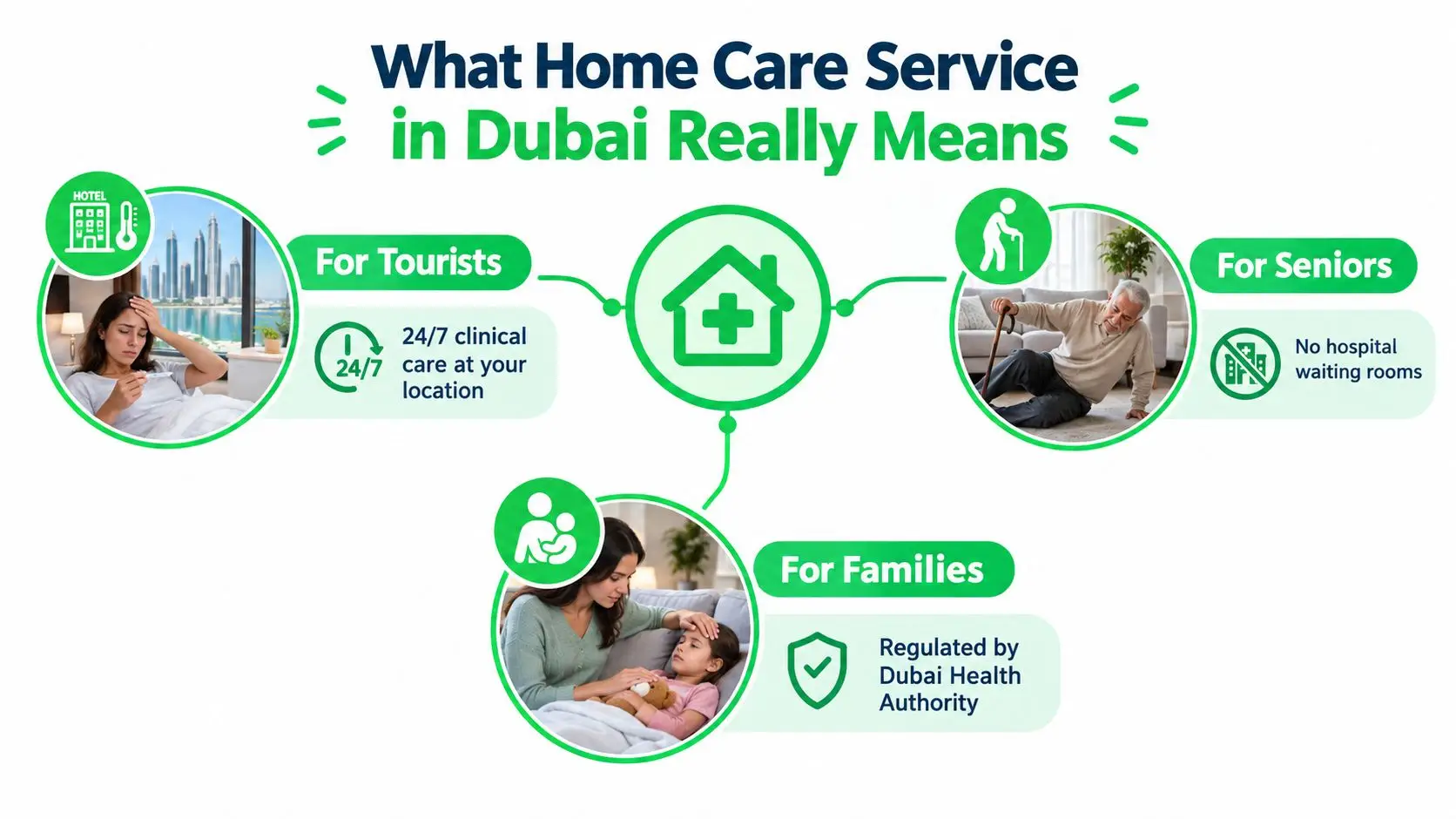
Home care means clinical care delivered at a patient's location, which may be a private residence, hotel, or office. A clinician assesses the person in that setting, explains what they find, and provides suitable treatment or advice. The location changes, but the need for professional judgment and clear clinical records doesn't.
Dubai treats home healthcare as part of its formal health system. The Dubai Health Authority (DHA) recorded 4,958 licensed healthcare facilities in 2023, including 55 hospitals, and reported approximately 5,800 licensed facilities in 2025, of which 222 were home healthcare centres. These figures place home care among established regulated healthcare services, rather than treating it solely as an informal caregiving arrangement. DHA's Dubai Health Statistical Yearbook provides the wider context for this expanding system.
When home care may fit
A home care visit may suit an urgent but non-emergency illness, recovery after a procedure, routine nursing support, rehabilitation, or assessment of an older adult whose mobility makes travel difficult. Families may also arrange paediatric assessment, while hotel guests and business travellers can request care without travelling to a clinic.
The key distinction is urgency. A clinician can assess many problems at home, but a home visit isn't a replacement for emergency services when someone may need immediate hospital-level treatment. Chest pain, severe breathing difficulty, signs of stroke, or severe bleeding should prompt an emergency response, not a routine booking.
For older adults, care may extend beyond a single visit. A UAE review describes home-care services as potentially including geriatric assessment, skilled nursing, home-safety checks, rehabilitation, nutrition, psychological assessment, and multidisciplinary support. The review of geriatric medicine and home-care services in the UAE helps explain why home care can involve a coordinated plan rather than a list of isolated tasks.
If you're comparing approaches to care at home, A Better Solution in Home Care offers a general resource on home-care options. For Dubai patients, the practical starting point remains the same: identify what help is needed, then confirm that the provider and clinician are authorised to deliver that care.
Core Services Included in a Home Care Package
A home care service can arrange different types of clinical support, but the right booking depends on the patient's immediate need. A doctor assesses symptoms and decides on a treatment plan; a nurse provides nursing procedures and monitoring; a physiotherapist focuses on movement, function, and rehabilitation. The provider should explain who will attend and what the visit includes before dispatch.
Match the request to the clinician
A doctor visit may suit a traveller with a fever or a Business Bay worker who needs an examination before deciding whether to continue a trip. A nurse may be the right person for wound dressing, injections, medication support, or observations prescribed as part of a care plan. Physiotherapy is a separate clinical service, not a general massage: the therapist assesses movement and works with the patient on exercises or rehabilitation goals.
IV therapy is not a cure-all for fatigue or illness. A clinician needs to assess whether it's appropriate, explain the risks, and use the right equipment and monitoring. Similarly, a request for a blood test involves more than collecting a sample. Ask who will collect it, how it will be handled, where processing takes place, and how results will be shared.
For mobility needs, equipment such as a walking aid or wheelchair may support safety, but it doesn't replace a clinical assessment. A guide to choosing mobility equipment can help families think through equipment options alongside advice from the treating clinician. For a closer look at nursing visits and available support, see home nursing services in Dubai.
| Service | Typical clinician | Common Dubai use case | Delivered to |
|---|---|---|---|
| Doctor on call | DHA-licensed physician | Fever, illness assessment, or medical advice for a visitor | Home, hotel, or office |
| Nursing care | DHA-licensed nurse | Wound dressing or prescribed medication support after surgery | Home, hotel, or office |
| Physiotherapy | DHA-licensed physiotherapist | Mobility support or rehabilitation after injury or a procedure | Home or office, subject to suitability |
| IV therapy | Clinician qualified to assess and administer treatment | A clinician-approved treatment request after assessment | Home, hotel, or office, subject to suitability |
| Home laboratory collection | Trained clinical staff, according to provider arrangements | Sample collection when travel to a laboratory is difficult | Home, hotel, or office, subject to provider arrangements |
Before booking, describe the symptoms or care need rather than naming a treatment you've already chosen. That gives the provider a chance to route the request to an appropriate clinician and clarify whether the service can safely be delivered at your location.
Why Dubai Residents and Visitors Choose Home Care
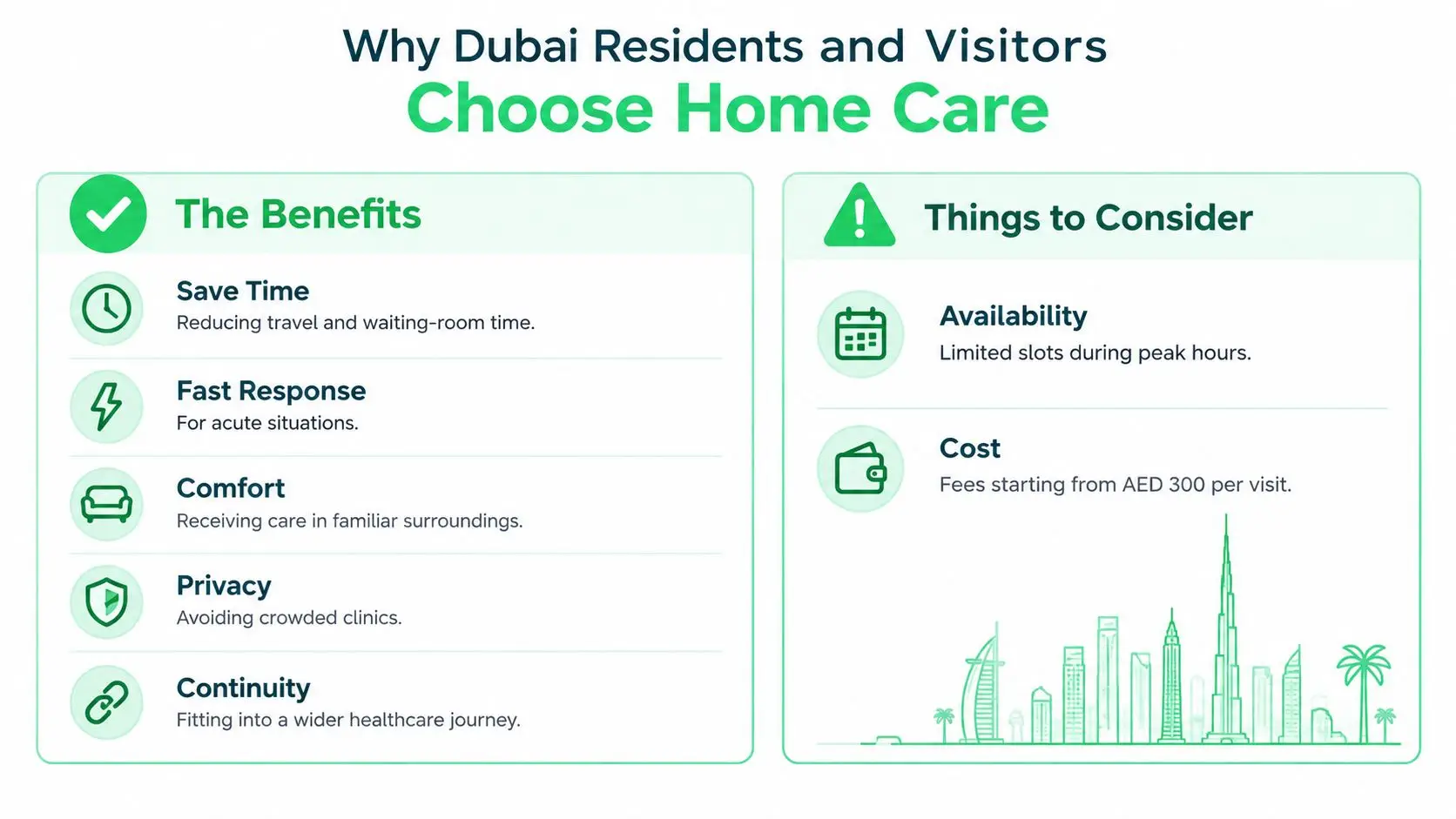
The appeal of home care isn't only that a clinician comes to you. The setting can reduce practical barriers, support continuity, and make it easier for family members to take part in decisions. Those benefits are most useful when the patient's condition is suitable for assessment and treatment outside hospital.
Five practical differences
- Less travel and waiting-room time. A patient with limited mobility may find a journey to a clinic tiring. A home visit removes the trip, though it doesn't guarantee an immediate arrival.
- A response at the patient's location. A hotel guest who becomes unwell can request an assessment without navigating an unfamiliar area. The provider still needs to triage the situation and confirm availability.
- More privacy. A visitor, executive, or family may prefer an in-room assessment to discussing symptoms in a busy waiting room.
- Continuity around recovery. Nursing and physiotherapy can fit into a wider plan after a procedure or during ongoing care, subject to the clinician's assessment.
- Family participation. Relatives can hear the explanation, ask questions, and understand what to monitor after the clinician leaves.
A familiar room can also make the conversation more practical. The clinician may see the patient's usual surroundings, discuss what support is available, and clarify how the family can follow the care plan. That doesn't mean home treatment is automatically better; it means the assessment happens in the environment where the patient will manage the next steps.
Dubai's wider elderly-care policy reflects the role of home-based support. DHA identifies ageing, chronic illness, disability, rehabilitation, and palliative care as contributors to long-term-care demand, and its long-term-care standards discuss the need for coordinated services. DHA's standards for long-term care services are relevant for families trying to understand how clinical care, rehabilitation, and family support can fit together.
Home care is still subject to practical limits. Clinician availability varies, and some conditions require equipment, observation, or treatment that can only be provided in a clinical facility. For a comparison of home nursing and facility-based care, this guide to home nursing versus hospital care in Dubai can help frame the decision.
How a Typical Home Care Visit Works
A home care visit usually begins with a call or message, but the clinical process starts before a clinician reaches the door. Clear information helps the provider decide what kind of response is suitable and what the attending professional should bring.
From first contact to arrival
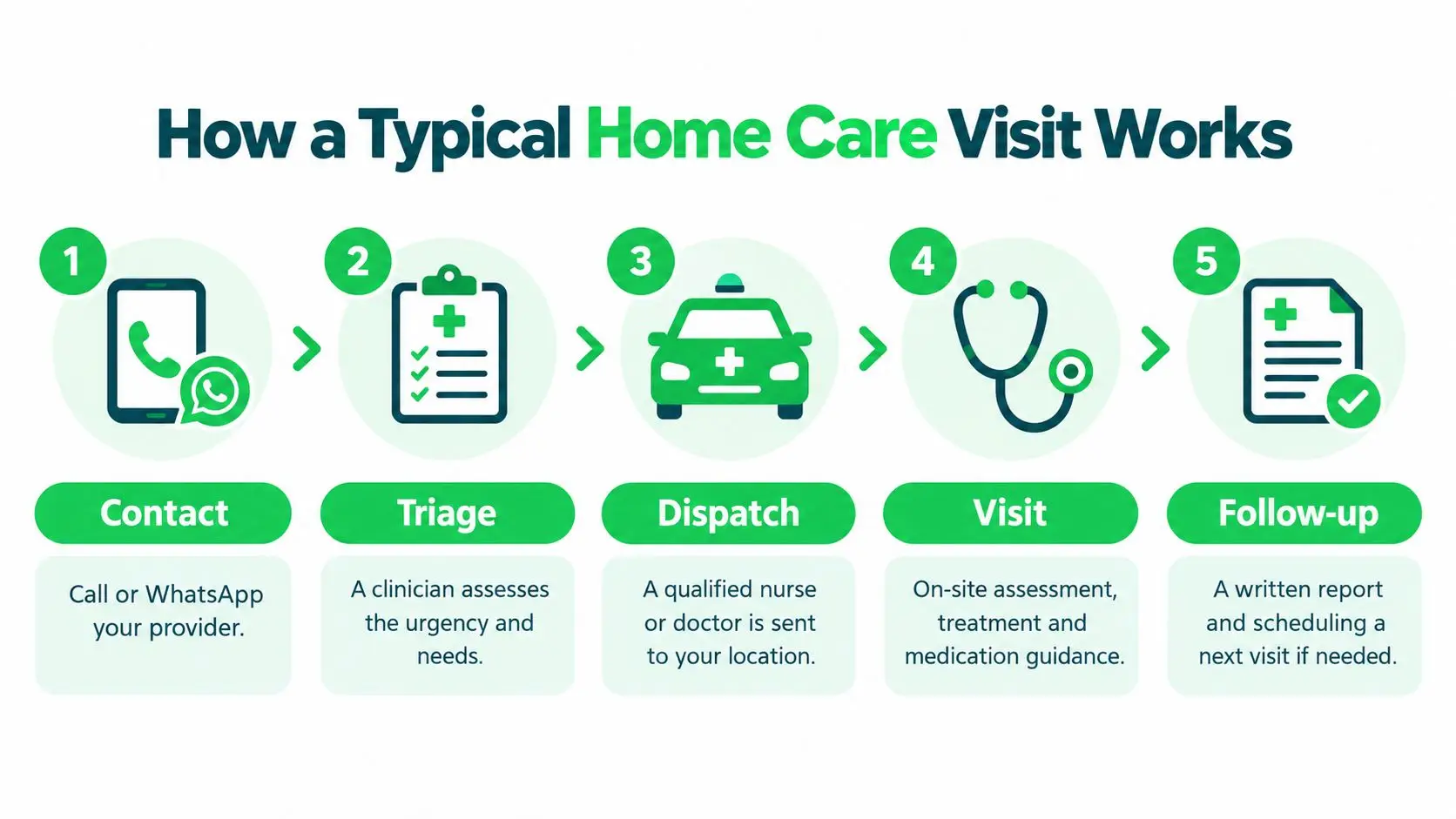
- Contact the provider. Explain the patient's location, main symptoms or care need, relevant medical history, and a callback number. If the patient is in a hotel or office, give the building name and access details.
- Answer triage questions. A coordinator or clinician may ask when symptoms began, how they've changed, what medication the patient takes, and whether there are warning signs. Triage means sorting the request by clinical urgency and deciding whether a home visit is appropriate.
- Confirm the visit. Ask which clinician is expected, what the service includes, the likely arrival window for your area, and the expected charges. Keep the patient's identification and available medication information ready.
A provider may coordinate by phone or WhatsApp, but a message doesn't replace urgent emergency care. If symptoms worsen while you're waiting, update the provider or call emergency services when the situation requires immediate hospital assessment.
Assessment, treatment, and follow-up
On arrival, the clinician confirms the patient's identity and takes a history. Depending on the request, they may check vital signs, examine the patient, review medication, assess mobility, or collect a sample. They should explain their findings and discuss the next step before treatment proceeds.
The procedure depends on the service. For an IV treatment, the clinician first assesses whether it's suitable, prepares the equipment, and monitors the patient as required. A physiotherapy visit typically includes movement assessment and exercises or other treatment chosen for the patient's needs. For a laboratory sample, the clinician collects and labels it according to the provider's process, then explains how results will be communicated.
The visit should produce a record of the assessment, care provided, and recommendations. Follow-up instructions may include monitoring symptoms, arranging another visit, contacting the patient's usual doctor, or seeking hospital care. If the clinician finds that the patient needs services beyond what can be delivered safely at home, they should explain the escalation plan. What to expect during a home nurse visit can help first-time patients prepare for the practical details.
Before the clinician arrives: Keep the patient's medication list, allergies, recent reports, and access instructions together. It helps the clinician focus the assessment on the person, not on reconstructing the basics.
How to Choose a Reliable Home Care Provider
A provider's advertised availability tells you little about whether the service fits your needs. Compare how the provider handles licensing, dispatch, clinical decisions, and communication. Ask direct questions and listen for clear answers rather than broad assurances.
A practical provider checklist
- Licensing and credentials: Ask, “Can you confirm the facility's DHA authorisation and the attending clinician's DHA registration?” DHA requirements include licensing and registration for home-healthcare professionals, along with a medical director responsible for clinical supervision, policies, and procedures. DHA's home healthcare services requirements explain why these are central checks, not administrative details.
- Response time for your location: Ask, “What arrival window should I expect in my area at this time?” A provider should discuss location and demand rather than promise that every request will be handled identically.
- Coverage: Confirm service for your exact neighbourhood, whether you're in Dubai Marina, JLT, Downtown, Palm Jumeirah, Business Bay, JVC, Umm Suqeim, Al Garhoud, or Arabian Ranches. Ask whether hotel and office access affects dispatch.
- Clinical protocols: Ask how the team documents assessments, reports incidents, handles medication, and escalates a patient who becomes unstable. The answer should describe a process, not just say that the team is experienced.
- Digital coordination: Ask whether the provider can send appointment details, visit documentation, and follow-up instructions securely. Clarify who will contact you if a result or care recommendation needs attention.
Providers should also be able to explain which requests fall outside home care. That matters if the family is arranging ongoing support for an older relative, where medication review, safety, rehabilitation, and escalation planning may need coordination. A guide for family caregivers managing elderly care offers further general context for organising care and supporting a relative.
A licensed provider should be willing to identify the clinician and explain what will happen next. If you can't get clear answers about authorisation, the expected service, or follow-up, pause before booking and compare alternatives. For more questions to raise during your search, consult this guide to finding a trusted home nurse in Dubai.
Pricing, Insurance, and Out-of-Pocket Costs
There isn't one universal home-care price that applies to every patient or visit. A quote may depend on the clinician type, the service requested, travel, time of day, supplies, medication, and whether laboratory processing is included. Ask for an itemised estimate before confirming the booking.
What to check before the visit
Ask whether the quoted amount covers the consultation, any after-hours or travel charge, consumables, medicines, sample collection, laboratory processing, and follow-up. Clarify cancellation rules and whether the provider prices hotel or office visits differently from residence visits. If the patient may need a repeat visit, ask how that would be billed.
Insurance needs its own check. A policy may treat a doctor visit, routine nursing, physiotherapy, IV treatment, and laboratory collection differently. “Covered by insurance” doesn't automatically mean every home-delivered service is reimbursable. Ask the insurer whether pre-authorisation is required, what documents are needed, and whether the provider is eligible under the policy.
Dubai's government investment guide reports that 98% of Dubai's population is covered by medical insurance, while describing ongoing health needs that make accessible services relevant. The same guide reports that non-communicable diseases account for 76% of deaths, and that more than 16% of people aged 20–79 have diabetes. These figures describe the wider health context, not an individual's coverage or eligibility for home care. Dubai's Health Investment Guide is useful background, but your insurer's policy terms determine what it will pay.
Before you agree to a visit, request the expected total and ask what could be billed separately.
For a claim, ask the provider for an itemised invoice, the clinician's details, and relevant visit documentation. Confirm the submission route and keep the insurer's response. Families planning ongoing support may also find financial tips for long-term elderly care useful when comparing recurring care with one-off visits.
Common Questions About Home Care Service in Dubai
Can a clinician visit a hotel or office? Yes, if the provider offers that service and access is coordinated. The clinician should be appropriately DHA-licensed, and the location should be confirmed when booking.
Can home care support an older person over time? Yes. One-off visits and ongoing care can both be arranged, but a continuing plan may need coordination among clinicians, family, and other care providers.
How do I verify a provider's DHA status? Ask for the facility's authorisation and the clinician's registration details, then confirm them through DHA's official licensing channels before the visit.
When should I skip home care and seek emergency help? Call emergency services for symptoms such as chest pain, signs of stroke, severe bleeding, or serious breathing difficulty. Don't wait for a routine home visit when immediate hospital care may be needed.
Making Home Care Work for You in Dubai
Home care is a regulated clinical option that can fit into a wider care plan, whether you're a resident, visitor, family carer, or employer arranging support. Before booking, confirm the clinician's DHA credentials, ask about the arrival window for your area, request an itemised quote, and check what your insurer requires. Keep emergency contact details accessible, and use emergency services when symptoms are urgent.

Vitals Healthcare Doctor On Call offers DHA-licensed doctor visits, nursing, physiotherapy, laboratory collection, and IV therapy at homes, hotels, and offices across Dubai. To ask about the service that fits your situation, expected response time, and documentation for an insurance claim, visit Vitals Healthcare Doctor On Call .