
You're probably here because the pump is already set up, the bag is hanging, or a patient has just asked, “What exactly does the iv drip formula mean?” In Dubai home care, that question has two very different answers. Sometimes it means the bedside math for a gravity infusion. Sometimes it means the recipe inside a named wellness drip such as a Myers' Cocktail or a hydration bag.
The two meanings matter because they lead to two different decisions. A nurse needs the right drop factor, the right time conversion, and the right flow rate. A patient needs to know what's in the bag, why that formulation was chosen, and whether the setup is clinically appropriate for home infusion. In UAE practice, both parts matter because IV therapy is used in hospital and home-care settings where accurate flow control affects hydration, electrolyte replacement, and medication delivery, and the clinical history of IV therapy only became reliable after major advances in saline therapy, blood transfusion, and infusion equipment, with normal saline standardised at 0.9% after Hamburger's work in 1883 (USQ infusion calculation reference).
If you're comparing formulas for bedside use, wellness support, or both, the sections below are arranged so you can jump straight to the part you need, from the standard drip-rate equation to common hospital fluids, Myers' Cocktail, and bedside safety.
Table of Contents
- Understanding the Two Meanings of IV Drip Formula
- Calculating Drip Rate the Standard Way
- Why Drop Factor Changes the Drip Rate
- Common Hospital IV Fluid Formulations
- Wellness IV Drip Formulations Explained
- Comparing Popular Vitamin Drips Side by Side
- Mixing and Compatibility Notes for Common Drips
- Matching Clinical Indications to the Right Drip
- Safety Checks Before Starting a Home IV Drip
- Bedside Monitoring During and After the Infusion
- Frequent Questions About IV Drip Formulas
Understanding the Two Meanings of IV Drip Formula
In a bedside chart, IV drip formula can mean two different things, and the distinction matters. One meaning is the calculation formula used to set a gravity drip at the bedside. The other is the ingredient formula inside the infusion itself, whether that is a hydration drip, a vitamin push, or a Myers' Cocktail.
The bedside meaning
The bedside meaning is the rate calculation. A clinician works from volume, time, and drop factor to determine how many drops per minute should enter the line. That becomes important as soon as a manual set is used, because the wrong drop factor changes the delivered rate, and in home care that can mean the infusion runs faster or slower than intended.
The formulation meaning
The formulation meaning is the bag recipe. In Dubai home care, that often means a hydration drip, a Myers' Cocktail, or a vitamin-based wellness infusion built around saline, B vitamins, magnesium, calcium, vitamin C, zinc, or glutathione. The classic Myers' Cocktail began as a mixture used to deliver magnesium, calcium, B-vitamins, and vitamin C directly into the bloodstream, which avoids digestion and gives immediate absorption (history of the Myers' Cocktail).
A practical way to separate the two is straightforward. The math tells you how fast the drip should run. The formulation tells you what is running through the line and why that mix was chosen.
Practical rule: If the question is “How many drops per minute?”, you need the calculation. If the question is “What's in the bag?”, you need the formulation.
For Dubai residents booking home IV therapy, both answers should be clear before the cannula goes in. If you are comparing wellness options with a clinician, the service overview at Vitals Healthcare's IV hydration and multivitamins therapy page gives a useful reference for the type of at-home care patients usually discuss.
Calculating Drip Rate the Standard Way
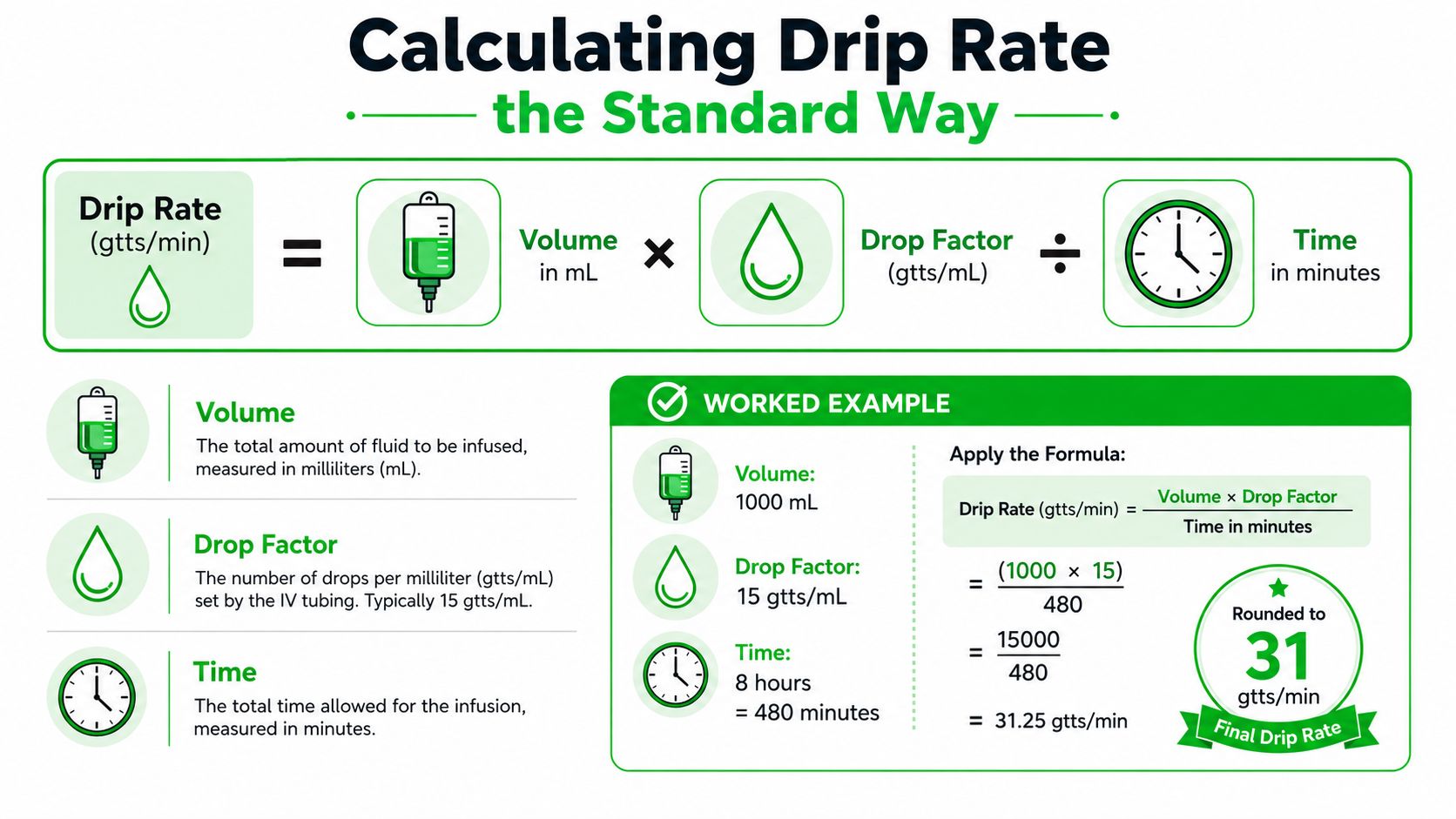
A gravity infusion is calculated at the bedside with a simple equation. Flow rate (gtts/min) = [volume (mL) ÷ time (min)] × drop factor (gtts/mL). The variables still need to be correct before the math works. Volume is the full amount of fluid in the bag, time is the total infusion window converted into minutes, and drop factor is the tubing's drop rate from the package.
Worked example
Take a 1000 mL bag over 8 hours with a 15 gtts/mL set. First convert 8 hours into minutes, which gives 480 minutes. Then apply the formula, (1000 × 15) ÷ 480 = 31.25 gtts/min, which rounds to 31 gtts/min for manual administration. That rounding is standard when a pump is not being used.
A bedside check like this is only as good as the inputs. If the time is left in hours, the result is wrong. If the tubing is misread, the rate is wrong as well.
When to rely on a pump
Use a pump whenever it is available, because it holds the rate more steadily than manual counting. Manual sets still have a place in home care, during transport, and in settings where a pump is not used, but the clinician has to stay exact about the calculation and the check.
For patients comparing home hydration options in Dubai, a quick look at the hydration level calculator can help frame the fluid discussion before the drip starts.
Manual drip counting is only as good as the tubing, the timer, and the person reading the line.
Why Drop Factor Changes the Drip Rate
A drip can look straightforward at the bag, then behave differently at the bedside once the tubing is hung. That difference comes from the drop factor, and it changes how many drops reach the patient each minute.
At the same 100 mL/h rate, the manual count shifts with the set. A 10 gtts/mL set lands at roughly 17 gtts/min, a 15 gtts/mL set at 25 gtts/min, and a 20 gtts/mL set at about 33 gtts/min. If you assume the wrong tubing from memory, the rate is off before the first drop falls.
Drip Rate by Tubing Set for 100 mL/h
| Drop factor | gtts/min at 100 mL/h | Typical use |
|---|---|---|
| 10 gtts/mL | 17 | Older or less common gravity sets |
| 15 gtts/mL | 25 | Common adult manual infusion set |
| 20 gtts/mL | 33 | Finer manual control in some setups |
| 60 gtts/mL | 100 | Microdrip tubing |
Microdrip tubing is easier to work with in manual counting because it is 60 gtts/mL, so gtts/min equals mL/h (Scribd IV drip-rate reference). In home IV work, that saves time, but only if the tubing is confirmed at the bedside and not inferred from the label alone.
A manual set can be right on paper and still wrong in practice if the wrong drop factor is attached. I see this most often when a well-chosen wellness drip, such as a hydration bag, a Myers' Cocktail, or a vitamin push setup, is matched to the wrong gravity tubing. The formulation may be appropriate, but the delivery changes as soon as the set changes.
Bedside rule: Read the tubing package every time. Never assume the drop factor from memory.
For home IV service in Dubai, that check protects the infusion plan. The bag can be correct and the formula can still be wrong if the wrong set is hung.
Common Hospital IV Fluid Formulations
A bedside order for fluid starts with the clinical problem, then the bag is chosen to fit that problem. In practice, the standard crystalloids do most of the work in dehydration, maintenance, and glucose-related support, while more specialised drips are reserved for narrower situations.
Standard IV Crystalloids at a Glance
| Fluid | Composition | Typical volume | Indications |
|---|---|---|---|
| Normal Saline 0.9% | Sodium chloride in water, standard isotonic saline benchmark at 0.9% | Commonly used in standard bags | Volume support, hydration, fluid replacement |
| Ringer's Lactate | Balanced crystalloid with electrolytes | Common hospital bag sizes vary by setting | Volume resuscitation, fluid replacement |
| Dextrose 5% in Water | Glucose in water solution | Common bag sizes vary by setting | Maintenance support, hypoglycaemia-related contexts |
| Dextrose 5% in Saline | Dextrose combined with saline | Common bag sizes vary by setting | Maintenance and combined fluid support |
| Half-normal saline | Lower sodium saline solution | Common bag sizes vary by setting | Selected maintenance situations |
The practical choice depends on the patient, not the label. Normal saline remains the reference point because it is predictable and widely used, while balanced crystalloids and dextrose-containing fluids are selected when the clinical goal changes. A fluid that is suitable for maintenance may not suit volume replacement, and a glucose-containing bag is not the same thing as a hydration bag. If you want a clinician-facing overview of how vitamin-containing wellness infusions fit into this same decision tree, the Vitamin C IV drip guide for Dubai home care is a useful companion reference.
For home care in Dubai, the safest approach is simple. Match the fluid to the issue being treated, then confirm whether the patient needs a standard crystalloid or a more specific wellness formulation. The bag is the intervention, and the details of the bag matter at the bedside.
Wellness IV Drip Formulations Explained
A home visit often starts with a simple request, someone feels flat after travel, dry after a long day, or run down and wants a nutrient-focused infusion. Wellness drips sit in that space. They are built around support goals, not disease treatment, and in Dubai they usually need to fit a practical bedside plan, screen the patient, and match the formulation to the underlying issue.
Myers' Cocktail as the prototype
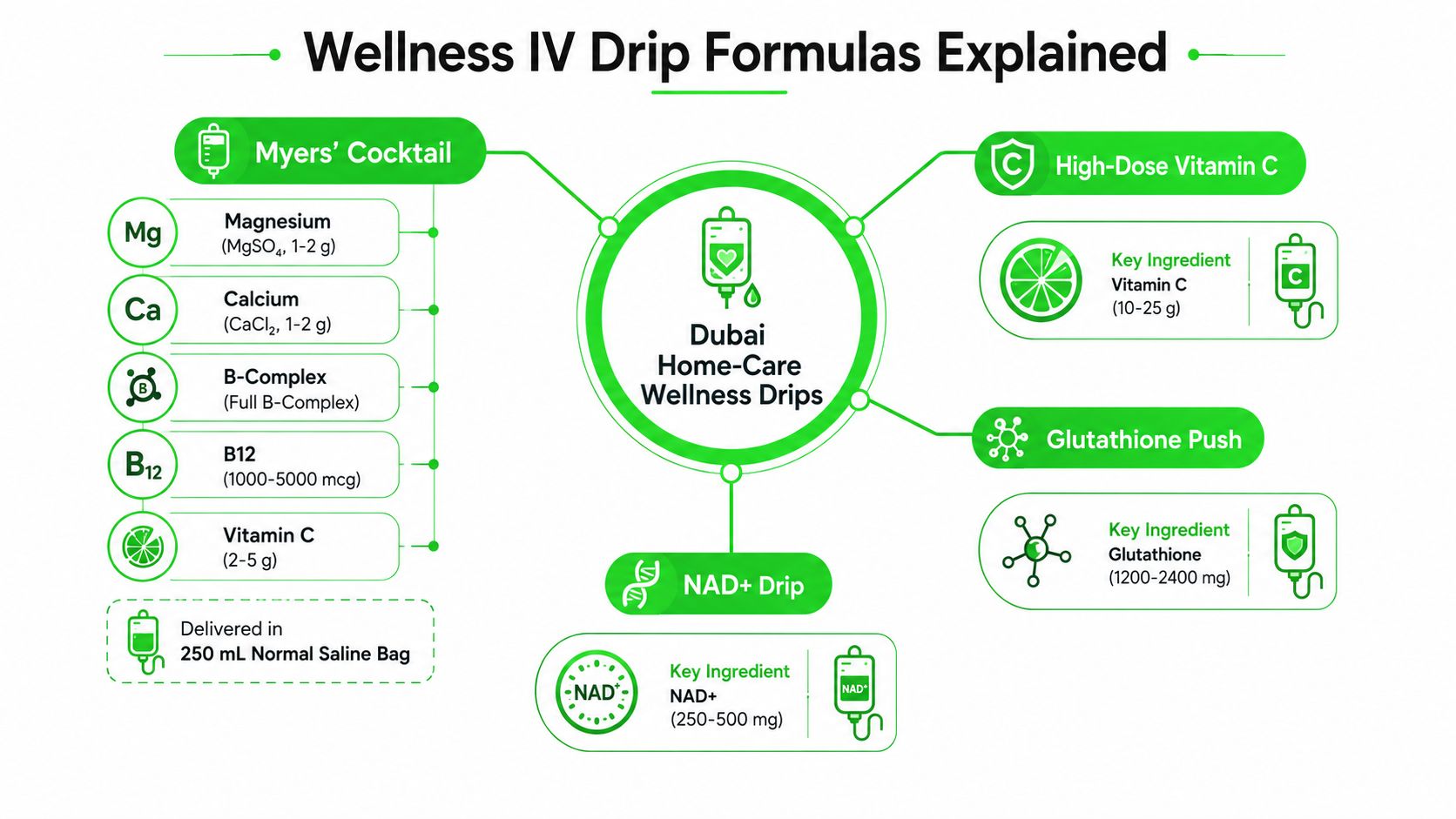
Myers' Cocktail is the reference point for many modern wellness drips. It is built around magnesium, calcium, B-vitamins, and vitamin C, given intravenously so the nutrients bypass digestion and are available right away. The original formula is often discussed as the starting point for today's nutrient drips, and many home protocols still use that framework in a 250 mL normal saline bag with a shorter infusion time than a larger hydration bag.
Other common wellness patterns
- Hydration drip: Normal saline, sometimes with B-complex added for a wellness session. The goal is straightforward, rehydration and support when oral intake has been poor.
- Hangover or jet-lag drip: Usually a hydration base with vitamin support aimed at fatigue, travel strain, and fluid loss.
- Immunity drip: Often built around high-dose vitamin C and zinc, with the goal of nutritional immune support rather than treatment.
- Beauty or skin drip: Commonly combines biotin and glutathione in a wellness context.
The clinical language matters. These are wellness formulations, not evidence-based treatments for specific diseases. A patient may feel better after a supportive infusion, but that does not make the drip a cure claim or a substitute for proper assessment.
For a closer look at vitamin C-based home infusions, the 2026 vitamin C IV drip guide is a practical companion for understanding how vitamin-focused sessions are usually framed.
Comparing Popular Vitamin Drips Side by Side
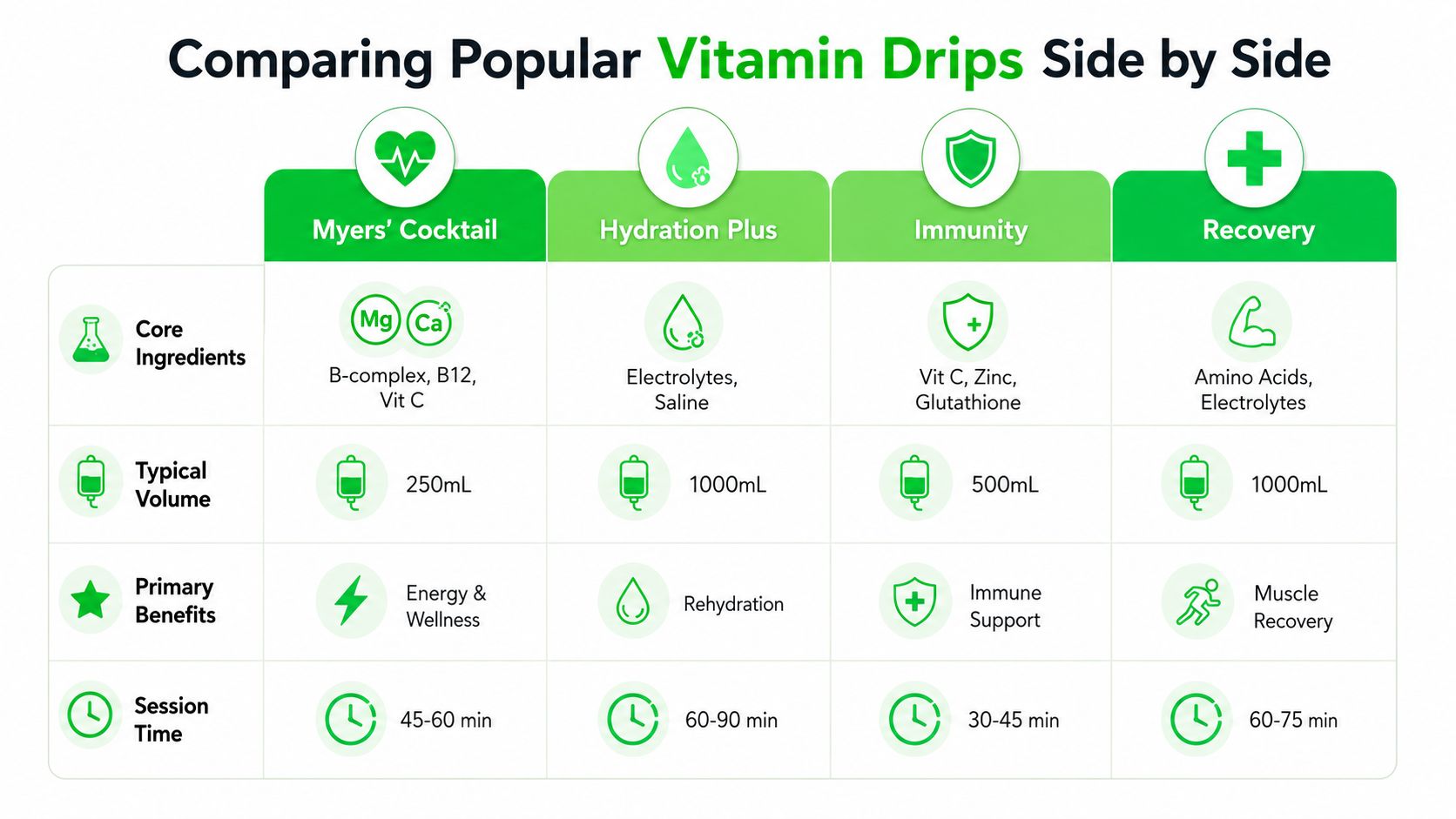
The easiest way to separate common drips is to compare the core ingredients, the volume, and the goal. Patients often hear the names first, then try to work backwards. That usually leads to confusion unless the comparison is laid out clearly.
Popular Vitamin Drips Compared
| Drip | Key ingredients | Typical duration | Best for |
|---|---|---|---|
| Myers' Cocktail | Magnesium, calcium, B-complex, B12, vitamin C | 45 to 60 min | Energy and general wellness |
| Hydration Plus | Electrolytes, saline | 60 to 90 min | Rehydration |
| Immunity | Vitamin C, zinc, glutathione | 30 to 45 min | Immune support |
| Recovery | Amino acids, electrolytes | 60 to 75 min | Muscle recovery |
What matters clinically is the patient's goal. A traveller who feels dry after a long flight usually needs a hydration-first approach. Someone asking for a broad nutrient infusion may fit a Myers' Cocktail. A patient wanting a support-focused session during a busy stretch may prefer an immunity blend, while post-exertion fatigue often points towards recovery-oriented amino acids and electrolytes.
If you want a broader look at cellular rejuvenation-style drip discussions, the NAD IV therapy guide for Dubai sits in the same family of wellness decision-making, although it's a different formulation conversation.
Mixing and Compatibility Notes for Common Drips
Compatibility is where good intentions get expensive fast. The ingredient list can look simple on paper, but calcium, vitamins, light exposure, and sequence of addition all affect what can safely go into the same line.
The rules that matter at the bedside
- Calcium and phosphate: Never mix them in the same IV bag because of precipitation risk.
- B-complex vitamins: They're light-sensitive, so they should be protected from light with an amber bag or wrapped tubing.
- Vitamin C: It can degrade with some compounds, so compatibility has to be checked before it's combined with other ingredients.
- Myers' Cocktail: Give it over the intended infusion window and monitor the rate rather than rushing it.
- Normal saline base: Use it for most drips unless a different carrier has been specifically chosen.
A practical sequence helps too. Minerals are usually checked before vitamins are added, and any push or mixed bag that includes sensitive ingredients should be handled carefully so the full dose that reaches the patient is still the dose that was prescribed.
Bedside rule: When in doubt, consult pharmacy before mixing anything new.
Stability is the other issue. Some infusions are meant to be prepared and used quickly, while others can be run over a longer infusion window once compatibility has been confirmed. That's not a place for improvisation, especially in a home setting where you can't afford to discover a precipitation problem halfway through the drip.
Matching Clinical Indications to the Right Drip
The right drip starts with the symptom pattern, not the menu. Dubai patients usually describe a few common scenarios, and the formulation choice follows the scenario rather than the other way around.
Practical matching in home care
- Dehydration after travel or a desert event: Normal saline or a hydration drip fits best when the main issue is fluid loss.
- Acute fatigue after a long flight or sleep debt: A Myers' Cocktail is often chosen when the aim is broader nutrient support.
- Suspected viral illness or seasonal workload: An immunity drip with vitamin C and zinc is commonly selected for support-oriented care.
- Post-procedure recovery or athletic depletion: A recovery drip with amino acids and electrolytes is the better match when the body needs support after exertion or strain.
The key is to avoid overpromising. A drip can support hydration and nutrient delivery, but it doesn't replace diagnostic care when symptoms are persistent, severe, or unexplained. That's why screening and informed consent come first, even when the booking sounds routine.
If a patient wants a home visit rather than travelling to a clinic, a licensed Dubai service such as Vitals Healthcare Doctor On Call can arrange clinician-led care in the home setting, which is especially relevant when the patient is too fatigued or too unwell to move around comfortably.
Safety Checks Before Starting a Home IV Drip
Home IV therapy starts with screening, not with the bag. The usual red flags are straightforward, but they're easy to miss if the process is rushed or if the patient assumes a wellness drip is automatically low risk.
The common checks include known allergy to formulation ingredients, pregnancy without obstetric clearance, significant kidney or cardiac disease when high-volume fluids are being considered, abnormal potassium or magnesium, and active infection at the cannula site. These concerns don't always stop IV therapy, but they do change the plan.
Documentation should be clear enough that another clinician could read it without guessing. That means the consent form, the ingredient list, the dose, the volume, the infusion duration, and the post-infusion vitals should all be recorded. In Dubai, a home IV service must be delivered by a DHA-licensed clinician, and those credentials should be visible on arrival.
A patient should never have to wonder who is inserting the cannula. That's a basic safety standard, not a premium extra.
Bedside Monitoring During and After the Infusion
Monitoring starts before the fluid runs and continues after the line is flushed. The first check is the baseline, because you can't assess change if you never measured the starting point.
What gets checked while the drip runs
The clinician should document baseline vitals, then recheck them during the infusion and again before discharge. The cannula site should be inspected regularly, including every 15 minutes in an active monitoring rhythm, so swelling, pain, leakage, or redness doesn't get missed. The patient should also be watched for flushing, nausea, or dizziness.
What the patient should say immediately
- Chest tightness: Stop the infusion and report it straight away.
- Breathlessness: This is an urgent stop signal.
- Sudden swelling at the site: That may mean infiltration or leakage.
- New rash, itching, or facial swelling: Treat as a reaction until proven otherwise.
After the infusion, patients usually do better with oral fluids and, if they feel light-headed, a light meal. Follow-up depends on the reason for the drip and the setting in which it was given. For patients who need ongoing nursing observation or doctor follow-up at home, the premium nursing care and doctor-on-call service page is relevant because bedside monitoring and repeat assessment are often part of the same care pathway.
Frequent Questions About IV Drip Formulas
How often can a wellness IV be repeated?
There isn't a universal schedule. Frequency depends on the patient's health history, the formulation, and the clinician's plan. Some people use IV therapy occasionally around travel or fatigue, while others need a spaced-out schedule under supervision.
Is a Myers' Cocktail safe during pregnancy?
Not automatically. Pregnancy needs obstetric clearance before any IV formulation is booked, especially if the session includes vitamins or minerals that should be reviewed in context.
What's the difference between a bolus push and a drip infusion?
A bolus push gives a substance more directly and over a shorter period, while a drip infusion delivers fluid over time through tubing. That difference matters because the rate, compatibility, and monitoring needs are not the same.
Does insurance cover home IV therapy in Dubai?
Coverage varies by policy and by the reason for treatment. Some insurers may reimburse medically documented home care, while wellness-only sessions are often handled differently. The safest answer is to confirm before booking and keep the invoice, consent form, and clinician notes.
If any question touches on contraindications or supervision, the safest reference point is always the safety section above.
If you need a home IV assessment in Dubai, book through Vitals Healthcare Doctor On Call for clinician-led care at home, in a hotel, or at the office. Their team can review the drip formula, the drop factor, and the bedside suitability before the infusion starts, so the session is planned around the patient rather than around guesswork.