
Most advice about IV drip price in Dubai gets the first part wrong. People hunt for one neat number, then get surprised when the final bill climbs because the quote was never just for saline and vitamins, it was for clinical attendance, dispatch, setup, and convenience. That's why smart buyers stop asking, “What's the price?” and start asking, “What's included?”
In Dubai and the wider AE market, that distinction matters more than it does in a clinic brochure. Home and hotel IV services are sold as a premium convenience, and provider pricing often reflects the full service package rather than the infusion bag alone. A mobile service can also add travel fees, and that extra layer changes the final number fast.
Table of Contents
- Why IV Drip Prices Vary So Wildly in Dubai
- Understanding the Price Tiers for Different IV Formulations
- Home vs Clinic vs Hospital Where You Get Treated Matters
- Breaking Down the Real Cost Stack Behind Your Quote
- Insurance Coverage and Reimbursement Realities
- How to Evaluate Providers Beyond the Sticker Price
- Making Smart Decisions About Your IV Therapy Investment
Why IV Drip Prices Vary So Wildly in Dubai
The biggest mistake people make is assuming every IV drip quote is comparable. It isn't. Two providers can both advertise “hydration” and still be pricing very different service bundles, because the bill often includes staffing, supervision, travel, sterile consumables, and urgency, not just the fluid itself.
The hidden layers behind the quote
The broad medical-wellness market already shows how wide the range can be. A 2026 pricing index found basic hydration IVs ranged from $64.99 to $249 across 10 brands, while another 2026 guide put basic hydration drips at $99 to $150, Myers' Cocktails at $175 to $275, and premium NAD+ treatments above $1,000 per session (pricing index). That spread isn't random. It reflects different ingredients, different service models, and different levels of supervision.
Practical rule: If two quotes look similar but one includes a clinician visit and the other doesn't, you are not comparing the same product.
Dubai buyers should think in terms of a service stack. A drip delivered at home or in a hotel is priced differently from the same formulation in a fixed clinic because the provider is absorbing dispatch logistics and bedside care. That's why a polished-looking “deal” can end up being more expensive once the extras appear.
The internal anchor many overlook is simple. IV drip price is rarely a single number in Dubai, it's a combination of treatment, time, and location. For a provider example that bundles home service into its offer, see Vitals Healthcare's at-home IV guide.
Why the same treatment can land in different brackets
The core product may be similar, but the delivery model changes the economics. A basic hydration bag can be inexpensive in principle, yet once you add a licensed clinician, equipment, and mobile coordination, the total rises into a premium bracket. That's especially true in Dubai, where convenience is part of what people are buying.
A 2026 review citing JAMA reported a median cost of $179 per session for IV hydration spas and noted these treatments were generally not covered by insurance because they weren't considered medically necessary (hydration therapy cost review). The same review said common single-session pricing starts around $100 to over $300, with higher-end infusions reaching $400 to $1,000+. That range tells you the category is wide, but still structured.
The market reward goes to providers that are clear about what you're paying for. If a quote is unusually low, ask what gets added later. In Dubai, the comparison is not just bag versus bag, it's service package versus service package.
Understanding the Price Tiers for Different IV Formulations
Formulation is the clearest driver of IV drip price. If you want a clean budget estimate, start with what's inside the bag, because the ingredient list changes the session from basic hydration to a higher-touch wellness treatment. The market tiers are consistent enough that you can usually place a quote in the right band before you book.
Basic hydration sits at the floor
Basic hydration is the entry point. Independent market guides show basic hydration drips generally start around $75 to $150 (menu-based market guide), while the broader cost index found $64.99 to $249 across brands (pricing index). In practice, that's the lane for saline and straightforward electrolyte support.
For AE buyers, that tier makes sense when the goal is simple rehydration after heat, travel, or a rough night. You're paying mostly for administration and oversight, not for a long ingredient list. That's why this tier should not be confused with high-spec vitamin cocktails.
Vitamin cocktails and specialty infusions climb fast
Once you move into nutrient-heavy formulas, the price rises quickly. A 2024 review in Nutrients said individual sessions often cost between $100 and over $300, depending on the formulation and provider (review in Nutrients). That aligns with broader market menus that place Myers' Cocktail around $150 to $350 and NAD+ infusions around $400 to $1,000+ (market guide).
The reason is obvious once you compare the formulas. A Myers' style drip usually adds vitamins and minerals that require more preparation and often more clinical discussion. NAD+ sits in a different bracket altogether because it is marketed as a premium specialty infusion, and the pricing reflects that positioning.
A useful reference point for Dubai readers is the internal guide on NAD IV therapy in Dubai, because it shows how specialty infusions are framed as a separate category rather than a minor upgrade.
Add-ons are small individually, but they stack
Many buyers get caught by this. In mobile IV pricing references, basic hydration for a nurse-monitored mobile service starts around $199, and each vitamin, antioxidant, or nutrient add-on can raise the session by about $20 per add-on (mobile pricing reference). That sounds modest until three or four extras are added.
Bottom line: If the base drip is cheap but every booster is extra, your “simple” session can become a premium one without the provider ever changing the headline price.
| IV Drip Price Tiers by Formulation Type | Typical Price Range | Common Use Cases |
|---|---|---|
| Basic hydration | $64.99 to $150 | Rehydration, travel recovery, mild fatigue |
| Vitamin-enhanced cocktails | $150 to $350 | Wellness support, recovery, nutrient boost |
| Premium specialty infusions | $400 to $1,000+ | High-end formulations, NAD+ style sessions |
The right question isn't “What's the cheapest drip?” It's “What formulation matches the result I want?” That's the only way to make the price make sense.
Home vs Clinic vs Hospital Where You Get Treated Matters
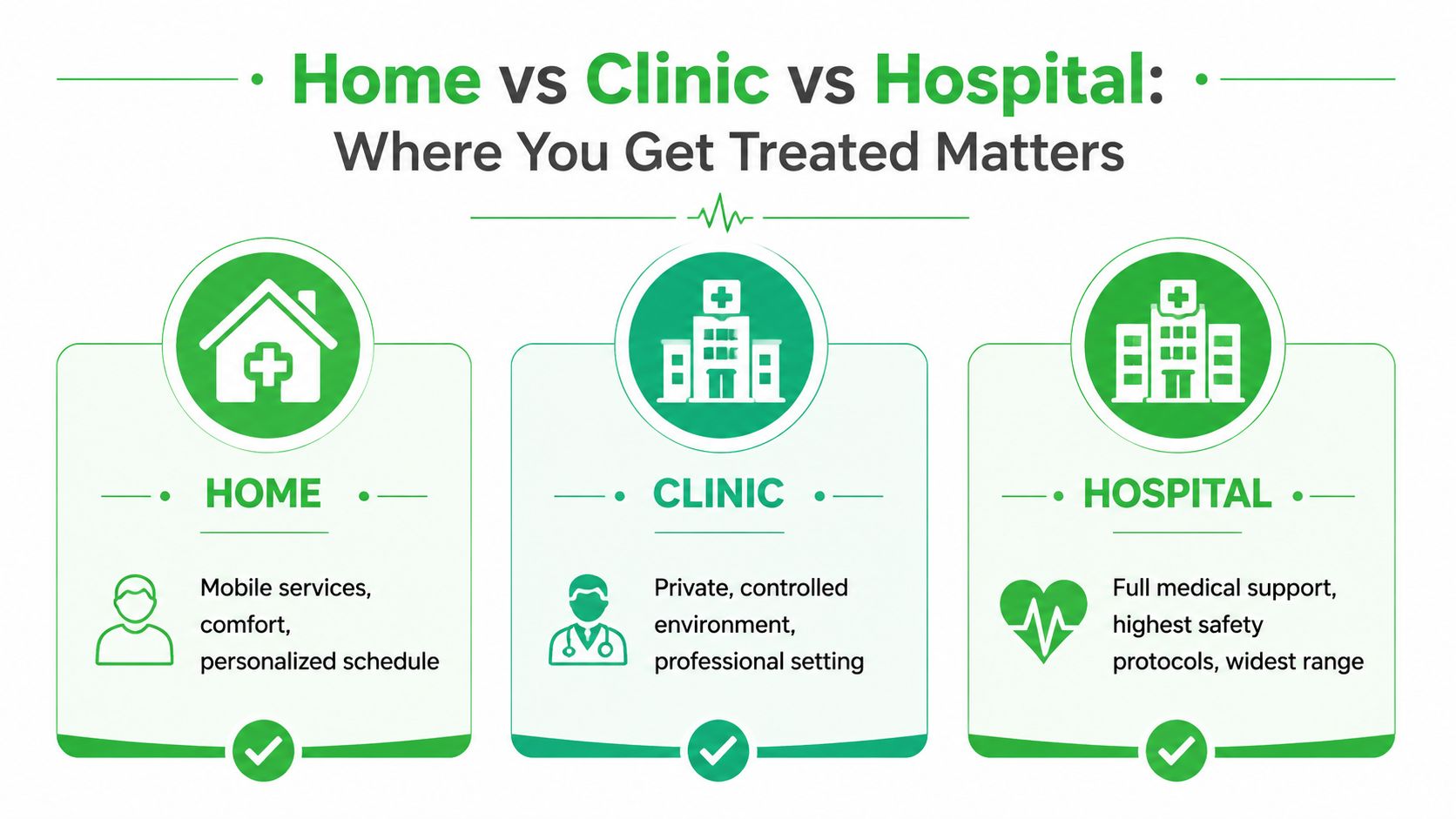
Location changes the bill as much as formulation does. In Dubai, the same broad treatment can feel like a different product depending on whether it's delivered at home, in a clinic, or through hospital outpatient care. The reason is simple, dispatch and convenience are part of the service.
Home service buys convenience, not just treatment
Home IV therapy is the premium convenience model. It usually costs more than a fixed-site visit because a clinician has to come to you, carry the equipment, set up safely, and complete the session in your space. A general IV therapy pricing guide says mobile services can add about $65 to $125 on top of the base treatment because of travel, sterile equipment, and setup (pricing strategy guide). Another mobile pricing analysis reports many businesses charging about $150 to $225 per session in mid-tier markets and $250 to $400 in premium metro markets (mobile pricing analysis).
That makes home service worth it when time is the scarce resource. If you're in a hotel, don't want a queue, or need discreet care, the higher sticker price can still be the rational choice. The value is in the avoided friction.
The relevant comparison for Dubai readers is doctor-at-home versus clinic visit, because the same logic applies to IV therapy.
Clinics and hospitals suit different budgets and risk tolerances
A clinic visit can be the middle ground. You usually trade some convenience for a lower overall service premium, a fixed environment, and a more predictable workflow. If you live close to the provider and parking is easy, that model can make financial sense.
Hospital outpatient care belongs in a different decision bucket. It's not the setting most individuals want for a wellness drip, but it does offer a broader medical support structure. The trade-off is that you may be paying for a level of system overhead you don't need for a straightforward hydration session.
Practical rule: If the treatment is elective and you care most about convenience, home service often wins on value. If you care most about reducing the bill and can handle the travel, clinic care is usually the cleaner option.
Breaking Down the Real Cost Stack Behind Your Quote
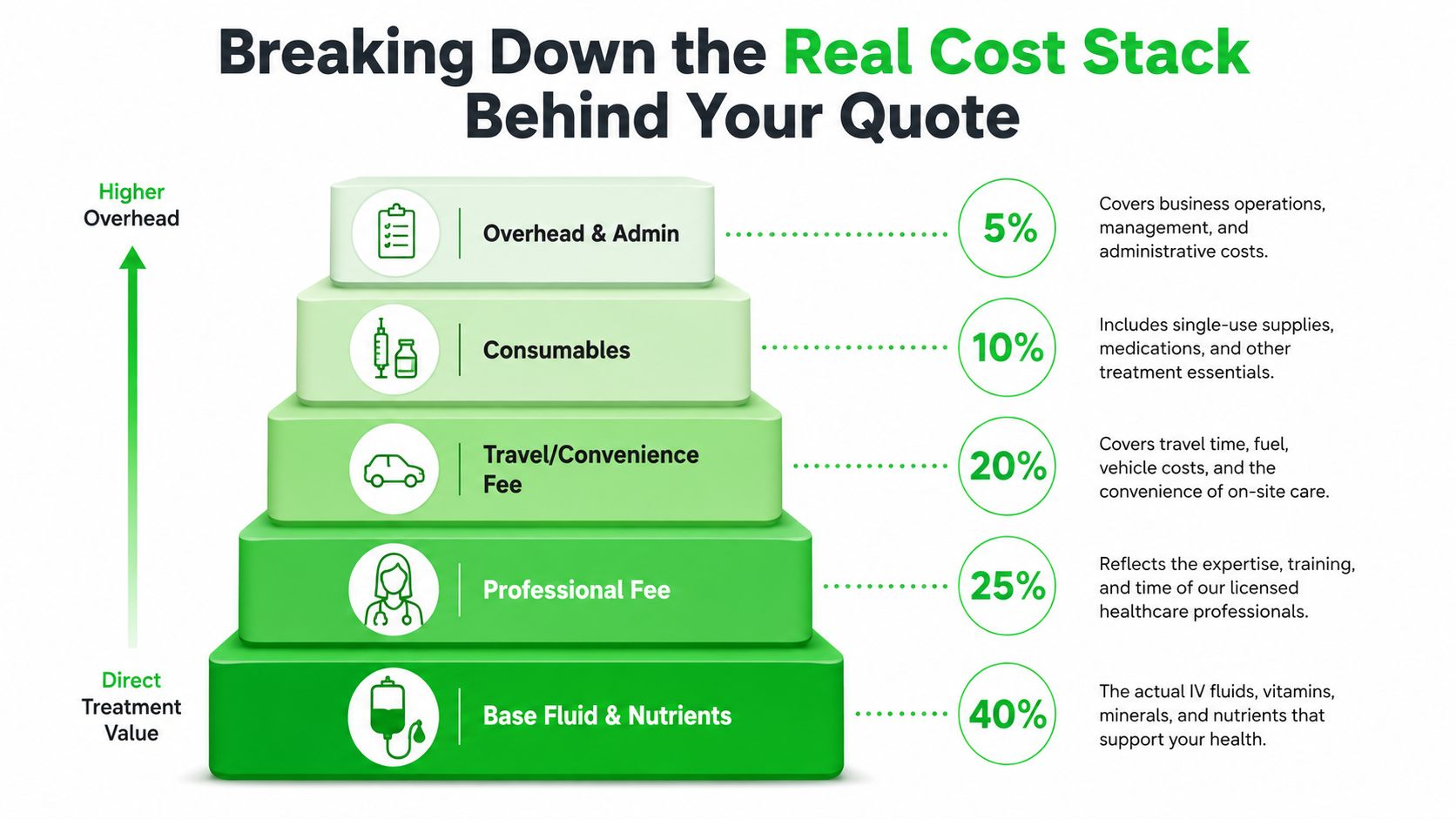
A quote that just says “IV drip” is too vague to trust. You need to know what sits under that number, because the headline price usually hides the cost stack. The most transparent providers price around components, not around mystery bundles.
Start with the base infusion
The first layer is the fluid and nutrients themselves. That includes saline, electrolytes, vitamins, and any specialty compounds. This is the part many assume they are paying for, but it is usually only part of the total.
The next layer is the professional fee, which accounts for the nurse or doctor who assesses you, places the line, monitors the infusion, and handles anything unexpected. In medically supervised home IV care, this is not optional overhead; it's part of why the service is priced above retail wellness products.
Then ask about delivery and overhead
Travel and convenience fees are where the bill often expands. Mobile services have to cover dispatch, timing, fuel, and the work of bringing a sterile setup into your home or hotel room. The general market guidance on mobile services makes that explicit, because delivery premiums are a normal feature of the category (pricing strategy guide).
The last layers are consumables and admin. Tubing, dressings, disposables, documentation, and scheduling are small on paper but real in practice. Technical standards matter too. A portable IV infusion pump can operate from 1 to 1200 ml/h with flow precision within ±3% when used with the manufacturer's IV set, while standard gravity infusion sets are specified around 20 drops per mL and may include 15 μm fluid filters and kink-resistant tubing (device specifications). Those specs matter commercially because precision, disposables, and monitoring support safer delivery.
If you want a benchmark for home-visit pricing structures, see home doctor visit cost in Dubai. The same logic applies to IV therapy, because the clinician's time and the dispatch model are part of the bill.
What to ask before you pay
- What is included in the base price? Ask whether consultation, cannulation, monitoring, and follow-up are bundled.
- Are travel fees separate? Mobile providers should state this clearly before arrival.
- Are boosters priced individually? Add-ons should be itemised, not hidden.
- Is there any after-hours premium? Urgent calls often cost more.
- Who is administering the drip? A transparent provider answers without hesitation.
A low quote is not a bargain if you get hit with extras after booking. If the price structure is unclear, walk away.
Insurance Coverage and Reimbursement Realities
People asking about IV drip price in Dubai want a simple answer on coverage. The direct answer is that elective hydration and vitamin drips are usually paid out of pocket. That matches broader IV therapy pricing guidance, which says wellness sessions are commonly excluded because they are not treated as medically necessary.
When coverage is possible
Coverage becomes more plausible when the infusion is medically necessary rather than elective. Specific clinical documentation, diagnosis codes, and physician notes are what determine whether a claim gets approved. If a doctor is treating a recognised condition and the insurer sees a clear clinical need, the case is stronger than if you are asking for a wellness boost after travel.
The practical problem is that many people confuse “good for me” with “covered.” Insurers usually do not make that leap. If the treatment is mainly for convenience, energy, beauty, or hangover recovery, plan on paying cash.
A useful comparison point is the broader home-versus-inpatient infusion discussion in the home infusion cost savings guide, which shows that cost-effectiveness depends heavily on setting. That matters in the UAE too, because the cheapest option on paper is not always the lowest total cost once travel, clinician time, and waiting are included.
Cash often wins on simplicity
In Dubai, cash payment often makes more sense than chasing reimbursement for a marginal claim. If you are paying for speed, privacy, or a hotel visit, the administrative effort can outweigh the benefit. That is especially true when the bill is relatively modest and the insurer is likely to push back.
Practical rule: Use insurance only when the treatment is clearly medical and properly documented. For wellness drips, pay directly and avoid the paperwork fight.
The providers worth considering make this simple by issuing invoices and payment records that insurers can use. Vitals Healthcare's 24/7 home doctor services guide shows how home-visit services are often structured with claim-ready documentation, which is the standard you should expect from any serious provider.
How to Evaluate Providers Beyond the Sticker Price
The cheapest provider isn't automatically a smart buy, and the most expensive one isn't automatically better. You should judge an IV drip provider on clinical quality, transparency, and patient experience, not on headline pricing alone. That's the only way to avoid paying premium money for weak service.
Check credentials and safety first
Start with the person who will administer the drip. You want a provider that can clearly state who supervises treatment, how they verify suitability, and what happens if the patient reacts badly. If the answer is vague, that's a warning sign.
The market also gives you useful clues through reviews. Don't skim star ratings, read the comments for repeated themes around punctuality, professionalism, cleanliness, and whether the final price matched the quote. Those are the signals that separate a polished sales page from a dependable service.
Judge value, not just price
A good provider should be able to explain formulation options, add-ons, and whether a home visit is the right model for your situation. That matters because the right choice for a tourist in a hotel room is not always the right choice for a resident who can visit a clinic easily. One practical option in Dubai is Vitals Healthcare Doctor On Call, which offers home-based medical visits and IV hydration alongside other on-call services.
| What to verify | Why it matters |
|---|---|
| Medical oversight | Protects you from unsafe or poorly supervised treatment |
| Ingredient clarity | Prevents vague “wellness” bundles with unclear contents |
| Dispatch timing | Helps you judge whether the delivery premium is fair |
| Equipment quality | Supports safer infusion and better flow control |
| Patient reviews | Reveals whether the service matches the marketing |
Practical rule: If a provider won't itemise the cost stack, don't trust the sticker price.
Making Smart Decisions About Your IV Therapy Investment
Buy IV therapy when the service matches a real need, not when the marketing sounds impressive. If you need fast rehydration, discreet hotel care, or supervised recovery, the higher convenience price can be justified. If you just want a vague wellness boost, compare it carefully against the cost of a clinic visit or a simpler treatment.
Use this checklist before booking:
- Confirm the formulation. Basic hydration, Myers-style cocktails, and specialty infusions sit in different price bands.
- Ask for itemised pricing. Base drip, travel, add-ons, and after-hours charges should be separate.
- Verify who attends. Licensed clinical oversight matters more than a sleek menu.
- Read reviews for pattern, not hype. Consistency in service is a stronger signal than one glowing comment.
- Decide on location first. Home, clinic, and hospital each serve a different need.
If the provider can't explain the bill in plain language, keep looking. That's the simplest red flag in the whole market.
If you want a provider that can handle IV hydration as part of broader home medical care, Vitals Healthcare Doctor On Call offers doctor visits, nursing support, and mobile treatment across Dubai. If you're comparing IV drip price options for home, hotel, or office care, visit their site and check whether the service model matches the level of convenience and supervision you need.