

You've just landed in Dubai after a long flight. Your mouth is dry, your head feels heavy, and the heat outside makes the idea of travelling to a clinic even less appealing. Or perhaps you've finished a summer shift outdoors, pushed through a demanding day at the office, or spent hours recovering from vomiting and can't keep fluids down. In those moments, IV hydration at home can sound like the quickest answer.
It can be appropriate, but it isn't merely a wellness upgrade. In Dubai, home IV therapy is a regulated medical procedure that requires clinical assessment, authorised prescribing, trained staff, and a clear plan for complications. The safest way to think about it is straightforward: the setting is your home, hotel room, or office, but the standard of care should still be medical.
Table of Contents
- When Home IV Hydration Actually Makes Sense
- How IV Fluids Work and When They Beat Oral Rehydration
- Common Fluids and Add-Ons Used in Home IV Drips
- DHA Licensing and the Safety Framework for Home IVs
- When Home IV Hydration Is the Wrong Choice
- What a Home IV Visit Typically Looks Like
- Choosing a Provider and Using Reviews as a Reference Signal
When Home IV Hydration Actually Makes Sense
A guest in a Palm Jumeirah hotel may ask for a drip after a long-haul flight, while a resident who has spent the day outdoors during hot weather may feel dizzy, weak, and unable to drink enough. An executive recovering from illness may want a clinician to visit an office rather than lose more time travelling to a clinic. These are realistic situations in which people ask about IV hydration at home, but the reason for treatment still matters more than convenience.
Dubai's wider healthcare system is already moving more care into residences, hotels, and other non-hospital settings. A Gulf News report on Dubai Health home-care activity says medicine home deliveries rose by 189%, from 37,724 in 2022 to nearly 109,000 in 2024, while home medical visits increased by 68%, from 23,277 to 39,114 over the same period. Those figures suggest that residents are becoming more comfortable receiving regulated care without travelling to a hospital or clinic.
The home setting depends on clinical infrastructure
Home IV hydration uses the same basic operational foundation as other home-health services. A licensed clinician must be dispatched, the patient needs a bedside assessment, sterile equipment must be available, and the provider needs a process for monitoring and escalation. The service isn't safe merely because it takes place in a familiar room.
The UAE market also has room for specialised infusion care. Mordor Intelligence's UAE home healthcare market estimate projects growth from USD 1.18 billion in 2025 to USD 2.19 billion by 2031, with a projected 10.84% CAGR from 2026 to 2031. The same source identifies rehabilitation therapy as 37.74% of market share in 2025. Separately, Grand View Research's UAE home infusion estimate values the market at USD 170.5 million in 2023 and projects it to reach USD 243.9 million by 2030, growing at 5.2% annually.
Clinical perspective: Home delivery is appropriate only when the patient is stable enough for home care and the provider can deliver the same core safeguards expected in a medical facility.
A home visit may suit moderate dehydration, poor oral intake, or recovery after heat exposure when no emergency warning signs are present. The next questions are more important than the menu of available drips: what is happening physiologically, which fluid is needed, and who has prescribed it?
For a regulated home-care option in Dubai, patients can review Vitals Healthcare's IV home service alongside other licensed providers. A responsible booking should lead to assessment first, not an automatic infusion.
How IV Fluids Work and When They Beat Oral Rehydration
After a long flight or a hot day in Dubai, thirst and fatigue may reflect mild fluid loss, but dizziness, reduced urination, confusion, or persistent vomiting require a different level of attention. The cause and severity determine whether drinking is enough or whether intravenous treatment is medically reasonable.
Blood carries fluid that supports circulation and helps organs receive oxygen and nutrients. Oral rehydration depends on the gut, so it works best when you are alert, able to swallow, and can keep drinks down. IV therapy places prescribed fluid directly into a vein, bypassing the digestive system. It is more like supplying water directly to a plant's root zone when dry soil or damaged roots prevent normal absorption.
What the base fluid does
Isotonic fluids, including normal saline and Ringer's lactate, can support fluid replacement and circulatory balance. Dextrose solutions may suit particular clinical needs. The selection depends on your condition, medical history, blood sugar considerations, and a physician's prescription, rather than on a wellness menu.
IV delivery may be reasonable when persistent vomiting, nausea, inflammation, swallowing difficulty, or another problem makes oral intake unreliable. UAE-based clinical guidance describes IV hydration as generally reserved for moderate to severe dehydration or situations where oral intake is not tolerated, including persistent vomiting, confusion, very low blood pressure, or inability to drink fluids. The UAE guidance on IV treatment for dehydration states that the infusion itself typically takes about 30 to 60 minutes.
The procedure still needs assessment, consent, a prescribed fluid, and monitoring. A drip can deliver fluid efficiently, but it cannot diagnose why you feel weak or correct every medical problem.
A practical decision boundary
Home IV care may be appropriate after substantial heat-related fluid loss, acute illness with poor intake, prolonged travel when symptoms continue, or strenuous exertion when oral replacement is not working. It is not automatically appropriate for ordinary tiredness after a flight.
Oral fluids are usually the sensible first step when you have mild thirst, remain alert, can keep drinks down, and have no concerning symptoms. Routine morning hydration and ordinary workout recovery generally call for drinking fluids and eating appropriately, not an invasive procedure.
A comparison of IV hydration and energy drinks explains why rapid fluid delivery and stimulant-based products are not interchangeable. IV treatment solves a fluid-delivery problem, not every cause of fatigue. If symptoms are severe, worsening, or accompanied by confusion, fainting, chest pain, or breathing difficulty, seek urgent medical care rather than arranging a home infusion.
Common Fluids and Add-Ons Used in Home IV Drips
The base fluid performs the main rehydration work. Add-ons may be considered for a particular clinical reason, but they don't turn an unsuitable treatment into a suitable one. A patient who feels exhausted after a flight still needs assessment for sleep loss, infection, medication effects, heat exposure, blood pressure problems, or another cause before vitamins are added.
Commonly discussed formulations include normal saline, Ringer's lactate, and dextrose solutions, with optional additions such as B-complex vitamins, vitamin C, magnesium, glutathione, and zinc. The appropriate combination, dose, and infusion rate should come from a DHA-licensed physician, not from a website menu selected without an examination.
Typical Dubai Home IV Hydration Formulations
| Formulation | Base Fluid | Common Add-Ons | Typical Use Case |
|---|---|---|---|
| Basic rehydration | Normal saline | None, or electrolytes when prescribed | Fluid replacement when oral intake is inadequate |
| Balanced fluid replacement | Ringer's lactate | Electrolytes or selected vitamins if clinically authorised | Dehydration where a balanced crystalloid is considered appropriate |
| Recovery-focused formulation | Normal saline | B-complex vitamins, magnesium, or vitamin C | Fatigue or recovery complaints after assessment, when an adjunct is appropriate |
| Antioxidant-oriented formulation | Normal saline | Glutathione, vitamin C, or zinc | Wellness or recovery requests that still require medical review |
| Energy-support formulation | Dextrose solution | Selected vitamins or minerals | Specific situations where the physician considers dextrose suitable |
The table describes common service patterns, not a self-prescribing guide. Add-ons aren't magic, and more ingredients don't necessarily mean better treatment. Every component has a dosing logic, possible contraindications, and compatibility considerations. Kidney disease, heart failure, pregnancy, uncontrolled hypertension, medication use, and allergies can all affect the decision.
A clinician should explain what is being prescribed, why it has been selected, and what alternatives exist. Before agreeing to treatment, ask who authorised the formulation and whether the provider will document the assessment and administered products. Vitals Healthcare's vitamin C IV guide can help readers understand how vitamin-focused drips are commonly presented, but educational content shouldn't replace a physician's evaluation.
DHA Licensing and the Safety Framework for Home IVs
After a long flight or a hot day in Dubai, a home IV can feel like a simple delivery service. Clinically, it is closer to a short medical procedure in your home, hotel, or workplace. The setting changes, but the requirements do not. The provider must hold a valid DHA facility licence, while the doctors and nurses involved must maintain current DHA registration.
The DHA Home Healthcare Regulation covers independent home healthcare facilities and other licensed health facilities, including governmental, semi-governmental, private, and free zone facilities. You can also review a provider's DHA-licensed home medical services in Dubai when checking whether its service operates within the local healthcare framework.
What a compliant visit should include
The safety process starts before any equipment is opened. A physician reviews symptoms, medical history, medicines, allergies, and relevant risks, then prescribes the fluid and volume. The nurse should use sterile, single-use supplies, prepare the skin aseptically, insert the cannula, monitor the patient, and record what happened.
A compliant service also needs a response plan if vital signs change or an adverse reaction develops. Dubai-focused IV safety guidance identifies prescription-first care, licensed nurse administration, aseptic preparation, emergency capability, and physician oversight as practical safety benchmarks.
Before booking, ask:
- Facility licence: Can the provider show or verify its active DHA facility licence?
- Clinician registration: Can you identify the visiting nurse's or doctor's DHA registration?
- Prescription: Who will assess you and authorise the fluid, volume, and add-ons?
- Equipment: Are the cannula, infusion set, gloves, and other relevant supplies sterile and single-use?
- Monitoring: Which vital signs will be checked before and during the infusion?
- Escalation: What happens if chest tightness, breathing difficulty, faintness, or worsening symptoms develops?
- Documentation: Will you receive a record of the assessment, prescription, treatment, and follow-up advice?
Practical rule: If a provider asks you to choose ingredients first and offers clinical review later, pause the booking. Ask how the medical decision is made.
DHA requirements and provider procedures may change. Verify current credentials rather than relying only on old advertisements or social media descriptions. The licence is the starting check, while assessment, monitoring, documentation, and an escalation plan show whether the visit is being delivered as medical care.
When Home IV Hydration Is the Wrong Choice
Not every dehydration episode belongs in a home-care appointment. A scheduled drip is the wrong option when the patient may need rapid diagnosis, resuscitation, imaging, laboratory testing, or hospital-level monitoring.
Seek urgent emergency assessment for confusion, fainting, collapse, chest pain, breathing difficulty, persistent vomiting, very low blood pressure, severe dehydration, or suspected heat stroke. A person who is difficult to wake, unable to stand safely, or deteriorating quickly shouldn't wait for a mobile clinician to arrive.
Dubai's heat makes this boundary especially important. Dubai home IV guidance on emergency escalation notes that summer heat drives a 30–40% surge in emergency visits, with dehydration identified as a leading cause. A convenient drip may appear attractive during hot weather, but convenience-focused marketing shouldn't override clinical urgency.
Use a simple safety rule
Home care may be reasonable when the person is alert, can drink at least some fluids, has stable vital signs, and has no serious warning symptom. Oral rehydration may be enough for mild symptoms, while a non-urgent home assessment can help determine whether IV treatment is justified when oral intake isn't reliable.
Emergency care is the correct route when red flags appear. Don't use a home IV appointment to delay evaluation for heat stroke, severe infection, cardiac symptoms, breathing problems, or a condition causing repeated vomiting.
If you're unsure whether someone is stable, treat uncertainty as a reason to seek urgent medical advice, not as evidence that a drip will be sufficient.
The purpose of this boundary isn't to reject home IV hydration. It protects patients who need a higher level of care and helps clinicians use home treatment for cases that are suitable for it.
What a Home IV Visit Typically Looks Like

After a long flight or hot day in Dubai, the first step is usually a phone or digital booking request. The coordinator records the patient's location, age, symptoms, medical history, medicines, allergies, and urgency. This information works like an early filter, helping the provider decide whether a home appointment is suitable or whether the patient needs urgent care elsewhere.
The clinician then confirms the appointment at the home, hotel, or office. Before treatment is agreed, the patient describes what happened, when symptoms began, and whether fluids or food have been tolerated. The clinician reviews the plan, answers practical questions, and decides whether the next step should be oral rehydration, an in-person medical assessment, testing, referral, or prescribed IV treatment.
A prescription should identify the selected fluid and any authorised add-ons. The patient should be able to ask who will attend, what the visit includes, how long the appointment may take, and what follow-up is available.
Once the visit begins, the patient is positioned comfortably and the clinician explains the procedure. A nurse then places the cannula and starts the prescribed infusion. UAE clinical guidance commonly describes the infusion as taking about 30 to 60 minutes, although the duration depends on the prescription and the patient's response. The patient can report discomfort, dizziness, nausea, or other changes during the visit rather than waiting until it ends.
At the end, the nurse removes the cannula, checks how the patient feels, documents the treatment, and explains what to do next. Ask which symptoms require a call to the provider and which require emergency services. Phone or WhatsApp updates can support routine questions, but they cannot replace emergency care. This guide to what happens during a home nurse visit provides further practical context.
For hotel appointments, arrange access with hotel management in advance. Room-entry rules, privacy, and staff coordination can affect timing. A clear booking trail, clinician identity, prescription details, and post-visit contact give the patient a record of care, not just a completed drip.
Choosing a Provider and Using Reviews as a Reference Signal
Reviews for references can help you compare Dubai home-healthcare providers, but star ratings alone don't establish clinical quality. Look for repeated comments about punctuality, clear communication, professional conduct, treatment effectiveness, and the way clinicians explain care. A large volume of detailed feedback gives you more context than a small number of enthusiastic ratings.
Independent Dubai listings illustrate how much review volume can vary. One provider is listed with 5.0/5 from 633 reviews, another with 5.0/5 from 188 reviews, and a third with 4.98/5 from 12 reviews on a Dubai home-healthcare reference listing. These figures are reputational signals, not proof that every treatment is suitable or that every review describes IV hydration.
Compare the evidence, not just the stars
| Provider Reference | Reported Rating | Reported Review Volume | Notable Service Themes |
|---|---|---|---|
| AIMS Health Care LLC Dubai | 4.7/5 | 1,973 reviews | 24/7 service, home IV therapy, punctuality, communication, effective IV treatments |
| Trusted Doctors Home Health Care Center Co LLC Dubai | 4.3/5 | 83 reviews | At-home IV therapy, nursing, physiotherapy, wound management, post-surgical support |
| Dubai provider reference listing | 5.0/5 | 633 reviews | Home healthcare and doctor-at-home service reference data |
The AIMS Health Care Dubai directory entry reports 4.7/5 from 1,973 reviews and describes 24/7 operations, home IV therapy, punctuality, communication, and treatment effectiveness. The Trusted Doctors directory entry reports 4.3/5 from 83 reviews, alongside services including nursing, physiotherapy, wound management, post-surgical support, and at-home IV therapy. The numbers show variation in review volume and service scope, not a clinical ranking.
Complete your own pre-booking check
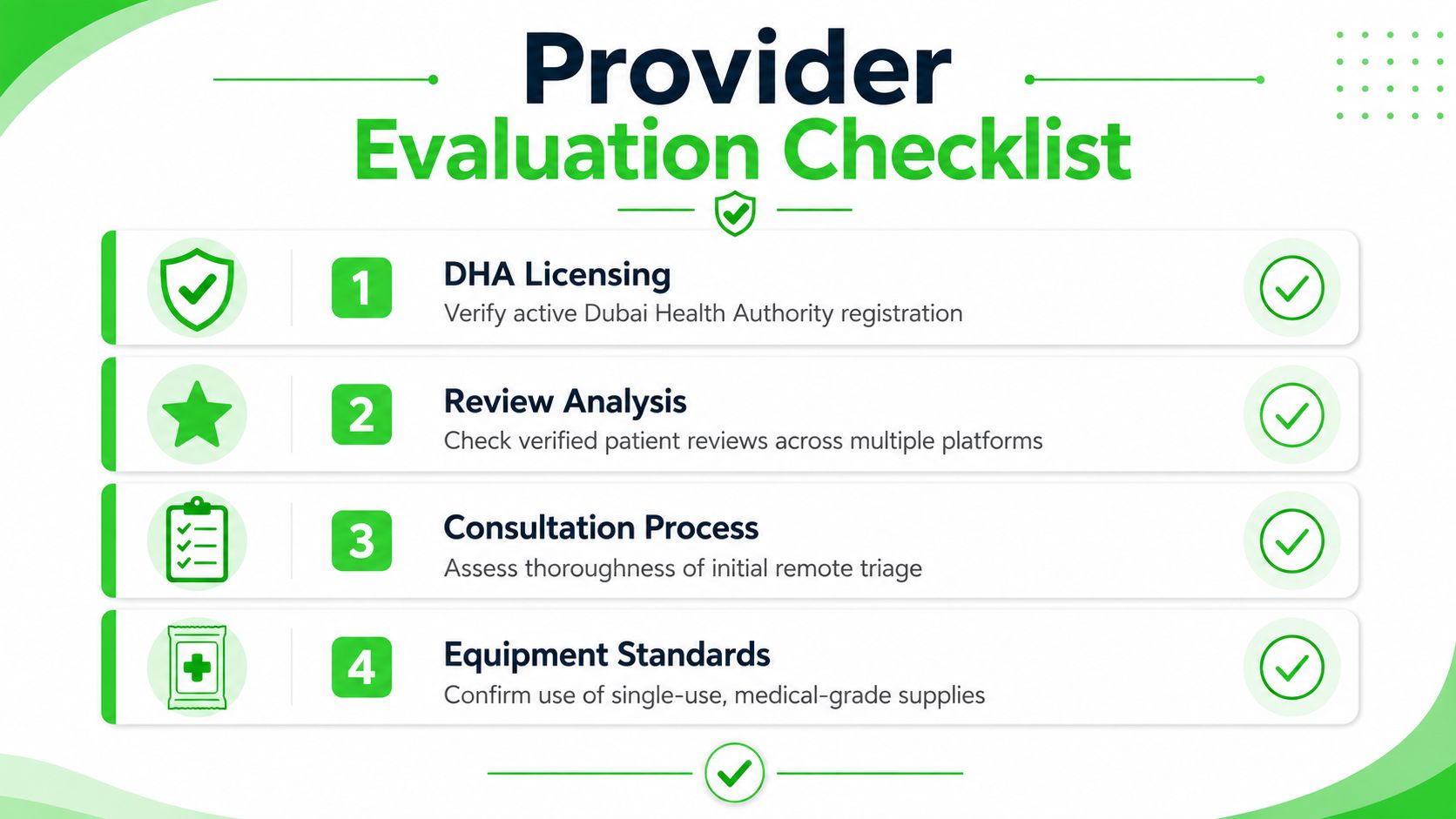
- Verify licensing: Confirm the facility's DHA licence and the visiting clinician's DHA registration.
- Ask about prescribing: Find out whether a physician assesses and authorises the formulation.
- Review the process: Check that triage, vital signs, sterile preparation, monitoring, and documentation are included.
- Read themes: Search reviews for specific details about communication, punctuality, professionalism, and treatment handling.
- Confirm escalation: Ask what the team will do if your condition worsens or an adverse reaction occurs.
- Clarify the setting: For a hotel or office, confirm access arrangements and permission requirements.
Vitals Healthcare Doctor On Call offers 24/7 doctor visits to homes, hotels, and offices across Dubai, with home IV hydration, mobile laboratory support, nursing, physiotherapy, and follow-up coordination. To discuss whether a home assessment is suitable for your symptoms, visit Vitals Healthcare Doctor On Call and request clinical guidance before choosing an IV formulation.