
A family in Dubai may face this decision after an older parent leaves hospital: the parent cannot safely manage medicines alone, but everyone is unsure whether moving into a facility is necessary. A similar question arises when a tourist, resident, or expatriate family needs short-term nursing support after surgery, a fall, or a change in health. The right answer depends on clinical needs, supervision, safety, family availability, and the person's preference for staying at home.
In Dubai, nursing home services generally refer to facility-based, supervised care for older adults who need ongoing support. However, the country has a relatively small institutional-care footprint, while home-based and family-centred care remain important parts of the wider system. This guide will help you understand the difference between nursing home care, home nursing, elderly care, and a Doctor On Call service, then choose the most suitable path without assuming that admission is always required.
Table of Contents
- Introduction Who This Guide Helps and What You Will Decide
- What Nursing Home Services Mean in Dubai
- Typical Services Included and Who Needs Them Most
- Nursing Home Services Compared With Home Nursing and Elderly Care
- How to Evaluate Providers in Dubai With Confidence
- Cost Factors and Regulatory Considerations in Dubai
- Choosing Between Facility Care and Home-Based Care Next Steps
Introduction Who This Guide Helps and What You Will Decide
Families often start searching for nursing home services at a stressful moment. An elderly parent may have returned from hospital with a wound, several prescriptions, and reduced mobility. A spouse may need help with bathing and meals. A visitor staying in a Dubai hotel may need medical attention but not a permanent care setting. Each situation calls for a different level of support.
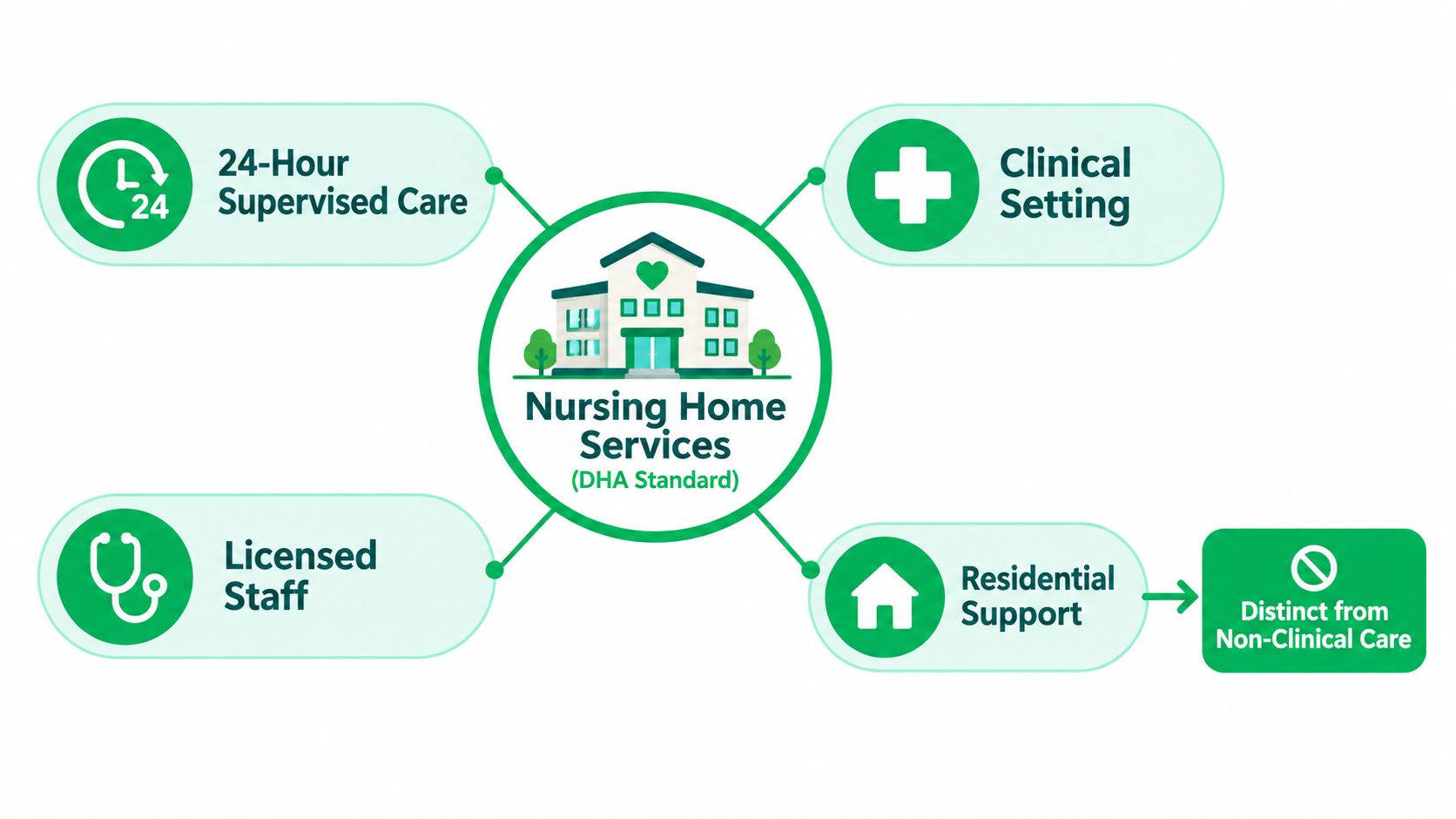
A nursing home is not just a place where an older person lives. Under Dubai Health Authority standards, it is a facility-based, 24-hour supervised care setting that uses clinical assessment, care planning, monitoring, and trained staff to support residents. Home healthcare is different. It brings medical, therapeutic, and personal care to the patient's home, hotel, or office through a DHA-authorised provider.
Dubai's care environment makes this distinction especially important. A 2025 business directory recorded 30 nursing homes across the UAE, including 20 in Dubai, 7 in Abu Dhabi, 2 in Sharjah, and 1 in Ras al-Khaimah. The same listing reported a 7.14% increase versus 2023 and an average facility age of 3 years and 6 months, indicating a small, developing institutional-care segment rather than a mature, saturated network. See the UAE nursing home directory data for the source details.
That limited footprint does not mean families lack options. It means the decision often involves comparing facility supervision with clinic-grade care delivered at home. A home plan may suit someone who is medically stable but needs nursing visits, wound care, medication support, physiotherapy, or help with daily activities. Facility care may be more appropriate when continuous observation or round-the-clock assistance is necessary.
For example, an older adult who is eating well, has stable vital signs, and only needs dressing changes after surgery may do well with scheduled nursing at home. By contrast, a person who becomes confused at night, forgets medication, and cannot transfer safely from bed to chair may face risks that are harder to manage without continuous supervision.
If you are concerned about a parent's changing abilities, the signs an elderly loved one may need care can help you organise your observations before speaking with a provider. The aim is not to force a decision. It is to match the person's actual needs with a safe, regulated care environment.
What Nursing Home Services Mean in Dubai
The simplest definition is this: nursing home services provide ongoing care inside a supervised facility, rather than sending a clinician to the person's usual residence for an isolated visit. Dubai's standards describe long-term care as a setting where residents receive 24-hour supervision and support according to their medical, functional, and cognitive needs. That can include clinical monitoring as well as help with personal activities.
This matters because many families use the term "nursing home" loosely. In practice, the phrase can be confused with assisted living, basic elderly companionship, live-in caregiving, or home nursing visits. These are not the same. A true nursing home model is designed for people who need a managed care environment, documented care plans, regular review, and staff presence throughout the day and night.
A simple way to think about it is to ask where responsibility sits. In a facility, the provider is responsible for the environment, staffing, monitoring, routine care, and response processes within that setting. At home, responsibility is shared. The clinical provider manages the tasks in the care plan, but family members or arranged caregivers often remain essential between visits.
Admission begins with a clinical assessment
Admission is not meant to be a purely administrative process. DHA standards require a formal physician assessment before admission, documenting chronic medical conditions, functional impairments, and cognitive decline. The assessment helps determine whether the facility can meet the person's needs and what level of staffing, observation, medication oversight, and support will be required.
For example, a person who needs help dressing but remains medically stable may need a different plan from someone who has cognitive impairment, multiple chronic conditions, frequent falls, or complex medication requirements. A careful assessment should identify those differences before placement.
A thorough admission review usually looks beyond diagnosis labels. It asks practical questions such as:
- Can the person get out of bed safely?
- Do they recognise when they need help?
- Are they eating and drinking enough?
- Have they fallen recently?
- Can they explain their medicines, or do they take the wrong doses?
- Are there pressure injury risks, wandering risks, or swallowing concerns?
This is why families should ask who performs the assessment, what records are reviewed, how medicines are reconciled, and how changes in condition are escalated. A facility that cannot clearly explain its admission process may not give you enough information to judge whether the placement is safe.
A useful real-world example is post-hospital discharge after pneumonia. One patient may be weak but alert, improving daily, and able to follow instructions. Another may have the same diagnosis but also dementia, unstable blood sugar, and repeated nighttime confusion. Both need support, but the safer setting may not be the same.
Home healthcare follows a different model
DHA defines a home healthcare service provider as an organisation or agency licensed to deliver medical, therapeutic, and personal care services in a patient's home. A licensed facility that adds home healthcare must apply through the Sheryan platform, according to the DHA Home Healthcare Services standards.
A useful comparison is a hospital ward versus a clinical service brought to the patient. A nursing home offers a residential environment with continuous supervision. Home healthcare keeps the patient in a familiar setting while clinicians visit according to the care plan. Home care may take place in a villa, apartment, hotel room, or office, but it does not automatically provide continuous observation unless that level of staffing is arranged.
That distinction affects expectations. Families sometimes assume that once home nursing is booked, someone will be present at all times. In many cases, home healthcare is visit-based. A nurse may come for medication administration, wound care, catheter care, IV therapy, or health monitoring, then leave after the task is complete. If the patient is at risk of falls, confusion, or wandering, those risks still have to be managed between visits.
For a fuller comparison of the two models, review this guide to home health care versus nursing home care. The key question is not which model sounds more comfortable. It is whether the chosen setting can safely deliver the required level of supervision and clinical support.
Typical Services Included and Who Needs Them Most
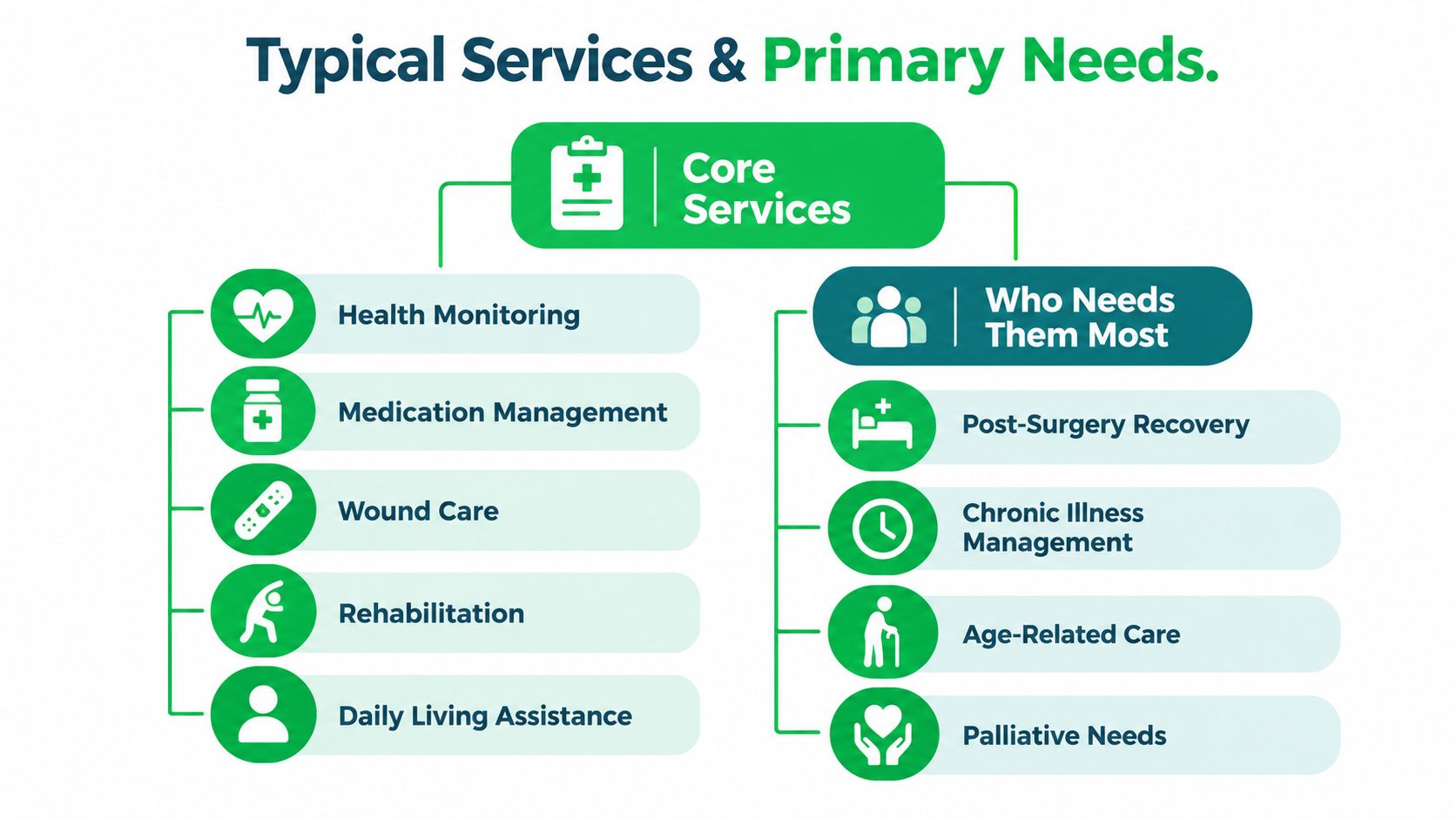
Nursing home services usually combine two layers of support. The first is clinical care, such as health monitoring, medication management, wound care, rehabilitation, and escalation when a resident's condition changes. The second is daily-living assistance, including support with eating, dressing, bathing, toileting, transfers, and mobility.
These services are not provided in the same intensity for every resident. One person may need a short period of rehabilitation after surgery. Another may need long-term support because frailty, dementia, or chronic illness has made independent living unsafe. The care plan should reflect the actual burden of need, not just the person's age.
Clinical services and daily support
A resident may need one service occasionally or several at the same time. Common examples include:
- Health monitoring: Observing symptoms, vital signs, nutrition, hydration, mobility, and changes in function.
- Medication management: Reviewing prescriptions, supporting administration, checking for changes, and communicating concerns to the treating team.
- Wound care: Dressing changes and monitoring for complications under an appropriate clinical plan.
- Rehabilitation: Physiotherapy and mobility support after illness, surgery, injury, or loss of strength.
- Cognitive supervision: Structured support for people with confusion, memory impairment, or dementia-related safety concerns.
- Personal assistance: Help with routine activities when the resident cannot manage them independently.
In practice, these services overlap. A person with a healing wound may also need pressure-area care, help turning in bed, pain monitoring, and support getting safely to the bathroom. Someone with Parkinson's disease may require medication timing, mobility assistance, fall prevention, and help with meals because tremor and fatigue affect eating.
Daily support often matters just as much as clinical tasks. Families sometimes focus on prescriptions and dressing changes, but many crises begin with ordinary activities becoming unsafe. Missing meals, dehydration, poor hygiene, difficulty toileting, and unsafe transfers can lead to infections, falls, skin breakdown, and hospital readmission.
The intensity varies. Someone recovering from a procedure may need temporary nursing and physiotherapy, while a frail person with several chronic conditions may require closer monitoring and support with most daily activities.
Profiles that may require greater supervision
Consider an older adult who takes numerous medicines, has limited mobility, and recently returned from hospital. Higher dependence in daily activities, a greater burden of illness, and polypharmacy are associated with a materially higher risk of adverse events after hospitalisation, which is why admission triage, medication reconciliation, and escalation plans matter. The DHA Long Term Care Services standards set out the assessment expectations for Dubai facilities.
Other examples include:
- Post-acute recovery: A person needs regular wound observation, transfers, exercises, or medication assistance but may recover enough to return home.
- Advanced daily-living dependence: A resident needs repeated help with bathing, toileting, feeding, repositioning, or safe transfers throughout the day.
- Cognitive supervision: A person with dementia may wander, forget medication, become disoriented, or need consistent routines and observation.
- Complex chronic illness: Several conditions may require coordinated monitoring and a clear response plan when symptoms worsen.
You can think of these needs in terms of risk patterns. A patient with one stable condition and a reliable family may do well at home. A patient with three unstable problems, poor balance, nighttime confusion, and no dependable support may need a setting with more continuous oversight.
For instance, a man recovering from hip surgery may only need two weeks of wound checks, walking practice, and medication reminders. A woman with heart failure, diabetes, impaired vision, and memory problems may need a much more structured plan because the risks interact with each other. Missing one diuretic dose, eating poorly, or falling on the way to the toilet can quickly trigger a setback.
The presence of one need does not automatically mean nursing home admission is necessary. A stable person may receive nursing, physiotherapy, and personal support at home. The practical question is whether the required services can be delivered reliably outside a facility.
Families considering home-based support can review premium nursing care at home in Dubai to understand how nursing visits and ongoing support may fit a recovery or long-term plan.
Nursing Home Services Compared With Home Nursing and Elderly Care
The choice becomes clearer when families compare the care environment, not just the service names. Facility care provides continuous presence in one location, while home nursing provides scheduled or arranged visits in a familiar environment. Elderly care at home may focus mainly on daily assistance, but it can also sit alongside regulated nursing and therapy when clinical needs require it.
Many families do not choose between these models once and for all. Care often changes in stages. A person may start with a doctor review at home, then add nursing visits after discharge, then require short-term rehabilitation, and later step down again to lighter support. Thinking in stages can make the decision less overwhelming.
Facility Care Versus Home-Based Care at a Glance
| Criteria | Nursing Home Services | Home Nursing and Elderly Care |
|---|---|---|
| Care intensity | Designed for ongoing, supervised support, including residents with significant functional or clinical needs | Suits planned visits or arranged in-home support, with intensity based on the care plan |
| Environment | Residential facility with staff and other residents | Patient's home, hotel, or office |
| Family role | Families remain involved but do not provide the daily care environment | Families may remain closely involved in routines, decisions, and observation |
| Personalisation | Care is organised within the facility's systems and staffing model | Care can be shaped around the person's home, schedule, routines, and preferences |
| Continuity | Staff and services are available within the same facility | Continuity depends on the provider's scheduling, documentation, handover, and follow-up |
| Best fit | People who need continuous supervision or cannot be safely supported at home | Medically stable patients needing nursing, rehabilitation, personal care, or monitoring at home |
Home nursing may be a reasonable alternative when the patient is medically stable, the home environment is suitable, and a responsible person or arranged caregiver can support the plan between visits. Examples include post-operative observation, injection support, wound dressing, medication assistance, physiotherapy, and help with mobility.
It may also supplement facility care. A family might arrange physiotherapy after discharge, use nursing visits during a transition, or ask for a home assessment before deciding whether admission is needed. The complete guide to home care options in Dubai can help families organise these alternatives.
A practical example is an elderly parent who strongly prefers staying at home and has a bedroom on the ground floor, family support, and a straightforward wound care plan. Home nursing may preserve comfort and routine without compromising safety. By contrast, if the same person has repeated nighttime falls, becomes disoriented, and needs frequent medication supervision, the home plan can become fragile very quickly.
Practical rule: Choose the setting that can reliably manage the person's highest-risk need, not merely the service that sounds most convenient.
Home care has limits. A person who repeatedly falls, becomes acutely confused, needs constant observation, or requires immediate clinical intervention may need a higher level of supervision than scheduled visits can provide. Conversely, moving a stable person away from a familiar home without assessing home-based options can create unnecessary disruption.
How to Evaluate Providers in Dubai With Confidence
A provider call or facility tour should produce clear answers, not general reassurance. Start by checking whether the organisation is licensed for the services it offers. DHA approval is mandatory in Dubai for facilities delivering health monitoring, medication management, or therapeutic support, and clinical services must be governed separately from non-clinical personal care.
Evaluation is not just about appearance. A clean room or polite call handler does not tell you whether medication is reconciled correctly, how deterioration is recognised, or who responds to an urgent problem at night. Families should look for systems, not just promises.
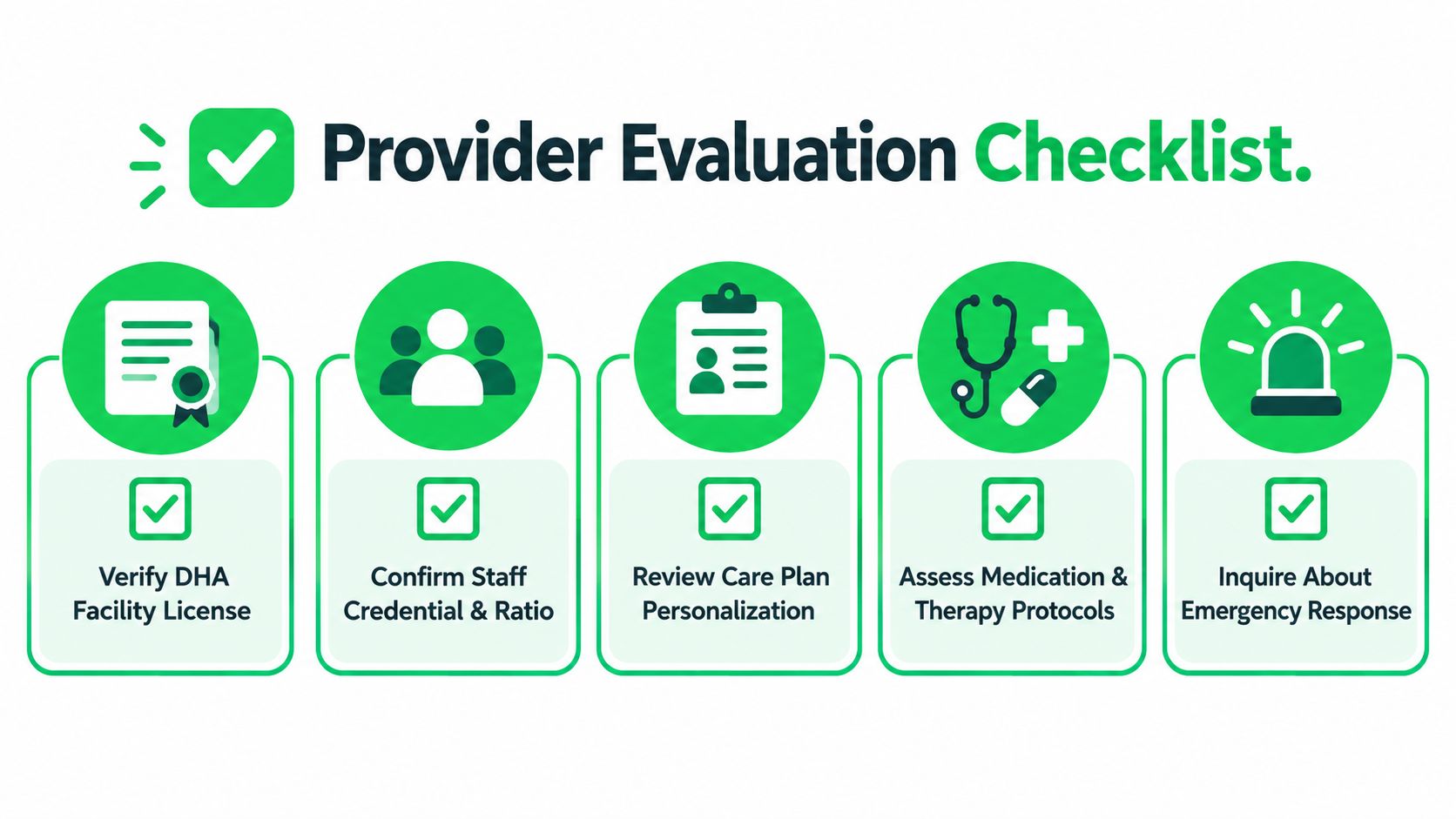
Questions to ask before agreeing to care
Use this checklist during a tour, assessment, or telephone conversation:
- Verify the DHA licence. Ask whether the licence covers the specific service required, such as nursing, medication administration, wound care, physiotherapy, or home healthcare.
- Ask who completes the assessment. Confirm that a qualified clinician reviews diagnoses, functional ability, cognitive status, current medicines, allergies, recent hospital notes, and mobility risks.
- Request a written care plan. It should state what staff will do, how often they will do it, what the family must do, and which changes require escalation.
- Clarify staffing and handovers. Ask who is present, how care is handed over between shifts or visits, and how the provider manages sickness or staffing changes.
- Examine medication controls. Ask how prescriptions are verified, who administers medicines, how missed doses are recorded, and how the provider communicates with doctors.
- Test the emergency pathway. Ask what happens if the person falls, becomes breathless, develops a fever, or shows sudden confusion.
- Review documentation. Confirm that visit notes, observations, wound records, therapy progress, and follow-up recommendations are available to the authorised care team.
It helps to turn these questions into scenarios. Instead of only asking, "Do you handle emergencies?" ask, "If my father becomes confused at 2 am and refuses medication, who is called and what happens next?" Instead of asking, "Do you do wound care?" ask, "How do you document wound changes and when do you contact the doctor?" Specific questions usually produce more revealing answers.
You can also ask for practical examples of coordination. If physiotherapy notices a decline in walking, how is that communicated to nursing staff or the physician? If a home nurse finds swelling, low oxygen, or new pain, what is the expected escalation route? Good providers should be able to explain this clearly.
Telehealth requires its own check
Remote support can be useful for follow-up, but telehealth is not automatically regulated by a general healthcare licence. Dubai's rules require telehealth services and platforms operating in the emirate to be licensed by DHA, with licensing categories including call centre, telebooth, or add-on services. Families can review the DHA telehealth licensing information when a provider proposes remote consultations or monitoring.
Telehealth works best when expectations are realistic. It can be useful for reviewing symptoms, checking progress, discussing test results, adjusting a routine plan, or deciding whether an in-person visit is needed. It is less suitable when the person needs hands-on assessment, urgent physical examination, or immediate intervention.
A provider's coverage area and response process also matter for home care. Ask whether clinicians can reach your neighbourhood, how urgent visits are prioritised, how reports are shared, and who remains responsible for follow-up after the initial visit. The guide to choosing elderly care services in Dubai offers another practical set of questions for families.
For example, a video follow-up may be perfectly adequate for discussing appetite, sleep, or progress with exercises after discharge. It is not enough for a new fall with hip pain, sudden breathlessness, or a rapidly worsening wound. Families should know in advance which problems can be managed remotely and which require an in-person response.
Cost Factors and Regulatory Considerations in Dubai
Families often ask for a single nursing home price, but there is not one meaningful figure without knowing the person's care requirements. Costs can change according to acuity, staffing needs, medication complexity, therapy intensity, length of stay, room arrangements, and the amount of supervision required. Home care costs are shaped differently, often by visit frequency, visit duration, nursing tasks, overnight support, equipment, therapy, and additional clinical services.
A facility providing 24-hour supervision has a different operating model from a nurse visiting once or several times during the day. A person who needs wound care and medication support may require a focused home plan, while someone needing constant assistance with transfers and cognitive safety may need more continuous staffing. Ask for an itemised proposal that separates clinical services, personal care, therapies, supplies, assessments, and follow-up.
This level of detail matters because two quotations that look similar at first glance may cover very different things. One plan may include only basic visits, while another includes medication administration, emergency response arrangements, physiotherapy reviews, consumables, and regular clinical reporting. Families should compare what is included, not just the headline number.
A useful budgeting example is to think in layers:
- Core care costs: nursing time, personal support, or facility stay
- Clinical add-ons: wound dressings, injections, IV therapy, catheter care, rehabilitation
- Supplies and equipment: dressings, continence products, mobility aids, pressure-relief items
- Review and coordination: doctor review, reassessment, documentation, and communication with family

Dubai's market context
Formal institutional elderly care has historically remained limited in the UAE. A PubMed study reported an institutionalisation rate of 7.0 to 14.0 per 1,000 people aged 65 or older in a UAE health district during the early 2000s, showing that only a small fraction of older adults lived in institutions at that time. The peer-reviewed study on institutionalised older adults provides the historical context.
More recent policy analysis estimated that Emiratis aged 60 and older represented about 2% of the population, or roughly 165,000 people, and projected age dependency among people over 65 to rise from 1.6 per 100 working-age people in 2020 to 18.5 by 2050. Those are projections and estimates discussed in the UAE Ministry of Community Empowerment statistics resource, not a current count of every older adult receiving care.
Organised nursing care remains a developing segment. UAE nursing care market estimates place the value at USD 18 million in 2025, with a projection of USD 26 million by 2032, representing a projected 5.3% CAGR, according to the DHA market document. Separately, a 2026 review estimated UAE long-term care revenue at USD 4.2 billion in 2025, projected to reach USD 7.3 billion by 2033, while noting limited documentation of dementia services and uncertainty around expatriate access. These figures use different market definitions, so they should not be treated as interchangeable.
For families, the practical takeaway is simple. Dubai has regulated care options, but the market is still developing, and service models are not identical from one provider to another. That makes assessment quality, licensing, scope of service, and follow-up processes especially important.
Clinical work must remain within the provider's licensed scope. Medication administration, wound care, rehabilitation, and health monitoring cannot be treated as ordinary residential support just because they happen in a living environment.
Choosing Between Facility Care and Home-Based Care Next Steps
A practical decision can start with five questions:
- Is the person medically stable? If symptoms are changing quickly or urgent assessment is needed, seek medical attention rather than relying on routine care.
- Can the home support the person safely? Consider stairs, bathroom access, transfers, falls, equipment, and whether someone can respond between visits.
- How much supervision is required? Scheduled nursing may suit a stable patient, while continuous observation may point towards facility care.
- What does cognition add to the risk? Dementia, wandering, confusion, or medication forgetfulness can change the supervision plan.
- What does the person prefer? A familiar home can support comfort and family involvement, provided the clinical plan is safe and realistic.
These questions work best when discussed with concrete examples. If the person has fallen twice this month, mention that. If the bathroom is upstairs and the patient cannot climb stairs, say so. If a family member is only available in the evenings, that changes what home care can realistically achieve.
Home-based care can include doctor visits, nursing, physiotherapy, lab sample collection, IV therapy, and elderly support. A Doctor On Call service may also help with an initial assessment or follow-up in a home or hotel, but it is not a substitute for emergency services when a life-threatening condition is present.
Prepare the person's diagnoses, discharge summary, allergies, medicine list, mobility concerns, recent symptoms, and family contact details. Then request a proper assessment from a DHA-licensed provider. Ask for a written plan that states what will happen during routine care, what requires a clinician, and when the patient should be transferred for urgent medical treatment.
A simple next step is to write down the person's top three risks before you call anyone. For example: falls during transfers, missed afternoon medicines, and poor food intake. This helps the provider focus on the issues most likely to affect safety. It also makes it easier to compare one recommended care plan with another.
The goal is not to choose the most intensive option by default. It is to choose the safest option that is proportionate to the person's real needs, daily risks, and preferences.
Vitals Healthcare Doctor On Call offers 24/7 doctor visits, nursing care, physiotherapy, home lab testing, IV therapy, and elderly support at homes, hotels, and offices across Dubai through DHA-licensed clinicians. To discuss whether clinic-grade home support could suit your situation, visit Vitals Healthcare Doctor On Call and request an assessment.