

You've left a Dubai clinic with two physiotherapy referrals after a back injury, surgery, or stroke, and both sound convincing. One therapist talks about strength, another mentions neurological retraining, and a third advertises sports rehabilitation. The practical question is simple: which type of physiotherapy is best for your condition?
The answer isn't the most expensive package or the most fashionable treatment label. It's the service that matches your diagnosis, recovery phase, functional goal, and ability to show measurable progress. Dubai's regulated physiotherapy framework supports that approach, with distinct pathways for musculoskeletal, neurological, paediatric, gait, and aquatic care rather than one universal modality. The Dubai Health Authority physiotherapy standards also emphasise patient-centred performance indicators, while the Emirates Physiotherapy Society recommends comparing baseline and discharge measures where appropriate.
Table of Contents
- Why the Right Physiotherapy Type Depends on Your Condition
- The Core Physiotherapy Types and What Each One Targets
- Comparing Physiotherapy Types Side by Side
- Matching the Type to the Condition or Goal
- When In-Home Physiotherapy Is the Better Option
- Why Evidence and Reviews Matter More Than the Label
- A Practical Checklist for Choosing the Right Type
- Reviews and References to Verify Before You Book
Why the Right Physiotherapy Type Depends on Your Condition
A 38-year-old living in JLT may leave an appointment after a lumbar disc herniation with two referrals, one to an orthopaedic physiotherapist and another to a neurological service. That can feel contradictory. In reality, both referrals may reflect different concerns, such as spinal movement and pain on one hand, or nerve-related weakness and altered sensation on the other.
No single type of physiotherapy is universally best. The strongest match depends on four decisions:
- Diagnosis: Is the problem musculoskeletal, neurological, cardiopulmonary, pelvic, vestibular, or developmental?
- Severity: Can you walk, bear weight, transfer safely, and complete exercises without supervision?
- Recovery phase: Are you controlling acute symptoms, restoring movement, rebuilding strength, or returning to a demanding activity?
- Outcome: Do you need less pain, a safer gait, better balance, improved breathing, or a return to sport?
Dubai's service categories are useful because they connect the therapy pathway to the patient's impairment and functional goal. DHA materials identify areas including neuro physiotherapy, gait, musculoskeletal, paediatric physiotherapy, and aqua therapy, which is a clinical classification rather than a marketing menu. The Emirates Physiotherapy Society standards of practice similarly support selecting care according to impairment, disability, and evidence-based practice.
Practical rule: Choose the physiotherapy type that can measure the problem you want to solve.
The same patient may need more than one category during recovery. Someone recovering from spinal surgery could start with orthopaedic rehabilitation to protect the surgical area and restore movement, then receive gait or neurological input if weakness affects walking. A patient may also switch between clinic and home delivery as their independence improves. If travel increases pain or creates a safety problem, home physiotherapy can support recovery while keeping the programme focused on everyday function.
There are trade-offs. Manual treatment may help settle symptoms quickly, but long-term independence usually requires active exercise and repeated functional practice. A sports programme may suit an athlete's return-to-play target, while a neurological programme may require more sustained work on transfers, balance, and gait. The best choice is the one that meets today's clinical need without losing sight of the final goal.
The Core Physiotherapy Types and What Each One Targets
Start by locating your problem in the category below. These labels don't replace an assessment, but they can help you avoid booking a specialist whose training doesn't match your needs.
Musculoskeletal and orthopaedic care
Orthopaedic physiotherapy targets bones, joints, muscles, tendons, ligaments, and post-operative recovery. It's usually the right starting point for a Dubai resident with knee osteoarthritis, a fracture, shoulder pain, spinal pain, or a joint replacement.
Neurological and movement retraining
Neurological physiotherapy helps people manage movement and function after stroke, Parkinson's disease, multiple sclerosis, brain injury, or spinal cord injury. A patient in a Sharjah rehabilitation centre may need gait training, balance work, muscle re-education, and transfer practice rather than a standard back-pain programme.
Sports and performance rehabilitation
Sports physiotherapy serves active people who need a safe return to training, competition, or a demanding hobby. For example, an athlete in Dubai Sports City after ACL reconstruction needs progressive strength, landing control, running preparation, and sport-specific testing.
Geriatric mobility support
Geriatric physiotherapy focuses on mobility decline, weakness, balance impairment, joint stiffness, and falls prevention. The aim isn't just to reduce discomfort. It's to help an older adult move safely through the home and preserve independence.
Paediatric development
Paediatric physiotherapy supports children with developmental delay, congenital conditions, neurological diagnoses, coordination difficulties, or injury. Treatment is adapted to the child's age, attention, play, family routine, and functional needs.
Pelvic health
Pelvic floor physiotherapy addresses incontinence, pelvic pain, prolapse-related symptoms, bowel-control concerns, and post-natal recovery. It requires a clinician with appropriate pelvic-health training, not just a general exercise prescription.
Cardiopulmonary rehabilitation
Cardiopulmonary physiotherapy supports people with heart and lung conditions, including recovery after cardiac surgery, COPD, and prolonged respiratory illness. It may involve breathing control, endurance training, secretion management, and monitored functional activity.
Aquatic rehabilitation
Aquatic physiotherapy uses water to reduce loading while practising movement. It can be useful when land-based exercise is difficult because of pain, weakness, or joint sensitivity, although access depends on an appropriate licensed facility and pool service.
Vestibular rehabilitation
Vestibular physiotherapy treats dizziness, vertigo, and balance disorders through assessment and movement retraining. It's a better fit for a patient whose main problem is spinning, visual motion sensitivity, or unsteadiness than for someone with isolated muscle pain.
For practical home exercise guidance, review expert-recommended physiotherapy exercises at home, but don't use generic exercises as a substitute for diagnosis. The category tells you where to begin. The assessment determines what you should do.
Comparing Physiotherapy Types Side by Side
Use the comparison below to choose a licensed physiotherapy pathway that matches your diagnosis and the outcome you need. It is a decision aid, not a fixed timetable. Typical session frequency and outcome windows vary with diagnosis, medical restrictions, adherence, and the clinician's assessment. UAE service standards support outcome-based care, but they do not set one universal number of visits or weeks for every patient.
| Type | Primary Condition Fit | Typical Session Frequency | Expected Outcome Window | Best Patient Profile |
|---|---|---|---|---|
| Orthopaedic | Back pain, fractures, joint conditions, sprains, post-operative rehabilitation | Set after assessment according to pain, loading status, and home support | Early changes may be tracked through movement, pain, strength, and function, with timing dependent on the condition | Adults with musculoskeletal injury or surgery |
| Neurological | Stroke, Parkinson's disease, multiple sclerosis, brain or spinal cord conditions | Often requires consistent supervised practice, adjusted to fatigue and safety | Progress is assessed through gait, transfers, balance, and independence rather than pain alone | Patients with altered movement, weakness, coordination, or balance |
| Sports | ACL rehabilitation, tendon injuries, muscle strains, return-to-play planning | Progression is based on criteria, training load, and sport demands | Advancement follows strength, movement quality, running, and sport-specific testing | Athletes and active adults |
| Geriatric | Falls risk, weakness, mobility decline, frailty, joint stiffness | Adjusted to endurance, safety, cognition, and family support | Functional gains are tracked through walking, transfers, strength, and confidence | Older adults seeking safer daily mobility |
| Paediatric | Developmental delay, congenital conditions, coordination and movement limitations | Organised around the child's tolerance, routine, and family participation | Progress is measured through age-appropriate movement and participation goals | Children needing tailored developmental rehabilitation |
| Pelvic floor | Incontinence, prolapse symptoms, pelvic pain, post-natal recovery | Determined by symptoms, assessment findings, and exercise response | Improvement is monitored through symptom control, function, and participation | People with pelvic-health concerns |
| Cardiopulmonary | Post-cardiac surgery, COPD, respiratory limitation, prolonged illness recovery | Governed by medical status, exertion tolerance, and monitoring needs | Progress is tracked through breathing, endurance, activity tolerance, and daily function | Patients whose heart or lung condition limits activity |
| Vestibular | Vertigo, dizziness, visual motion sensitivity, balance disorders | Based on symptom provocation, safety, and response to habituation or balance work | Changes are assessed through dizziness, balance, walking, and confidence | Patients with vestibular or balance-related symptoms |
For mechanically classified low-back pain, the local evidence offers a useful example of how the treatment label should connect to a measurable result. A study of 64 patients found that both McKenzie and Brunkow exercise programmes improved spinal mobility, with statistically significant pre- and post-treatment gains reported as p<0.01 across all measured motions, according to a Dubai-based comparison of McKenzie and Brunkow exercise programmes. The McKenzie group showed stronger end-of-treatment improvements in extension and right and left side flexion.
The practical recommendation is specific. For mechanically classified lumbar pain where directional preference is identified during assessment, McKenzie-style exercise may be the stronger technical choice for measurable mobility recovery. That result does not make it suitable for neurological weakness, pelvic dysfunction, vertigo, or a child's developmental condition.
Choose neurological rehabilitation when the main target is altered movement, gait, transfers, coordination, or balance. It often requires consistent supervised practice and a longer commitment than a straightforward musculoskeletal problem. Sports rehabilitation provides a structured return-to-training pathway, but its testing and loading principles serve active recovery rather than every mobility or medical problem.
Compare each row by condition fit and outcome measure. A licensed UAE clinician should establish the baseline, select the pathway, and reassess whether movement, strength, function, endurance, or independence is improving. The label matters less than the match between the diagnosis, the clinician's scope, and the result being measured.
Matching the Type to the Condition or Goal
The quickest way to decide is to start with the function you've lost. Don't book “general physiotherapy” if you already know that your main problem is walking after stroke, running after ACL surgery, or controlling urine after childbirth.
| Condition or Goal | Best-Fit Type | Key Outcome Measure | Typical Window |
|---|---|---|---|
| Non-specific or mechanically classified low-back pain | Orthopaedic physiotherapy with directional-preference exercise where indicated | Spinal range, disability, walking tolerance, and functional movement | Set after baseline assessment and reassessed during care |
| Post-fracture stiffness and restricted range | Orthopaedic rehabilitation with medically appropriate loading | Joint range, strength, swelling, and daily-use function | Depends on fracture healing and medical clearance |
| Stroke-related weakness, gait, or transfer difficulty | Neurological physiotherapy | Gait, transfers, balance, and independence | Ongoing reassessment according to recovery and fatigue |
| ACL reconstruction | Sports physiotherapy with criterion-based progression | Strength symmetry, landing control, running tolerance, and sport tasks | Progression follows clinical criteria, not a calendar alone |
| Elderly mobility decline or balance loss | Geriatric physiotherapy | Transfers, walking, strength, balance, and falls risk | Adjusted to safety, endurance, and home participation |
| Post-partum incontinence or pelvic dysfunction | Pelvic floor physiotherapy | Symptom control, pelvic-floor function, and daily participation | Based on assessment findings and response to the programme |
Low-back pain
For non-specific low-back pain, I'd start with orthopaedic or musculoskeletal physiotherapy, not passive treatment alone. The clinician should classify the presentation, assess movement, and build an active programme. The McKenzie and Brunkow comparison cited above found significant mobility gains in both groups, with stronger end-of-treatment improvements for McKenzie in extension and side flexion. That makes directional-preference work a sensible option when the examination identifies a mechanically suitable pattern.
Post-fracture stiffness
After a fracture, the priority is not to force range before the bone and surrounding tissues are ready. Orthopaedic rehabilitation should follow the surgeon's restrictions, then progress from protected movement to loading, strength, and practical use of the limb. Ask the therapist to track joint range and function rather than applying heat or massage.
Post-stroke rehabilitation
Choose neurological physiotherapy when the problem involves weakness, altered coordination, balance, gait, or transfers after stroke. DHA's regulated service framework is important here because appropriate rehabilitation should be linked to repeat outcome measurement. A therapist should show whether the patient is standing more safely, transferring with less assistance, or walking more effectively.
ACL reconstruction
An ACL patient should choose sports physiotherapy, but only if the programme is criterion-based. Running and sport progression should depend on strength, landing mechanics, swelling, control, and surgeon or therapist clearance. A generic knee routine may reduce stiffness, but it won't necessarily prepare an athlete for cutting, deceleration, or unpredictable sport demands.
Older-adult mobility loss
For an older adult with weakness, sarcopenia, or balance loss, geriatric physiotherapy is the strongest match. The programme should prioritise functional strength, gait, transfers, confidence, and falls prevention. If the patient can't travel safely, a home assessment can reveal hazards and movement problems that a clinic session may miss.
Pelvic floor symptoms
Post-partum incontinence, prolapse symptoms, and pelvic pain require pelvic-health expertise. Internal assessment may be appropriate when clinically indicated, and biofeedback can help the patient understand muscle coordination. A general abdominal workout is not a substitute for a pelvic-floor assessment.
For patients returning to exercise after injury, sports injury physiotherapy at home in Dubai can be considered when the home environment is suitable for the early rehabilitation stage. The right setting still depends on the equipment, testing, and supervision your programme requires.
When In-Home Physiotherapy Is the Better Option
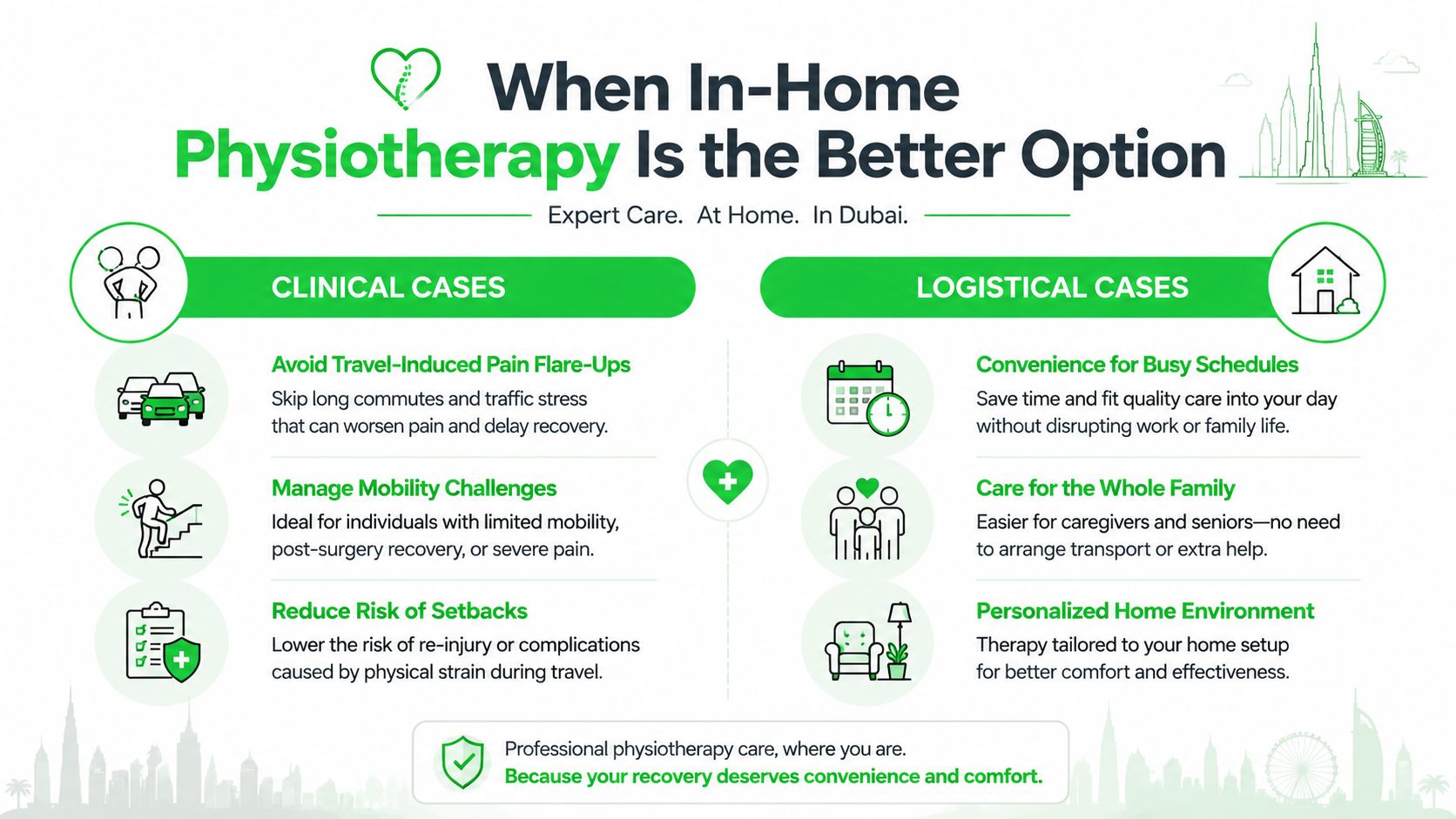
Home physiotherapy is clinically useful when the journey to the clinic is part of the problem. If sitting in a car increases pain, stairs are restricted after surgery, or neurological weakness makes transfers unsafe, bringing the therapist to you can make the session more relevant and safer.
Choose home care for a clinical reason
Home delivery is particularly sensible when:
- Travel provokes symptoms: The patient arrives exhausted or in more pain than before leaving home.
- Weight-bearing is restricted: Post-operative precautions make stairs, parking, or clinic transfers difficult.
- Transport is unsafe: Weakness, dizziness, poor balance, or cognitive changes create a fall risk.
- The goal is home independence: Bed transfers, bathroom safety, stair practice, and walking through the actual home may matter more than exercises on a clinic plinth.
The home also reveals barriers that patients may forget to mention. A therapist can observe how you rise from your own chair, reach the bathroom, manage a doorway, or use a walking aid on your usual flooring. That information can shape a more practical programme.
Consider the Dubai logistics
Traffic, parking, work schedules, and dependent-care responsibilities can turn a clinic appointment into a major project. A home session may be easier to complete consistently, especially for an older adult or a patient recovering from surgery. A common starting cadence is two to three sessions per week for the first three weeks, followed by tapering as the home programme stabilises. This is a planning pattern, not a universal prescription, and the therapist should adjust it to the diagnosis and safety requirements.
Home care has limits. It may not provide a hydrotherapy pool, isokinetic testing, or every form of electrotherapy equipment. If your rehabilitation needs those resources, a hybrid model is more appropriate, with home sessions for function and clinic visits for specific testing or equipment.
Before booking, verify that the visiting clinician and provider operate under the correct Dubai home-care licensing pathway. A general clinic licence doesn't automatically answer whether the service is authorised for in-home rehabilitation. You can also compare the practical model offered by physiotherapy at home in Dubai with a conventional clinic plan, then ask how the provider handles reassessment and referrals.
Why Evidence and Reviews Matter More Than the Label
A premium name doesn't make a treatment appropriate. A sports physiotherapist may be excellent, but that doesn't mean the clinician is the right choice for a stroke survivor, a child with developmental needs, or a patient with pelvic-floor symptoms.
The UAE evidence-based-practice literature supports a more careful view. One UAE study found that physiotherapists generally reported awareness of evidence-based practice, while their knowledge was limited to only a few key terms, as described in the UAE evidence-based-practice study. That matters because a label such as “orthopaedic” or “outpatient” tells you less than the therapist's ability to assess, use relevant evidence, and reassess the patient consistently.
What a credible plan should show
Ask the clinician to explain:
- The working diagnosis: What impairment is limiting you?
- The treatment rationale: Why does this technique fit your condition?
- The outcome measure: What will be tested at baseline and again during care?
- The progression rule: What must improve before exercises become harder?
- The referral threshold: When will the therapist contact your physician or recommend further review?
For low-back pain, the Oswestry Disability Index may help track disability. For balance problems, the Berg Balance Scale may be relevant. Stroke rehabilitation may use a structured measure of independence and mobility. The exact tool should match the clinical problem, and the therapist should explain what the score means rather than presenting a number without context.
The strongest clinic is not the one with the longest treatment menu. It's the one that can explain what it is measuring and what it will change if progress stalls.
Reviews need the same scrutiny. “Great service” and “felt better” can describe kindness and short-term comfort, but they don't prove that the patient regained walking ability, returned to work, or improved a validated score. Look for comments that identify the condition, the therapist's specialty, the functional goal, and the way progress was monitored.
A UAE cardiopulmonary survey also framed physiotherapy around evidence-based practice and sub-specialty care, as shown in the UAE cardiopulmonary physiotherapy survey. That reinforces the central point: the evidence should match the condition, and the clinician should apply it consistently.

A Practical Checklist for Choosing the Right Type
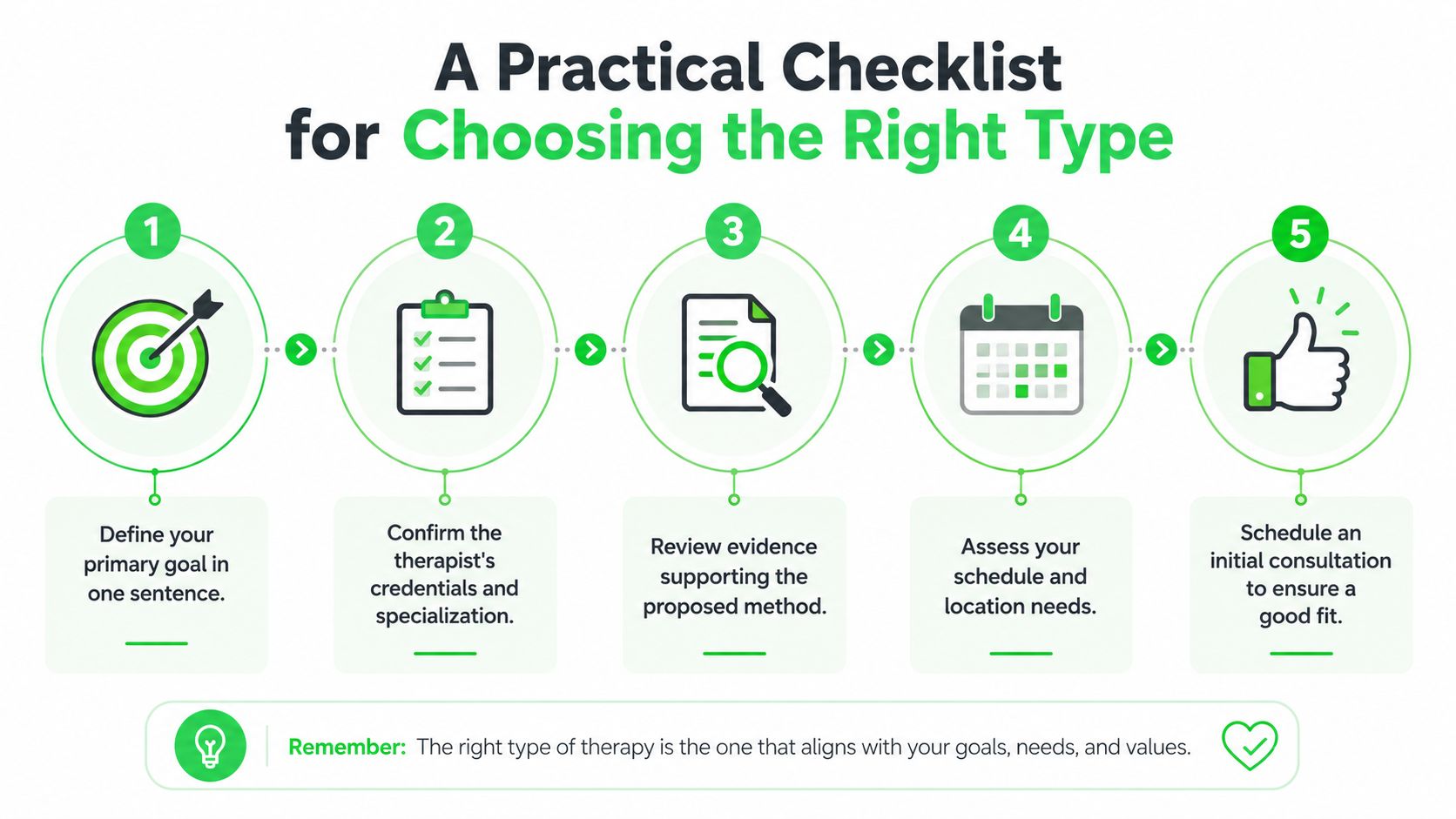
Use this checklist before you commit to a long rehabilitation plan.
- Define the goal: Write one sentence, such as “I want to walk unaided,” “I want to lift my toddler,” or “I want to return to running.”
- Confirm the diagnosis: Ask the referring physician or review the orthopaedic report. Identify whether the issue is musculoskeletal, neurological, cardiopulmonary, pelvic, vestibular, or developmental.
- Ask about measurement: Find out which validated outcome measures the therapist uses and how progress will be reported.
- Verify credentials: Check the clinician's DHA licence and specialty registration through the relevant professional registry.
- Choose the setting: Decide between home and clinic based on mobility, post-operative restrictions, travel pain, and the equipment your programme requires.
Book an initial assessment block rather than accepting a long package immediately. A short, defined starting period gives you time to judge communication, clinical reasoning, reassessment, and whether the proposed plan fits your real life. This guide to finding a physiotherapist on call can help you compare availability and delivery options.
Reviews and References to Verify Before You Book
Check reviews for the named clinic and individual therapist, not just the brand. Google and Doctify can show patterns in patient experience, while Dubai or Abu Dhabi licensing registers confirm professional credentials. Evidence on direct access to physiotherapy supports matching the access route and specialty to the diagnosis, rather than choosing from a generic booking page. Review the UAE physiotherapy direct-access evidence before you book.
For low-back pain, examine the McKenzie and Brunkow comparison. For broader regional context, prioritise outcome audits and evidence reviews over testimonials. World Physiotherapy's UAE profile reports workforce data for the country and the wider Asia Western Pacific region. That context helps assess the local service environment, but your decision still rests on the therapist's licence, assessment quality, treatment plan, and measurable outcome.
Vitals Healthcare Doctor On Call provides DHA-licensed on-call physiotherapy in homes and hotels across Dubai for pain management, rehabilitation, and mobility support. If home delivery suits your condition, visit Vitals Healthcare Doctor On Call to arrange an assessment and discuss an orthopaedic, neurological, sports, geriatric, or other specialised pathway.