
You've just finished a run along Dubai's outdoor paths. Your head is pounding, your calves are tightening, and water alone hasn't restored the way you feel. After heavy sweating, the problem may not be a simple lack of water. Your body may also have lost sodium and other electrolytes that help keep fluid in circulation, support nerve signals, and allow muscles to contract normally.
That's where IV drip electrolytes enter the conversation. They're clinical fluids, not automatic wellness upgrades, and they're only appropriate when an assessment shows that oral intake isn't enough or a specific fluid deficit needs supervised correction. This guide explains what these infusions contain, how clinicians choose them, and when a home visit should give way to oral rehydration or emergency care.
Table of Contents
- What IV Drip Electrolytes Really Are
- From Oral Rehydration to Modern IV Therapy
- Common Electrolyte IV Solutions and Their Composition
- How Clinicians Decide When an Electrolyte IV Is Needed
- Choosing Between IV Therapy, Oral Rehydration, and Emergency Care
- Common Misconceptions About Wellness Drips
- What a Safe Home IV Electrolyte Session Looks Like in Dubai
What IV Drip Electrolytes Really Are
After a long outdoor run in Dubai's heat, thirst may improve with water while cramps, weakness, dizziness, or very low urine output continue. Heavy sweating can remove sodium and other electrolytes along with fluid. The appropriate response depends on the likely amount lost, medical history, symptoms, and whether the person can drink safely.
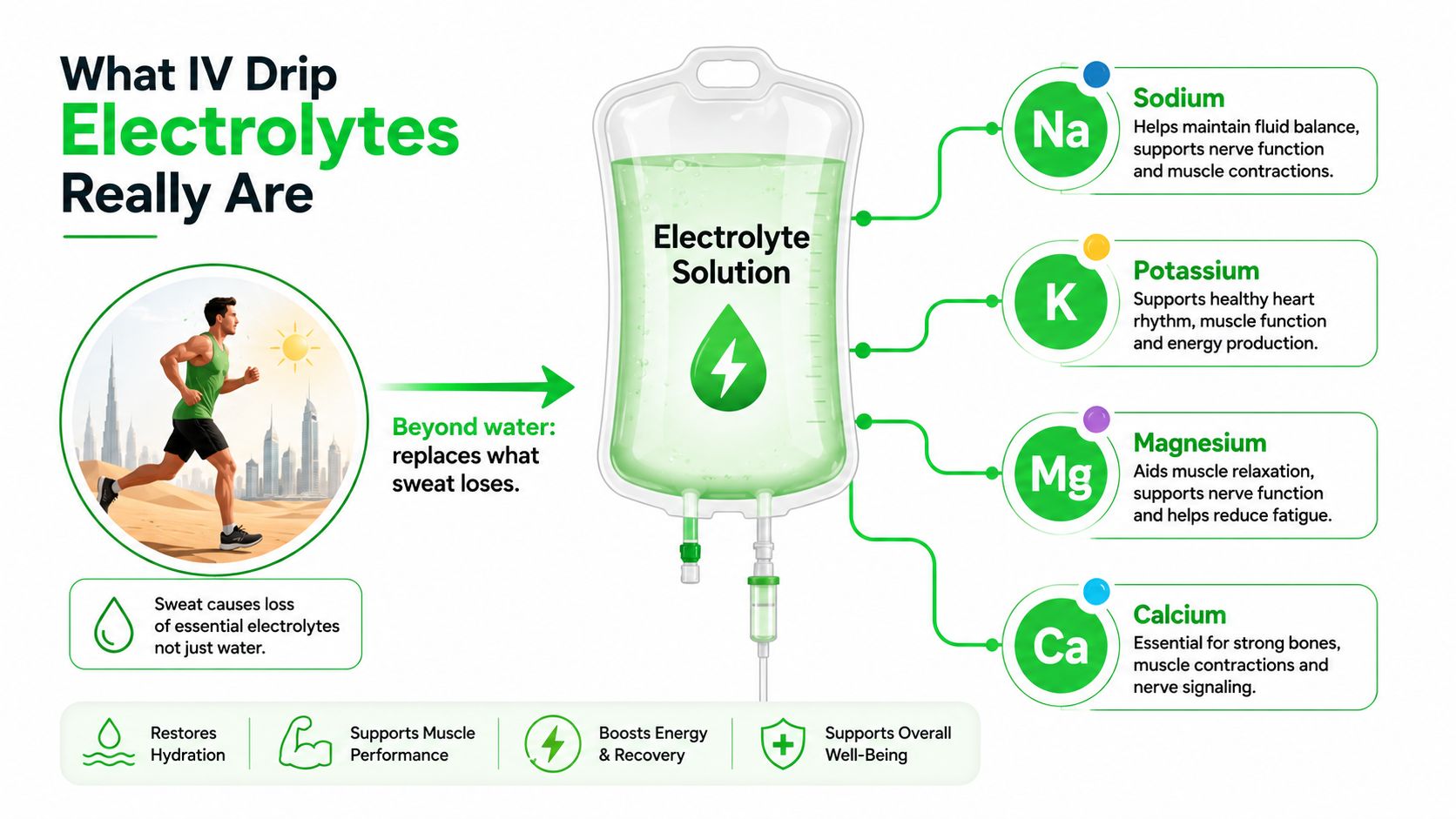
Electrolytes are charged minerals that help control fluid distribution, nerve signalling, and muscle contraction. Sodium helps maintain fluid outside cells. Potassium supports cellular and muscle function, while chloride contributes to fluid balance and electrical neutrality. Magnesium and calcium also serve important functions, yet placing them in an IV is not automatically useful or safe.
The fluid is the treatment, not the label
Clinicians generally use a sterile crystalloid solution for an electrolyte IV, such as 0.9% sodium chloride, Ringer's lactate, or another balanced crystalloid. These fluids provide water and measured ion concentrations. Some formulations also contain potassium, calcium, magnesium, lactate, acetate, or other buffers. The selection should match the clinical problem, rather than a colourful menu or a promise of energy and recovery.
For resuscitation, adult fluid guidance describes sodium concentrations in the range of 130–154 mmol/L. For routine maintenance, it gives approximately 25–30 mL/kg/day of water, around 1 mmol/kg/day each of sodium, potassium, and chloride, and 50–100 g/day of glucose to reduce starvation ketosis. These principles appear in the clinical reference on intravenous fluid therapy.
Why IV delivery needs more respect
An IV line sends fluid directly into a vein, bypassing digestion. This can help when someone cannot absorb or retain enough fluid by mouth. It also reduces the body's opportunity to slow an unsuitable dose, so the volume, ingredients, rate, and monitoring matter.
Clinical perspective: An IV drip should address a measurable or strongly suspected clinical need. A wellness menu alone is not a medical indication.
Dubai's heat increases the practical risk of sweat-related fluid loss, particularly during outdoor work or exercise. Heat, however, does not make every tired person a candidate for an IV. A clinician must distinguish ordinary fatigue from dehydration, heat illness, electrolyte disturbance, or another condition that needs urgent assessment. When symptoms are mild and the person can drink and keep fluids down, oral rehydration may provide the safer route.
From Oral Rehydration to Modern IV Therapy
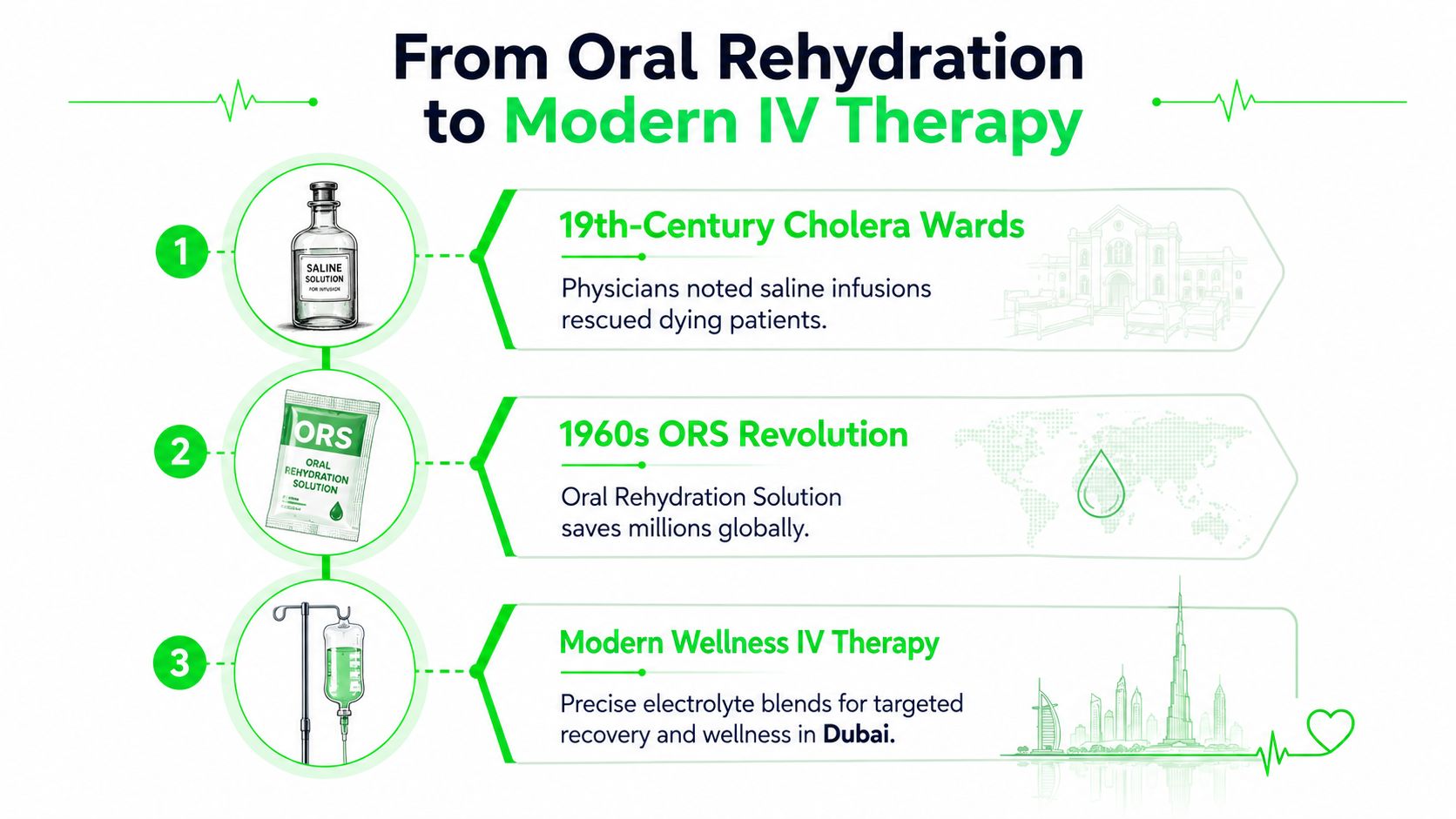
Modern IV electrolyte treatment grew from clinical efforts to support people whose severe fluid loss impaired circulation. Oral rehydration followed a different path, offering a simpler option for people who could drink and absorb a carefully balanced solution. Neither route is automatically better. The right choice depends on how much fluid has been lost and whether the gut can do its job.
The shared principle is sodium and glucose replacement. In the intestine, sodium and glucose transport helps water move into the body. Through a vein, fluid enters the circulation directly, which is useful when drinking is not possible or absorption is inadequate.
World Bank data for the United Arab Emirates tracks diarrhoea treatment coverage using oral rehydration solution packets. That reflects the continuing public-health role of ORS in dehydration care. The classic WHO oral rehydration formulation is described as containing 90 mmol/L sodium, 111 mmol/L glucose, and 30 mmol/L bicarbonate, as recorded in the World Bank UAE indicator data.
Two routes, one physiological principle
Oral rehydration is often suitable for mild or moderate dehydration when a person is alert, can swallow, and is not vomiting persistently. In that situation, fluids taken by mouth avoid the risks and equipment associated with an IV line.
IV therapy has a narrower role. The NICE recommendations for intravenous fluid therapy advise using IV fluids when oral or enteral intake is inadequate, then stopping them as soon as possible. IV treatment therefore belongs within clinical assessment, monitoring, and reassessment, rather than serving as a default wellness service.
Why home drips carry responsibility
A home setting does not change how intravenous fluids act. Administration still requires an appropriate prescription, suitable equipment, baseline observations, monitoring during the infusion, and a plan if the person worsens.
An adult resuscitation approach may use a 500 mL bolus over less than 15 minutes when rapid IV fluid is clinically required, followed by reassessment, as described in the NCBI clinical fluid reference. This is not a template for every person who feels dehydrated at home. It shows why the infusion rate and the patient's response matter alongside the bag's contents.
Dubai's heat can increase sweat-related fluid loss during outdoor work or exercise. Heat alone does not establish a need for an IV. A clinician must distinguish ordinary tiredness from dehydration, heat illness, electrolyte disturbance, or a condition needing urgent care. If symptoms are mild and fluids stay down, oral rehydration is often the safer route.
Common Electrolyte IV Solutions and Their Composition
The bag's name matters less than its ion profile, buffer, concentration, volume, and the patient's condition. A clinician might choose 0.9% sodium chloride for straightforward volume and sodium replacement, a lactated solution when a more balanced electrolyte pattern is suitable, or another balanced crystalloid when chloride exposure and acid-base considerations matter.
A useful comparison is below. Values for standard formulations can vary by manufacturer and product presentation, so a provider should verify the exact label before administration.
| Solution | Na+ (mmol/L) | K+ (mmol/L) | Cl- (mmol/L) | Buffer | Osmolarity (mOsm/L) | Typical Use |
|---|---|---|---|---|---|---|
| 0.9% sodium chloride | 154 | 0 | 154 | None | Product-dependent | Sodium-containing volume replacement |
| Ringer's lactate | Product-dependent | Product-dependent | Product-dependent | Lactate | Product-dependent | Fluid replacement when a balanced electrolyte solution is suitable |
| Balanced crystalloid, such as Plasma-Lyte or Hartmann's | Product-dependent | Product-dependent | Product-dependent | Acetate, gluconate, or lactate, depending on product | Product-dependent | Replacement or resuscitation selected according to clinical status |
0.9% sodium chloride
Often called normal saline, this solution contains sodium and chloride without potassium, calcium, or magnesium. The PubMed-indexed review of electrolyte therapy notes that many clinical situations can be managed judiciously with 0.9% saline and 5% dextrose, with additional electrolytes added only when the individual needs them.
Normal saline can be useful, but “available everywhere” doesn't mean “interchangeable for everyone”. Large volumes may contribute to hyperchloraemic acidosis, especially when a patient receives more chloride than their physiology requires. A clinician also needs to consider kidney function, heart function, blood pressure, and existing sodium abnormalities.
Ringer's lactate and related balanced fluids
Ringer's lactate contains sodium, chloride, potassium, calcium, and lactate, which the body metabolises as a buffer. Hartmann's solution is a related lactate-containing balanced crystalloid. Products such as Plasma-Lyte use different buffers, including acetate and gluconate, and have their own electrolyte profiles.
These fluids may resemble plasma more closely than saline in their overall electrolyte pattern, but that doesn't make them universally superior. Lactate-containing solutions may need to be avoided or selected cautiously in severe liver impairment, depending on the patient and the treating clinician's judgement. The exact formulation must be checked rather than inferred from a brand or menu title.
Add-ons require a reason
Potassium, calcium, and magnesium salts can be clinically valuable when testing or the patient's presentation supports their use. They can also cause harm if given in the wrong amount, too quickly, or to someone with impaired kidney clearance.
Safety boundary: A “stronger” electrolyte bag isn't automatically a better bag. The appropriate solution is the one that addresses the deficit without creating a new one.
How Clinicians Decide When an Electrolyte IV Is Needed
A clinician doesn't prescribe an IV because a patient says, “I feel dehydrated.” That description matters, but the decision also depends on observable signs, fluid intake, urine output, medications, medical conditions, and, when available, laboratory results.
NICE describes five purposes for IV fluids: Resuscitation, Routine maintenance, Replacement, Redistribution, and Reassessment. The final term is sometimes described as reassessment rather than routing. In plain language, the clinician first asks what the fluid is meant to accomplish, then checks whether the chosen fluid is working and whether it should continue.
The five questions behind the prescription
| 5R Step | Clinical Question | Bedside Sign to Check | Action in a Home Visit |
|---|---|---|---|
| Resuscitation | Is circulation threatened? | Blood pressure, pulse, mental state, skin perfusion | Escalate urgently or give supervised resuscitation if appropriate |
| Routine maintenance | Can the patient meet ordinary needs orally? | Intake, urine output, swallowing ability | Prefer oral or enteral intake when adequate |
| Replacement | What has the patient lost? | Sweating, vomiting, diarrhoea, urine output, cramps | Choose fluid and electrolytes that match the loss |
| Redistribution | Is fluid in the wrong body compartment? | Swelling, lung findings, posture-related breathlessness | Modify treatment and consider hospital assessment |
| Reassessment | Has the patient improved or worsened? | Repeat observations and symptoms | Slow, stop, change, or escalate treatment |
A construction worker finishing a hot shift may report cramping and say he has urinated very little for 12 hours. That combination deserves more than a standard wellness bag. The nurse or doctor would check vital signs, mental state, breathing, medical history, medications, fluid intake, sweating, and any vomiting or diarrhoea. Laboratory testing may be needed if a potassium, sodium, kidney, or acid-base problem is possible.
The plan might involve a balanced crystalloid rather than plain saline if the clinical picture supports it. The exact volume and rate must be prescribed for that patient. A plan such as 1 L of Ringer's lactate over 45 minutes is not a universal home protocol, and it shouldn't be copied from an article. The clinician must reassess during and after administration, particularly if the patient has heart failure, kidney disease, hypertension, or an uncertain diagnosis.
Choosing Between IV Therapy, Oral Rehydration, and Emergency Care
A runner finishes a hot workout feeling thirsty and mildly crampy, but remains alert and can swallow. Cooling down, resting, and drinking an appropriate oral rehydration solution usually makes more sense than inserting an IV. The route should match the severity of dehydration and the person's ability to drink, not the promise of faster treatment.
Dubai's heat-safety guidance recommends electrolyte replacement during heavy sweating. Salt helps the body absorb and retain water. For prolonged consumption, the guidance advises keeping fluid at 4% or less sugar and alternating electrolyte replacement fluid with water on every second drink. These points appear in the Dubai heat-safety guidance.
A practical decision pathway
- Mild dehydration: Someone who can drink, stays oriented, and has no warning symptoms can use ORS or a suitable electrolyte drink, move to a cool environment, and monitor recovery.
- Moderate dehydration: An outdoor worker with ongoing cramps, weakness, poor intake, or difficulty replacing losses should arrange same-day medical assessment. A supervised home IV may be appropriate only after a clinician confirms that oral replacement is insufficient.
- Severe or uncertain illness: Confusion, fainting, severe weakness, heatstroke symptoms, inability to stay awake, chest symptoms, breathing difficulty, or absent urine require emergency assessment. Do not delay an ambulance to arrange a wellness drip.
A person who cannot keep 500 mL of oral fluid down within an hour may need escalation, but this threshold does not replace clinical judgement. Persistent vomiting, altered mental state, severe heat exposure, or significant medical disease can justify urgent assessment sooner.
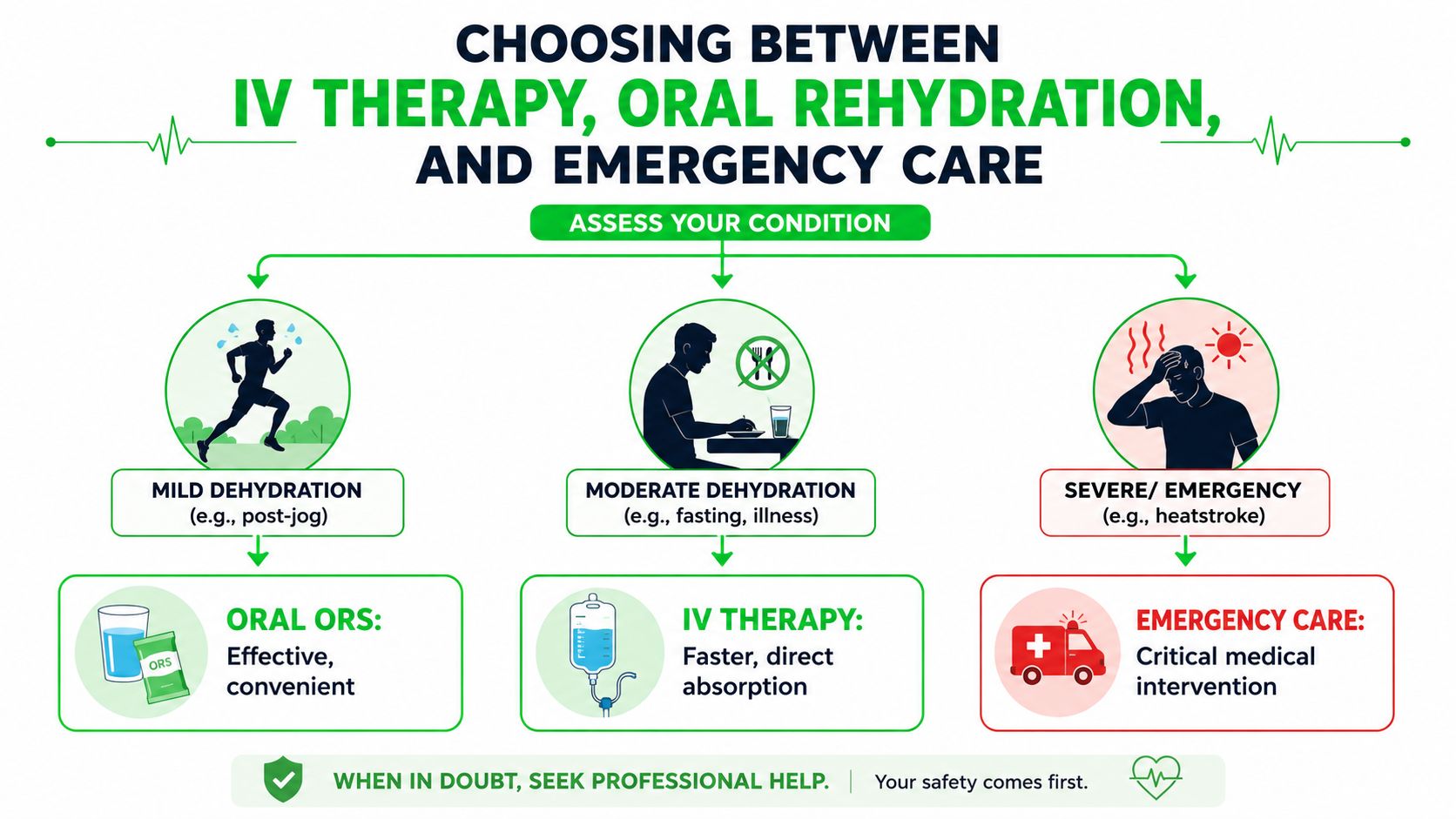
Oral rehydration is often the simpler option and avoids IV complications. IV therapy delivers fluid directly into the circulation, but it requires a trained professional, sterile technique, monitoring, and a prescription. Emergency care adds diagnostic testing, cooling, observation, and treatment for heatstroke or organ complications that a home drip cannot safely provide.
For athletes, UAE hydration guidance gives roughly 500–1,000 mg per litre for most athletes, with up to 1,500 mg/L for “salty sweaters”, and advises replacing about 1.25–1.5 litres for every kilogram of body weight lost during training to account for ongoing urine losses. The Dubai exercise hydration guidance is a practical reference, not a prescription for IV dosing.
Common Misconceptions About Wellness Drips
After a hot day in Dubai, a person may feel drained and assume an electrolyte drip will “detox” the body or prevent illness. The right question is narrower: is there a fluid or electrolyte problem that needs medical treatment, or would oral rehydration and rest be enough?
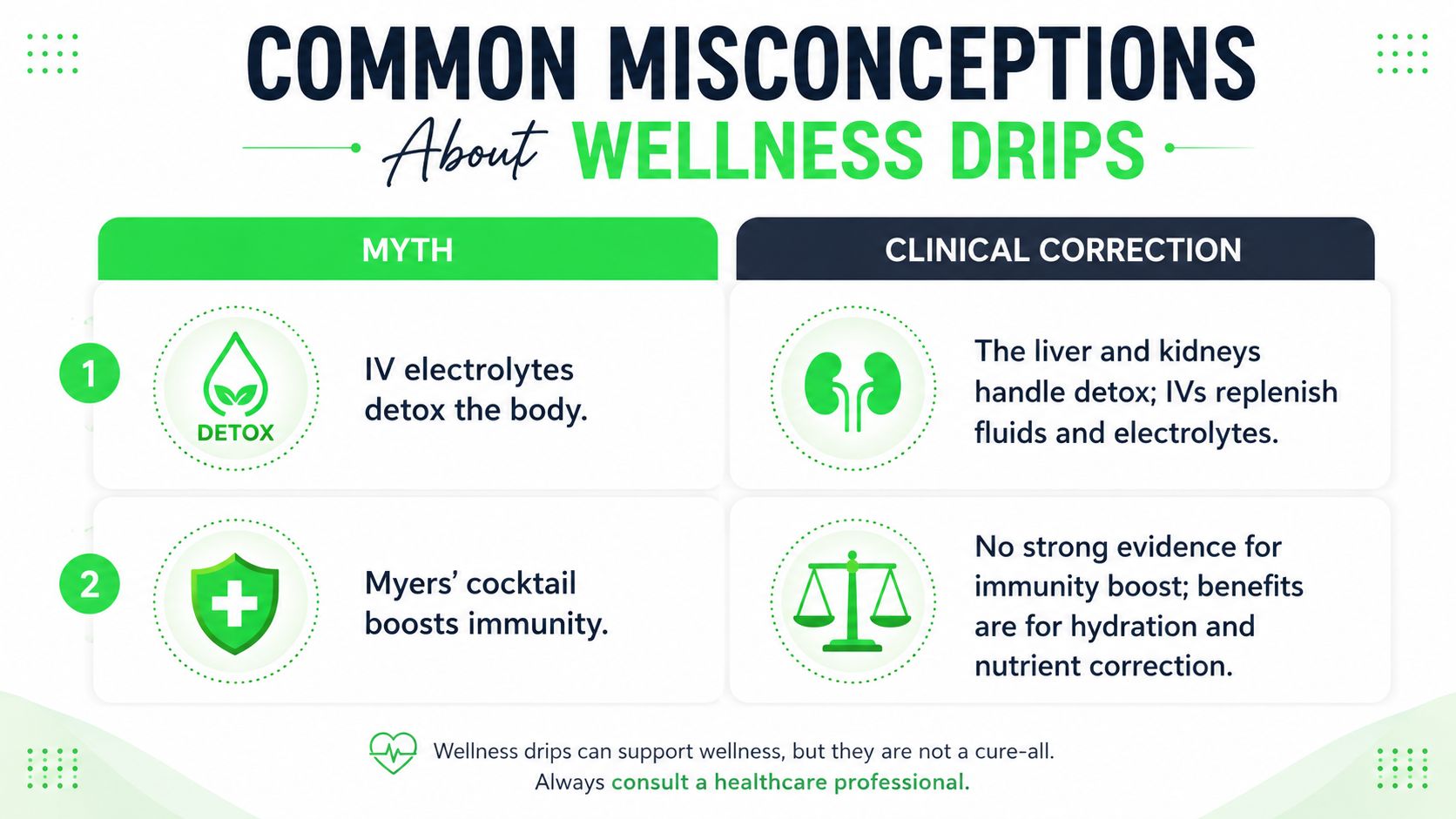
Myth: IV electrolytes detox the body. The liver and kidneys already process and remove many waste products. An IV can replace fluid and electrolytes when a deficiency exists, much like refilling a tank that has run low. It does not replace those organs or give a healthy person a special cleanse.
Myth: A Myers' cocktail boosts immunity in healthy adults. Vitamins and minerals may help correct a documented deficiency or support treatment for a specific clinical problem. That does not establish a general immunity benefit for everyone. The clinician must consider the ingredients, dose, kidney function, medicines, allergies, and reason for treatment.
Myth: Anyone can safely prescribe weekly drips. Repeated treatment requires assessment, not a routine membership schedule. Kidney disease can reduce potassium clearance, while heart failure can make extra fluid harmful. High blood pressure, pregnancy, medication interactions, allergies, or an undiagnosed illness can also change the risk.
Myth: Normal saline and balanced crystalloids are interchangeable. Both are crystalloid fluids, but their electrolyte and buffer profiles differ. The suitable option depends on circulation, the type of fluid loss, kidney function, acid-base status, and the treatment goal. A drip chosen for convenience may be unsuitable for the patient.
A safe service begins with clinician-led assessment. The Dubai IV drip safety review notes that DHA requirements include a doctor's prescription, documented assessment, and recording the fluid type, volume, and flow rate before infusion. Those records show what was given and why.
A wellness label doesn't remove medical risk. Safe IV therapy follows the same clinical discipline as other outpatient treatment.
The 2026 intravenous fluid therapy guidance states that fluid type and volume should match the patient's condition, intravascular volume status, and electrolyte levels. For stable patients, a clinician may select an isotonic crystalloid, such as a balanced solution or 0.9% sodium chloride, but the choice still requires individual assessment.
What a Safe Home IV Electrolyte Session Looks Like in Dubai
A safe home visit should feel like a clinical appointment in your home, hotel, or office. Before a bag is connected, a doctor or qualified clinician should decide why IV therapy is being considered and whether oral rehydration or emergency care is safer. In Dubai's heat, sweating can contribute to fluid and electrolyte loss, but heat exposure alone does not make an IV necessary.
Before the nurse arrives
The process should start with a provider licensed to deliver healthcare in Dubai. A clinician may use telephone or telehealth triage to ask about heat exposure, vomiting, diarrhoea, urine output, chronic disease, allergies, pregnancy, medications, and previous reactions. If IV treatment is appropriate, the doctor prescribes the fluid and records the treatment plan.
The prescription should specify the fluid type, volume, and flow rate. The provider should explain oral alternatives, expected sensations, possible complications, and the symptoms that would require a different plan. Identity checks, allergy screening, and consent should happen before cannulation.
A wellness label does not remove medical risk. The fluid must suit the patient's condition, not just the reason for the booking.
The Dubai IV drip safety review notes that DHA requirements include a doctor's prescription, documented assessment, and records of the fluid type, volume, and flow rate before infusion. These details show what was administered and why.
During the infusion
A registered nurse should use sterile, single-use equipment and compare the bag with the prescription. Baseline observations may include pulse, blood pressure, temperature, breathing, oxygen saturation when clinically relevant, and the patient's general appearance.
After inserting and securing the cannula, the nurse starts the infusion at the prescribed rate and monitors the patient. Pain, swelling, redness, leakage, breathlessness, chest discomfort, rash, sudden headache, confusion, or worsening weakness requires immediate reassessment. A small needle does not make an IV harmless.
After the bag finishes
The handover should record what was administered and how the patient responded. It should also include oral hydration guidance, cooling advice when heat exposure contributed, relevant medication instructions, and clear escalation criteria.
Seek emergency help instead of continuing a home infusion for confusion, fainting, suspected heatstroke, severe breathing difficulty, chest pain, persistent inability to drink, rapidly worsening weakness, or very low or absent urine. These symptoms may require hospital testing and treatment.
Before booking, ask for the provider's DHA licensing details and confirm that the visiting clinician is authorised. Ask who will prescribe and administer the fluid, which observations will be recorded, and whether referral can be arranged if home care is unsuitable. Vitals Healthcare Doctor On Call offers doctor and nurse home visits, mobile assessment, diagnostics, and IV hydration by licensed professionals in homes, hotels, and offices.
If you have dehydration, cramps, vomiting, heat-related weakness, or uncertainty about oral fluids, Vitals Healthcare Doctor On Call offers clinician-led home assessments and IV hydration in Dubai. Discuss your symptoms and medical history before arranging an electrolyte infusion.