
Dubai has very few licensed residential elder-care facilities, so regulated in-home care is a practical and often preferred alternative for most families. The right choice depends on whether your parent needs accommodation, continuous nursing supervision, rehabilitation, dementia support, or help that can safely be organised at home.
A hospital discharge can turn an ordinary Dubai household into a care operation overnight. An adult child may be arranging medication, mobility support, physiotherapy, follow-up appointments and supervision while still working and managing family responsibilities. Searching for an “old age home in Dubai” may seem like the obvious first step, but residential availability is limited and the regulatory category matters.
The more useful question is not where a parent can live. It's which care model can deliver safe, continuous and appropriate support, while preserving dignity and meeting Dubai's licensing requirements.
Table of Contents
- Why This Decision Matters More Than You Think
- Understanding Dubai Elder Care Regulations
- Comparing Residential Facilities and In-Home Care
- Real Costs Behind Each Care Model
- When Each Care Model Fits Best
- How to Choose the Right Care Provider
- Making a Confident Care Decision
Why This Decision Matters More Than You Think
A family may begin with a parent who has returned home after hospital treatment. The parent can communicate clearly, but struggles to stand, needs help bathing and forgets medication times. One relative wants a residential facility because supervision feels safer. Another believes familiar surroundings will support recovery. Both concerns are reasonable, but neither answer works without assessing the actual care burden.
Dubai doesn't offer a broad, informal market of residential old-age homes. Its long-term care system is organised around licensed categories, including convalescence facilities, nursing homes and palliative care or hospice facilities, all subject to Dubai and UAE requirements under the Dubai Health Authority's long-term care standards. That means a listing that sounds like accommodation may not be authorised to provide nursing, medication management or therapeutic support.

The choice is shaped by supply
Dubai-focused reporting cites Dubai Statistics Centre data indicating that about 170,000 people in Dubai are aged over 55, while expatriates represent almost 92% of the emirate's population as reported in this senior-living overview. A separate UAE business guide cited in the same discussion says approximately 5% of the UAE population is aged 60 and above, with that share rising.
Those figures don't mean every older person needs institutional care. They do show why families are asking more carefully about the available models. Dubai's older population includes residents with different citizenships, family arrangements, languages, insurance policies and expectations about remaining at home. A residential solution designed for one group may not suit another.
Practical rule: Treat “old age home” as a search phrase, not as proof that a provider offers licensed long-term care.
The UAE's policy framework also recognises formal senior support. Federal Law No. 9 of 2019 established rights for Senior Emiratis, including access to Senior Emiratis' Establishments free of charge under specified controls and the possibility of Alternative Family care with prior approval when family support is unavailable. The practical result is a care environment built around regulated services, family participation and home support, rather than a large private retirement-home sector.
Understanding Dubai Elder Care Regulations
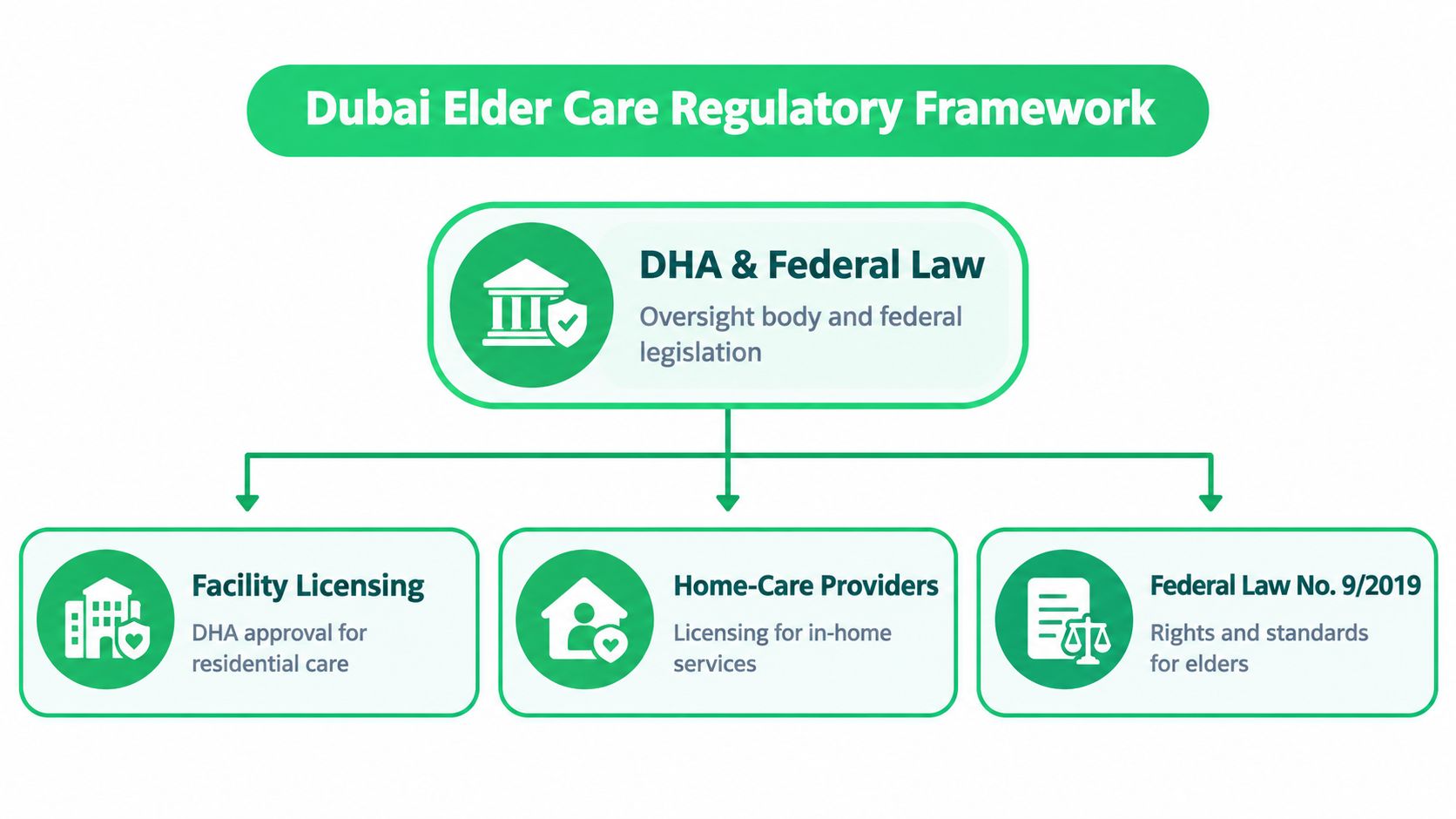
Regulation is the first filter, not an administrative detail to check after choosing a provider. A residential centre that delivers nursing or other long-term clinical care must fit a DHA-approved facility type. An independent home healthcare provider operating in Dubai also requires a DHA licence, and long-term care providers must follow DHA procedures and applicable UAE and Dubai law under the DHA's home healthcare requirements.
What licensing should cover
Ask the provider to identify the exact scope of its licence. “Senior care” may refer to companionship and daily assistance, while a parent may need skilled nursing, wound care, injections, medication support, rehabilitation or palliative services. Those are different operational responsibilities.
A credible provider should be able to explain:
- Facility classification: Whether the centre is approved as a convalescence facility, nursing home, palliative care or hospice facility, where applicable.
- Clinical staffing: Which nurses, physicians, therapists and support workers are involved, and whether their credentials meet DHA requirements.
- Care governance: How staff document assessments, medication administration, incidents, changes in condition and communication with family.
- Inspection readiness: Whether the organisation can demonstrate that its premises, records and clinical processes are maintained for regulatory inspection.
- Escalation procedures: Who responds when a resident falls, develops breathing problems, becomes acutely confused or needs hospital transfer.
Federal Law No. 9 of 2019 also matters because it frames senior care as a rights-based responsibility. Senior Emiratis aged 60 and above are guaranteed medical care that includes preventive services, mobile nursing units and supportive medical devices on the official UAE platform for senior Emirati rights and protections. Providers can face penalties for abuse or neglect, so safeguarding isn't optional.
For families comparing systems internationally, a guide to HIS and RQIA rules can help explain how another regulated care environment approaches inspection and quality oversight. It shouldn't replace Dubai-specific verification, but it can clarify why licensing, documented care plans and inspection evidence deserve close attention.
For a Dubai-focused explanation of home-based support, families can also review this guide to elderly care in Dubai. The key question remains local and direct: can this provider legally deliver the level of care your parent needs?
Comparing Residential Facilities and In-Home Care
Residential and home-based care solve different problems. A facility provides a controlled environment with staff and routines on site. Home care keeps the older person in familiar surroundings, but requires careful coordination between the family, clinicians and the home itself.
| Criteria | Residential Facility | In-Home Care |
|---|---|---|
| Medical support | Staff and clinical services may be available on site, depending on the licensed category and care plan | Nurses, doctors and therapists visit according to an agreed schedule; urgent changes need an escalation plan |
| Family involvement | Relatives visit and participate in decisions, but daily care is delivered within the facility | Family remains closely involved in routines, communication and the home environment |
| Regulatory oversight | The premises, facility category, staffing and records fall within the centre's licensed operation | The home healthcare provider must hold the appropriate DHA licence and document service delivery |
| Daily living environment | Structured routines, shared spaces and planned activities | Familiar home, personal belongings and existing routines, with modifications where needed |
| Changing care needs | The facility may absorb some changes if it has the right clinical capability and capacity | The care plan can expand or reduce, but added visits, equipment or specialist services must be coordinated |
| Family workload | Less hands-on responsibility, although relatives still monitor quality and decisions | Greater responsibility for selecting, scheduling and reviewing services |
| Home suitability | The facility is designed for its approved purpose | Mobility, bathroom access, lighting, fall hazards and caregiver space must be assessed |
Medical complexity changes the balance
A person who needs companionship and help preparing meals may not need a residential placement. Someone requiring continuous observation, frequent transfers or complex nursing may need a facility with the correct capability, or a carefully staffed home-care arrangement. Neither label is enough by itself.
Home care can include geriatric assessment, skilled nursing, home-safety assessment and modification, rehabilitation, nutritional evaluation, psychological assessment and multidisciplinary support. Families considering adaptations can use this practical resource on ageing-in-place remodelling to think through bathrooms, access routes and safer daily movement, even though the construction guidance comes from another market.
The home model works poorly when relatives assume one caregiver can cover every need indefinitely. It also fails when a provider sends staff without a written care plan, escalation process or clear replacement arrangements for absence. Residential care, meanwhile, may reduce family workload but can create distress if the parent feels displaced, isolated or unable to maintain familiar routines.
A useful Dubai-specific overview of home care options can help families map services to needs. The decision should then be tested against the parent's mobility, cognition, medical risks, home layout and available family support.
Real Costs Behind Each Care Model
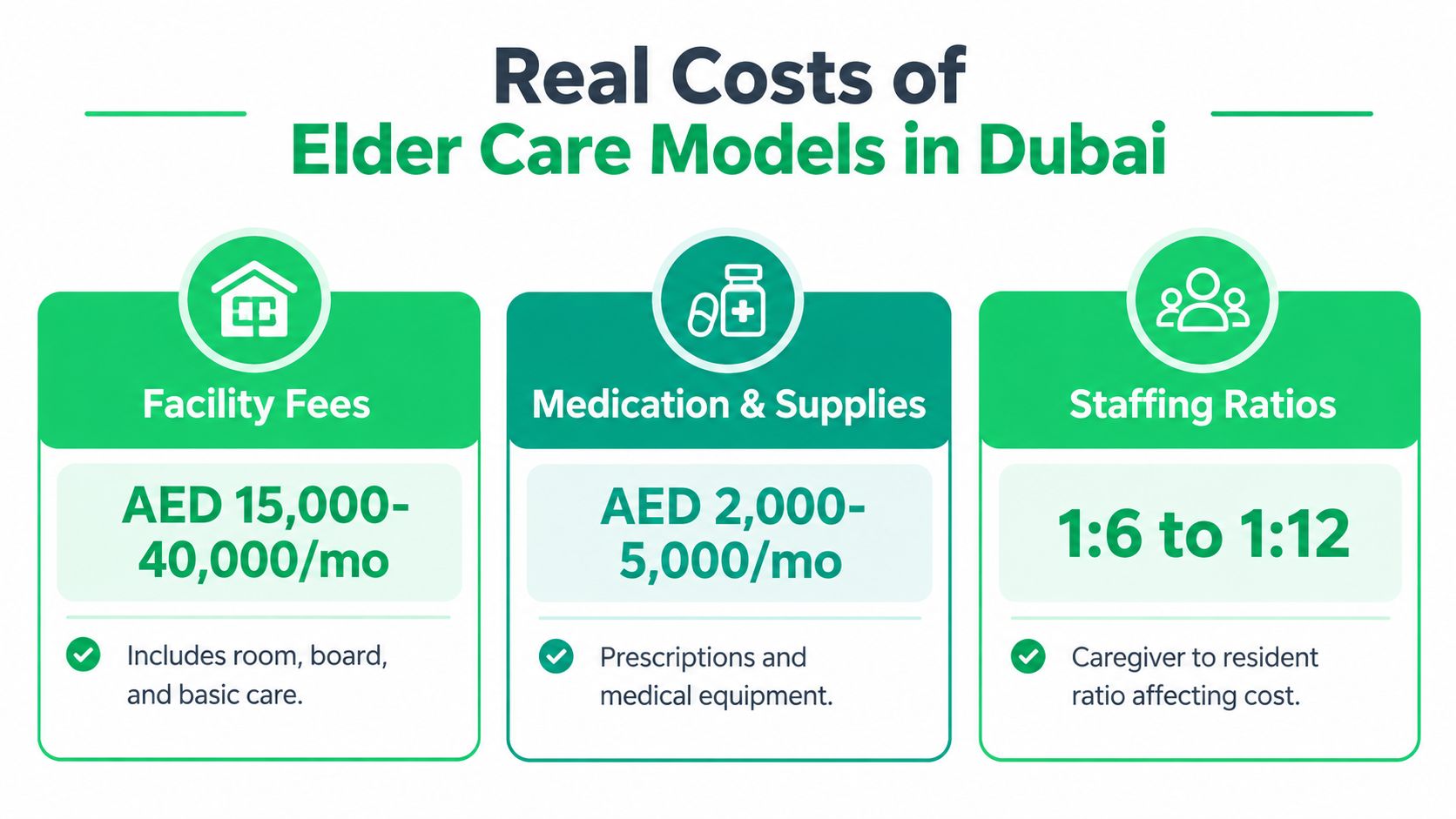
Families often ask for a monthly price before defining the service. That approach produces unreliable comparisons. A facility fee may include accommodation and basic support but exclude specialist treatment, medication, transport, equipment or hospital-related expenses. Home care may look simpler until several services need to be coordinated.
The correct budget starts with a written care specification:
- Clinical input: Doctor reviews, nursing visits, medication administration, wound care and monitoring.
- Daily assistance: Bathing, dressing, transfers, meals, toileting and companionship.
- Therapy: Physiotherapy, occupational input or rehabilitation after illness.
- Equipment: Mobility aids, pressure-relieving products, continence supplies and other medically indicated items.
- Coordination: Family communication, appointment scheduling, reports and replacement staff.
Where residential expenses accumulate
Residential care can combine room, food, basic personal assistance and some clinical oversight in one agreement. That apparent simplicity is useful, but families should ask what happens when needs exceed the standard package. Extra nursing attention, specialist reviews, ambulance transport, hospital transfers, consumables and additional supervision may sit outside the headline fee.
The staffing model matters as well. A centre should explain how many staff are present during day and night shifts, how it manages leave, and whether the advertised team is shared across residents. A low headline cost may reflect limited one-to-one attention rather than genuine value.
What home care requires you to price
Home care may be billed by visit, hour, shift or an agreed package. Families should confirm whether consultation, travel, night attendance, urgent call-outs, physiotherapy, nursing procedures and reports are billed separately. Live-in arrangements also need clarity around rest periods, accommodation expectations, relief cover and what happens when the assigned caregiver is unavailable.
Insurance doesn't automatically cover every form of elder support. A service may be medically necessary yet still require pre-authorisation, a referral, specific documentation or direct payment by the family. UAE data cited by UNFPA indicates that at least 97% of older persons in Dubai are protected by health insurance in the referenced regional analysis. That makes it sensible to ask the insurer and provider the same question in writing: what is covered, under which benefit, and with which documentation?
Families can use this financial planning guide for long-term elderly care to organise those questions. The cheapest model on paper may become expensive if it creates missed medication, repeated emergency visits or unsuitable staffing.
When Each Care Model Fits Best
A care model becomes clearer when the family describes a normal day rather than a diagnosis. “Post-operative” or “early dementia” doesn't explain whether the person can transfer safely, recognise danger, eat independently or call for help.

After hospital discharge
A parent recovering from surgery may need wound observation, medication support, mobility practice and physiotherapy. If the home can be made safe and relatives can participate in planning, scheduled nursing and therapy visits may be more comfortable than moving the parent immediately.
This approach only works if someone tracks changes. Increasing pain, fever, confusion, falls or inability to eat should trigger a defined clinical escalation rather than an informal family discussion. The provider should give written instructions and identify who can assess the parent when the recovery doesn't follow the expected path.
With cognitive decline
A person with moderate cognitive decline may wander, miss meals, become distressed at night or struggle with unfamiliar caregivers. A structured residential environment can offer consistent routines and staff presence, but only if the facility is licensed and equipped for the person's cognitive and behavioural needs.
Home care may still work where the parent remains settled in familiar surroundings and the family can maintain reliable supervision. It becomes fragile when relatives rotate informally, instructions differ between caregivers and no one owns the care plan.
With isolation and light assistance
An independent older person who mainly needs companionship, help with shopping, meal preparation, transport or household safety may benefit from home-based support. Keeping ordinary routines can preserve confidence and make assistance feel proportionate rather than institutional.
Respite care can also help relatives sustain this arrangement without treating family availability as unlimited. This Dubai respite-care guide is useful when a family caregiver needs planned relief, temporary support or a controlled trial of additional help.
The best match is the one that meets the parent's risks without taking away more independence than necessary. If needs rise, the plan should be able to move from companionship to nursing, or from home care to a licensed facility, without waiting for a crisis.
How to Choose the Right Care Provider
Start with verification, not a sales visit. Ask for the provider's DHA licence, confirm that the licence covers the service being offered, and check whether the named clinicians are appropriately credentialed. A polished website can't substitute for a documented legal scope.
Use a repeatable screening process
- Describe the care need in writing. Include diagnoses, mobility, cognition, medication responsibilities, continence, falls, diet and the support needed overnight.
- Request a care plan before signing. It should identify tasks, visit frequency, responsible staff, escalation routes and family communication.
- Test staff continuity. Ask who covers sickness, leave and emergencies. Frequent unexplained substitutions can undermine dementia care and medication routines.
- Observe the service. At a facility, look at cleanliness, odour, call-bell response, staff tone, privacy and resident engagement. At home, assess punctuality, hand hygiene, documentation and respect for the parent's preferences.
- Check the exit terms. Understand notice periods, refunds, replacement arrangements, incident reporting and how the provider responds if the care level changes.
Ask, “What happens at 2am when this resident falls?” The answer reveals more than a brochure.
Families should also ask how the provider measures outcomes. For home care, that might mean tracking mobility, appetite, medication adherence, skin condition, sleep or falls. For residential care, ask how relatives receive updates and how changes in behaviour or health are documented.
Official Dubai channels, including the Community Development Authority's Elderly Happiness and Home Care, or Weleef, initiatives, provide useful context for the city's formal senior-support ecosystem. DHA directories and licensing information should remain the reference point for healthcare providers. A practical checklist for choosing elderly care services in Dubai can help families record answers consistently instead of relying on first impressions.
Making a Confident Care Decision
There isn't one universally superior answer. Residential care may be appropriate when a parent needs a controlled setting, continuous supervision or services that the home cannot safely support. In-home care may be the better fit when the parent is stable, the environment can be adapted and family members can participate in a properly regulated plan.
The decision should rest on four tests:
- Safety: Can the parent receive the required supervision, medication support and emergency response?
- Capability: Does the provider have the right licence, staff and clinical scope?
- Sustainability: Can the family maintain the arrangement without relying on unrealistic unpaid availability?
- Adaptability: Can care increase, reduce or change location as the parent's condition develops?
Many families begin with home-based care because it preserves routine and avoids an unnecessary move. Others need residential support earlier because of falls, advanced cognitive decline, complex nursing needs or the absence of reliable supervision. Starting at home isn't a promise to remain at home permanently, and choosing a facility isn't a failure of family care.
Arrange a geriatric assessment, verify the provider's DHA credentials, ask the insurer for written coverage information and create a care plan with a review date. Agree in advance on the signs that would require more visits, specialist input, emergency assessment or a move to a licensed long-term care setting.
Vitals Healthcare Doctor On Call offers DHA-licensed doctor visits, nursing care, physiotherapy, home laboratory collection and elderly care at home across Dubai, including medication support, daily assistance and family coordination. If your parent needs a clinical assessment or a regulated home-care pathway while you compare longer-term options, visit Vitals Healthcare Doctor On Call to discuss care delivered at home.