

You wake in Dubai feeling hot, achy, and unusually tired. The thermometer confirms a fever, but it doesn't tell you why. You may have work, a flight, children to care for, or a hotel checkout ahead, and the question isn't only how high the temperature is. It's whether you can safely rest and watch, whether you need a clinician to assess you today, or whether something in the pattern needs urgent care.
Table of Contents
- When Fever Means More Than a Temperature Change
- Understanding How Viral Fever Develops
- Recognising Common Viral Fever Symptoms
- Comparing Viral Bacterial and Dengue Patterns
- Reading Fever Timelines and Warning Signs
- Using Safe Home Care for Viral Fever
- Knowing When to Seek Urgent Medical Care
- Making a Clear Next-Step Decision
When Fever Means More Than a Temperature Change
A resident in Jumeirah Village Circle wakes with fever, headache, and muscle pain two days after colleagues reported flu. Across the city, a hotel guest develops the same temperature a week after returning from a tropical trip, but she also has pain behind her eyes, nausea, and a rash. A parent in an office receives a call that a young child is feverish, vomiting, and drinking less than usual. The thermometer reading may look similar in all three cases. The safest next step may not be.
That's the first idea to hold onto. Viral fever symptoms describe a pattern linked to a viral infection, not one single disease. Fever is like a warning light on a dashboard. It tells you something needs attention, but it doesn't name the engine problem. Influenza, COVID-19, dengue, and other infections can all switch that light on, and bacterial illness can sometimes look similar at the start.
What changes the decision
Clinicians look beyond the number. They ask how quickly the illness began, which symptoms arrived together, how the person is drinking and breathing, and whether age, pregnancy, or chronic illness raises the risk. Recent travel and mosquito exposure matter too, especially in an international hub such as Dubai.
- Onset and duration: A sudden illness feels different from one that builds slowly or keeps worsening.
- Symptom cluster: Cough and sore throat point the conversation one way. Severe headache, eye pain, rash, or bleeding point it another way.
- Personal risk: A healthy adult, an older person, and a pregnant patient shouldn't follow the same wait and see plan.
Fever tells you to pay attention. The pattern around the fever helps you decide how quickly to act.
When the pattern is unclear, Vitals Healthcare On-Call Doctor can bring a clinical assessment to a Dubai home, hotel, or office. That visit can document vital signs and hydration, review medicines and risk factors, and clarify whether observation, testing, or escalation is the proportionate step. You're not expected to diagnose yourself from a thermometer.
Understanding How Viral Fever Develops
Start with a simple sequence. A virus enters the body, the immune system responds, and that response raises body temperature. The fever itself is part of the defence. Many of the miserable feelings that come with it, such as headache, widespread aches, fatigue, and reduced appetite, reflect the wider immune reaction and the body systems the virus affects. That's why two people with the same temperature can feel very different.
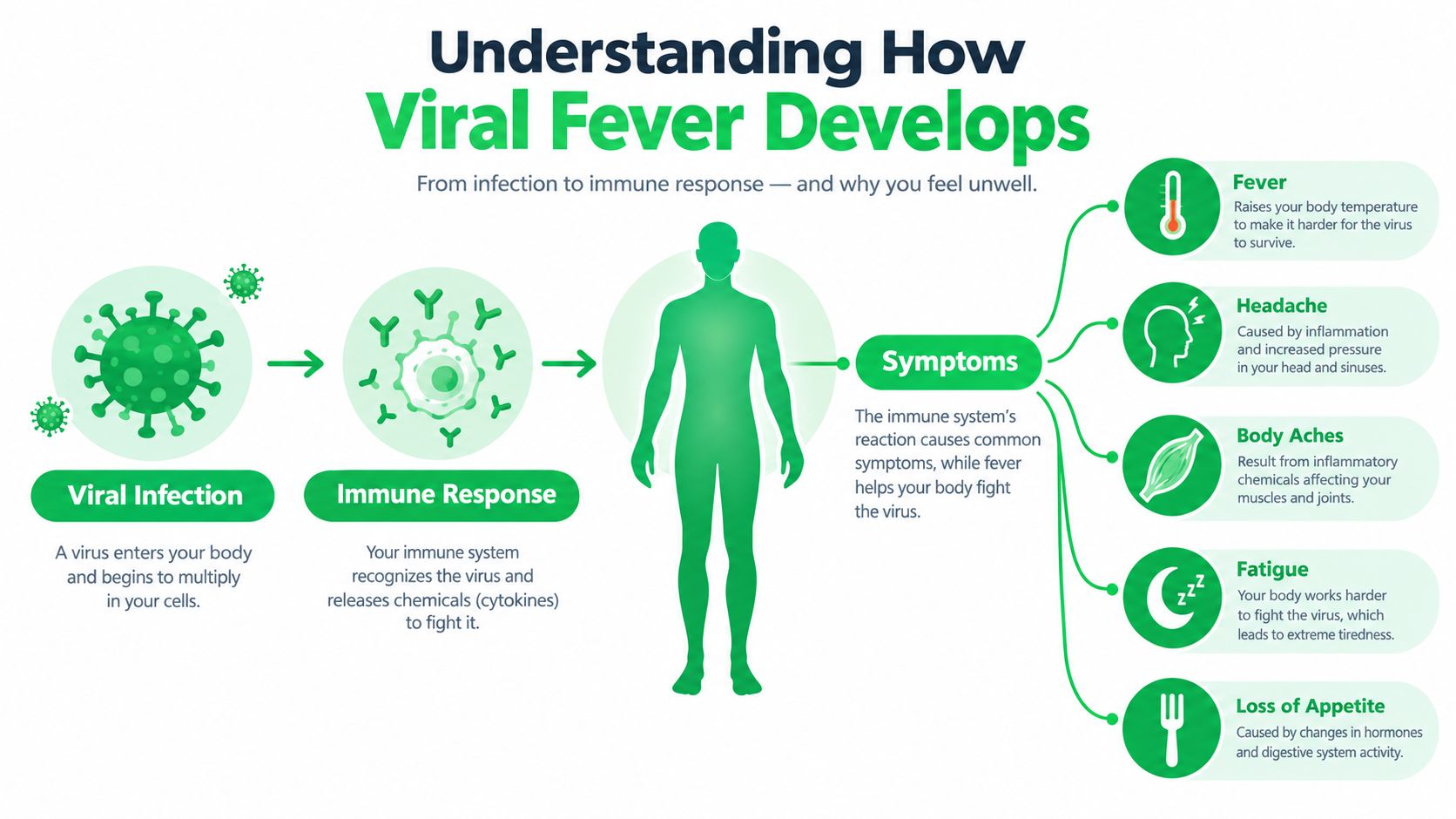
Viral fever is therefore an umbrella term. It isn't a confirmed diagnosis. A respiratory virus may mainly affect the nose, throat, and airways while also causing body pain and malaise. A mosquito-borne virus such as dengue may produce fever with severe headache, eye pain, nausea, and rash. The shared word viral shouldn't hide those differences.
Timing gives useful clues
Seasonal influenza often begins suddenly. The UAE Ministry of Health and Prevention seasonal influenza awareness guide describes an incubation period that's usually about 2 days, ranging from 1 to 4 days, with symptoms commonly subsiding within a week without medical intervention. A person may feel fairly well in the morning and unmistakably unwell by evening.
Dengue follows a different clock. The World Health Organization dengue questions and answers reports symptoms beginning 4 to 10 days after an infected mosquito bite, with illness commonly lasting 2 to 7 days. Knowing when you travelled, when mosquito exposure may have happened, and when fever started can therefore change the questions a clinician asks.
Why one reading isn't enough
A single temperature doesn't show direction. Is the fever new, settling, returning, or paired with worsening vomiting or breathlessness? Is the person drinking normally? Has there been recent travel? Those details turn a number into a timeline.
Practical rule: Record when symptoms started, not only the highest temperature. Onset, combination, and change over time often carry more weight than one reading.
Dubai guidance also reminds us that severity varies. The Dubai Health Authority influenza guideline notes that uncomplicated illness usually subsides within approximately one week, but disease can range from mild to hospital level. If you're unsure which path you're on, Vitals Healthcare On-Call Doctor can assess you where you are, review the full pattern, and advise whether home observation remains reasonable or testing and referral are needed.
Recognising Common Viral Fever Symptoms
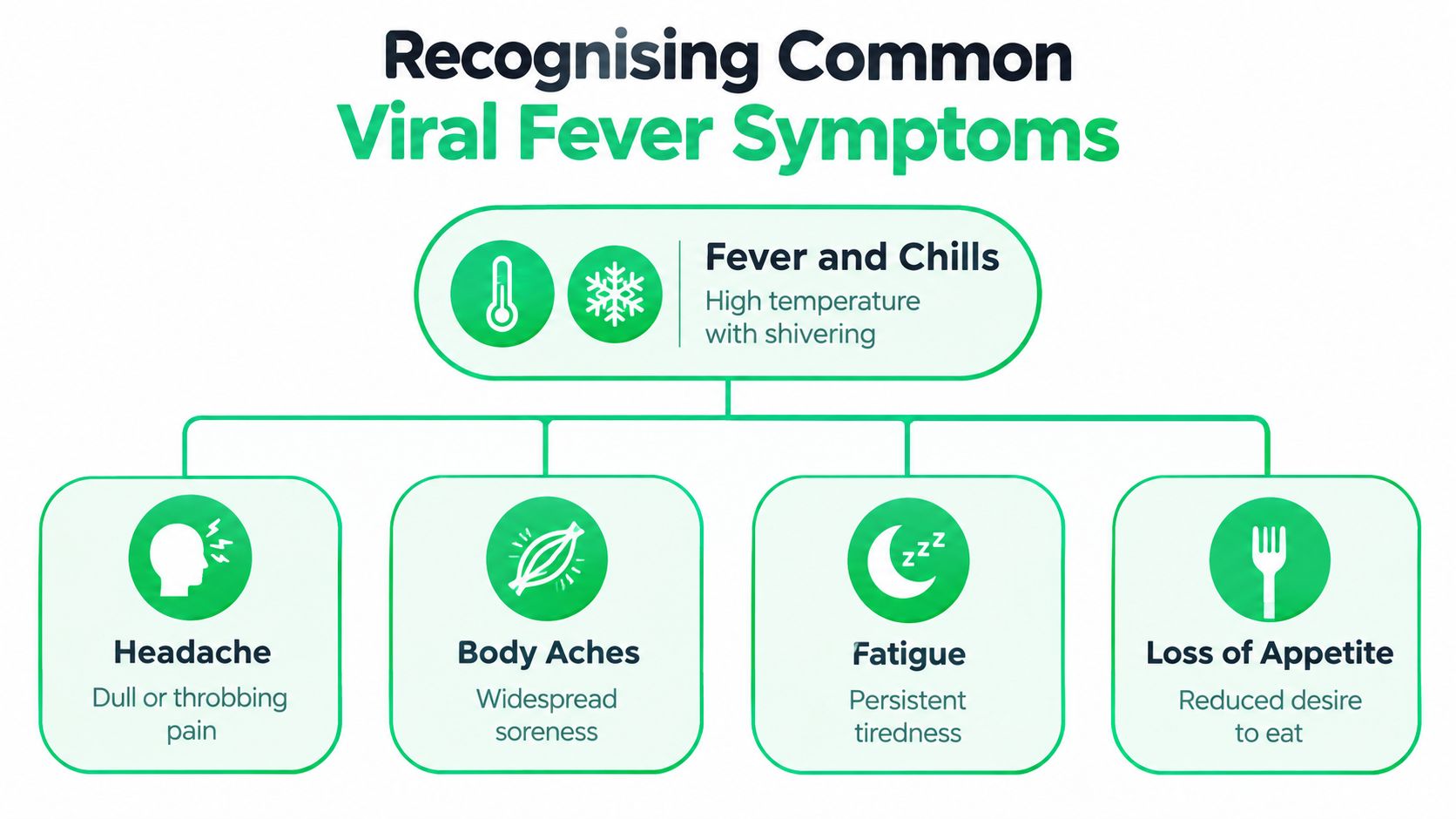
Think in layers rather than memorising a long list. At the centre is fever, sometimes with chills or shivering as temperature rises. Around it sit whole body symptoms that explain why you may feel unwell even when the temperature briefly improves. Then come organ specific clues, such as cough, vomiting, rash, or eye pain, which help a clinician narrow the possibilities.
Whole body symptoms
Headache, muscle or joint pain, fatigue, malaise, and loss of appetite often travel together. The MOHAP guidance on important influenza symptoms identifies sudden onset fever, cough, a runny or blocked nose, and muscle or joint pain as key features. That sudden, all over feeling is a useful clue, though it still doesn't prove influenza.
Respiratory and digestive clues
A respiratory cluster includes cough, sore throat, runny nose, and nasal congestion alongside fever and body pain. Children can broaden the picture. Younger children may also develop vomiting and diarrhoea, as noted in the MOHAP influenza awareness material cited earlier. Adults can have nausea too, so one digestive symptom shouldn't be used alone to label the illness.
- Respiratory cluster: Cough, sore throat, runny or blocked nose, headache, and myalgia suggest an influenza like pattern that still needs context.
- Digestive cluster: Nausea, vomiting, or diarrhoea matters most when fluids aren't staying down or dehydration develops.
- Dengue like cluster: Severe headache, pain behind the eyes, marked muscle or joint pain, nausea or vomiting, swollen glands, and rash need travel and mosquito questions.
Consider two examples. An office worker develops abrupt fever, cough, sore throat, and body aches during a workplace outbreak. That combination fits a familiar respiratory pattern. Another person returns from travel, then develops high fever with severe headache, retro orbital pain, vomiting, and rash. The second pattern shouldn't be casually called flu, because exposure history changes the risk assessment.
The same symptom can carry different weight in different company. Headache with a blocked nose is common in respiratory illness. Headache with eye pain, rash, and recent mosquito exposure prompts a different conversation. Vitals Healthcare On-Call Doctor can work through those combinations with you at home or in a hotel, without asking you to guess which cluster matters.
Comparing Viral Bacterial and Dengue Patterns
People often ask for a simple rule that separates viral from bacterial fever. There isn't a reliable home rule. Symptoms overlap, early illness can evolve, and a bacterial infection can occasionally follow a viral one. Comparison is still useful if you treat it as a guide to better questions, not as a diagnosis.
Influenza like illness in Dubai commonly produces sudden fever with headache, sore throat, runny nose, cough, myalgia or arthralgia, and malaise. A bacterial illness may instead draw attention to one focal area, such as severe throat pain, painful urination, a worsening cough with breathing difficulty, or a course that deteriorates rather than gradually improves. Those clues aren't absolute. They are reasons for assessment, especially when the pattern doesn't fit the expected viral course.
| Pattern | Possible Clues | History or Timing | Why It Matters |
|---|---|---|---|
| Influenza like viral illness | Sudden fever, cough, sore throat, runny nose, headache, body aches, malaise | Often abrupt onset, commonly settles within about a week if uncomplicated | Helps decide on isolation, supportive care, and whether high risk status needs earlier review |
| Possible bacterial illness | Focal pain, marked deterioration, severe local symptoms, or failure to follow an expected improving course | May be present from the start or develop after initial viral symptoms | Antibiotics only help when a clinician judges a bacterial cause is likely |
| Dengue like viral illness | High fever, severe headache, pain behind the eyes, nausea or vomiting, rash, swollen glands, body aches | Symptoms can begin 4 to 10 days after a mosquito bite and last 2 to 7 days | Bleeding risk and warning signs after fever falls change medication and monitoring decisions |
Dengue deserves separate attention because it's viral, yet it isn't managed like ordinary flu. The Dubai Health Authority circular on dengue surveillance in Dubai reflects local surveillance of dengue fever cases, and Emirates Health Services identifies dengue as transmitted by Aedes mosquitoes. If you're planning travel where mosquitoes are common, a mosquito protection guide for Thailand from Misaj can help you think about bite prevention before you go, which is far easier than reconstructing exposure after fever starts.
A falling temperature doesn't always mean recovery. With dengue, important warning signs can appear around or after the fever subsides.
That point also affects self medication. When dengue is possible, bleeding risk changes the safety profile of some pain medicines, so choices should be clinician directed rather than automatic. Don't delay assessment because the thermometer looks better.
If your symptoms resemble flu but you're high risk, worsening, or unsure about travel exposure, Vitals Healthcare On-Call Doctor can assess the pattern and advise on testing or referral. You can also review the service for influenza care with a doctor on call in Nad Al Shiba when an in person review at your location would help you decide.
Reading Fever Timelines and Warning Signs
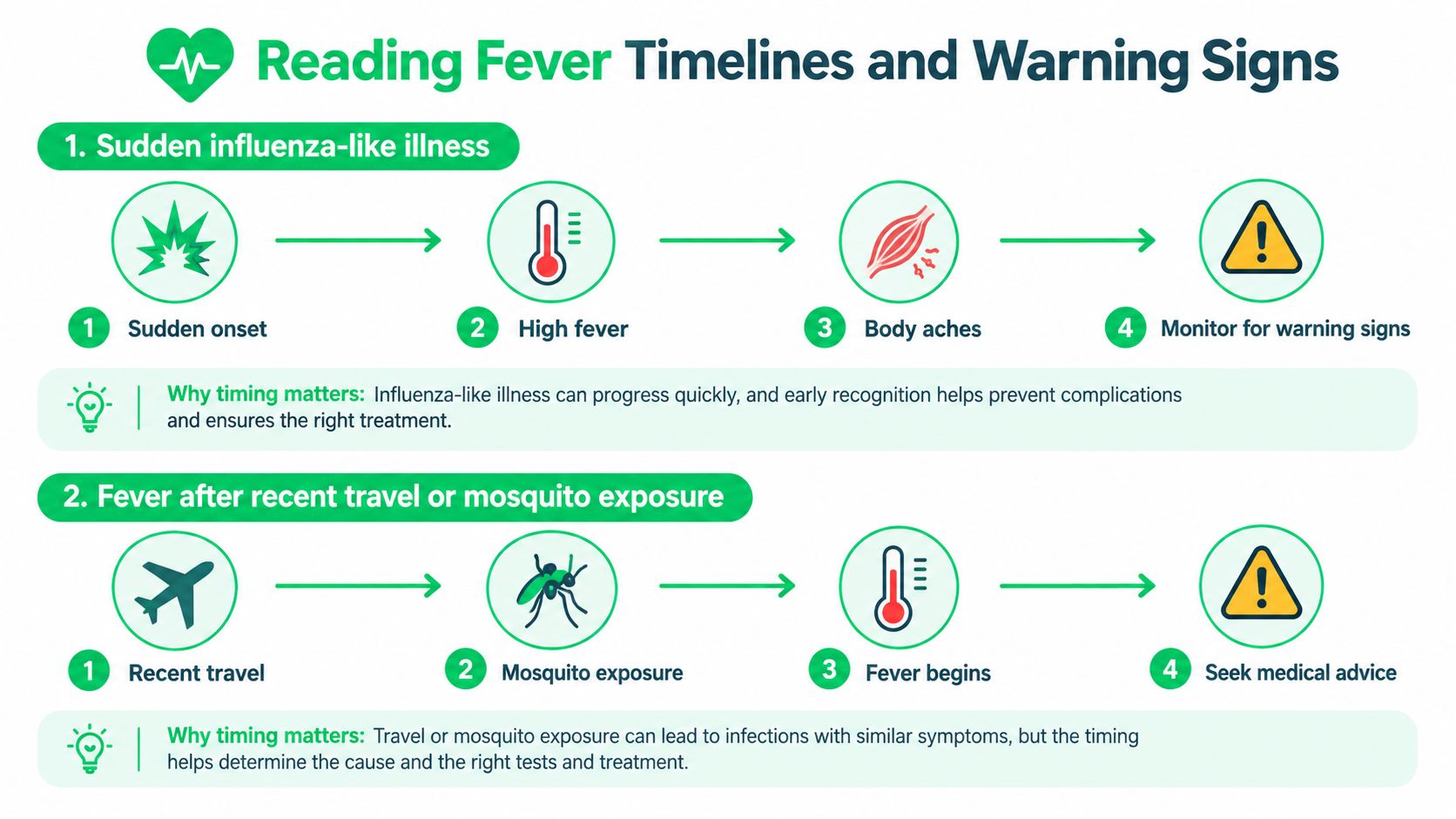
Timelines prevent two common mistakes. The first is calling every fever flu on day one. The second is assuming improvement in temperature always means the illness is ending. Ask when exposure may have happened, when symptoms began, and whether the overall condition is improving, flat, or worsening.
Two timelines that feel similar at first
An influenza like illness may start abruptly with fever, cough, sore throat, and body aches, then gradually ease over several days. A travel linked illness may begin days after return, with fever plus severe headache, eye pain, nausea, or rash. Dubai guidance describes dengue as an acute illness lasting roughly 2 to 10 days with high fever and at least two associated findings, a pattern set out in the UAE Department of Health dengue clinical guidance. Fever during travel or within roughly two weeks after returning should prompt you to share destinations and dates.
Local relevance isn't theoretical. The UAE Ministry of Health and Prevention 2023 Statistical Annual Report recorded 2,414 dengue fever cases, and appropriate medical care reduces dengue fatality to below 1%. Preparedness reporting in Gulf News coverage of UAE dengue control teams listed nine specialised teams, 409 eliminated mosquito breeding sites, 1,200 mosquito surveys, and 134 health facilities equipped for dengue related services in May 2024.
Changes that raise urgency
- Fluid warning signs: Persistent vomiting, marked thirst, reduced urination, or inability to keep fluids down.
- Breathing or brain warning signs: Rapid or difficult breathing, confusion, lethargy, restlessness, or altered consciousness.
- Dengue warning signs: Severe abdominal pain or tenderness, mucosal bleeding, bleeding gums, blood in vomit or stool, fluid accumulation, or pronounced weakness.
The WHO dengue outbreak toolbox stresses that severe symptoms often begin after fever has subsided. Older adults, pregnant patients, young children, and people with chronic cardiopulmonary, metabolic, or immune conditions shouldn't use the same low risk pathway as a healthy adult. When blood testing is part of the assessment, Vitals Healthcare On-Call Doctor can advise whether a full blood test at home or urgent facility based testing is more appropriate.
Using Safe Home Care for Viral Fever
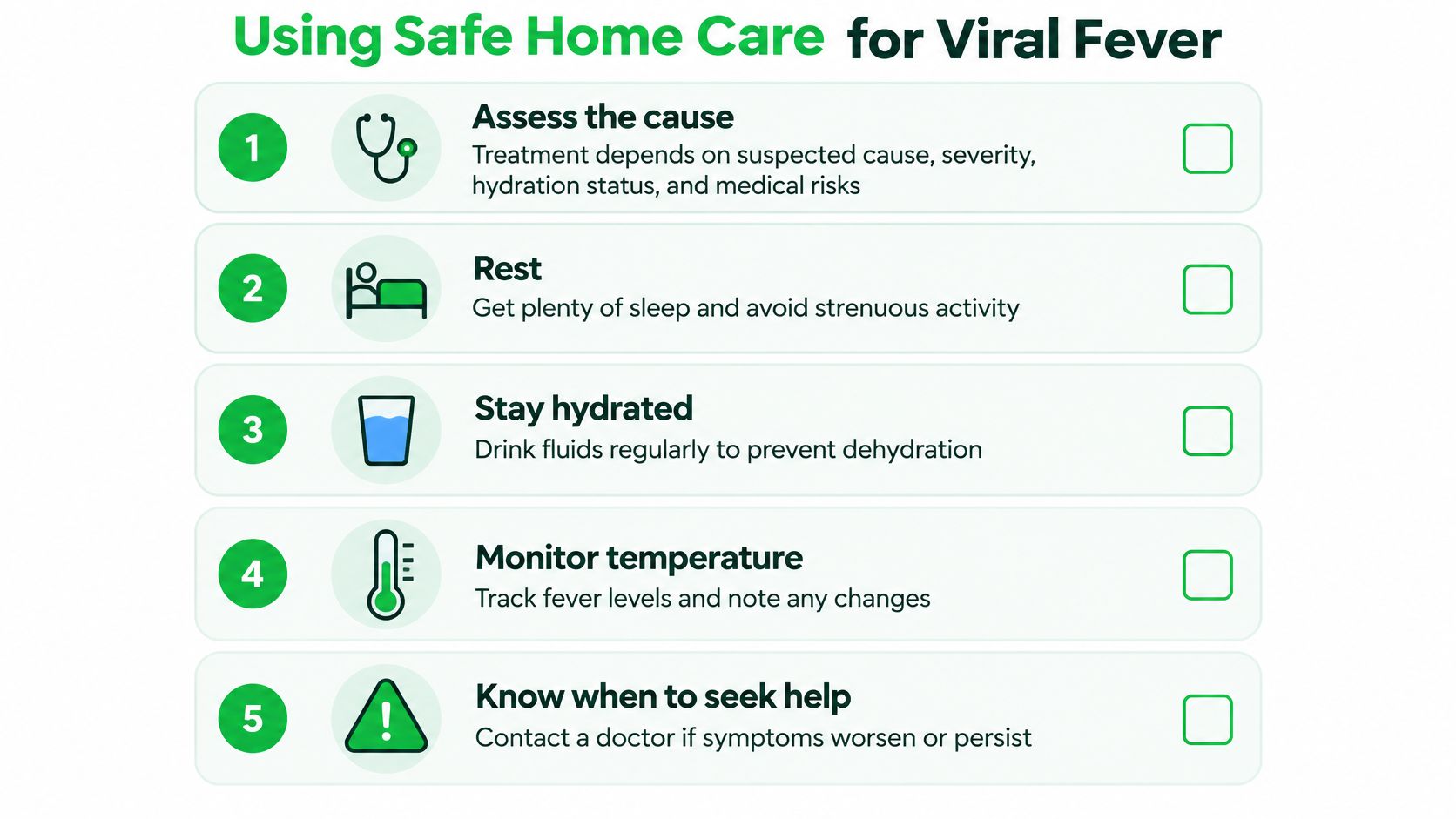
Safe home care starts with a question, not a medicine cupboard. What's the likely pattern, how severe is it, and is the person hydrated and breathing comfortably? If the illness looks mild, the person is lower risk, and there are no warning signs, supportive care and close observation may be reasonable. If any of those conditions change, the plan should change too.
A sensible sequence
- Rest and reduce contact: Stay home while feverish when you can, especially with respiratory symptoms, to limit transmission.
- Drink regularly: Take fluids in small, frequent amounts if nausea makes large drinks difficult, and watch urination and thirst.
- Eat lightly as tolerated: Appetite often returns gradually. Forcing heavy meals isn't necessary.
- Track the pattern: Note temperature, timing, fluid intake, vomiting, breathing, rash, and any new pain.
- Review medicines carefully: Don't casually combine products, and seek clinician guidance if dengue is possible or you take regular medication.
Three assumptions cause trouble. First, antibiotics don't treat viruses, so they shouldn't be started just because fever feels strong. Second, not every mild case needs a laboratory test. Abu Dhabi influenza guidance distinguishes mild uncomplicated illness from high risk, progressive, or severe disease, with testing indicated for high risk or worsening patients, as described in the Abu Dhabi 2025 to 2026 influenza guidance. Third, an IV drip isn't automatically necessary. Hydration treatment should follow assessment of vomiting, dehydration, kidney or heart disease, and possible dengue.
Hotel guests and office workers face an extra problem. They may not have a regular clinician nearby, and they may be tempted to push through. Vitals Healthcare On-Call Doctor can assess you on site, personalise advice to your medicines and medical history, and explain whether oral fluids are enough or whether IV therapy for dehydration should even be considered. That decision belongs after assessment, not before it.
Knowing When to Seek Urgent Medical Care
Use three levels. Emergency care now is for severe breathing difficulty, confusion or altered consciousness, bleeding, severe abdominal pain, persistent vomiting, signs of severe dehydration, pale or cold skin, or profound weakness. Don't wait for a home visit if those features are present. Suspected severe dengue belongs in emergency care.
Same day clinician review is prudent when fever follows recent travel or mosquito exposure, symptoms are worsening or unusually prolonged, the cause is uncertain, or the patient is older, pregnant, very young, or living with chronic heart, lung, metabolic, kidney, or immune conditions. Repeated vomiting, poor fluid intake, a new rash with severe headache or eye pain, or fever that improves then gives way to abdominal pain also deserve prompt review.
Information to have ready
- Who is ill: Age, pregnancy status, chronic conditions, allergies, and regular medicines.
- How it evolved: Onset date, temperature pattern, main symptoms, fluid intake, urination, and breathing.
- Where exposure may fit: Recent destinations and dates, mosquito bites, sick contacts, and any bleeding or rash.
That checklist helps Vitals Healthcare On-Call Doctor triage more safely before and during a visit at home, in a hotel, or at an office. If you're weighing a clinic trip against a visit at your location, this guide on fever or flu and when to call a home doctor instead of visiting a clinic can help you frame the choice. Emergency warning signs override convenience every time.
Making a Clear Next-Step Decision
Keep the decision simple. If illness is mild, you're lower risk, you're drinking adequately, and no warning signs are present, supportive care with close observation may be reasonable. If fever is worsening, the cause is uncertain, you're higher risk, or recent travel or mosquito exposure could matter, request a clinician's assessment. If an emergency warning sign is present, seek immediate emergency care.
For Dubai residents, hotel guests, visitors, and office workers, Vitals Healthcare On-Call Doctor offers an on site evaluation without a waiting room journey, plus guidance on testing, medicines, hydration, or escalation. You can learn how the doctor on call service works before you need it. Early assessment isn't about assuming the worst. It's about reducing uncertainty while the pattern is still developing.
If fever has left you unsure whether to rest, test, or seek urgent help, Vitals Healthcare Doctor On Call can assess viral fever symptoms at your home, hotel, or office in Dubai and advise on testing, hydration, medicines, or escalation. Visit Vitals Healthcare Doctor On Call to arrange a clinician visit when you need clear, on site medical guidance.