
You wake with itchy eyes, a blocked nose and a throat that feels permanently irritated. By the time you reach your phone, you're wondering whether the culprit is a cold, the air-conditioning, construction dust, a food reaction or something in your bedroom. After several weeks of repeating the same cycle, another antihistamine may feel easier than booking an allergy test in Dubai, but symptom relief alone won't tell you what's driving the problem.
The useful question isn't whether you should test. It's which test matches your symptoms, whether home collection is enough, and whether a positive result will change what you do next. This guide gives you a practical way to make that decision, including the trade-offs between skin testing, blood testing, patch testing, mobile collection and broad allergen panels.
Table of Contents
- Why Allergy Testing Matters for Dubai Residents and Visitors
- How Common Allergies Really Are Across the UAE
- Types of Allergy Tests Available in Dubai
- What Actually Happens During an Allergy Test
- At-Home and Hotel Allergy Testing in Dubai
- Allergy Test Costs in Dubai and What Drives the Price
- How to Choose the Right Allergy Test Provider
- Preparing for Your Allergy Test and Reading the Results
Why Allergy Testing Matters for Dubai Residents and Visitors
A Dubai resident may sneeze through the commute, work beneath air-conditioning and return to a bedroom where nasal blockage starts again. A visitor might develop hives after a restaurant meal or irritation soon after checking into a hotel. Repeating antihistamines can reduce symptoms, but it will not identify the trigger or show whether the exposure is still present.
Dubai residents regularly encounter dust, indoor allergens, mould and airborne irritants. Travellers can add unfamiliar foods, hotel environments and temporary exposures to that list. UAE studies report allergic rhinitis prevalence ranging from at least 7% in a nationwide sample to over 30% in regional subgroups, including 32% in an Al Ain study and 36% in another Gulf study (UAE allergy evidence).
Testing should answer a clinical question
Choose the test around the symptom pattern, not the size of the laboratory's menu:
- Repeated sneezing, itchy eyes or nasal blockage usually calls for an inhalant-focused assessment.
- Wheezing or recurrent cough may require allergy testing alongside respiratory assessment.
- Hives, swelling or vomiting soon after a food supports a targeted food allergy evaluation.
- A rash where jewellery, cosmetics or hair products touch the skin points more strongly towards contact allergy and may require patch testing.
- Bloating or vague fatigue alone does not justify a large allergy panel.
A focused result can guide practical action, such as reducing a specific exposure, choosing appropriate medication or seeking specialist treatment when symptoms remain difficult to control. Broad panels often create confusing positives that do not match real-life reactions. Home collection is convenient for an initial blood assessment, but it cannot replace an examination when breathing symptoms, widespread hives or a suspected severe reaction need clinical attention.
For a plain-language explanation of how testing guides treatment, see this overview of allergy testing as a secret weapon.
Practical rule: Test the pattern you have, not every substance you can place on a laboratory form.
How Common Allergies Really Are Across the UAE
A child in Dubai who wakes with a blocked nose, itchy eyes or nighttime cough may be reacting to a persistent indoor trigger, not a short seasonal flare. UAE research recorded the highest asthma prevalence in Dubai among the younger age group at 12.9%, while allergic rhinitis and hay fever were also common among children (UAE paediatric allergy study).
The setting helps explain why symptoms can continue. Dust, bedding, carpets, air-conditioning and other airborne exposures keep the nose and airways in contact with potential triggers. A northern UAE study found 64.4% of tested patients positive for at least one inhaled allergen (regional allergy research). That result describes sensitisation in a tested group, not proof that every positive allergen causes symptoms.
Common triggers in Dubai and the UAE
| Finding | What the evidence shows | Practical relevance |
|---|---|---|
| Inhaled allergens | 64.4% positive for at least one inhaled allergen in one tested northern UAE group (regional allergy research) | Dust, bedding, indoor air and other airborne exposures may sustain nasal or respiratory symptoms |
| Allergic rhinitis in children | 46.5% at age 6 to 7 and 51.3% at age 13 to 14 (UAE paediatric allergy study) | Persistent sneezing, nasal blockage and itchy eyes merit an inhalant-focused assessment |
| Hay fever in children | 22.1% at age 6 to 7 and 19.9% at age 13 to 14 (UAE paediatric allergy study) | Timing and outdoor exposure still matter before labelling symptoms as pollen allergy |
The practical conclusion is clear. Dubai's allergy burden supports testing when symptoms follow a consistent pattern, but it does not support ordering every available allergen. Broad panels can produce positives that have no connection to a patient's daily reactions. Match the test to the history, timing and exposure, then use the result to guide avoidance or treatment. A targeted answer is more useful than a long list of sensitivities.
Types of Allergy Tests Available in Dubai
A patient with morning sneezing needs a different work-up from someone who develops a rash after wearing a watch. The right allergy test depends on the timing of symptoms, the suspected trigger and the immune response under investigation. Skin prick and patch testing both involve the skin, but they answer different questions. Specific IgE blood testing can help when antihistamines or eczema make skin testing impractical. Total IgE alone rarely identifies the cause.
Match the test to the symptom
| Test | Best match | Main advantage | Main limitation |
|---|---|---|---|
| Skin prick testing | Immediate rhinitis, asthma or food reactions | Rapid in-clinic result | Antihistamines can interfere |
| Specific IgE blood testing | Medication users, severe eczema or selected broader panels | No skin exposure and no antihistamine washout | A positive result still needs clinical interpretation |
| Patch testing | Delayed contact dermatitis | Measures delayed contact reactions | Requires later readings |
| Component-resolved diagnostics | Ambiguous food or latex allergy | Adds molecular detail | More specialised and generally more expensive |
| Challenge testing | Uncertain food allergy after initial tests | Tests real-world clinical reactivity under supervision | Must be performed by an equipped clinical team |
Dubai allergy services use skin prick testing for suspected inhalant, food, medication, latex and insect-venom allergy. Intradermal testing, component analysis or a supervised challenge may be appropriate when first-line testing leaves the diagnosis unclear. Skin prick and specific IgE tests assess immediate hypersensitivity, while patch testing addresses delayed contact dermatitis.
Broad panels need restraint
Dubai providers offer regional panels that may cover dust mites, pet dander, pollens, moulds and common foods. Panel breadth, not test quality, drives much of the price difference between providers (Dubai regional allergy panels). A long list can look thorough when symptoms are vague, but it does not automatically produce a better diagnosis.
Broad testing may detect sensitisation with no connection to a patient's daily reactions. That can lead to unnecessary food restrictions, anxiety and repeat consultations. Choose inhalant, food or contact testing according to the symptom pattern, then ask a clinician to interpret the result alongside exposure history. Component-resolved diagnostics or challenge testing belongs with a specialist when the initial answer remains uncertain.
Home collection can be useful for a selected blood-based panel, particularly when travel, work or medication makes a clinic visit difficult. See practical guidance on lab tests you can book at home in Dubai, but do not treat home collection as a substitute for examination, skin testing or supervised challenge testing.
Dust control still matters after testing. Guidance on how mattress protectors block dust mites may help reduce bedroom exposure, while persistent or severe symptoms require clinical assessment.
What Actually Happens During an Allergy Test
A clinic visit usually starts with history, not a blood tube or a tray of allergen extracts. The clinician should ask when symptoms begin, where they occur, what you've eaten or touched, whether medication helps and whether you've experienced breathing difficulty, swelling or faintness.
For skin prick testing, small drops of selected allergens are placed on the forearm or back. The skin is lightly pricked through each drop, then observed for about 15 to 20 minutes before raised reactions are assessed. The service pathway described by Dubai providers may include intradermal testing when a first-line skin test doesn't provide enough sensitivity (Dubai allergy testing guidance).
Medication and timing matter
Antihistamines can suppress a skin reaction, so Dubai clinic guidance commonly advises stopping them for 5 to 7 days before skin prick testing (Dubai preparation guidance). Don't stop prescription medication without checking with the clinician who prescribed it. Blood-based specific IgE testing is useful when you can't pause antihistamines or when skin conditions make the test difficult.
A blood test involves a standard venous sample. The laboratory then measures specific IgE against the chosen allergens. Skin testing can produce a same-visit result, while blood testing may take longer depending on the laboratory and panel. Patch testing needs a different schedule because the patches remain in place and reactions are assessed later, often after about 48 hours (Dubai allergy service information).
A clear result is one that fits the story. An equivocal result may lead to a narrower repeat test, component testing or a supervised food challenge. A negative test shouldn't end the conversation if symptoms strongly suggest another diagnosis, such as irritation, infection, reflux or chronic urticaria.
If your schedule makes a clinic visit difficult, blood testing at home in Dubai can cover sample collection, but it doesn't replace the history and examination that determine which test is appropriate.
At-Home and Hotel Allergy Testing in Dubai
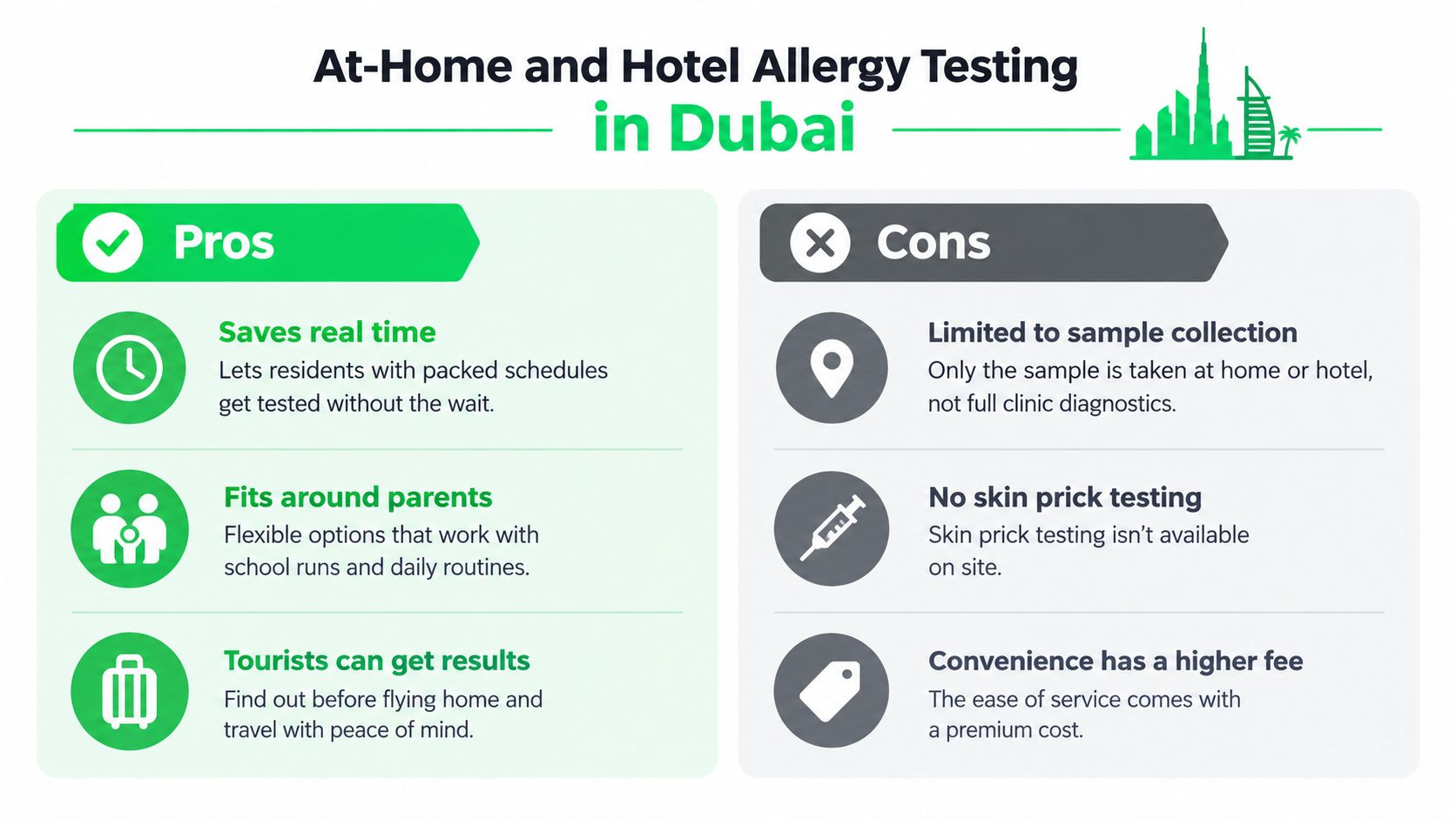
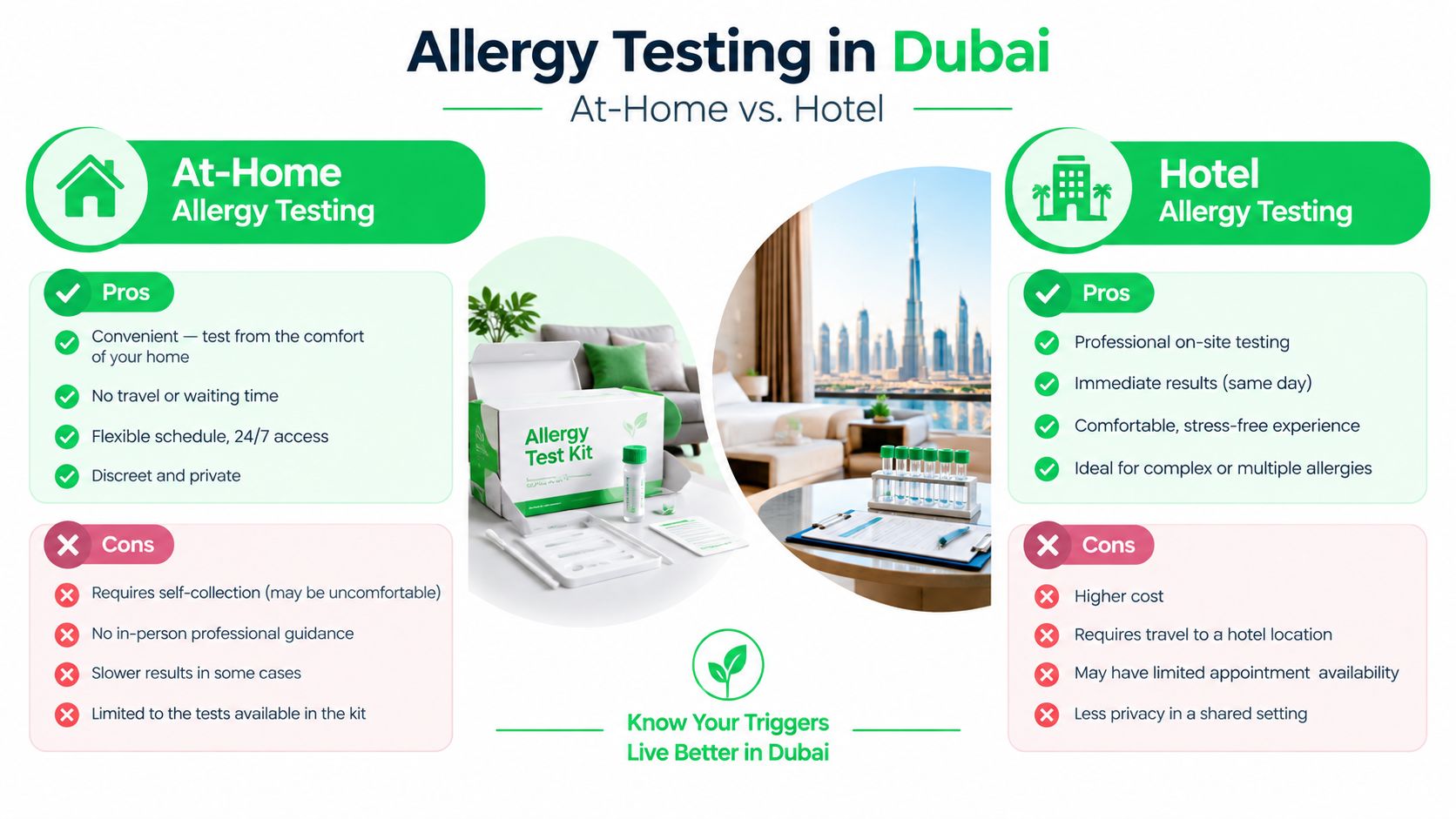
Home and hotel collection is useful when the main obstacle is access. A parent managing school runs, a professional working between meetings in DIFC or Media City, or a visitor leaving Dubai soon may reasonably prefer a nurse to collect a blood sample at the chosen location.
The typical process begins with a questionnaire and panel selection. A mobile clinician then collects venous blood or a capillary sample, sends it to a laboratory under controlled conditions and shares the report digitally. That convenience can prevent a delayed test, particularly when the patient already knows which blood-based investigation has been recommended.
Where mobile collection helps
Choose home or hotel blood collection when:
- You need a follow-up sample: A clinician has already selected the relevant specific IgE panel.
- You can't pause antihistamines: Blood testing avoids the skin-test washout issue described by Dubai clinic guidance (testing preparation advice).
- You're travelling: A hotel visit may be more practical than navigating a new clinic system.
- You need privacy or convenience: Collection at home avoids travel and waiting-room time.
The trade-off is important. Mobile collection doesn't provide a full physical examination, on-site skin prick testing, supervised oral food challenge or immediate management of an acute allergic reaction. It also makes it easier for a patient to order a broad panel without discussing whether each allergen matches the symptom history.
A home blood test is a collection service, not a complete allergy consultation.
For residents comparing mobile options, the mobile lab testing guide for Dubai is a practical starting point. My recommendation is clear: use home collection for a planned blood test, monitoring or a clinician-directed follow-up. For a first episode involving breathing symptoms, widespread hives, swelling or a suspected serious food reaction, book an in-person clinical assessment instead.
Allergy Test Costs in Dubai and What Drives the Price
A low quoted price can become expensive if it answers the wrong clinical question. Compare the service, not just the number. A targeted IgE panel, skin prick assessment, contact patch series and broad exploratory blood panel provide different information. The fee may also exclude the consultation needed to interpret the result and decide what to do next.
Published Dubai pricing gives a useful reference point: targeted IgE panels start at AED 850, while broader panels covering 40 or more allergens cost about AED 1,600 (Dubai allergy panel pricing). These are examples from one provider, not a universal Dubai tariff.
What you're paying for
Four factors usually drive the final price:
- Number of allergens: Each additional target adds laboratory work, though a larger panel is not automatically more useful.
- Testing method: Skin prick testing, specific IgE and component-resolved diagnostics answer different questions and require different levels of clinical input.
- Provider setting: A hospital immunology service may include specialist review, emergency readiness and follow-up.
- Interpretation: A report listing positive results without relating them to symptoms can create confusion rather than a safe action plan.
| Panel tier | Allergen count | Typical price in Dubai | Best for | Typical turnaround |
|---|---|---|---|---|
| Targeted regional IgE panel | Targeted selection | From AED 850 | A clear inhalant or food pattern | Laboratory-dependent |
| Broader regional panel | Broad selection | Around AED 1,600 | Several plausible exposures after clinical history | Laboratory-dependent |
| Skin prick assessment | Selected inhalant or food allergens | Provider-dependent | Fast, supervised assessment | Often same visit |
| Patch testing | Selected contact allergens | Provider-dependent | Delayed rash linked to products or materials | Requires scheduled readings |
| Component-resolved testing | Selected molecular components | Specialist pricing | Complex or unclear food and latex cases | Laboratory-dependent |
Avoid bargain panels promising hundreds of results for a very low fee. Pooled extracts, unclear reporting and no clinical explanation can turn a cheap test into an expensive detour. Ask what the quote includes: consultation, sample collection, laboratory analysis, written report and follow-up discussion. A broader blood test package may be convenient, but the panel should still match the symptom pattern and the decision you need to make.
How to Choose the Right Allergy Test Provider
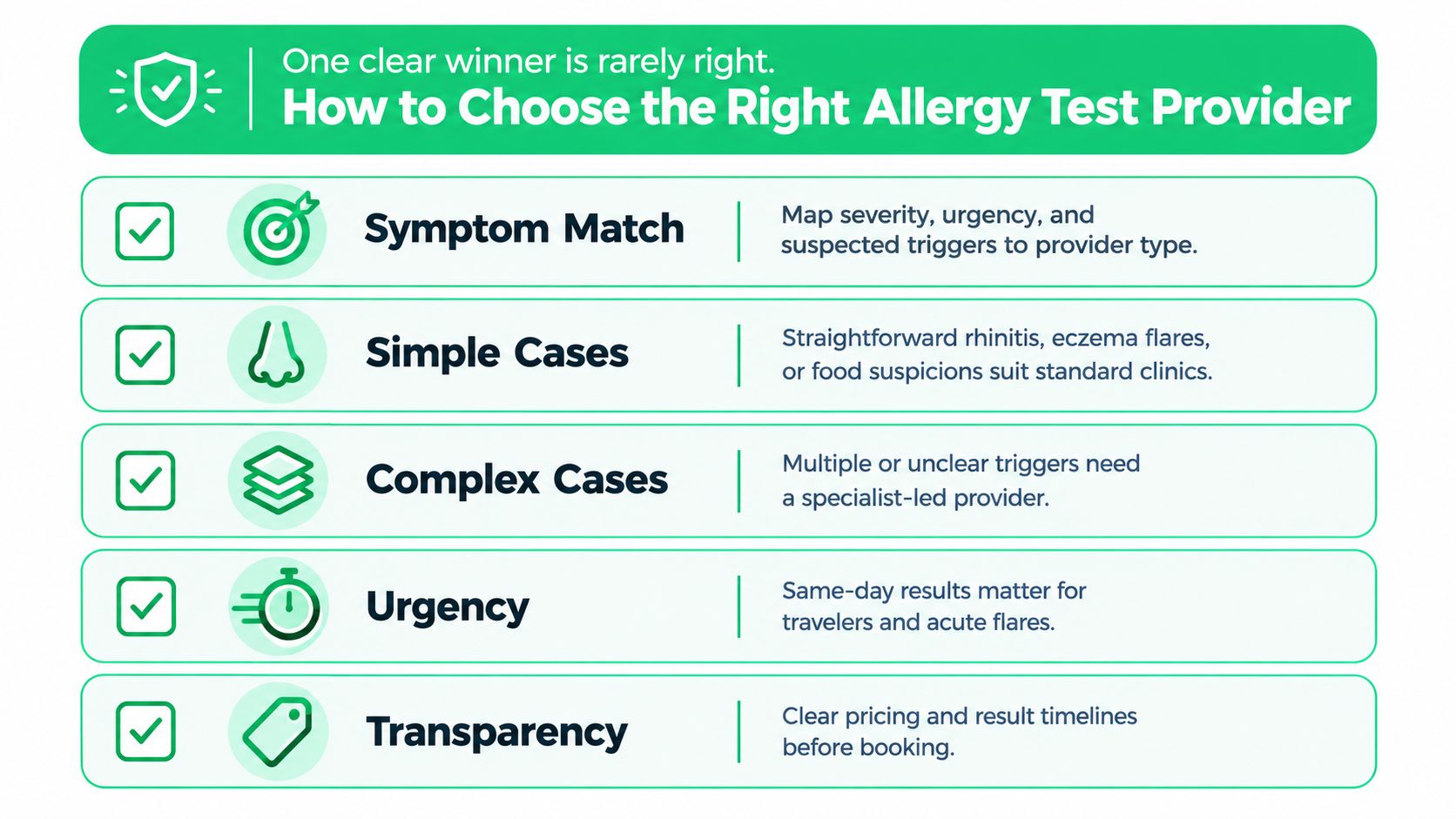
There isn't one universally correct provider. The best choice depends on severity, urgency and symptom type.
For straightforward rhinitis, recurring eczema flares or a clearly suspected food reaction, choose a DHA-licensed clinic that can take a history and offer skin prick testing or targeted blood testing. This keeps the test close to the clinical decision and allows the team to respond if the result is unclear.
Home or hotel blood collection suits a different patient. It works well for a traveller, a parent coordinating several appointments or someone whose clinician has already chosen a specific blood panel. It's less suitable when the first presentation includes multiple body systems, uncertain triggers or symptoms that haven't responded to initial treatment.
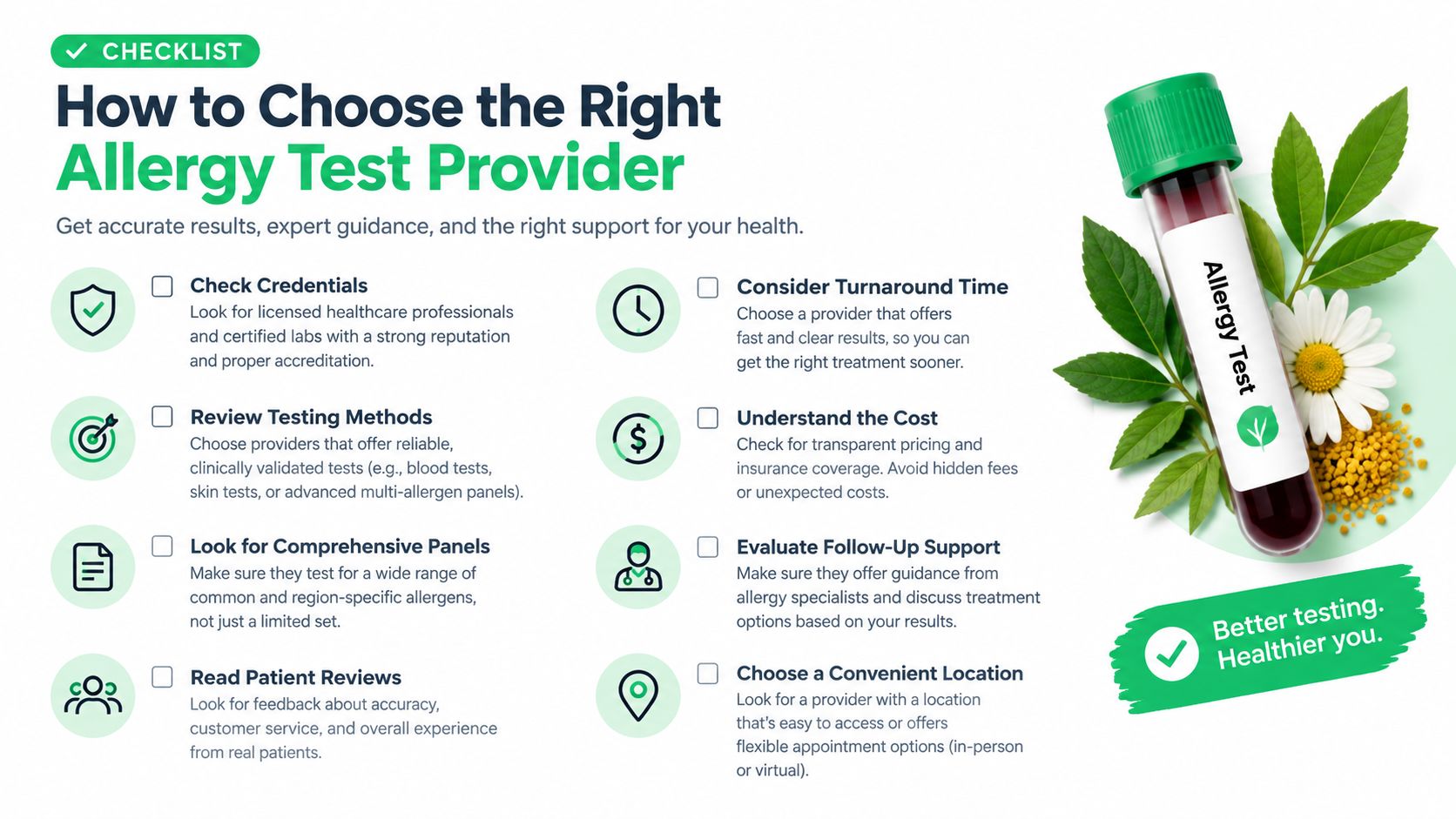
Use a provider checklist
Before you book, ask these questions:
- Is the service DHA licensed? Confirm that the clinicians and facility operate within Dubai's regulated healthcare system.
- Who interprets the result? Look for an allergist, immunologist, pathologist or clinician with relevant allergy experience.
- Are the units clear? Blood reports should identify the measurement system, such as kU/L, while skin testing should explain wheal measurements in millimetres.
- What does the fee include? Ask about consultation, collection, laboratory work and follow-up before paying.
- Can the provider explain accreditation? A credible service should be willing to identify the laboratory responsible for analysis.
- Will someone review your history first? A provider that sells a 40-plus allergen panel without asking about symptoms is prioritising volume over diagnosis.
When specialist care is the right move
Refer to a board-certified allergist when symptoms are severe, involve breathing or circulation, affect several systems, or continue despite appropriate first-line treatment. A specialist can decide whether you need intradermal testing, component-resolved diagnostics, spirometry, a supervised food challenge or investigation for a non-allergic cause.
Avoid any provider that promises a permanent cure from one panel. Testing identifies sensitisation and supports a diagnosis. It doesn't replace a clinical examination, and it can't make an irrelevant positive result meaningful.
Preparing for Your Allergy Test and Reading the Results
Your preparation should match the test method. For skin prick testing, ask about antihistamines before booking. As noted earlier, this test usually needs a 5 to 7 day washout. Do not stop prescription medicines without medical advice. Confirm whether antidepressants, heartburn medicines, topical products, inhalers or nasal treatments can affect the appointment.
Specific IgE blood testing usually does not require fasting. Drink water, bring an up-to-date medication list and record when symptoms occur, what you were exposed to and what you recently ate. A short symptom diary is more useful than ordering a broad list of untested allergens because it helps the clinician compare the report with your daily experience.
Read results with three questions
At the appointment, ask:
- Which results show sensitisation? Identify the allergens that crossed the laboratory or skin-test threshold.
- How strong is each result? Ask what the reported class, kU/L value or wheal measurement means.
- Does the result match my symptoms? A positive result matters only when exposure timing fits your symptoms. A convincing history with a weak or negative result may still require further assessment.
High rates of allergic rhinitis and inhalant sensitisation in the UAE support targeted testing. They do not show that every positive item on a broad panel causes illness. If the report conflicts with your experience, do not start eliminating foods or changing medicines alone. Ask whether you need a narrower repeat test, patch testing, respiratory assessment or a supervised challenge.
Before booking, answer three practical questions: What is the symptom pattern? How urgent is the problem? Who will provide follow-up care? Clear answers reduce the risk of paying for a panel that produces information without a useful next step. For broader diagnostic planning, review full blood testing in Dubai.
Vitals Healthcare Doctor On Call offers DHA-licensed home, hotel and office visits, including mobile blood sample collection for clinician-directed allergy testing. If travel is difficult, visit Vitals Healthcare Doctor On Call to arrange collection and discuss the appropriate next step.