
The popular advice about IV treatment in Dubai is simple: choose a drip menu, pay for convenience, and let a nurse arrive at your hotel. That advice misses the central issue. An IV cannula enters a vein, and fluids or medication then enter your circulation. This is a regulated clinical procedure, not room service with a wellness aesthetic.
A premium price, a polished website, and a luxury hotel visit don't prove that a provider is medically sound. What matters is whether the facility is authorised for home healthcare, whether the attending clinician is licensed, whether a doctor governs the treatment, and whether the team can respond if the patient deteriorates. In Dubai, those checks separate genuine concierge medicine from an unregulated wellness trend.
Table of Contents
- The Reality of Mobile IV Care in the Emirates
- Navigating Dubai Health Authority Regulations
- Evaluating Clinical Need Versus Wellness Convenience
- How to Vet a Mobile Healthcare Provider
- Understanding Pricing and Booking Logistics
- The Vitals Healthcare Standard for In-Room Care
- Your Final Checklist for Safe IV Therapy
The Reality of Mobile IV Care in the Emirates
Mobile IV care has obvious appeal. A resident can avoid traffic, a hotel guest can receive an assessment in a private room, and a busy executive can remain at the office rather than spend time in a waiting room. That convenience is valuable, but it can also disguise a weak clinical model.
The treatment remains medical wherever it happens. A nurse needs to assess the patient, confirm the prescription or clinical indication, use sterile equipment, monitor the infusion, and know what to do if the patient develops an allergic reaction, fluid intolerance, fainting, or another complication. A phone booking and attractive drip names don't replace those safeguards.
The practical test: Don't ask first which drip contains the most ingredients. Ask who is legally authorised to prescribe, supervise, and administer it.
Dubai's market contains a clear tension. Consumers increasingly want discreet, same-day care in homes, hotels, and offices, while safe care requires documentation, consent, clinical judgement, and emergency preparation. The faster and more luxurious the service feels, the easier it is to forget that the patient still needs a medical assessment.
This is particularly important for clients requesting high-dose vitamin formulations, glutathione, NAD+, or other treatments marketed for energy, immunity, recovery, or appearance. A clinician should establish whether the requested product is appropriate, whether the patient has a relevant medical condition, and whether medications or allergies create a problem. A provider that allows a customer to select a complex infusion like an item from a restaurant menu is showing you a governance problem.
For clinicians and medically informed readers, a structured medical calculator for GPs can support dose and fluid calculations, but a calculator isn't a substitute for examining the patient or making a treatment decision. Patients booking a home visit should also understand the difference between a general wellness consultation and a formal IV home service in Dubai, where the provider's licensing and clinical workflow should be clear before the appointment.
The right question isn't, “How quickly can someone bring me a drip?” It's, “Can this team deliver clinic-grade care safely outside a clinic?”
Navigating Dubai Health Authority Regulations
Dubai's rules treat home healthcare as a formal medical activity. The Dubai Health Authority, or DHA, requires licensed healthcare facilities to obtain approval to add home healthcare services through the Sheryan platform. It also requires professionals delivering home healthcare to be DHA-licensed and registered. These obligations apply to the clinical structure behind the visit, not merely to the nurse's job title.
The DHA's home healthcare standards also require specialised consent forms for services such as IV therapy. That detail matters. It confirms that IV treatment is handled as a regulated clinical service requiring informed consent, rather than as a cosmetic add-on that can be delivered with minimal documentation. The applicable DHA home healthcare standards provide the relevant framework for facilities and professionals.
What legitimate authorisation should include
A credible mobile provider should be able to explain its facility status and home healthcare approval without evasive language. The patient shouldn't have to infer compliance from phrases such as “medical team”, “certified staff”, or “doctor available”. Ask direct questions.
- Facility authorisation: Confirm that the organisation is a licensed healthcare facility approved to add home healthcare services through the DHA's Sheryan platform.
- Practitioner registration: Ask whether the specific nurse or doctor attending the visit is DHA-licensed and registered. A company's general licence doesn't automatically prove that every person it dispatches is authorised.
- Clinical consent: Expect a specialised consent process for IV therapy. The clinician should explain the proposed treatment, material risks, alternatives, and circumstances in which treatment should be stopped.
- Medical governance: Find out who assesses the patient, who approves the infusion, and who remains responsible for the clinical decision after the nurse leaves.
- Record keeping: A legitimate service should document the assessment, treatment, monitoring, and follow-up advice.
The compliance burden has a commercial consequence. Dubai's 2024 Executive Council resolution sets a fee of AED 2,000 per year for adding home healthcare services, creating a concrete licensing benchmark for providers that want to treat patients in their homes. That fee doesn't by itself prove quality, but it illustrates that lawful home healthcare involves an identifiable regulatory and administrative structure.
Why the rules matter to a guest or resident
A provider that can't show facility authorisation, practitioner registration, and proper consent is asking you to accept regulatory risk without giving you useful protection. That risk is greater in a hotel room, where the patient may not know whether the person at the door is part of a licensed medical facility or an informal operator using medical language.
For clients considering an aesthetic or antioxidant service, including a glutathione injection in Dubai, the same principle applies. The ingredient or marketing objective doesn't remove the need for clinical screening, lawful administration, and appropriate consent.
Evaluating Clinical Need Versus Wellness Convenience
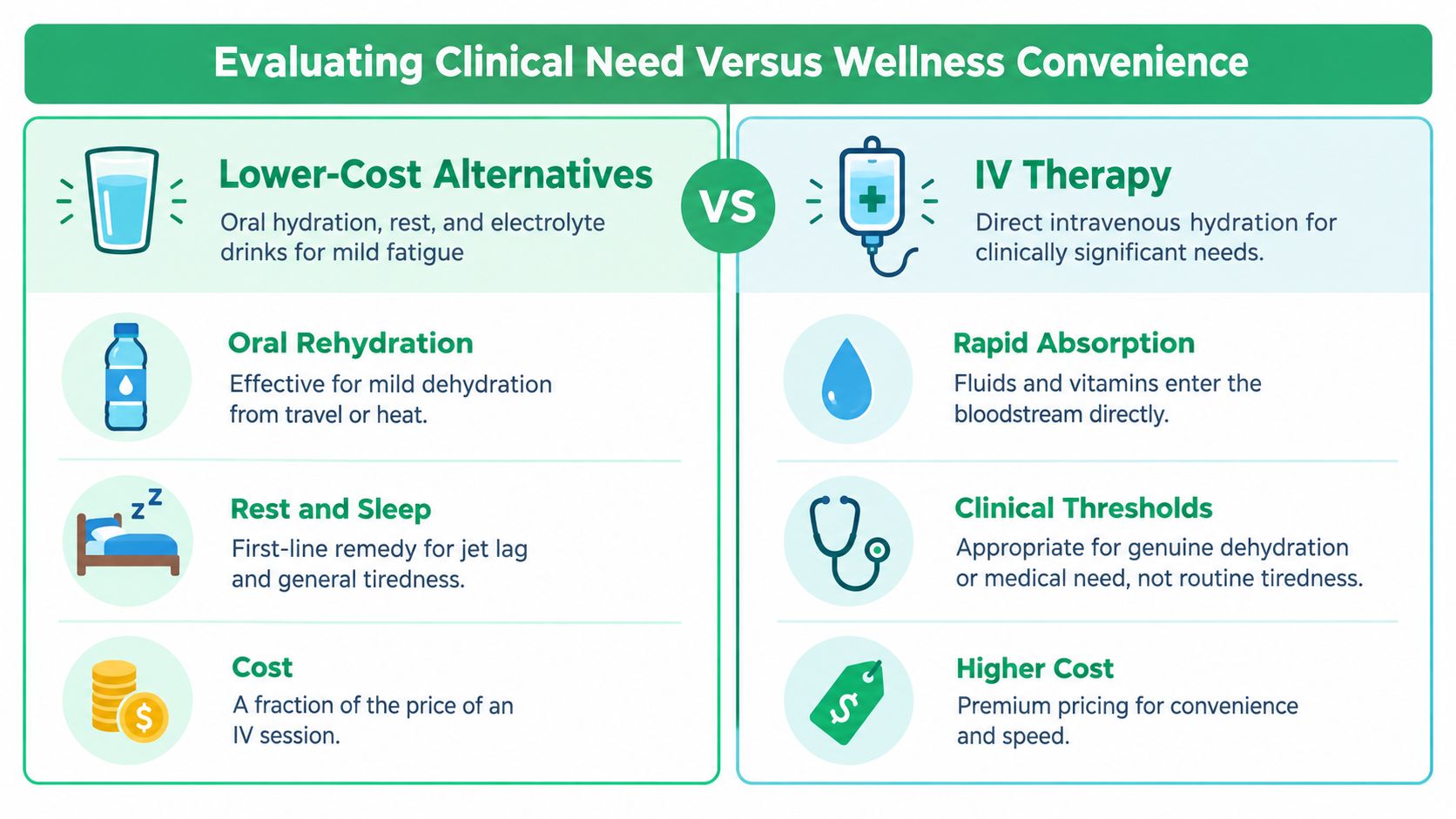
A polished drip menu is not a clinical assessment. In Dubai, mobile IV services can look like hotel wellness amenities while operating with very different levels of medical oversight. The correct question is whether a licensed clinician has identified a treatment need, not whether an attractive formula promises faster recovery.
Common requests involve fatigue, dehydration, a difficult flight, heat exposure, or recovery after illness. These symptoms may be genuine, yet they do not automatically justify an infusion. A person who can drink, absorb fluids, rest, and recover normally will often gain convenience rather than medical necessity from IV therapy.
For clinically dehydrated patients in the UAE, expert guidance favours isotonic crystalloids as first-line IV fluids. It commonly describes 0.9% saline for initial volume expansion at about 10 to 20 mL/kg over 1 to 2 hours, followed by deficit replacement over at least 4 to 6 hours with 0.9% saline or Ringer's acetate. These figures belong to clinician-led treatment decisions, not customer self-selection, as outlined in the regional guidance on IV therapy for dehydration.
When oral care may be enough
Mild tiredness after travel does not establish a fluid deficit. For an alert person who can drink and is not repeatedly losing fluid, begin with oral fluids, a suitable electrolyte drink where appropriate, food, and sleep. Rest remains the sensible response to ordinary jet lag and general fatigue.
IV treatment becomes more defensible when oral intake fails or symptoms indicate higher risk. Persistent vomiting, confusion, very low blood pressure, or an inability to drink require clinical assessment before an infusion starts. These signs may point to a broader medical problem rather than a request for luxury recovery.
A properly governed provider should ask what happened, check vital signs, review medications and medical history, and document the clinical decision. The result may be IV fluids, another treatment, urgent transfer, or supportive care without an infusion. A colourful formula is not a substitute for that decision process.
Who should pause before booking
Tell the clinician about kidney disease, heart disease, previous fluid overload, allergies, pregnancy, and every medication or supplement you take. IV fluids and additives can be unsuitable for people who cannot clear fluid effectively. Ingredients can also interact with medication or aggravate an existing condition.
Question high-risk formulations rather than accepting them as harmless upgrades. Vitamin C, NAD+, glutathione, and other additives require a clinical rationale, safe preparation, and appropriate supervision. If the provider cannot explain why an ingredient is being used, what alternatives exist, or which clinician approved it, do not proceed.
Price can also distort clinical judgment. Dubai IV treatment is marketed across a wide range, roughly AED 300 to AED 2,500 or more per session depending on formulation and setting. Regional market guidance on Dubai IV therapy and performance treatments documents that range. A higher fee indicates a premium-wellness position, not a better clinical outcome.
How to Vet a Mobile Healthcare Provider
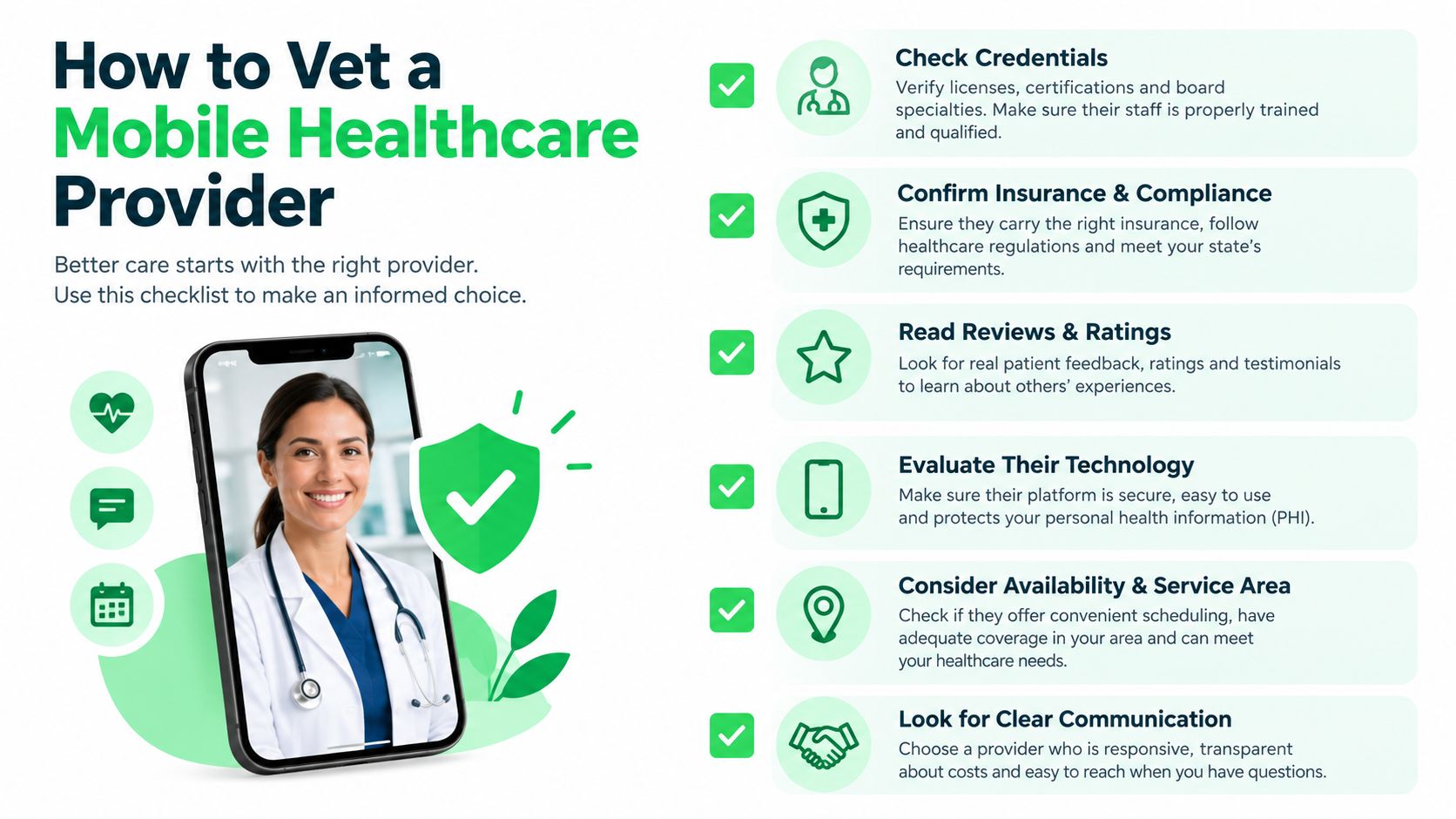
Treat provider selection as due diligence, not a shopping exercise. A reputable company should answer specific questions before taking payment or sending a clinician. If the answers are vague, move on.
Start with the facility
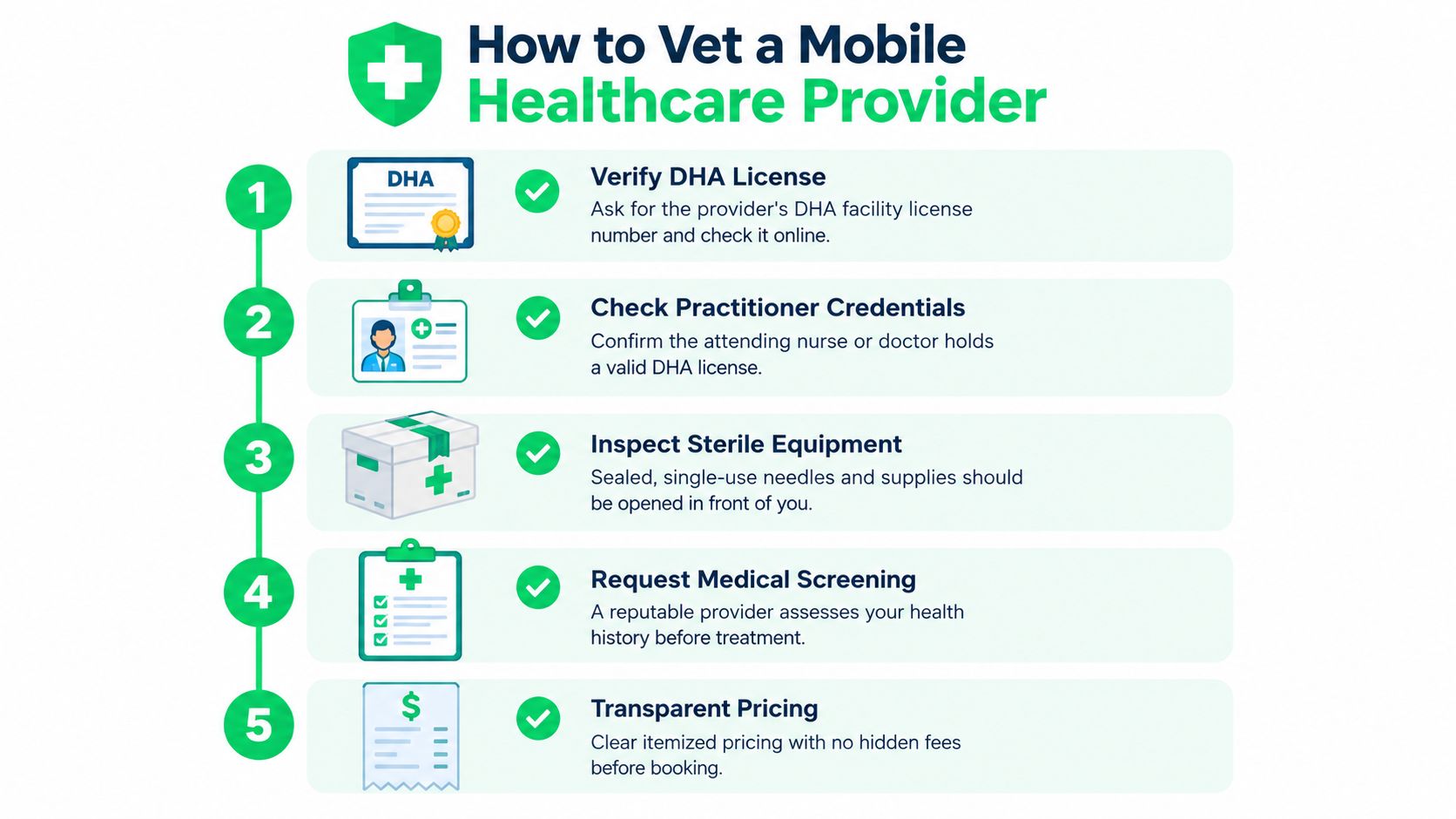
Ask for the provider's DHA home healthcare facility licence information and confirm that the organisation is authorised to deliver care at home, in hotels, or in offices. A clinic licence and a home healthcare approval aren't interchangeable. The mobile service needs to sit inside the correct regulatory category.
Then ask who will attend. You want the full name and professional status of the nurse or doctor, together with confirmation that the individual is currently DHA-licensed and registered. Don't accept “our medical staff are licensed” as an answer when you're asking about the person who will insert the cannula.
Establish who makes the medical decision
A nurse may administer an infusion, but the patient should understand who assessed and approved the treatment. Ask these questions before booking:
- Who reviews my health history and current medication?
- Is a physician involved before the infusion starts?
- Can the clinician refuse treatment if my symptoms suggest another problem?
- Who supervises higher-risk infusions, such as high-dose vitamin C or NAD+?
- What happens if I develop a reaction during or after the visit?
The answers should describe a real process, not just repeat the word “doctor”. Physician oversight means someone with appropriate responsibility makes a clinical judgement based on the patient's condition. It doesn't mean a doctor exists somewhere in the company's marketing material.
Inspect the bedside process
Sterile, single-use equipment should be opened in front of you. The clinician should check your history, allergies, and symptoms, assess your condition, and explain the infusion before establishing access. They should monitor you during treatment and provide clear aftercare instructions.
Emergency readiness also matters. Ask whether the attending clinician carries appropriate emergency supplies and whether the service has a defined escalation pathway. A home visit lacks the immediate infrastructure of a hospital, so the team must know when home treatment is no longer suitable.
Read warnings about overcharging and fake IV treatment in home healthcare before you commit. Unclear invoices, pressure to buy packages, refusal to disclose the practitioner, and promises that ignore your medical history are all reasons to stop the booking.
Understanding Pricing and Booking Logistics
A low quote is not a bargain if it omits the clinician visit, medical review, sterile supplies, monitoring, travel, or follow-up. Ask for an itemised quotation before you approve treatment. A higher fee may reflect legitimate clinical staffing and travel, but it still requires a clear explanation.
Dubai's mobile IV market is built for convenience. Bookings commonly happen by phone or WhatsApp, with clinicians visiting residences, hotels, and offices. That convenience also creates a governance gap: some operators can sell a drip menu before confirming who is medically responsible for the visit or whether the requested infusion is suitable.
Ask two separate questions before paying: which DHA-licensed clinician will attend, and what exactly does the quoted fee include? A polished booking page does not answer either question.
What the market signals
Dubai IV treatment is commonly quoted at roughly AED 300 to AED 2,500 or more per session, depending on the formulation and setting. Review this Dubai IV hydration therapy cost guide to understand what a home visit may include before authorising treatment. Price alone does not establish clinical value, ingredient quality, or proper medical oversight.
Use the following table to control the booking conversation. It describes what a properly organised service should clarify, not what every provider delivers.
| Service element | Standard expectation |
|---|---|
| Initial contact | Phone or WhatsApp coordination, with the service and next steps explained clearly |
| Clinical screening | Review of symptoms, medical history, allergies, and current medication |
| Practitioner | A named DHA-licensed nurse or doctor with defined clinical responsibility |
| Treatment location | Home, hotel, or office visit with privacy and a safe working area |
| Equipment | Sterile, single-use IV supplies and appropriate clinical waste handling |
| Monitoring | Assessment before treatment, observation during infusion, and a post-treatment check |
| Pricing | Itemised quote covering the formulation, visit, supplies, and added services |
| Payment | Clear payment options and an invoice for personal records or an insurance enquiry |
| Follow-up | Written aftercare and instructions for escalation if symptoms worsen |
Plan for the visit properly
Give the provider the exact address, building or hotel details, room or access information, contact number, and relevant health information. Hotel guests should check visitor-registration requirements with reception. Office patients need a private area where the clinician can assess them without interruption.
Do not schedule an infusion immediately before a flight, demanding meeting, or long drive if you are unwell. The assessment may identify a need for testing, another service, or urgent referral. If laboratory support is relevant, ask whether home sample collection is available separately. Do not accept added ingredients just because they are included in a package.
A transparent provider confirms the formula after clinical review, identifies the attending clinician, states the full cost, and issues an invoice. If staff avoid those details, pressure you to book quickly, or treat the drip menu as a substitute for assessment, cancel the appointment. Convenience should shorten coordination, not remove medical accountability.
The Vitals Healthcare Standard for In-Room Care
A regulated mobile model should feel less like ordering a product and more like arranging a clinical visit. The interaction starts digitally, but the purpose of the call or WhatsApp exchange is to collect relevant information, understand the request, and organise an appropriate clinician. The patient should know what is being requested, where the visit will occur, and what information the medical team needs before arrival.
At the bedside, the clinician's first task is assessment. That can include reviewing symptoms and medical history, checking vital signs, confirming allergies and medication, and deciding whether IV treatment is suitable. The infusion should follow that assessment, not precede it.
Vitals Healthcare Doctor On Call offers 24/7 doctor on call visits, nursing, home laboratory collection, physiotherapy, and IV hydration or multivitamin therapy at homes, hotels, and offices across Dubai. Its stated operating model uses DHA-licensed clinicians, mobile clinical assessments, digital coordination, multiple payment options, and invoices for insurance claims.
What a sound visit looks like
The patient should receive more than a bag and a cannula. The attending clinician should bring a sterile setup, establish access using appropriate technique, observe the patient throughout the infusion, and provide post-treatment guidance. If symptoms suggest that the patient needs another level of care, the clinician should prioritise escalation over completing a wellness booking.
Home care also needs continuity. A treatment record, the patient's reported response, and any follow-up recommendation give the next clinician useful context. This becomes more important when a patient has recurring fatigue, repeated dehydration, chronic disease, or requests for repeated vitamin infusions.
Mobile lab collection can add value where the clinical question involves a possible deficiency or another underlying cause of fatigue. It shouldn't be used to justify a preselected drip. The sensible sequence is to collect relevant information, assess the patient, use testing where clinically indicated, and then decide what treatment is appropriate.
Why the setting changes the risk calculation
A hotel room offers privacy and comfort, but it isn't a substitute for a clinic's resources. The mobile clinician must carry the necessary equipment, maintain sterile practice, recognise deterioration, and know when the patient should be transferred for further care. That is why a provider's internal clinical training and escalation procedures matter as much as its advertised response time.
For a first infusion, a complex medical history, or an unexplained symptom, a clinic may be the more prudent setting. For a patient with an established plan and a straightforward indication, a properly governed home visit can reduce travel without removing clinical oversight.
Your Final Checklist for Safe IV Therapy
Before you book IV treatment in Dubai, make the decision in this order. First, decide whether your symptoms need medical assessment. Then verify the provider's legal structure. Only after those checks should you discuss a formulation and price.
The booking checklist
- Clarify the problem: Explain whether you're dealing with vomiting, inability to drink, heat exposure, fatigue, post-travel symptoms, or another concern. Don't reduce a potentially serious symptom to a request for “energy”.
- Ask about alternatives: Find out whether oral hydration, rest, food, observation, or another medical service is more appropriate.
- Verify the facility: Request confirmation that the provider has the relevant DHA approval for home healthcare.
- Verify the clinician: Confirm that the attending nurse or doctor is DHA-licensed and registered.
- Confirm medical oversight: Ask who reviews your history, approves the infusion, and manages complications.
- Expect specialised consent: Read the consent information and ask about material risks, ingredients, and alternatives before treatment.
- Inspect supplies: Single-use sterile equipment should be opened in front of you, with safe disposal after the procedure.
- Review your medical risks: Disclose kidney disease, heart conditions, fluid overload risk, allergies, pregnancy, and medication interactions.
- Demand transparent pricing: Get an itemised quote and an invoice before authorising optional additives or packages.
- Plan escalation: Know what to do if confusion, persistent vomiting, very low blood pressure, breathing difficulty, or worsening symptoms continue.
IV access also carries risks such as bruising, vein irritation, infection, fluid overload, and reactions to ingredients. Read the provider's explanation of IV drip side effects and ask the clinician to explain which risks apply to your health profile.
A safe decision is not “I want an IV, so find me one.” It is “I have these symptoms, this history, and this goal. Is an infusion clinically appropriate, and who is accountable for delivering it?”
Choose the provider that answers that question clearly. If the company focuses on speed, luxury, and a long menu while avoiding licensing, consent, physician oversight, and emergency readiness, the service is not meeting the standard you should accept.
Vitals Healthcare Doctor On Call offers 24/7 doctor visits, DHA-licensed nursing, home assessments, mobile lab collection, and IV hydration delivered to homes, hotels, and offices across Dubai. For regulated, clinic-grade support when you need IV treatment evaluated and delivered at your location, visit Vitals Healthcare Doctor On Call .