
Dubai IV hydration therapy typically costs AED 300 to AED 1,500 per session, depending on the formula and whether treatment is delivered in a clinic or at home. The starting figure usually covers basic hydration, while vitamins, specialist ingredients, travel, timing, and taxes can move the final invoice much higher.
That range is the useful answer, but it isn't the whole answer. The sticker price often describes the drip menu, not the complete service you buy. In practice, you're paying for the fluid, the selected formula, clinical assessment, cannulation, monitoring, consumables, location, timing, and applicable charges.
I've reviewed Dubai pricing across clinics, hotels, and mobile services, and the biggest mistake is comparing a basic in-clinic saline session with a premium hotel-room infusion. Those are different products, even if both are advertised as “IV hydration”. The reviews and references around IV therapy also make one point clear: buyers need to compare the complete service, not just the name of the bag.
Table of Contents
- What a Typical IV Hydration Session Costs in Dubai
- How IV Hydration Therapy Actually Works
- The Five Building Blocks Behind Every IV Price Tag
- Clinic, Hotel or Home Visit Compared
- How Package Deals Change the Per-Visit Price
- Reading Your Invoice and Claiming It Back
- When a Premium Drip Is Worth the Upgrade
- A Short Checklist Before You Book
What a Typical IV Hydration Session Costs in Dubai
The practical Dubai range is AED 300 to AED 1,500 per session. A Dubai IV therapy price guide from Novomed places basic hydration drips at AED 300 to AED 500, vitamin and energy formulas at AED 400 to AED 900, immunity-focused options at AED 500 to AED 1,000, and glutathione or beauty drips at AED 700 to AED 1,500.
That makes the entry price easy to misunderstand. A hydration-only bag may sit at the lower end, while a formula with vitamins, antioxidants, medication, practitioner time, and home delivery can approach the upper end. The price isn't determined by saline alone.
The five questions behind the quote
Before booking, ask the provider to identify:
- What is in the bag? Confirm the fluid volume and every additive.
- Who is administering it? The clinician's assessment, cannulation, monitoring, and removal are part of the service.
- Where will treatment happen? Clinic, hotel, home, and office visits carry different operational costs.
- When is the appointment? Night, weekend, holiday, and urgent bookings may be priced differently.
- What taxes and service charges apply? A quoted base rate may not be the all-in amount.
The same hydration concept can therefore move from a modest clinic appointment to a premium mobile visit. If you're comparing home-care options, review the provider's Dubai home doctor visit cost guide and ask whether the quoted medical visit includes IV therapy or prices it separately.
| Setting | Low (AED) | Typical (AED) | High (AED) |
|---|---|---|---|
| Clinic | 300 | 500 | 900 |
| Hotel room | 500 | 800 | 1,400 |
| Home visit | 400 | 700 | 1,500 |
| Office or group booking | 400 | 700 | 1,400 |
These setting figures are practical comparison bands, not a universal tariff. Get the written invoice walk-through before the clinician arrives. The sections below separate the bag, formula, call-out, timing, and tax so you can judge the quote properly.
How IV Hydration Therapy Actually Works
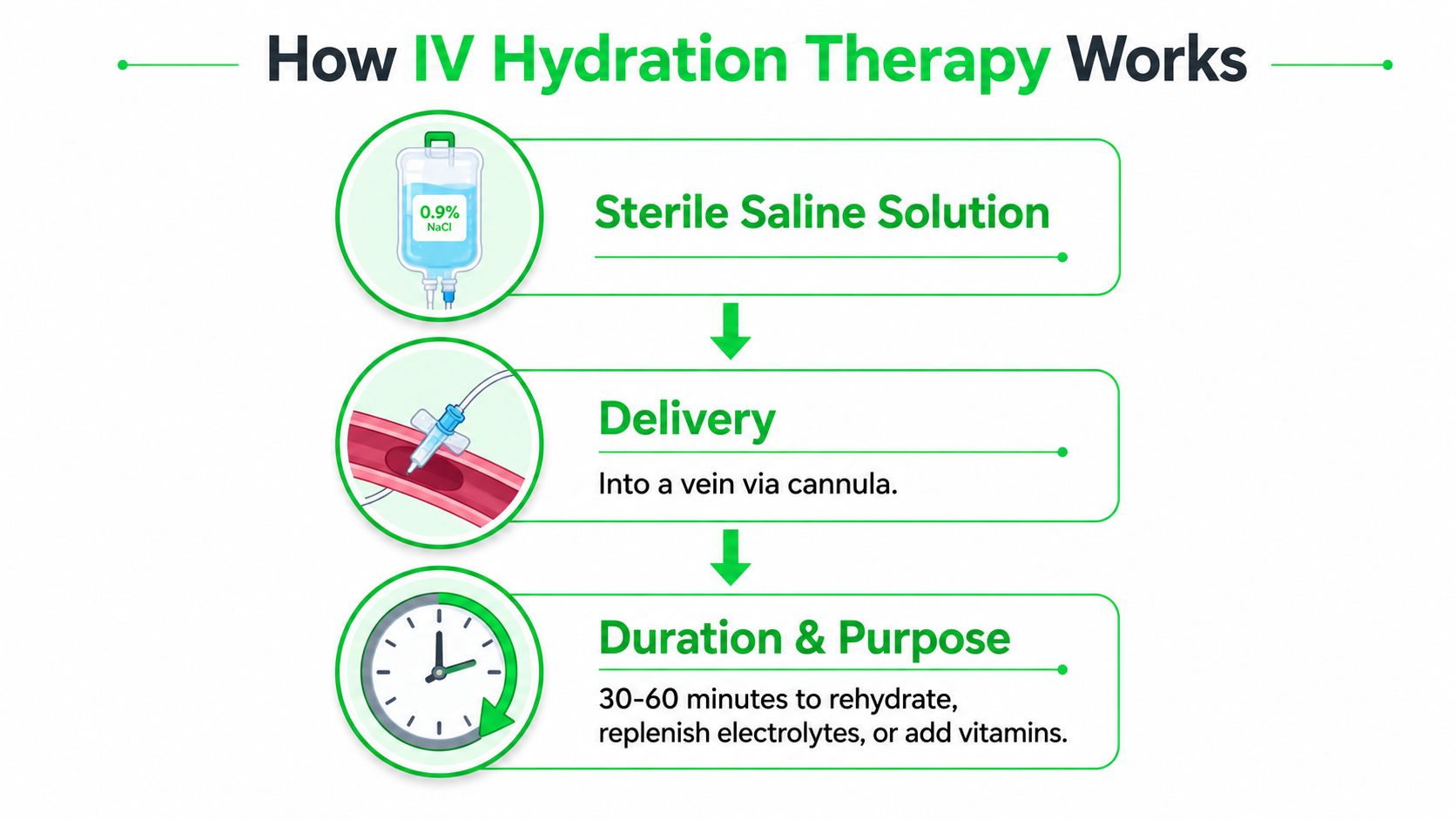
IV hydration therapy delivers a sterile fluid solution into a vein through a small cannula. The clinician places the cannula, connects the infusion, checks the patient during treatment, and removes the line after the session. Treatment is generally used to support hydration, replenish electrolytes, or deliver selected vitamins when a clinician considers the route appropriate.
A provider's menu usually falls into four broad tiers. Recognising the tier stops you from paying premium prices for a basic service with a fashionable name.
The entry-level bag
Basic saline rehydration is the simplest option. It is marketed towards people who may be dehydrated after travel, heat exposure, reduced fluid intake, or a short illness. The clinical decision should still come first, particularly if the person is vomiting, confused, severely weak, or unable to keep fluids down.
The recovery blend
Electrolyte and mineral formulas add ingredients such as magnesium or other selected minerals. Clinics commonly market them for sports recovery, fatigue, or recovery after exertion, but the additive should match the patient's symptoms and medical history.
The wellness menu
Vitamin-focused drips may include B-complex, vitamin C, or glutathione. These are often promoted for energy, immunity, skin appearance, or general wellness. A menu description isn't proof that every ingredient is necessary, so ask what the clinician expects the additive to address.
The premium formula
Signature infusions combine multiple ingredients and may include NAD+, high-dose glutathione, or custom blends. They take more explanation, not less. If a provider can't state the intended indication, dose, risks, and alternatives clearly, don't buy the upgrade.
For a more detailed service overview, compare the provider's IV drip therapy information with the actual treatment quote. The name on a menu isn't enough. You need the ingredient list and clinical rationale.
The Five Building Blocks Behind Every IV Price Tag
A Dubai IV invoice is usually built from five cost components. The fluid is only one of them, and the formula often creates the largest difference between an ordinary hydration appointment and a premium infusion.
The requested price bands for individual components are useful for reverse-engineering, but they aren't universal Dubai charges. Treat them as discussion points to test against a written quote.
Formula
The base solution and selected ingredients establish the starting point. A generic saline bag is materially different from a premium formula containing NAD+ or glutathione. Review the IV drip bag explanation before accepting a menu label that doesn't show the contents.
Additives
A B12 injection, anti-nausea medicine, magnesium, or zinc may be added separately. A provider may bundle these into a named drip, or list them à la carte. Ask for both versions, because the bundled formula can conceal which ingredient is creating the uplift.
Practitioner time
A nurse or DHA-licensed clinician doesn't deliver a bag. The visit may include health screening, cannulation, observation, troubleshooting, and line removal. Those clinical tasks should appear in the service description or be clearly included in the base price.
Location
Home and hotel care require travel, equipment transport, parking, access coordination, and time away from the clinic. A central address may attract a smaller call-out charge than a distant location, while hotel access can create extra logistics even when the patient is nearby.
Timing
Late-night, public-holiday, and urgent bookings can carry a premium. Don't assume a provider's daytime quote applies at every hour.
| Cost Component | Low (AED) | Mid (AED) | High (AED) | What Drives It |
|---|---|---|---|---|
| Formula | 150 | 600 | 900+ | Saline, vitamins, antioxidants, specialty ingredients |
| Additives | 40 | 90 | 150 each | Medication, minerals, injections, dose |
| Practitioner time | 100 | 175 | 250 | Assessment, cannulation, monitoring, removal |
| Location fee | 100 | 200 | Varies | Distance, hotel access, parking, travel time |
| After-hours premium | Qualitative | Qualitative | Qualitative | Night, holiday, urgency, staffing |
A simple reverse calculation works like this: start with the base fluid, add the chosen ingredients, add clinical time and consumables, then add travel if applicable. Apply any after-hours uplift to the relevant service components, and check whether municipality charges, service charges, and VAT are included or added later.
Practical rule: If the provider can't separate formula, clinician time, travel, timing, and tax, you can't compare the quote fairly.
Clinic, Hotel or Home Visit Compared
Venue changes the invoice even when the bag is identical. A clinic normally provides the baseline because the patient travels to an established clinical setting, while a hotel or home visit transfers travel and logistics to the provider.
A clinic appointment is usually the cleanest comparison. You can ask about the formula, sit in a controlled setting, and avoid a mobile call-out. Hotel treatment offers privacy and convenience, but the clinician may spend additional time navigating reception, parking, lifts, room access, and hotel procedures.
Home treatment sits between those two models. During ordinary hours and within a convenient service area, it can be competitively priced once you account for your own travel, parking, waiting, and recovery time. Overnight or urgent home care is a different proposition, because staffing and dispatch arrangements can affect the total.
| Visit type | Typical total | Common extras |
|---|---|---|
| Clinic | AED 400–700 | Additives, assessment, premium formula |
| Hotel room | AED 600–950 | Call-out, parking, access logistics, additives |
| Home visit | AED 700–1,100 overnight | Travel, after-hours premium, additives |
| Office visit | Quoted case by case | Group minimum, travel, timing, formula upgrades |
These comparison bands are drawn from the Dubai service scenarios described in the pricing brief, and they should be treated as planning figures rather than guaranteed quotes. The IV home service information from Vitals Healthcare is relevant when comparing in-home convenience with a clinic appointment.
Ask for one quote with five separate lines:
- Formula: Name the fluid and ingredients.
- Consumables: Confirm whether tubing, cannula, and related supplies are included.
- Clinician fee: Identify assessment, administration, monitoring, and removal.
- Call-out: State the travel or hotel fee and the covered area.
- Timing: Confirm any urgent, overnight, weekend, or holiday surcharge.
Don't compare a “from” price with an all-inclusive mobile quote. Compare the same ingredients, bag size, clinical supervision, venue, appointment time, and cancellation terms.
How Package Deals Change the Per-Visit Price
Packages can reduce the effective cost, but only if you'll use the sessions. The strongest Dubai benchmark comes from a hotel pricing sheet published in March 2025. It listed the ORIGINAL IV DRIP at AED 765 for one session, AED 675 per session for two, and AED 585 per session for five. Its ULTIMATE DRIP was listed at AED 1,658 for one, AED 1,463 per session for two, and AED 1,268 per session for five. The sheet states that prices included a 7% municipality fee, 10% service charge, and 5% VAT. Review the Dubai hotel IV therapy pricing sheet before using it as a historical benchmark.
The basic five-session rate in that sheet is about 23.5% lower than the single-session rate, calculated from AED 585 compared with AED 765. That isn't a promise that every Dubai provider offers the same reduction. It shows why the correct comparison is the effective price per used visit.
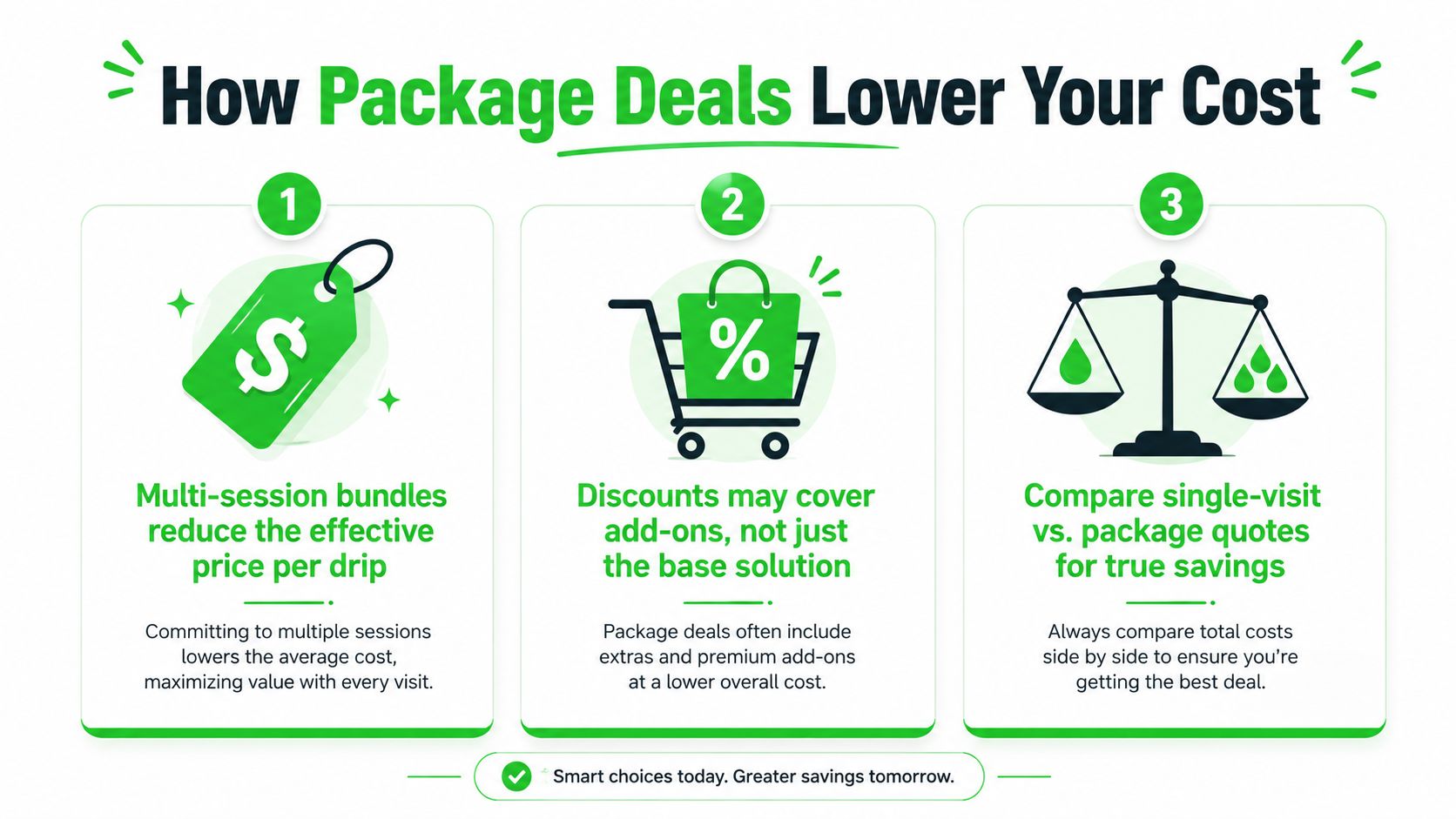
Run this calculation before paying
- Take the full package price. Don't rely on the displayed “from” rate.
- Divide by sessions you realistically expect to use. Unused visits aren't savings.
- Add excluded items. Night visits, travel, hotel access, additives, and reassessments may be outside the bundle.
- Check the contract. Confirm expiry, refunds, transfer rules, and whether sessions can be shared.
A package is sensible for a repeat clinical protocol or a predictable need. It's poor value when the provider creates pressure to buy before explaining why several infusions are appropriate. Request a written per-visit breakdown and confirm whether the bundle includes the clinician, consumables, venue fee, and normal appointment hours.
Reading Your Invoice and Claiming It Back
A proper invoice should tell you what happened, who provided it, where it happened, and how the total was calculated. “IV package” isn't enough. You need the treatment description, ingredients, date, provider details, and payment record.
The line items to inspect
Look for:
- Base infusion: The hydration or infusion charge.
- Additives: Each vitamin, mineral, medicine, or injection.
- Clinical service: Nurse or clinician assessment, administration, monitoring, and removal.
- Consumables: Cannula, tubing, and other single-use supplies where charged separately.
- Travel and timing: Call-out, hotel, urgent, overnight, weekend, or holiday fees.
- Mandatory charges: Municipality fee, service charge, and 5% VAT where applicable.
The Dubai hotel pricing sheet is a useful example because it states the inclusion of a 7% municipality fee, 10% service charge, and 5% VAT in its listed prices. That doesn't mean every provider applies charges identically, so insist on seeing the treatment provider's own itemisation.
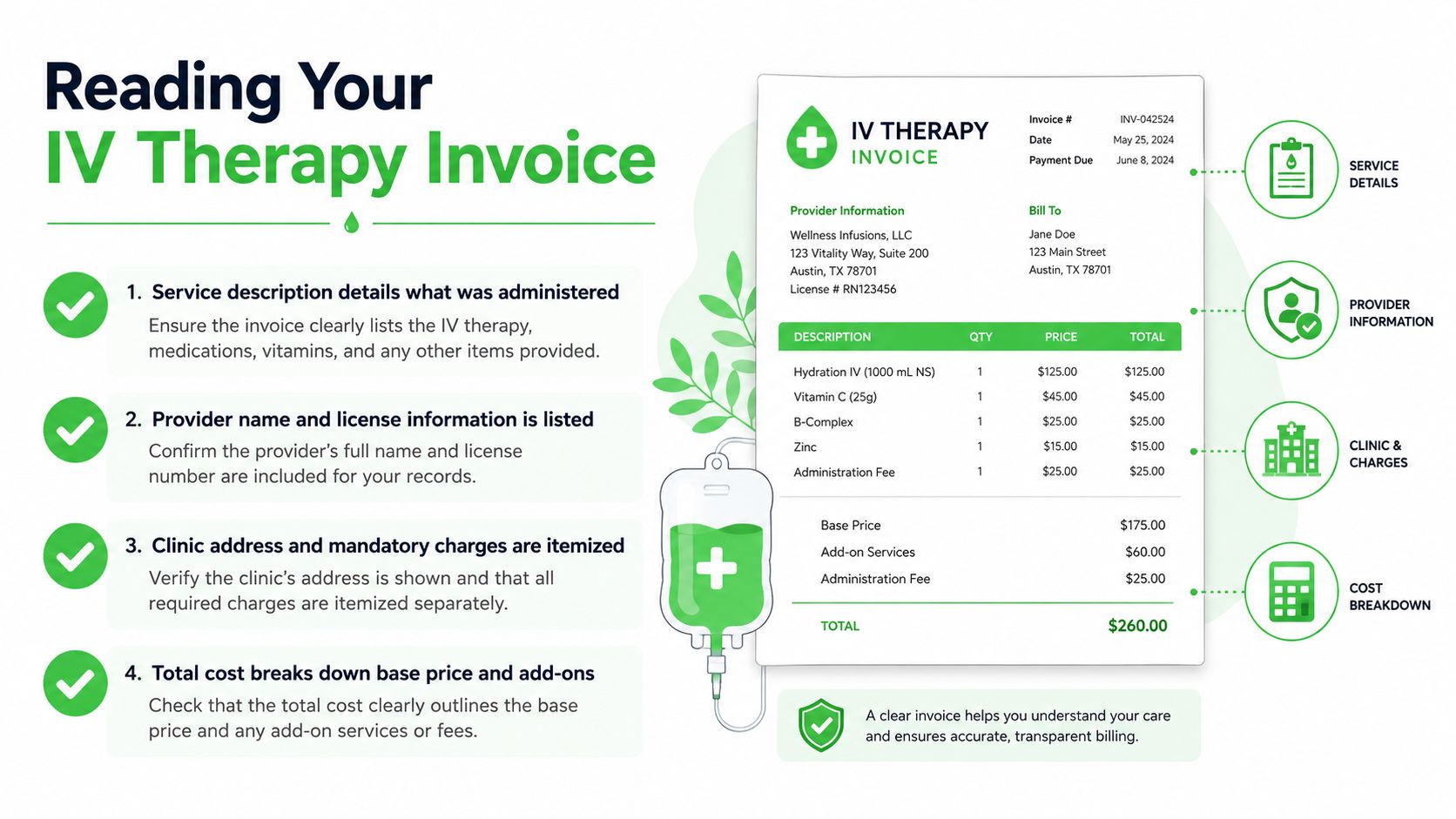
The document should identify the approved facility or administering DHA-licensed professional, treatment date, medical or invoice reference, payment status, and business contact. If the provider refuses to give those details, choose another service.
Insurance requires evidence
Don't assume a wellness, hangover, performance, or elective hydration drip will be reimbursed. Reimbursement is more plausible when a clinician documents medical necessity, supports the treatment with a diagnosis or prescription, and explains why the chosen route was appropriate.
Before treatment, ask for the invoice, receipt, medical report or prescription, and proof of payment. Submit them according to your insurer's rules. If the insurer asks why oral fluids weren't suitable, request a concise clinical explanation, not promotional wording. The Dubai home doctor insurance and cost guide can help you understand the wider documentation questions to raise with a provider.
When a Premium Drip Is Worth the Upgrade
The most expensive bag isn't automatically the most useful. Dubai pricing spans from simple saline drips around AED 239 to AED 915 across brands, while NAD+ and other premium infusions can exceed AED 3,670 per session, according to the Dubai IV drip pricing review from Vitals Healthcare.
That spread tells you where the markup hides. You may be paying for a more complex formula, staffing, setting, consultation, and brand positioning rather than a benefit that rises in direct proportion to price. A premium ingredient deserves a clinical reason, not a glossy menu description.
Use the two-question test
Ask:
- Does the additive match the symptom or documented need?
- Is the dose clinically justified and supervised?
B-complex or magnesium may be reasonable considerations in a clinician-led plan for selected recovery complaints, but the answer depends on the patient's history and the cause of the symptoms. Glutathione, high-dose vitamin C, and NAD+ are often marketed to healthy adults for broad wellness promises, and I wouldn't pay a large premium without a defined objective and qualified assessment.
| Additive | Typical Dubai Price Uplift (AED) | Worth It For | Skip If |
|---|---|---|---|
| B-complex | Qualitative | A clinician identifies a relevant nutritional or recovery rationale | You're buying it only because “energy” appears on the menu |
| Magnesium | Qualitative | A suitable recovery or deficiency-related indication | You haven't discussed medicines, kidney health, or symptoms |
| Glutathione | Qualitative | A specific clinician-supervised protocol | The pitch promises beauty or detox without a clear outcome |
| High-dose vitamin C | Qualitative | A documented reason and appropriate screening | The provider can't explain dose, risks, or alternatives |
| NAD+ | Above AED 3,670 may apply | A defined specialist protocol | The offer is vague, premium-priced, and wellness-only |
The incremental cost should buy a medically defensible intervention, not just more ingredients. If the additive doesn't change the decision, save the difference and choose the simpler formula.
A Short Checklist Before You Book
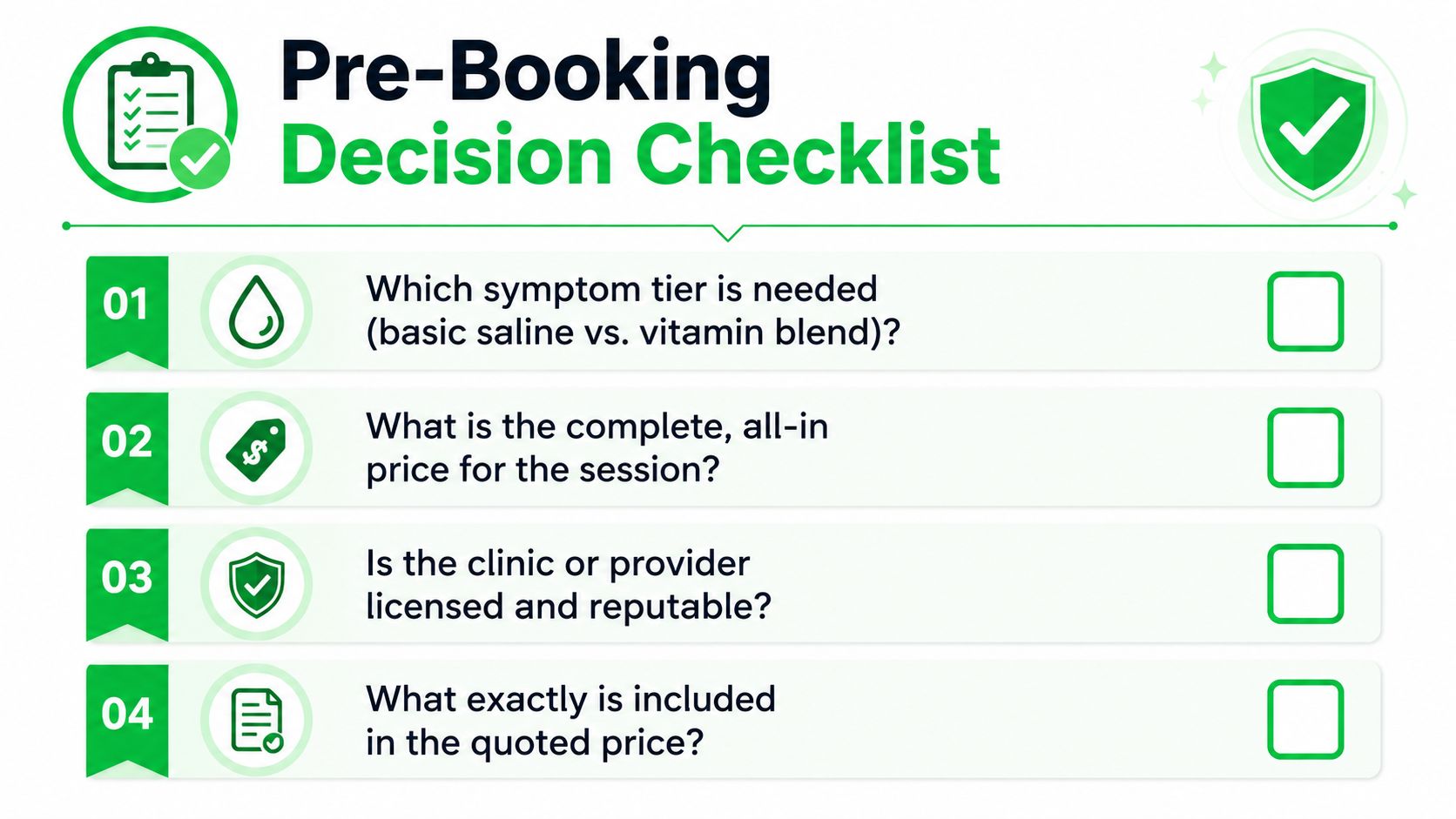
Run these four questions before you click the booking button. If the provider can't answer one clearly, pause the appointment.
-
Which symptom tier fits the situation? Is basic saline rehydration enough, would a Myers-style blend be clinically appropriate, or is there a genuine reason to consider a premium additive stack?
-
What is the complete all-in price? Does the quote include the formula, consumables, clinician or nurse time, call-out, hotel access, urgent timing, municipality fee, service charge, and VAT where applicable?
-
Is the provider licensed and reputable? Will a DHA-licensed clinician assess and administer the treatment, and can the provider explain when IV therapy isn't appropriate?
-
What will the invoice show? Will it list the ingredients, service date, administering professional or facility, mandatory charges, payment status, and every add-on needed for an insurance or employer claim?
My recommendation is simple. Choose the least expensive formula that matches a documented clinical need, select a clinic when convenience doesn't justify a call-out, and use a package only when you'll use the included sessions before expiry. Ask for the final invoice before treatment, not after the cannula is already in place.
For home, hotel, or office IV hydration in Dubai, Vitals Healthcare Doctor On Call offers appointments with DHA-licensed clinicians and provides itemised invoices for payment and insurance records. Visit the service to request a quote that separates the formula, clinical care, location, timing, and any applicable charges before you book.