
An adult child in Dubai may notice the change gradually. A parent starts missing medical appointments, needs help preparing meals, feels unsteady walking to the bathroom, or forgets whether medication has been taken. The family wants to respect the parent's independence, but work, school, travel, and other responsibilities make daily supervision difficult.
That's where elderly care services can help. Home care isn't just a nurse visiting to complete a medical task. A well-organised service combines clinical attention, personal assistance, safety checks, rehabilitation, and communication with relatives. The aim is to help an older person remain safe and supported at home while giving the family a reliable plan rather than a series of emergency arrangements.
Table of Contents
- Understanding Elderly Care Services in Dubai Homes
- Types of Home Care Services Available
- Building a Comprehensive Care Plan
- Choosing a Reputable Elderly Care Provider
- Understanding Costs and Payment Options
- Ensuring Quality and Continuity of Care
- Frequently Asked Questions
Understanding Elderly Care Services in Dubai Homes
A parent who begins needing help with bathing after a hospital stay may soon need support in several connected areas. Medication reminders, meal assistance, walking checks, safer transfers, and early attention to changes in condition can all become part of the same home routine.
Care works best when these tasks follow one plan. A nurse may identify a clinical concern, while a caregiver notices that the person is eating less or struggling with everyday movement. If those observations are shared, the family receives one clearer picture instead of separate pieces of information. Dubai providers should also show how their staff, home visits, documentation, and escalation procedures meet applicable local requirements.
The UAE's National Policy for Senior Emiratis, approved on 21 October 2018, presents care as part of a wider system covering healthcare, active living, civic participation, infrastructure and transportation, financial stability, safety and security, and quality of future life. Its healthcare measures include preventive services, medical insurance, mobile nursing units, and supportive medical devices. For a family, the practical lesson is simple: home care should connect health support with the person's daily environment.
Why home support matters
The UAE has a young population overall, yet its older population is changing. World Bank-based data shows that people aged 65 and above represented 1.69563% of the population in 2023 and 1.76696% in 2024. These are national figures, not a description of every Dubai neighbourhood, but they help explain the growing attention to organised ageing support. The World Bank-based UAE age data should also be read alongside Emirati-specific trends.
Dubai's Emirati population has a different age profile from the national population, which includes many working-age expatriates. Older people were estimated to represent 6.6% of Dubai's Emirati population, with projections of 11% by 2032 and 29% by 2050, according to Dubai Statistics Centre figures reported in the same data source. These projections support services that protect independence, reduce avoidable travel, and give families dependable help at home.
Families can review home care options for older adults in Dubai when institutional care is unnecessary or not preferred. The selected arrangement may combine nursing, physiotherapy, personal assistance, companionship, safety monitoring, and communication with doctors. Continuity matters: the people providing support should understand the care plan, record changes, and keep relatives informed.
Practical rule: Choose care around the person's daily risks and routines, not around a generic list of services.
Types of Home Care Services Available
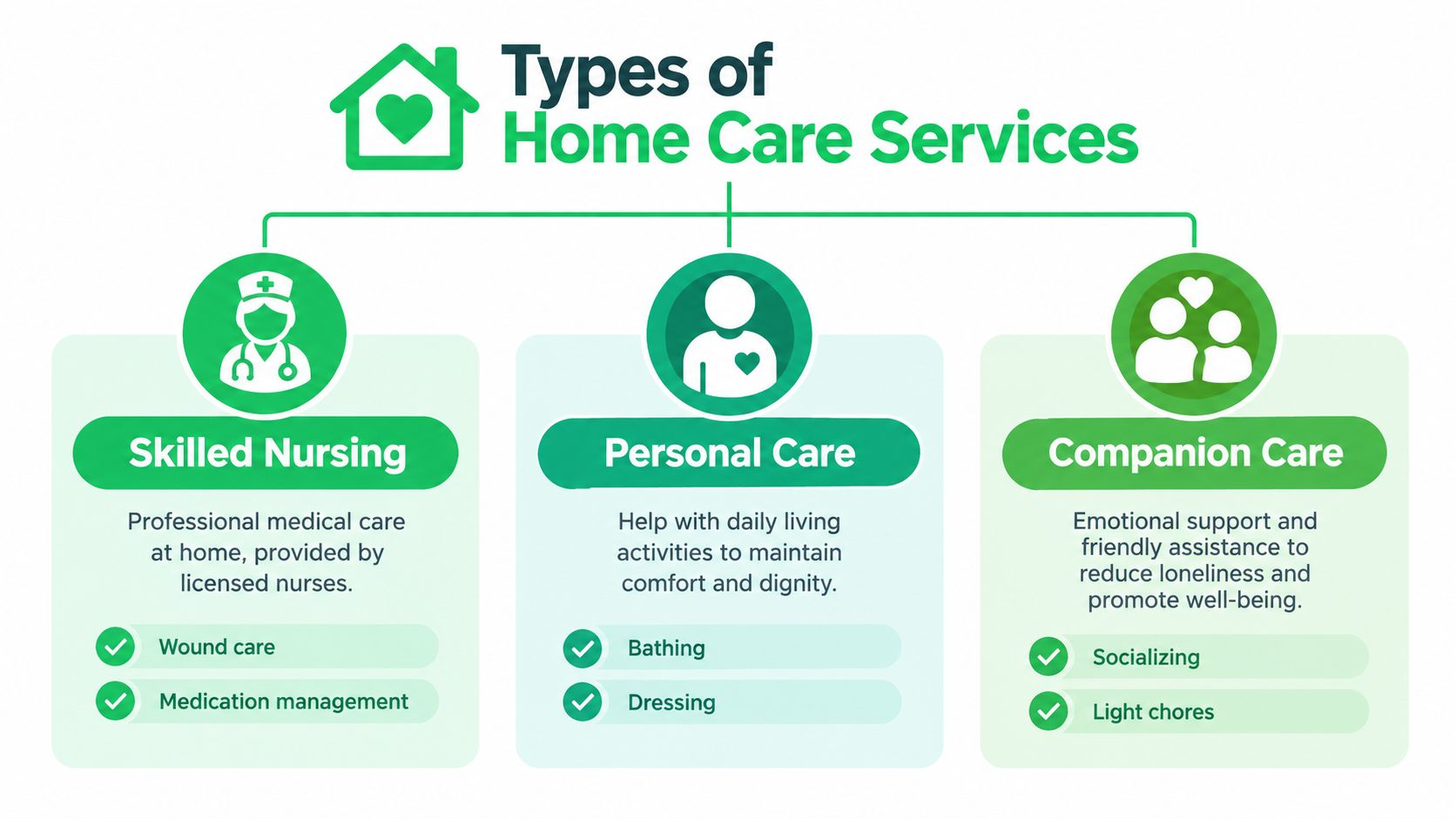
The first useful distinction is between clinical care and daily living support. Clinical care requires appropriately qualified professionals and may involve assessment, treatment, monitoring, or escalation. Daily support helps a person complete ordinary activities safely and comfortably. Some older adults need one category, while others need both during the same visit.
Skilled nursing at home
A nurse may support wound care, injections, medication administration, pressure-sore prevention, vital-sign observation, and chronic-condition monitoring. The nurse should also know what requires escalation. A new wound infection, worsening breathlessness, unusual drowsiness, or a significant change in function shouldn't be treated as a routine care task.
Chronic disease information is useful for planning, but it must be interpreted correctly. A UAE healthy-ageing report states that 67% of elderly users had chronic disease, with reported conditions including diabetes at 32.4%, hypertension at 16.2%, arthritis at 10.5%, and heart disease at 3.8%. These are elderly-user figures rather than a population-wide Dubai survey, so they support risk planning, not assumptions about every older resident. The UAE healthy-ageing report describes the reported figures.
For a person with diabetes, nursing support might include medication reconciliation, glucose monitoring, foot and skin checks, nutrition discussion, and prompt attention to wounds. Someone with hypertension or heart disease may need symptom and vital-sign observation, with clear instructions about when the family should seek urgent medical assessment.
Personal care and rehabilitation
Personal care covers activities such as bathing, dressing, toileting, grooming, eating, and safe movement around the home. The task may look simple, but the method matters. A rushed transfer can cause a fall, while unsuitable footwear, a wet bathroom floor, or poor lighting can turn an ordinary routine into a hazard.
Physiotherapy adds a different layer. A physiotherapist may assess strength, balance, walking, transfers, and equipment needs after surgery, illness, or a period of reduced activity. The plan should fit the person's actual home, because practising movement in a clinic doesn't automatically solve the difficulty of reaching the bedroom or using the bathroom safely.
Companionship and dementia-sensitive support
Companionship care can include conversation, supervised walks, light household tasks, support with meals, and calm social interaction. It can be particularly valuable when a person spends long periods alone, but companionship shouldn't be presented as a substitute for clinical assessment.
Dementia requires careful navigation. A recent UAE-focused academic review identifies gaps involving dementia-specific policy, fragmented services, workforce training, and reliance on families with limited formal support. The UAE dementia-care review supports a practical approach: sudden confusion, new wandering, a fall, medication errors, or abrupt behavioural change should prompt clinical consideration rather than being dismissed as normal ageing.
Families comparing the benefits of home nursing care for older adults should ask how the provider combines these categories. The strongest arrangement connects the nurse, caregiver, physiotherapist, family, and doctor through one care record and one escalation process.
Building a Comprehensive Care Plan
A care plan should answer a simple question: who does what, when, and what happens if the person's condition changes? It starts with more than a diagnosis. The assessment should cover medicines, allergies, pain, nutrition, hydration, sleep, continence, mobility, cognition, mood, communication preferences, home hazards, family availability, and the older person's own priorities.
The plan then turns those findings into practical actions. A person with diabetes and hypertension may need medication review, glucose and blood-pressure monitoring, nutrition support, foot checks, and a clear list of warning symptoms. Someone recovering from a hip fracture may need transfer assistance, physiotherapy, fall-risk controls, pain observation, help with personal care, and a gradual return to ordinary activities.
One shared plan for several professionals
A doctor may determine the medical direction. A nurse can monitor treatment and identify changes. A physiotherapist can address strength, gait, balance, and transfers. A social worker or care coordinator may help the family organise services, equipment, communication, and contingency arrangements. These roles work best when each professional can see the relevant information rather than starting from a blank page.
Falls deserve a structured place in the plan. A Gulf-region systematic review reported fall prevalence ranging from 6.7% to 79%, reflecting differences between studies and definitions. One study covering Sharjah and Dubai found that approximately 50% of older adults had experienced a fall, but that estimate shouldn't be generalised to every UAE senior. The Gulf-region falls review explains why fall prevention needs a careful, locally informed approach.
The home assessment should examine gait, balance, dizziness on standing, previous falls, medicines that may cause dizziness, footwear, lighting, bathrooms, and transfer technique. A baseline mobility record, room-by-room hazard checklist, and caregiver demonstration can show whether the plan is working.
A good care plan is a living handover document. It should change when the person's function, symptoms, medicines, or family circumstances change.
Planning for gaps
Families also need a backup arrangement. What happens if the usual caregiver is ill, the family is travelling, the older person returns home after hospital treatment, or overnight supervision becomes necessary? Guidance for senior Emiratis recognises alternative home care when families can't provide direct supervision, temporary alternative care when responsibilities can't be fulfilled, and home modifications for safety. UAE guidance on support for senior Emiratis provides useful context for this type of planning.
For practical ideas about adapting a home to support independence, families can also review this ageing in place guide from Michigan. The location differs, but the general principle is relevant: remove avoidable obstacles before they become emergencies.
Families considering respite care in Dubai should define the handover details in advance. Record the medication list, emergency contacts, mobility instructions, preferred hospital, consent arrangements, wound information, and the person responsible for making decisions.
Choosing a Reputable Elderly Care Provider
A provider can sound caring on the telephone and still be unsuitable for a complex case. Compare agencies by clinical governance, staff competence, communication, availability, and continuity, not only by the number of services listed on a website.
For medical visits in Dubai, ask whether the clinicians are licensed by the Dubai Health Authority, and clarify where the Ministry of Health and Prevention fits into the provider's licensing and service arrangements. Licensing requirements can vary according to the professional role and service type, so a provider should explain which organisation regulates each part of the proposed care.
Compare the provider models
A clinical home-health provider may be appropriate when the older person needs nursing, physician review, wound management, medication support, physiotherapy, or escalation of symptoms. A non-medical care agency may focus on bathing, dressing, meals, companionship, and supervision. Some families need both, but they shouldn't assume that a personal caregiver can perform a regulated clinical task.
| Provider feature | What it may suit | What to verify |
|---|---|---|
| Clinical home healthcare | Medical monitoring, nursing, rehabilitation, post-operative support | Professional licences, clinical supervision, escalation procedures |
| Personal-care service | Bathing, dressing, meals, companionship, household routines | Training, references, safeguarding, replacement arrangements |
| Coordinated mixed model | Older adults with medical and daily living needs | Shared care plan, named coordinator, communication between teams |
Staff questions matter. Ask who will visit, what training they have, how the provider checks identity and background, and who supervises their work. For dementia, falls, wound care, or complex medicines, ask for specific experience rather than accepting a general statement that staff are “experienced”.
Test the communication system
Ask how the family receives updates, where visit notes are stored, and how quickly a clinician responds to a change. Find out whether the agency provides a replacement when a caregiver is unavailable, whether the family can speak to a coordinator outside ordinary office hours, and how emergencies are handled.
A useful guide to finding a trusted home nurse in Dubai can help families prepare questions before speaking with agencies. Use the first consultation to describe the person's actual routine, including difficult times of day, transfer needs, cultural preferences, language needs, and previous incidents.
Ask before signing: “If the regular caregiver cannot attend tomorrow, who contacts us, who covers the visit, and how will the replacement receive the care instructions?”
Don't choose based on a promised number of hours alone. A lower-cost arrangement can become unsuitable if it creates missed visits, repeated staff changes, poor handovers, or delayed escalation.
Understanding Costs and Payment Options
A family may budget for a nurse's visit, then discover that personal care, transport, equipment, or overnight supervision is billed separately. Start with the person's daily routine and clinical risks, then match each need to a service and its cost. In Dubai, ask the provider to show how the proposed clinical work, staffing, and supervision fit its licensed home-care operation.
Build the budget in steps
List the tasks relatives cannot reliably cover. Separate medical work from personal assistance and companionship. Mark the periods when help is most likely to be needed, such as bathing, transfers, medication times, nights, or the hours when relatives are at work.
Request a written proposal with each item identified:
- service type and visit frequency
- minimum booking rules
- nursing, therapy, or doctor involvement
- consumables and assessments
- equipment or wound supplies
- travel or urgent-call charges
- cancellation terms
- the provider's replacement and supervision arrangements
Ask for more than one care model:
- Short scheduled visits: Appropriate when relatives cover the remaining routines.
- Regular daily support: Suitable when the older person needs repeated help with personal care, meals, mobility, or supervision.
- Overnight or live-in arrangements: Relevant when the person cannot safely remain alone for long periods.
- Mixed clinical support: Combines nursing, doctor review, physiotherapy, or laboratory services with daily assistance.
These options are not interchangeable. Compare what each model covers, who coordinates the work, and how changes in the person's condition affect the plan. The lower quote may leave gaps, while a larger package may include tasks the family does not need.
Check funding and exclusions
Private payment may be the simplest route, but ask insurers whether the policy covers home nursing, physiotherapy, medical equipment, wound supplies, or doctor visits. Coverage can depend on medical necessity, pre-authorisation, provider status, and the policy wording. Request written confirmation instead of relying on an informal telephone explanation.
Senior Emiratis may have access to support connected with government policy and services. Families should confirm eligibility, approved services, and current arrangements with the relevant authority. Ask the provider whether any documentation or approval is needed before care begins.
Keep a monthly care file containing invoices, insurance documents, prescriptions, visit records, and changes in hours. Review it after a hospital discharge, new fall, wound, cognitive concern, or change in family availability. Those events can alter both the required service and the expected cost.
Families can use these financial tips for long-term elderly care to organise questions and documents. The goal is to make the full obligation visible before care starts, not merely to choose the cheapest package.
Ensuring Quality and Continuity of Care
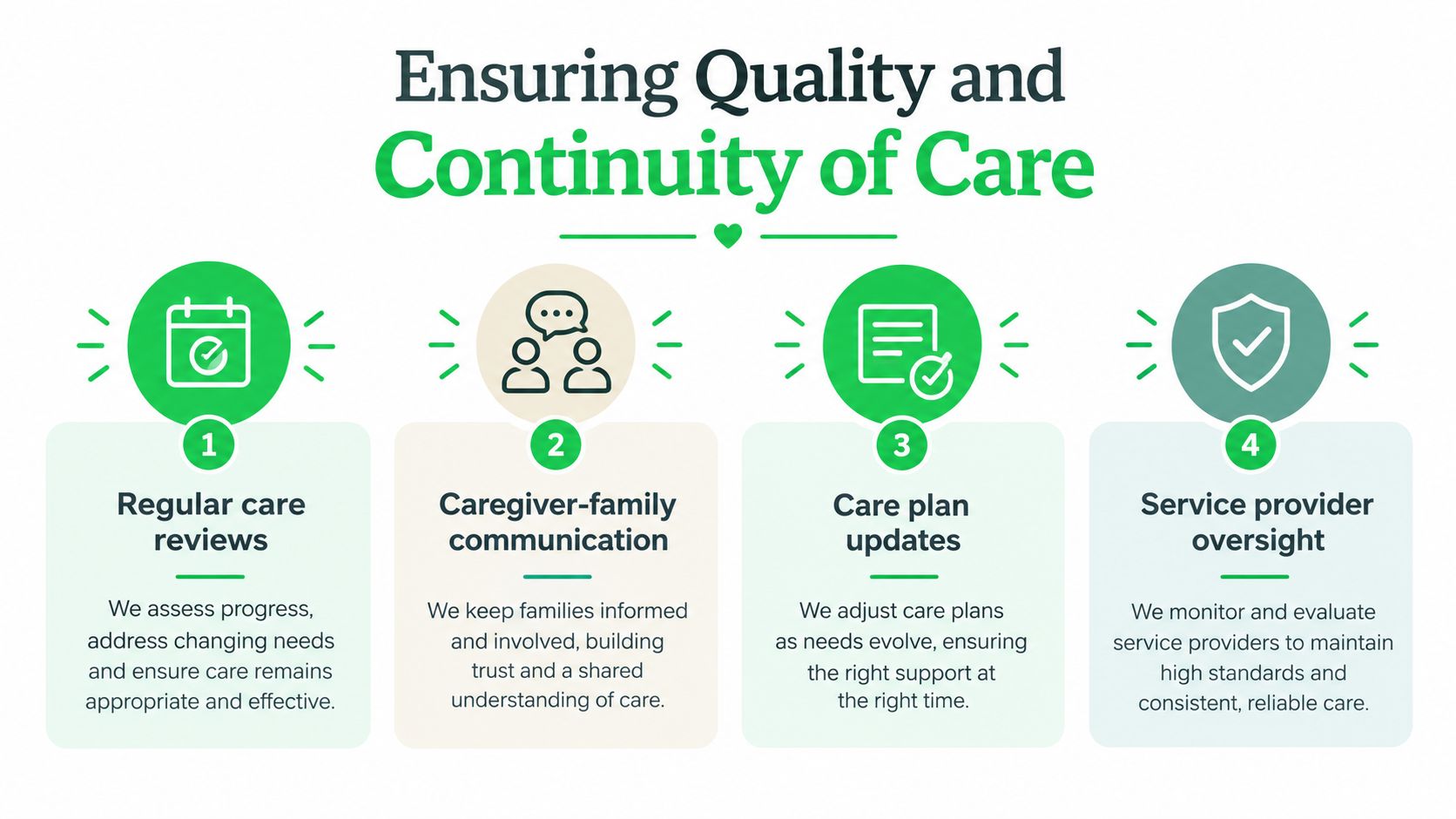
Continuity means more than sending someone to the same address. The next caregiver needs to know what happened during the previous visit, whether the person ate, whether medication was taken, how the person walked, whether a wound changed, and whether the family needs to act.
Make handovers visible
Use a shared care record or provider system to document visits, observations, medicines, incidents, and follow-up actions. Families should know who reviews the notes and how urgent findings are escalated. A phone or messaging channel can support quick communication, but important clinical decisions should also be recorded in the formal care record.
Nominate one family contact and one provider coordinator. This prevents several relatives from giving conflicting instructions and gives the care team a clear route for questions. The coordinator should arrange reviews when there is a new diagnosis, medication change, fall, hospital discharge, worsening function, or repeated refusal of care.
Caregiver turnover can disrupt routines, particularly for a person with cognitive impairment or anxiety. Ask providers how they retain staff, introduce replacements, preserve care notes, and ensure that a new person understands transfer methods and preferences before working alone.
Treat the home as part of the care system
A safe plan includes the environment. Check flooring, lighting, bathroom access, bed height, walking routes, chairs, and items that may obstruct transfers. Families looking for practical furniture-related ideas can review this resource on preventing falls with better furniture, then ask a clinician or physiotherapist whether a proposed change suits the individual.
Review care quality through observable questions:
- Attendance: Did scheduled visits occur, and were delays communicated?
- Consistency: Did staff follow the current plan and record changes?
- Safety: Were falls, medication concerns, wounds, and symptoms escalated?
- Communication: Did the family receive a clear update and next action?
- Adaptation: Was the plan revised when the person's needs changed?
Quality isn't proved by a brochure. It appears in reliable attendance, accurate records, appropriate escalation, respectful care, and a backup system that works when the original plan fails.
Frequently Asked Questions
Are home-care nurses qualified?
Ask for the clinician's relevant DHA licence, role, experience, supervision arrangements, and scope of practice. Personal caregivers and nurses don't have the same responsibilities.
What happens during an emergency?
Call emergency services for severe breathlessness, chest pain, major injury, sudden neurological symptoms, acute confusion, uncontrolled bleeding, or rapidly worsening function. The care plan should list contacts and the preferred handover information.
What if the caregiver isn't suitable?
Tell the provider promptly, describe the specific concern, and request a documented review or replacement. Don't wait if there's a safety, dignity, or safeguarding issue.
Is medical care different from personal care?
Yes. Nursing and physician services address clinical needs. Personal care supports bathing, dressing, meals, mobility, and routines. Some families need a coordinated combination.
How do we begin?
Start with an assessment at home, provide the full medication and medical history, describe the daily routine, and ask for a written plan covering visits, costs, communication, and emergency escalation.
Vitals Healthcare Doctor On Call offers DHA-licensed doctor visits, nursing, physiotherapy, home laboratory collection, and elderly care support across Dubai. For help coordinating medical attention and practical support at home, visit Vitals Healthcare Doctor On Call .