
For healthy adults, IV drips are rarely worth the cost. For documented dehydration, illness, or impaired oral intake, they're a defensible medical treatment, but in Dubai they should still be treated as regulated care, not a casual wellness add-on.
Most of the hype misses the underlying question: are IV drips worth it for the problem you have. In Dubai, that means separating medically indicated hydration from elective vitamin infusions, then judging the treatment on clinical need, risk, and convenience under a DHA-regulated framework.
| Decision point | Clinic-grade IV drip | Oral fluids or food |
|---|---|---|
| Best fit | Documented dehydration, illness, or impaired oral intake | Mild thirst, routine fatigue, everyday maintenance |
| Main upside | Rapid rehydration under clinical supervision | Low cost, low risk, easy access |
| Main trade-off | Higher cost and procedure risk | Slower relief when the gut is working normally |
| Dubai context | Must be delivered by a licensed provider under DHA rules | Available without a procedure or facility licence |
Table of Contents
- The Real Question Behind the Hype
- What an IV Drip Actually Does
- What UAE Evidence Shows
- IV Drips Compared With Oral Alternatives
- When an IV Drip Is Genuinely Worth It
- Safety Checklist Before You Book
- Cost, Value, and the Convenience Premium
- Your Decision Checklist and Final Verdict
The Real Question Behind the Hype
The wellness pitch for IV drips sounds persuasive because it sells speed, privacy, and a feeling of being “fixed” without a clinic visit. The trouble is that those are marketing benefits, not medical proof. In Dubai, the dividing line is whether the drip is being used as regulated medical care or as a lifestyle product dressed up as treatment.
That distinction matters because the Dubai Health Authority is the sole healthcare regulator in the emirate under Law No. 6 of 2018, and any provider offering IV therapy needs a valid DHA facility licence and DHA-registered clinicians vitalshealthcare.ae's Dubai IV therapy overview. The regulatory bar exists around safety, infection control, monitoring, documentation of fluid type and volume, and emergency response, not around convenience or branding. A properly delivered IV drip has a real role when oral hydration isn't enough, but that doesn't make every vitamin bag worthwhile.
Medical need beats wellness mood
The cleanest way to think about the treatment is simple. If someone is dehydrated enough that they can't replace fluids orally, if they have a documented deficiency, or if illness is blocking intake, IV therapy can be clinically sensible. If they're just tired, busy, or chasing a quick reset, the case gets much weaker.
Practical rule: if the reason for booking sounds like a marketing slogan, it's probably a weak reason for an IV.
That's especially relevant in the UAE, where heat, travel, and long days can make dehydration more likely, but where the treatment still has to be prescribed and administered inside a licensed framework. The rest of the decision comes down to whether the convenience premium is justified by a real physiological need, not by the idea that an IV drip must be stronger just because it's intravenous.
What an IV Drip Actually Does
A standard drip is built around fluid replacement first, not vitamins. In clinical settings and Dubai mobile services, that usually means an isotonic base such as saline or a Ringer's lactate-type solution, with possible additives like B-complex, vitamin C, magnesium, glutathione, or zinc, depending on the provider and the indication vitalshealthcare.ae's IV formula page. The point is to put fluid into the bloodstream directly, which bypasses the digestive tract and first-pass metabolism.
That bypass is the main pharmacokinetic argument for IV delivery. If the gut is working normally, though, the ceiling on benefit is much lower than the marketing suggests. Oral hydration and oral supplements already work well for many healthy adults, so the IV route mostly wins on speed and, in some cases, on tolerance when nausea, vomiting, or poor absorption gets in the way.
What's usually inside the bag
The base fluid does the heavy lifting. Vitamins and minerals are secondary, and in healthy adults they're often the least convincing part of the mix. That's why it helps to think of IV therapy as a delivery method first, and a supplement platform second.
If you're comparing that with an oral wellness product, a simple hydration drink or supplement mix may cover the same everyday use case without a cannula, monitoring, or facility licence. For readers who want a consumer-side reference point, hydration for daily energy is a useful way to see how oral options are positioned when the aim is routine maintenance rather than clinical rehydration.
The more intact the gut, the smaller the argument for IV-only benefit.
That's why it helps to read the label and the clinical rationale before you book. If the formula is mostly fluids with a modest vitamin add-on, the value is usually about rehydration. If the claim is broad energy, immunity, or beauty support, you're moving into much thinner evidence territory.
What UAE Evidence Shows
The UAE evidence supports a limited medical role for IV hydration, while offering a much weaker basis for elective wellness infusions. A UAE-reported clinical study found dehydration in 42.5% of participants, and 24.3% of those with dehydration required hospitalization Khaleej Times on UAE IV drip risks. Those figures show that dehydration can become clinically significant in the region. They do not show that a vitamin drip improves health when no dehydration, deficiency, or absorption problem is present.
Where the evidence is strongest
Saline and electrolyte replacement have the clearest rationale because they address fluid loss directly. The benefit depends on the patient's condition, however. Someone unable to drink or retain fluids has a different clinical need from a healthy client seeking an energy or immunity treatment.
Vitamin-heavy infusions require a stronger justification. They may make sense when a clinician has identified a deficiency or when oral replacement is unsuitable. Without those conditions, the added ingredients do not automatically create a measurable health benefit. The IV route can deliver nutrients directly, but delivery speed is not proof that the body needs more of them.
UAE media reporting that quotes Dubai clinicians describes wellness-focused IV drips as more trend-driven than science-backed. It also identifies severe dehydration and documented deficiency as the situations with the clearest potential benefit, rather than routine use in healthy people. That distinction separates medical-grade hydration from elective vitamin infusions, which are often sold through broader claims about energy, immunity, appearance, or recovery.
| Use Case | Evidence Strength | UAE Context |
|---|---|---|
| True dehydration | Stronger | Relevant in hot-weather illness, travel, or poor oral intake |
| Documented deficiency | Stronger | Best considered when a clinician has a reason to replace nutrients directly |
| Wellness energy or immunity cocktails | Weaker | Popular in Dubai, but the supporting evidence is less convincing |
| Routine cosmetic or performance use | Weakest | Clinical upside remains unclear without a medical indication |
The practical conclusion is conditional, not promotional. IV drips have a defensible role when they solve a defined medical problem, especially when oral intake is inadequate. Their case weakens when the treatment is offered as a general vitality product. At that point, the buyer is paying for an invasive delivery method and convenience, while the expected outcome may be difficult to measure.
IV Drips Compared With Oral Alternatives
The faster route is not automatically the better treatment. The useful comparison is IV therapy against oral rehydration, electrolyte drinks, and water with food. If the gut is working and fluid loss is mild, oral intake usually addresses the problem without a procedure. Nausea, repeated vomiting, or impaired absorption changes that calculation because the patient may be unable to retain or absorb enough fluid.
The decision should therefore follow the clinical barrier, not the product's marketing. Someone who can drink and keep fluids down has a practical oral option. Someone who cannot may need IV treatment, with assessment and monitoring rather than a wellness formula chosen by preference.
| Factor | IV Drip | Oral Rehydration / Electrolyte Drink | Water + Food |
|---|---|---|---|
| Speed of rehydration | Fastest | Slower, but often sufficient | Slowest |
| Need for clinical supervision | Yes | No | No |
| Best use case | Vomiting, significant dehydration, impaired intake | Mild to moderate dehydration, routine recovery | Everyday maintenance |
| Convenience | High if delivered at home or hotel | High and immediate | Highest |
| Procedure risk | Present | Very low | Very low |
The convenience column needs careful reading in the UAE market. A drip delivered at home or to a hotel removes travel and waiting, but it does not remove the need for clinical assessment or the risks of venous access. The convenience premium may improve access when a person is genuinely unable to drink, yet it adds little medical value when oral replacement is already feasible.
Where oral wins
Oral options are the sensible first choice when the stomach cooperates. This includes routine post-workout hydration, mild travel fatigue, and everyday tiredness without signs of significant dehydration. Water, food, or an oral rehydration product can address these situations without exposing the person to insertion-site complications or an unnecessary invasive treatment.
Packaged products such as tangerine immune support sticks show how the market offers a portable alternative to a procedure. Oral products rely on digestion and absorption, so they are less suitable when vomiting persists or absorption is impaired. They also do not treat an underlying infection. If infection, rather than dehydration, is driving the illness, consult guidance on IV drip antibiotics instead of treating hydration as the main problem.
Clinical shortcut: if water, oral rehydration, and rest remain realistic, an IV drip usually is not the first choice.
The relevant question is not which route feels stronger. It is which route matches the actual problem. For mild dehydration, oral intake generally offers the lower-risk, lower-cost path. IV treatment earns a clearer role when oral intake fails or a clinician identifies a medical need for faster fluid replacement.
When an IV Drip Is Genuinely Worth It
Dubai gives you some of the clearest real-world examples of where the drip earns its keep. Summer heat, travel schedules, and active lifestyles can push people from mildly dry to completely depleted, especially when vomiting or food intolerance enters the picture. In those cases, the issue isn't wellness. It's restoration of fluid balance.
The cases that make sense
A patient with gastrointestinal illness who hasn't kept fluids down for hours is one of the clearest candidates. So is a runner or training-block athlete with obvious fluid loss and a clinician documenting dehydration or electrolyte concern. Acute food poisoning with persistent vomiting also fits, because oral rehydration may fail repeatedly before it ever has a chance to work.
Travel-related use is more nuanced. A jet-lagged business traveller or a person seeking a hangover protocol may value the speed and privacy, but that's a convenience decision unless there's a true dehydration issue. In those cases, the drip may make someone feel better sooner, yet the medical justification is weaker than in acute illness.
Plain-English test: if the drip is replacing what you can't keep down, it makes sense. If it's mainly about feeling fresher faster, the case is softer.
The Dubai context matters here. The city's heat and pace can make dehydration more likely than in cooler, slower environments, so the threshold for taking symptoms seriously should be lower. Even then, the outcome window is usually short-term rehydration and symptom relief, not durable performance gains or a permanent energy reset.
What a reasonable expectation looks like
The practical upside is simple relief, not transformation. A properly supervised drip can help someone who's dehydrated, nauseated, or unable to drink enough. It doesn't turn a healthy adult into a better one, and it doesn't create a medical need where none exists.
That's the line to keep in mind when you're deciding whether the booking is medical or elective. If the goal is to restore hydration after a clear loss, the treatment is defensible. If the goal is to buy a more comfortable version of a nap and a water bottle, the value drops quickly.
Safety Checklist Before You Book
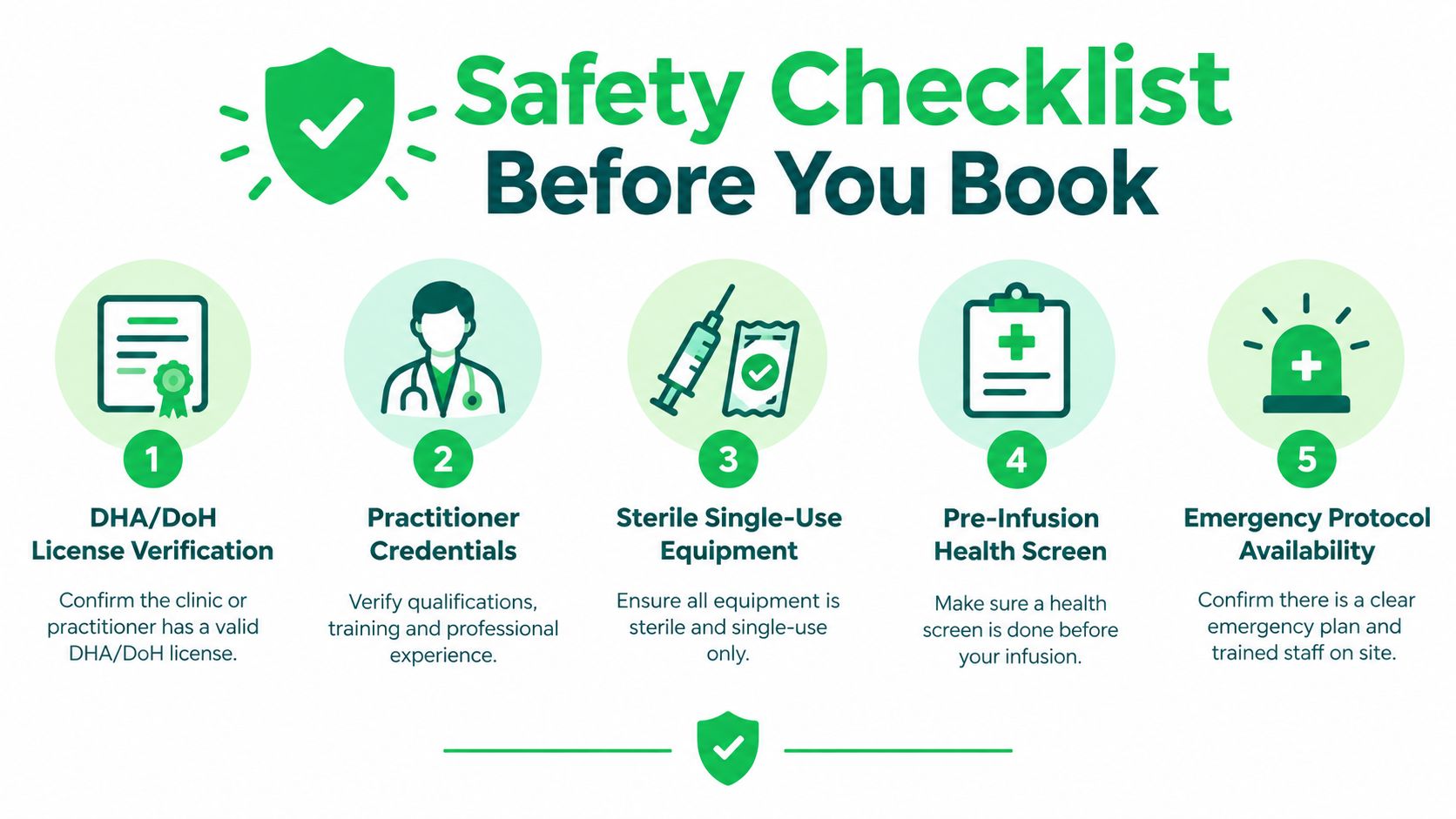
Safety starts before the needle goes in. In Dubai, the first checkpoint is licensing, because the provider has to operate under the DHA framework, and home or mobile IV therapy should be delivered by DHA-registered clinicians. After that, the question becomes whether the provider screens properly, uses sterile single-use equipment, and has an escalation plan if something goes wrong.

The checks that matter
- Confirm the licence: Ask whether the clinic or mobile team holds the right DHA approval for IV therapy.
- Verify who's treating you: A licensed nurse or physician should handle cannulation and monitoring.
- Ask about sterile supplies: Single-use equipment should be standard, not optional.
- Expect a pre-infusion screen: Allergies, renal issues, current illness, and medication use need review.
- Look for an emergency pathway: If adverse reactions happen, the provider should know exactly how to escalate.
That checklist is not bureaucracy for its own sake. It's the difference between regulated care and a casual wellness visit with medical props. For a deeper practical note on procedure hygiene, the bloodstream infection guidance from BacteriaFAQ.com is worth reading because it reinforces why line care, sterility, and handling matter.
Red flags to respect
A missing consent form is a problem. So is any provider that can't explain the contents of the bag, the screening process, or the batch documentation for what they're infusing. If the price looks far below what a licensed service would usually charge, that's not a bargain signal, it's a due-diligence signal.
You can also use Vitals Healthcare's IV treatment page as a reference point for how a regulated Dubai provider presents in-home IV care. The useful takeaway is not the brand name itself, but the standard it implies, clinical assessment first, infusion second.
Cost, Value, and the Convenience Premium
Dubai IV pricing reflects three different services: treatment in a clinic, a hotel or home visit, and a premium mobile appointment built around privacy and convenience. The Dubai IV drip therapy cost guide provides a useful reference for local pricing. Bills typically include clinical time, consumables, the fluid or supplement mixture, and travel. A home visit therefore charges for time saved and the ability to avoid a waiting room, not necessarily for a different medical result.
The comparison with clinic care matters. Medical-grade hydration can have a reasonable value when someone has a genuine hydration problem and cannot keep fluids down. Elective vitamin infusions face a higher bar. If the expected result is only a short-lived lift that rest and oral fluids could provide, paying for delivery, privacy, and setup makes the value weaker.
| Typical Dubai IV Drip Cost vs. Expected Value (2026) | Drip Type | Indicative AED Range (Home Visit) | Typical Contents | Likely Insurance Coverage |
|---|---|---|---|---|
| Typical Dubai IV Drip Cost vs. Expected Value (2026) | Basic hydration | AED 350-600 | Saline or electrolyte fluid | More likely if medically indicated |
| Typical Dubai IV Drip Cost vs. Expected Value (2026) | Myers-style vitamin cocktail | AED 600-900 | Fluids plus vitamins and minerals | Usually self-pay |
| Typical Dubai IV Drip Cost vs. Expected Value (2026) | NAD+ style drip | AED 1,200+ | Premium infusion mix | Usually self-pay |
These ranges make the convenience premium visible. A clinic appointment may reduce or remove the travel charge, while a home visit adds it. The higher fee can still be rational if avoiding travel or waiting helps someone obtain needed hydration promptly. It is harder to justify for a wellness infusion with no clear clinical indication.
How to judge value for yourself
Ask three questions. Is there a medical reason oral fluids are insufficient? What would lost work, travel, or sleep cost if you rested instead? Are you paying for a better health outcome, or for a more comfortable setting?
For medically indicated hydration, the fee may be reasonable when oral intake has failed or vomiting makes drinking unrealistic. For elective wellness drips, convenience is usually the main product. That can be a valid personal purchase, but it does not establish medical necessity or guarantee a meaningful health benefit.
If the drip only removes inconvenience, price sensitivity should be high.
Your Decision Checklist and Final Verdict
Use this before booking. If you can't check most of these boxes, the IV probably isn't the right move.
- Clinical indication exists: dehydration, illness, or impaired oral intake is the reason.
- Provider is licensed: the service operates under Dubai's regulated framework.
- Screening happens first: allergies, illness, renal concerns, and current medicines are reviewed.
- Sterile supplies are used: single-use equipment and proper handling are essential.
- Pricing is transparent: you know what's included before anyone sets up the line.
The verdict by reader type
Healthy adults seeking wellness can usually skip it unless they just want the convenience and can afford the premium without expecting a dramatic result. Patients with short-term dehydration or illness have the strongest case, especially when oral intake has failed or vomiting makes drinking unrealistic. Chronic patients whose clinicians recommend parenteral therapy should follow medical advice rather than any general checklist.
The plain answer to are IV drips worth it is no for most readers, and yes for a clearly defined minority. The minority is the group with a real clinical need, where the drip solves a problem that oral hydration can't solve quickly enough.
If you're deciding between oral fluids, clinic care, or a home visit, Vitals Healthcare Doctor On Call offers DHA-licensed doctor, nursing, and IV therapy services in Dubai, including treatment at home, in hotels, or at the office. Visit Vitals Healthcare Doctor On Call to review the service details and decide whether a regulated, clinician-led visit fits your situation.