



In Dubai, glutathione IV treatment sits in a grey zone because the DHA has formally warned against its cosmetic injection use. Any administration should only follow documented medical assessment by a DHA-licensed professional.
You may have seen the promotion while scrolling through social media: a discreet home visit, a hotel-room drip, or a promise of brighter skin and more energy. The treatment can look as simple as hanging a fluid bag and resting for a while, but an intravenous medicine is never merely a beauty appointment. It involves a product entering the bloodstream, a route of administration covered by Dubai's regulatory warning, and a patient whose medical history must be assessed before treatment.
The sensible question isn't only, “Does glutathione work?” It's also, “Why am I considering it, who is responsible for the decision, what evidence supports that purpose, and what happens if I react?” Those questions matter even more when convenience, privacy, or travel plans create pressure to proceed quickly.
Table of Contents
- What Glutathione IV Treatment Actually Involves
- How Glutathione Is Claimed to Work in the Body
- Claimed Benefits and the Evidence Behind Them
- What Happens During a Glutathione IV Session
- Safety, Side Effects, and Who Should Avoid It
- How Dubai Regulates Glutathione IV Treatment
- The Screening Checklist Before Any Glutathione IV Drip
- Making an Informed Decision About Glutathione IV Treatment
What Glutathione IV Treatment Actually Involves
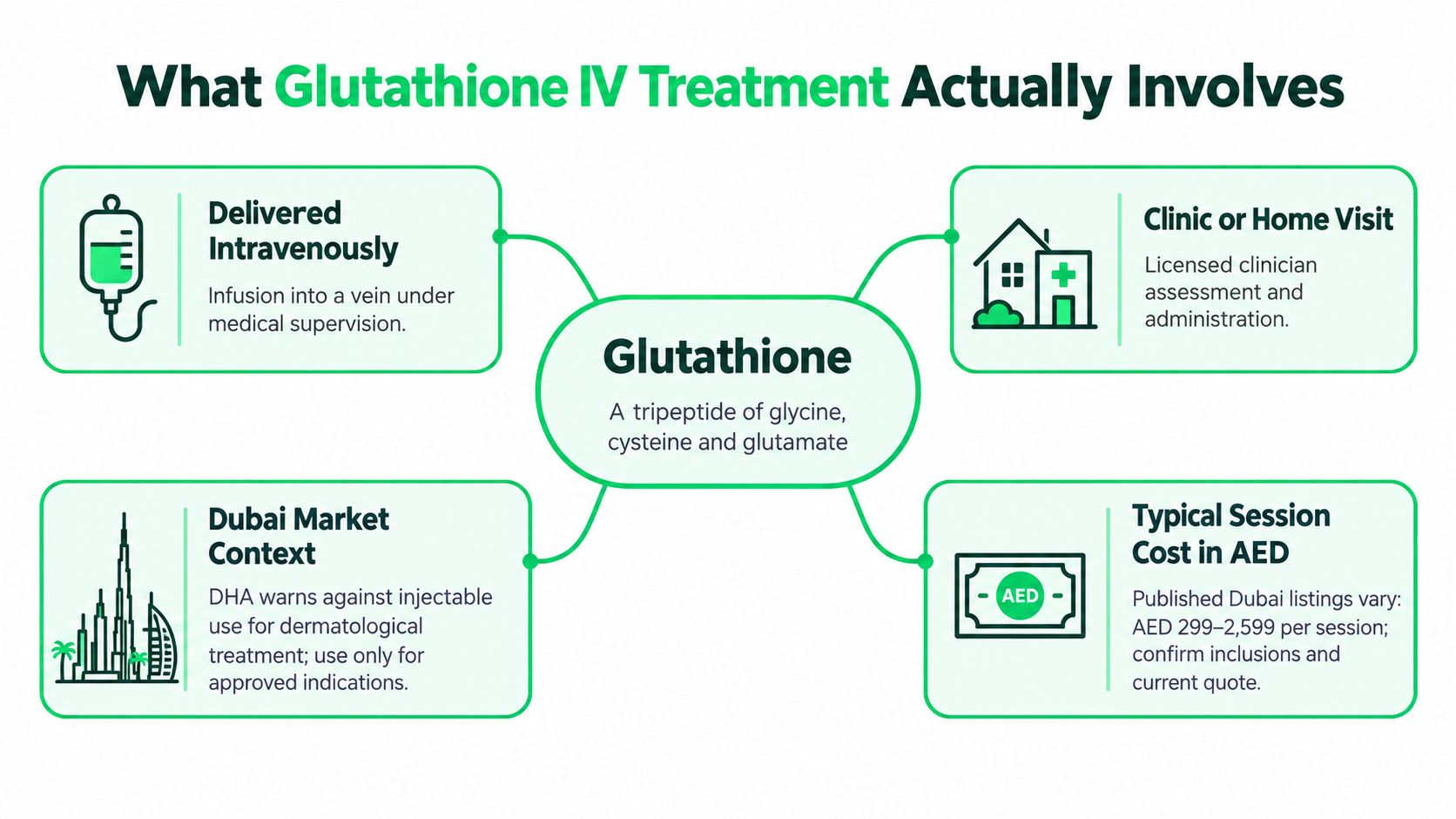
A Dubai resident might see glutathione described online as an antioxidant drip for skin tone, detoxification, energy, or general wellness. Glutathione is a tripeptide made from glycine, cysteine, and glutamate, and the body produces it naturally. That doesn't mean an infused product is equivalent to the glutathione already present in your cells.
During treatment, a clinician introduces a pharmaceutical preparation through a cannula placed in a vein. Intravenous delivery avoids digestion and puts the product directly into the bloodstream. That direct exposure is precisely why the procedure deserves more care than an oral supplement. The clinician must consider the product's source, sterility, expiry, compatibility with other ingredients, the patient's medical history, and the ability to respond to an adverse reaction.
A drip is a drug administration event
The phrase “wellness drip” can make the procedure sound harmless. In practice, it's closer to a short medication administration appointment. A clinician should confirm the indication, explain uncertainty around cosmetic claims, record consent, check vital signs, use aseptic equipment, and monitor you while the infusion runs.
A home visit doesn't change those responsibilities. Whether treatment takes place in a clinic, hotel room, or office, the same clinical questions remain. You can read about how home IV care is described in IV hydration and multivitamins therapy, but convenience should never be confused with a lower-risk route.
The Dubai-specific issue is central. On 5 October 2021, the Dubai Health Authority circulated Circular CIR-2021-00000172, warning against glutathione for dermatological treatment when injected intravenously, intramuscularly, or subcutaneously. That means cosmetic skin-lightening marketing must not be treated as proof that the treatment is officially endorsed for that purpose.
The rest of the decision follows from this distinction. Glutathione has a legitimate biochemical role in the body, yet a plausible mechanism doesn't automatically establish that an IV treatment is appropriate for cosmetic use or routine wellness.
How Glutathione Is Claimed to Work in the Body
Glutathione works as part of the body's antioxidant and redox systems. In plain language, it helps cells manage reactive molecules that can damage proteins, fats, and other cellular structures. It also participates in processes involving the liver and interacts with other antioxidant systems, including vitamins C and E.
That description explains why the ingredient attracts attention. A promoter may take a real biological function and extend it into a broad promise of brighter skin, more energy, stronger immunity, or “detoxification”. The first statement concerns physiology. The second concerns a clinical outcome, and it requires evidence for the specific condition and route of treatment.
Why IV delivery is promoted
An oral product must pass through the digestive system before its components become available to the body. An IV preparation bypasses that process and creates direct systemic exposure. Providers therefore argue that infusion can raise circulating glutathione more directly than a capsule.
That argument may explain the route, but it doesn't answer the more important questions: Does the increase improve the patient's condition? Is the dose appropriate? How long does any effect last? Does the benefit outweigh the risks of venous access, systemic exposure, and product administration?
A useful analogy is fuel delivery. Putting fuel directly into an engine may be faster than carrying it through a long supply route, but speed doesn't prove that the engine needs more fuel or that the fuel is suitable. The clinical indication still comes first.
The difference between mechanism and outcome
Glutathione's role in antioxidant defence is not the same as proof that an IV drip reverses ageing or lightens skin safely. A person may feel different after treatment for many reasons, including rest, hydration, expectation, or relief from a busy schedule. A responsible clinician separates those possibilities from a treatment effect.
This distinction is particularly important in Dubai, where social media often compresses complex medical decisions into a short before-and-after message. A sound consultation should explain what is known, what remains uncertain, and why the DHA warning changes how cosmetic injection claims should be interpreted.
Claimed Benefits and the Evidence Behind Them
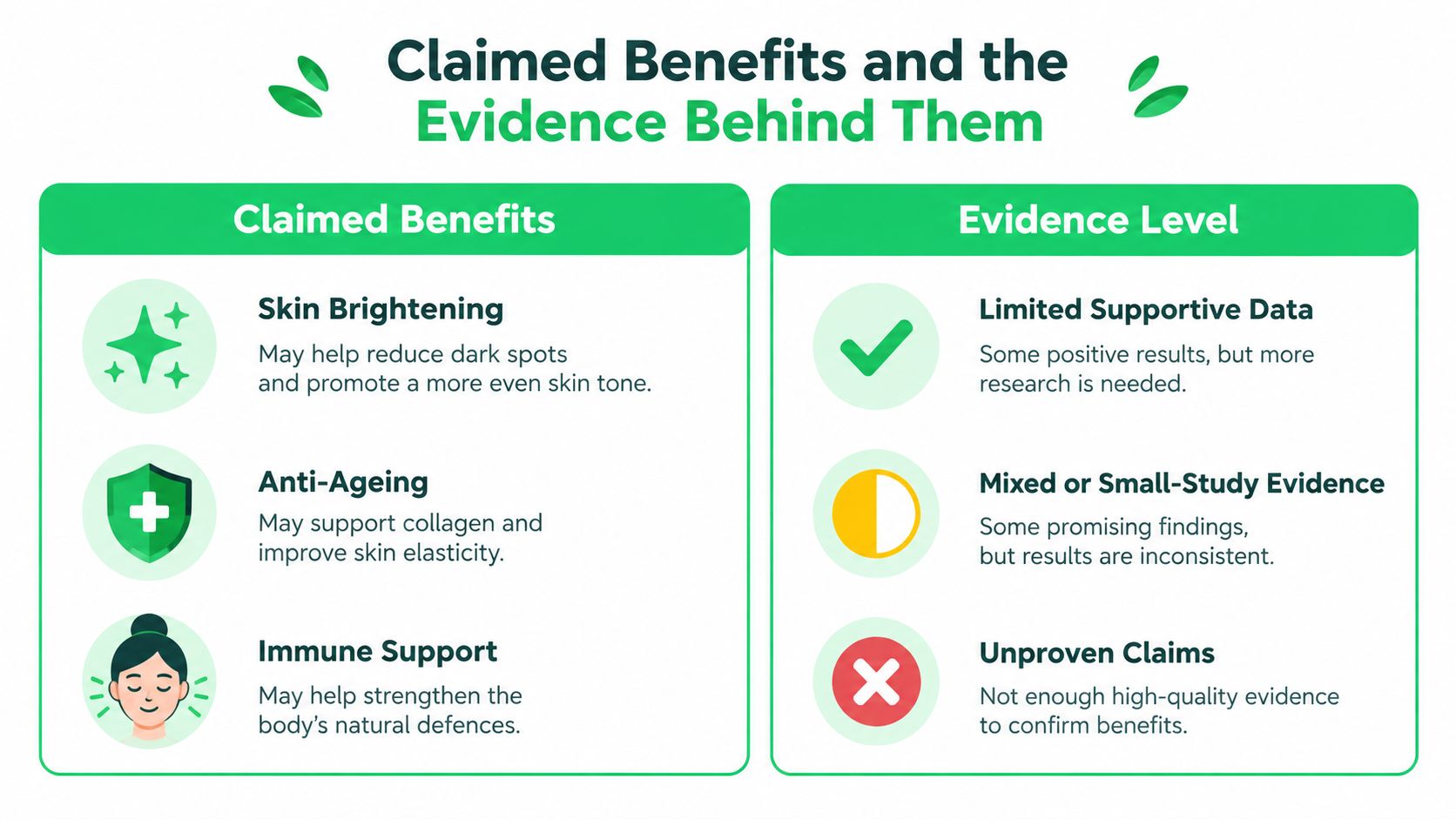
The most common claims fall into different evidence categories, and they shouldn't be treated as one package. Glutathione's biological role is plausible and medically relevant in selected settings, while evidence for routine cosmetic or wellness infusion is much less settled.
Skin brightening is the claim most directly affected by Dubai's regulatory position. Some research has explored glutathione and pigmentation, but the evidence for IV cosmetic use remains limited and doesn't justify presenting the treatment as an officially endorsed skin-lightening therapy. The DHA's warning applies to dermatological use administered into a vein, muscle, or under the skin, so a patient should treat confident cosmetic promises with caution.
Anti-ageing language is broader still. “Antioxidant” describes a biological function, not a guaranteed improvement in wrinkles, energy, appearance, or lifespan. Immune support and liver detoxification are also frequently advertised, yet a mechanism alone doesn't establish that an otherwise healthy person needs an IV infusion.
A practical evidence grading
| Claim | What can reasonably be said |
|---|---|
| Skin brightening | Evidence is limited, and cosmetic injection use is specifically addressed by the DHA warning. |
| Anti-ageing | Broad promotional language goes beyond what a biochemical antioxidant role can prove. |
| Immune support | A biological rationale exists, but routine IV use for healthy people requires stronger condition-specific evidence. |
| Energy and fatigue | A person's symptoms need assessment rather than automatic attribution to low glutathione. |
| Liver support | Any medical use should be tied to a defined clinical situation and physician supervision. |
| Fertility | Evidence from limited research cannot be converted into a general promise for every patient. |
The same discipline applies to any wellness service that combines several ingredients. A resource such as the Longevity Clinics rubric can help readers think about treatment claims, medical oversight, and the difference between a polished service experience and a defensible clinical pathway.
A patient considering broader IV wellness information may also encounter real benefits of vitamin IV therapy. That type of material should be read as general education, not as a substitute for an individual assessment or as evidence that glutathione is suitable for a particular purpose.
Why the evidence gap matters
Weak evidence doesn't prove that every patient will experience no effect. It does mean that a provider shouldn't guarantee results, imply that cosmetic use is regulator-approved, or use testimonials as a replacement for clinical reasoning. The more ambitious the claim, the more precisely the provider should identify the indication, supporting evidence, alternatives, and limitations.
What Happens During a Glutathione IV Session
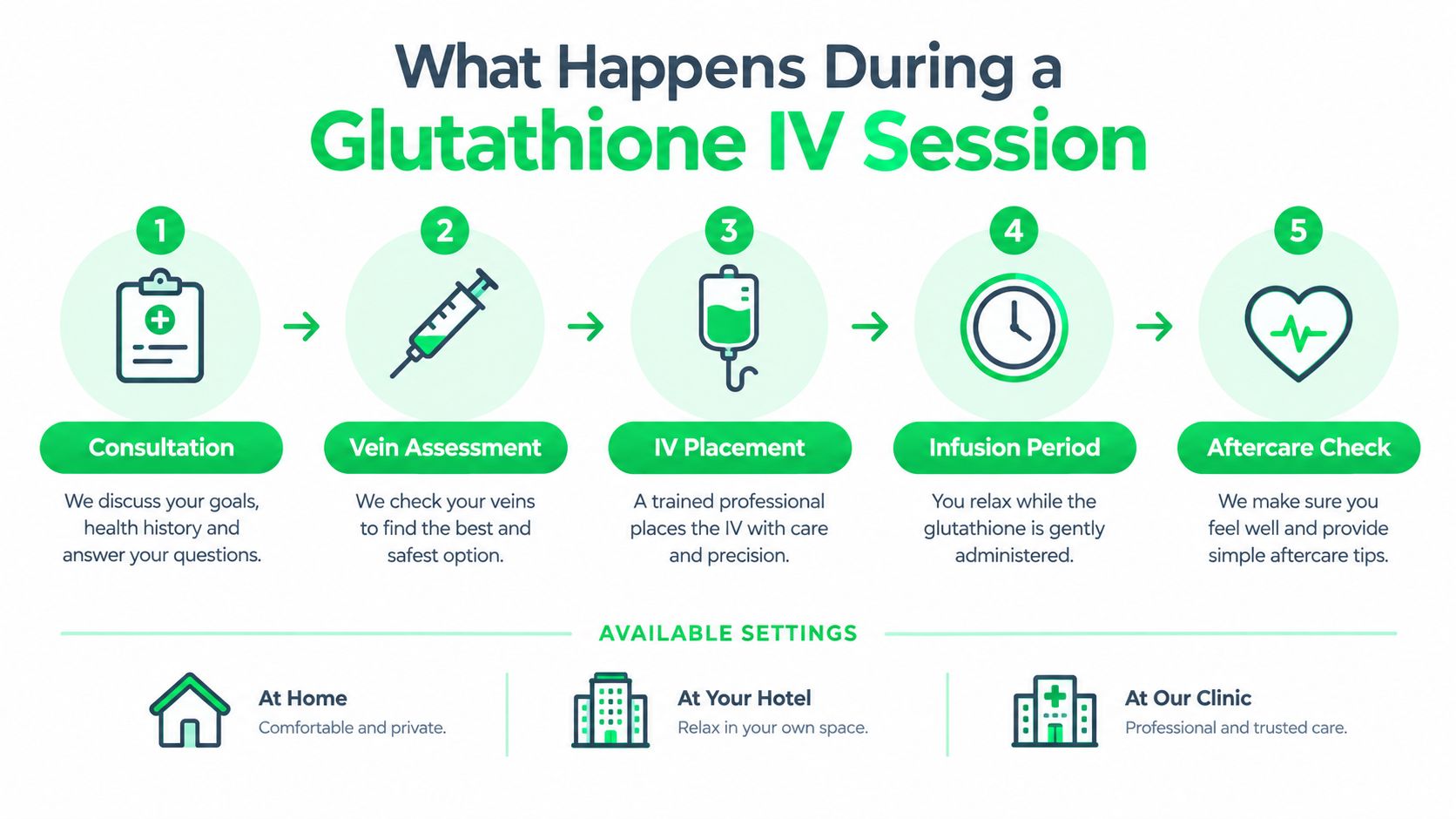
A responsible session starts before the clinician arrives. A booking conversation or medical intake should establish why you're requesting treatment, review relevant conditions and medicines, and identify reasons to defer. If the interaction consists only of selecting a flavour or package, important clinical information may be missing.
The usual sequence
- Consultation: The clinician clarifies the goal and checks whether cosmetic or wellness language is masking a medical symptom that needs another evaluation.
- History and examination: Medicines, allergies, pregnancy status, relevant diseases, and previous reactions should be discussed.
- Preparation: The clinician verifies the product, expiry, storage conditions, and sterile, single-use supplies.
- Cannula placement: A peripheral cannula is inserted into a vein, followed by a check of baseline vital signs and the planned infusion.
- Observation and aftercare: The patient remains under observation during administration and receives clear instructions about symptoms that require urgent help.
The exact speed and contents of an infusion depend on the clinician's decision and the product being used. There shouldn't be a universal social-media protocol applied to every patient, particularly because dosing practices aren't standardised for cosmetic use.
Clinic, home, hotel, or office
A clinic may offer easier access to additional equipment and escalation support. A home or hotel visit may be more private and convenient, but the clinician must bring appropriate emergency equipment and have a clear transfer pathway if the patient deteriorates.
The setting should match the patient's risk, not merely their preference. Someone with significant medical conditions, a history of serious reactions, or an uncertain indication may need assessment in a setting with broader medical support rather than a mobile wellness appointment.
For a plain-language description of the logistics of mobile nursing care, see what really happens during a home nurse visit. Before any infusion, ask who will assess you, who prescribed or authorised the treatment, how long you'll be monitored, and what happens if you need urgent transfer.
Practical rule: A session isn't complete when the bag is empty. It's complete when the clinician has assessed your response and explained what to do next.
Safety, Side Effects, and Who Should Avoid It
The principal risk of glutathione IV treatment comes from the whole process, not just the molecule. Systemic exposure, uncertain product quality, infusion technique, contamination, and patient selection can all affect safety.
Possible reactions range from uncomfortable symptoms such as nausea, headache, dizziness, flushing, gastrointestinal upset, local irritation, or vein discomfort to serious events. Reported or warned-about complications include anaphylaxis, severe cutaneous reactions such as Stevens–Johnson syndrome, liver injury, kidney injury, thyroid disturbance, and infection from non-sterile preparation or administration.
A reaction can develop during or after the infusion. Facial swelling, breathing difficulty, widespread hives, severe dizziness, chest symptoms, or sudden deterioration require the infusion to stop and urgent medical assessment. In a mobile setting, emergency equipment and an escalation plan must be immediately available, not treated as optional extras.
The vitamin C and G6PD question
Some providers combine glutathione with high-dose vitamin C. Vitamin C can cause haemolysis, the breakdown of red blood cells, in people with glucose-6-phosphate dehydrogenase deficiency, commonly called G6PD deficiency. If such a combination is being considered, the patient's G6PD status should be established first.
This is why a request for a quick drip shouldn't be handled like a routine beverage order. The clinician needs enough information to decide whether the ingredients can be used together and whether testing is appropriate.
When postponement may be safer
A clinician should take particular care, defer treatment, or seek specialist input when a patient is:
- Pregnant or breastfeeding: Cosmetic or wellness use shouldn't proceed without a clear medical rationale and appropriate professional advice.
- Receiving active chemotherapy: Any proposed antioxidant infusion needs coordination with the treating oncology team.
- Living with asthma or a known thiol allergy: The risk of a serious reaction requires careful assessment.
- Managing liver or kidney disease: Reduced organ reserve may alter the risk of systemic treatment.
- Taking multiple medicines or supplements: Interactions and overlapping ingredients need review.
A patient should also ask how the provider handles sterile preparation, product traceability, documentation, and emergency transfer. General beauty-oriented discussion, such as Skin Perfection on IV infusion beauty, can provide context about how the service is marketed, but it shouldn't replace medical consent or risk assessment.
How Dubai Regulates Glutathione IV Treatment
The DHA's position is more specific than a general warning about “glutathione”. On 5 October 2021, DHA Circular CIR-2021-00000172 warned against using glutathione for dermatological treatment when administered by injection into a vein, muscle, or under the skin. The circular therefore directly covers intravenous glutathione marketed for cosmetic skin-lightening purposes in Dubai.
That doesn't mean every possible administration can be described in the same way. A medically justified use, where an approved indication and physician supervision apply, is a different question from a cosmetic injection promoted as a routine beauty treatment. The patient should ask the provider to explain that distinction clearly rather than accepting a general claim that the product is “approved”.
What transparency should look like
A Dubai patient should be able to ask:
- Is the facility licensed by the DHA?
- Is the clinician's professional licence current and relevant to the service?
- What is the documented indication?
- What product is being used, and can its source, expiry, and storage be verified?
- Who authorised the treatment?
- What records will be kept?
- What monitoring and emergency arrangements are in place?
The DHA's drug-control function oversees medication governance, including approvals involving healthcare facilities, professional scope, custody, and transfer of regulated medicines. That context explains why product handling and documentation matter, especially when treatment moves from a regulated facility into a home, hotel, or office.
| Aspect | What the DHA says | What it means in practice |
|---|---|---|
| Cosmetic dermatological use | The circular warns against glutathione administered intravenously, intramuscularly, or subcutaneously for this use. | Don't treat IV skin-lightening promotion as official endorsement. |
| Medical rationale | The warning distinguishes cosmetic use from medically justified, approved indications. | Ask for a documented indication and physician assessment. |
| Professional oversight | Medication governance includes facility and professional responsibilities. | Verify the DHA-licensed provider and the treatment record. |
| Mobile delivery | A change of location doesn't remove clinical obligations. | Home convenience must not replace monitoring or emergency readiness. |
Information about quality treatment protocols may help you understand what to ask about documentation and clinical processes. The responsibility remains with the provider to apply Dubai's requirements to the specific patient and product.
The Screening Checklist Before Any Glutathione IV Drip
Before an infusion, the clinician should be able to answer a basic question: What is the medical reason for giving this product to this person, by this route, today? If the answer is only “skin brightening” or a social-media package, the patient should pause, because the DHA warning directly addresses cosmetic dermatological injection use.
A proper screen should cover:
- Current medicines and supplements: Include prescription medicines, over-the-counter products, and any other IV ingredients.
- Pregnancy and breastfeeding: These statuses must be disclosed before treatment.
- Chemotherapy: Active cancer treatment requires coordination with the oncology team.
- Asthma and allergies: Mention asthma, prior infusion reactions, thiol or sulfite allergy, and unexplained episodes of swelling or breathing difficulty.
- G6PD status: This is particularly important if high-dose vitamin C may be added.
- Liver and kidney history: Existing disease may change the risk assessment.
- Recent procedures or vaccinations: The clinician should decide whether timing or current symptoms warrant postponement.
Tests and consent
There isn't one universal test panel for every patient. Depending on the indication, history, and ingredients, a clinician may consider liver function, kidney function, a complete blood count, or G6PD testing where vitamin C co-administration is contemplated. Testing should be connected to a clinical question, not ordered as a decorative part of a package.
Written consent should state the proposed purpose, uncertainty of benefit, alternatives, possible adverse reactions, the products and route involved, monitoring arrangements, and escalation plan. Patients who want to understand the logistics of mobile diagnostic support can review home blood sampling, but blood testing doesn't make an otherwise unsupported cosmetic indication appropriate.
A hotel booking, work schedule, or flight departure is not a clinical indication.
If the clinician can't complete the assessment because you're in a hurry, the safer decision may be to delay or decline the infusion. Convenience can remove travel time, but it doesn't remove the possibility of a systemic reaction.
Making an Informed Decision About Glutathione IV Treatment
A sensible decision begins with the goal, not the drip. If you want treatment for fatigue, pigmentation, recurrent illness, or a liver concern, that symptom deserves an appropriate assessment before glutathione is considered. An IV product shouldn't become a shortcut around diagnosis.
Use this decision sequence:
- Name the outcome you want. Avoid broad terms such as “detox” unless the clinician defines what that means medically.
- Ask whether an appropriate indication exists. Cosmetic skin-lightening injection use is subject to the DHA warning.
- Check the provider. Confirm DHA licensing, professional responsibility, product traceability, and documentation.
- Review your risk factors. Discuss medicines, pregnancy, breastfeeding, chemotherapy, asthma, allergies, G6PD deficiency, and liver or kidney disease.
- Choose the setting based on safety. A clinic may be more suitable when the patient needs closer support or the history is complex.
- Agree on follow-up. Know which symptoms are expected, which require a call, and which require emergency care.
Red flags before booking
Walk away from a provider who guarantees skin lightening, refuses to discuss the DHA circular, offers treatment without a medical history, cannot identify the product source, discourages questions about complications, or treats home delivery as proof that the treatment is low risk. A polished room, fast booking process, or attractive package doesn't correct those failures.
Patients comparing claims across clinics may find it useful to compare clinics and treatment claims using questions about evidence, oversight, and transparency rather than appearance or testimonials. The right outcome may be treatment, a different medical evaluation, or no infusion at all.
Glutathione IV treatment should be approached as a clinician-led decision, not a routine purchase. In Dubai, the DHA's warning makes the distinction between cosmetic promotion and medically justified care especially important, while the uncertain evidence makes screening and informed consent more valuable than speed.
Vitals Healthcare Doctor On Call offers DHA-licensed doctor, nursing, home laboratory, and clinician-coordinated IV services for patients in homes, hotels, and offices across Dubai. To discuss whether an assessment is appropriate before considering glutathione IV treatment, visit Vitals Healthcare Doctor On Call .