



You're in Dubai, you feel well, and you're deciding whether to book a heart checkup package now or wait until something hurts. Perhaps a parent had heart disease, your last blood-pressure reading was higher than expected, or you just want reassurance before a busy year of work and travel. The difficult part isn't finding a package. It's knowing whether the tests included will answer the question you truly have.
A useful cardiac checkup isn't a random collection of measurements. It's a process that identifies risk, explains what the findings mean, and connects them to a sensible next step. The Dubai Health Authority's guidance supports this risk-based approach, including cardiovascular measurements and a calculated 10-year risk score for adults without established disease. Dubai Health Authority's periodic screening guideline is a better starting point than choosing the longest panel merely because it contains more tests.
Table of Contents
- Why a Heart Checkup Package Matters Before Symptoms Appear
- What a Heart Checkup Package Actually Is
- Common Tests Included in a Cardiac Screening Package
- Who Should Book a Heart Checkup and How Often
- Preparing for a Heart Checkup at Home or On Site
- Comparing Clinic Packages, Home Visits, and Rapid On-Site Care
- Reading Your Results and Knowing When to Act
- A Simple Decision Framework for Your Next Step
Why a Heart Checkup Package Matters Before Symptoms Appear
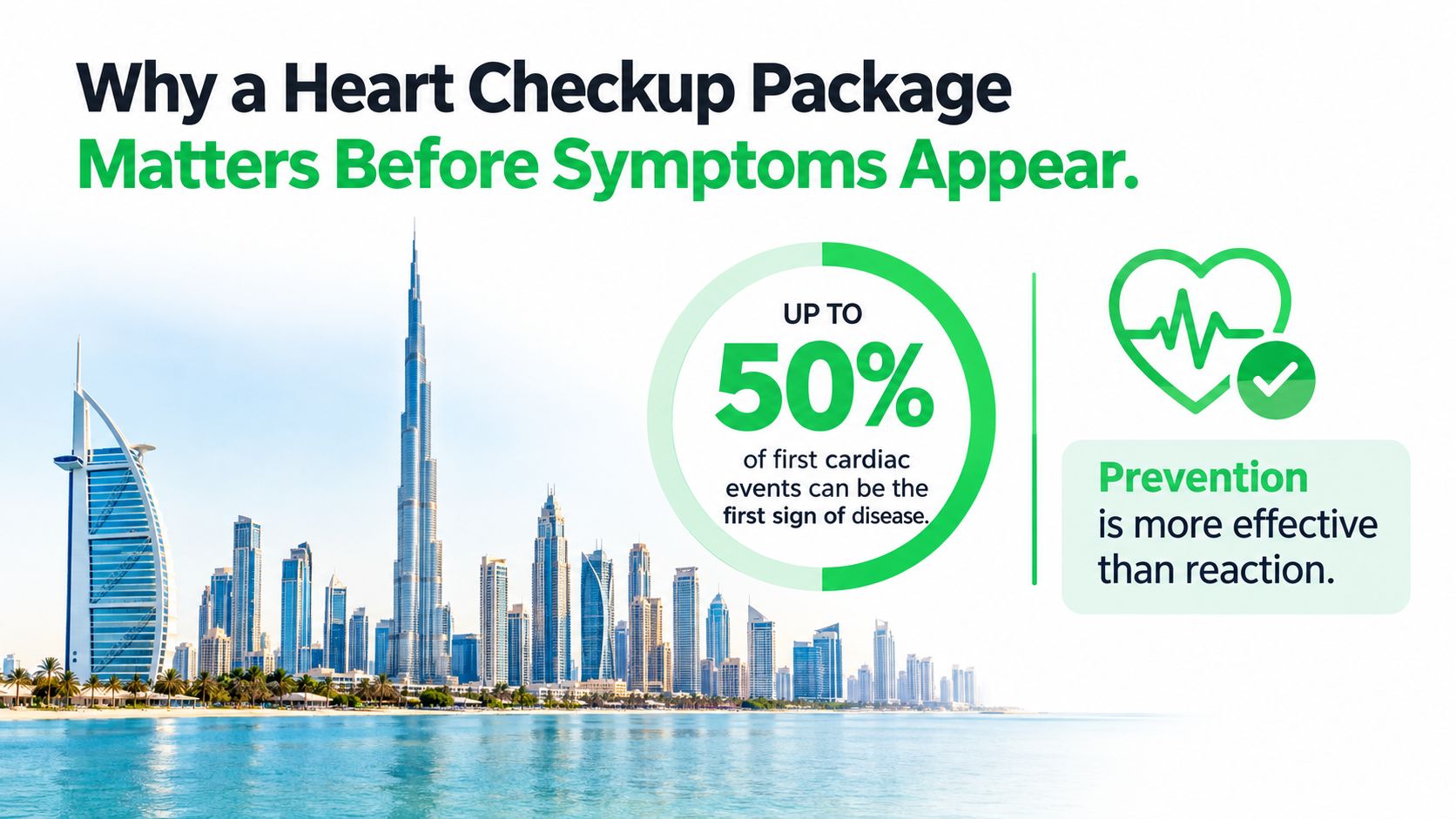
A Dubai resident might postpone screening because nothing hurts. That decision feels reasonable until you consider what preventive assessment is designed to find: high blood pressure, abnormal cholesterol, raised glucose, excess weight, smoking-related risk, or a family pattern that may not produce obvious symptoms.
The UAE's cardiovascular burden makes this more than a theoretical concern. Cardiovascular disease was the country's leading overall cause of death in 2021, with an estimated 5,122.7 deaths, representing approximately 25.5% of all deaths. Ischemic heart disease accounted for 52.7% of prevalent cardiovascular cases. These figures come from the UAE cardiovascular disease burden analysis.
A screening visit is different from diagnostic care. Screening asks, “What is my current risk, and what should I do next?” Diagnostic testing asks, “Could these symptoms indicate a specific condition?” Chest pain, fainting, severe breathlessness, or markedly abnormal vital signs belong in the second category, not in a routine package appointment.
The risk may be measurable before it is noticeable
National survey findings show why a symptom-only strategy misses important information. The Ministry of Health and Prevention reported 22.4% of adults living with obesity, 25.9% with high blood pressure, 12.5% with high blood glucose, and 54.2% with high cholesterol. Those figures are reported in the official national health survey results.
| Risk factor | UAE adult prevalence |
|---|---|
| Obesity | 22.4% |
| High blood pressure | 25.9% |
| Elevated blood glucose | 12.5% |
| High cholesterol | 54.2% |
The point isn't that every adult needs every available cardiac test. The point is that absence of symptoms isn't the same as absence of risk. A well-designed heart checkup package helps you decide whether reassurance is appropriate, whether you need lifestyle support and repeat measurements, or whether a clinician should investigate further.
What a Heart Checkup Package Actually Is
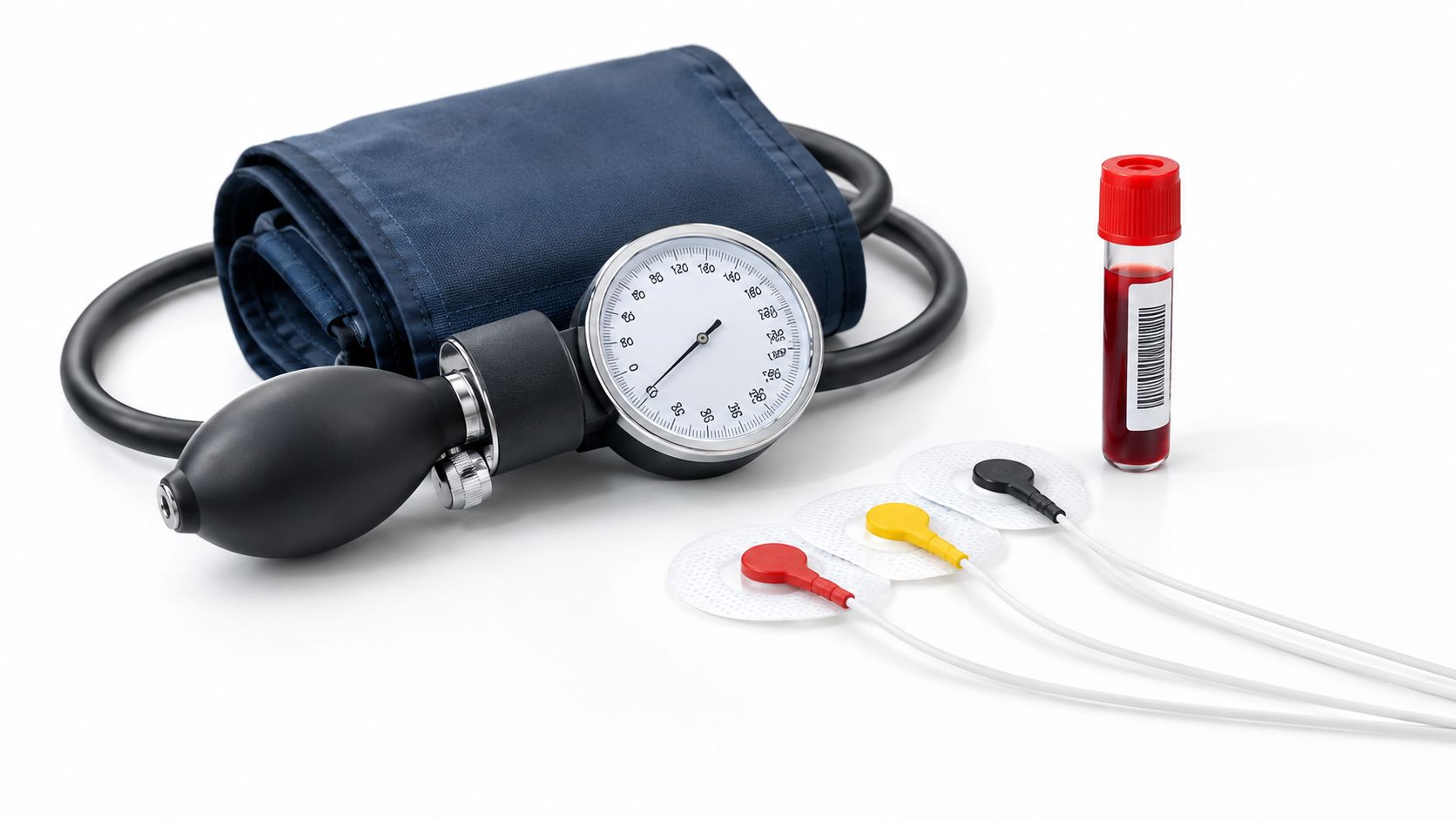
A heart checkup package is a structured cardiovascular-risk assessment. It usually combines health history, vital signs, blood tests, body measurements, and selected cardiac tests. The package becomes clinically useful when a qualified clinician interprets the results together rather than handing you isolated numbers.
It works much like a pre-flight systems check. A pilot doesn't decide that an aircraft is safe because one instrument looks normal. The crew considers fuel, navigation, engine readings, weather, and the aircraft's history as one operating picture. Cardiovascular screening works similarly. Blood pressure, cholesterol, glucose, smoking status, body size, symptoms, and family history each describe a different part of your risk.
The three layers of a package
The base layer covers measurements that apply to many adults. This normally includes blood pressure, weight, height, body-mass index, relevant history, smoking status, and blood tests for cholesterol and glucose. These findings help identify silent risk factors.
The cardiac layer may include a resting ECG, and sometimes an echocardiogram or stress test. These tests answer different questions. An ECG records the heart's electrical activity at rest, while an echocardiogram examines structure and movement. A treadmill or stress ECG looks at how the heart responds to exertion.
The interpretation layer includes clinician review, risk calculation, and follow-up advice. It's the part that turns measurements into action. A high cholesterol result may call for lifestyle changes and a repeat test, while the same result in someone with diabetes, kidney disease, symptoms, or a strong family history may need a different response.
A package also isn't automatically the same as a cardiology consultation. Some bundles provide testing without specialist interpretation, while others include a clinician or cardiologist review. Before booking, ask who reviews the results, whether the package calculates overall cardiovascular risk, and what happens if one result is borderline.
Common Tests Included in a Cardiac Screening Package
A fixed panel can look impressive, yet every test answers a different question. A useful cardiac screening package works more like a filter system: basic measurements identify risk, and targeted heart tests investigate a specific concern.
Start with silent-risk measurements
Blood pressure estimates the force of blood against artery walls. Stress, recent activity, caffeine, pain, or an incorrectly sized cuff can affect one reading, so an unexpected result may need confirmation. Blood pressure screening cannot reveal every form of heart disease and does not replace assessment of symptoms.
A lipid panel measures total cholesterol, LDL cholesterol, HDL cholesterol, and triglycerides. These markers help estimate cholesterol-related cardiovascular risk, but they do not show every feature of artery health. Age, blood pressure, smoking, diabetes status, body measurements, and family history give the result meaning.
Fasting glucose or HbA1c assesses blood-sugar status. HbA1c reflects longer-term glucose exposure, while glucose testing measures the level at a particular time. Neither result should stand alone, and an unexpected finding may require confirmation or clinician-led follow-up.
Body-mass index and waist circumference provide context for weight-related risk. They are screening measures, not direct measurements of artery narrowing, heart-muscle function, or fitness.
The Dubai Health Authority recommends cardiovascular-risk measurements for adults aged 18 and older every three years, with earlier or annual assessment when risk factors justify it. Its approach combines blood pressure, smoking, diabetes, lipid measurements, body-mass index, and medical history into a 10-year cardiovascular risk score, as set out in the Dubai Health Authority screening guidance cited earlier in this article.
| Test | What it measures | What it misses |
|---|---|---|
| Blood pressure | Pressure in the arteries | One reading may not represent usual pressure or reveal structural disease |
| Lipid panel | Cholesterol and triglyceride markers | It does not directly show plaque or heart function |
| Glucose or HbA1c | Current or longer-term blood-sugar status | It does not diagnose every cause of symptoms |
| Body-mass index and waist circumference | Weight-related body measurements | They do not measure artery narrowing, heart function, or fitness |
| Resting ECG | Electrical activity and rhythm at rest | It may not reveal exertion-related problems |
| Echocardiogram | Heart structure, valves, and movement | It does not answer every question about coronary arteries |
| Stress ECG | Heart response during exertion | It is not a universal test for every person without symptoms |
These results work together rather than as separate verdicts. For example, a cholesterol result may carry different significance when combined with diabetes, smoking, raised blood pressure, or a strong family history. The resulting risk picture helps determine whether routine follow-up is suitable or whether a focused cardiac test deserves consideration.
Add cardiac tests when the question requires them
A resting ECG records electrical activity while the heart is at rest. It can identify certain rhythm patterns and electrical abnormalities, but it cannot rule out all coronary artery disease or predict every future event.
An echocardiogram uses ultrasound to examine the heart chambers, valves, pumping movement, and selected structural features. It answers a different question from a lipid panel or risk score, so ordering one does not replace the other.
A treadmill or stress ECG observes the heart during exertion. Symptoms, medical history, or clinical risk may justify it, while an asymptomatic adult may not need it automatically. The decision should follow the question being investigated, not the size of a marketed package.
A cardiologist review can help when results are abnormal, symptoms are present, risk is difficult to classify, or advanced testing needs consideration. Home or on-site services in Dubai can support the first layer by collecting samples and measurements, but convenience does not change the need for proper interpretation. For practical preparation around sample collection, see this guide to home blood sampling.
Who Should Book a Heart Checkup and How Often
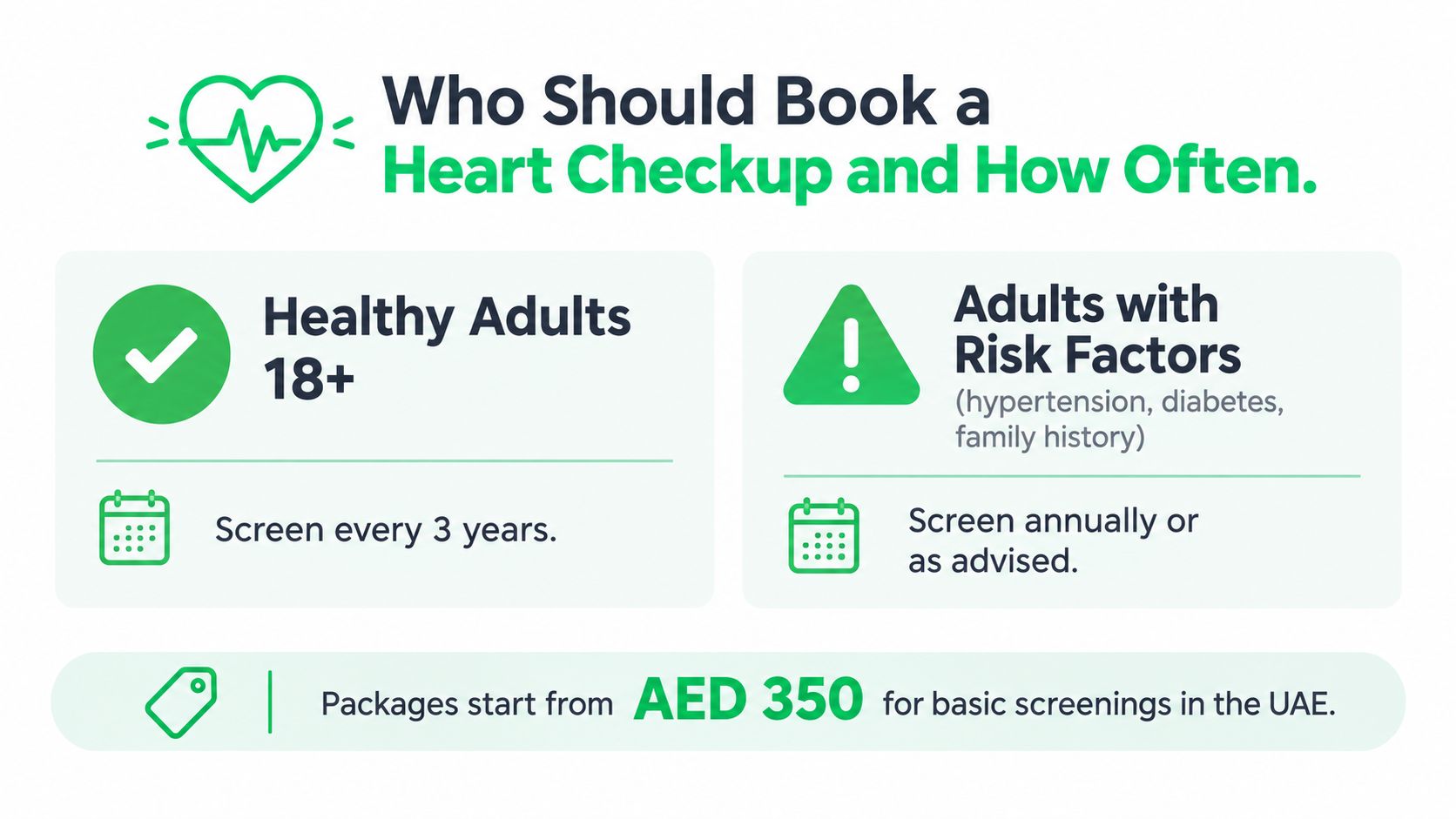
A healthy adult may have no warning signs while blood pressure, glucose, cholesterol, smoking exposure, and family history are already shaping cardiovascular risk. Screening works like a filter: it identifies people who can follow routine checks and those who need earlier review or targeted testing. For adults aged 18 or older without established chronic disease, Dubai guidance supports cardiovascular-risk measurement every three years. Earlier or annual assessment may be appropriate when risk factors are present, as set out in the Dubai Health Authority guideline cited earlier.
Use a short personal risk check
Book sooner, or ask a clinician about a more frequent plan, if you have:
- A family history: A close relative with early heart disease can change how routine results are interpreted.
- Smoking exposure: Current smoking raises risk even when blood pressure and cholesterol appear acceptable.
- Previous high readings: A history of high blood pressure needs confirmation and follow-up, rather than reliance on one normal measurement.
- Weight-related risk: Body size, waist measurement, activity, and glucose are often assessed together.
- A known glucose or cholesterol issue: Abnormal results may persist without symptoms and can require repeat testing.
- A changing health picture: New exertional breathlessness, reduced exercise tolerance, or unusual fatigue calls for clinical advice rather than routine reassurance.
The UAE National Health Survey reported that 67.9% of adults aged 18 to 69 were overweight, 27.8% were obese, and 52.5% had at least three combined cardiovascular risk factors. The factors included smoking, low fruit-and-vegetable intake, insufficient physical activity, overweight, and raised blood pressure, as described in the UAE National Health Survey report.
Know when a generic package isn't the right pathway
People already being treated for heart disease, hypertension, diabetes, or chronic kidney disease fall outside routine screening for a healthy population. Their care should follow the treating clinician's plan, including medication review and condition-specific targets.
A fixed marketing panel cannot replace that plan. A more expensive bundle does not automatically provide the interpretation needed for a known condition. Home and on-site services in Dubai can make first-line measurements easier to arrange, and information about a doctor on call at home in Dubai can help you compare that option with clinic-based care. The deciding question remains what action the results should support: routine screening, planned follow-up, or prompt medical assessment.
Preparing for a Heart Checkup at Home or On Site
Preparation is straightforward, but small details can affect the quality of a reading. Ask the provider whether fasting is required for your specific lipid and glucose tests. If fasting is requested, follow the stated period, drink water unless told otherwise, and don't stop prescribed medicines unless your clinician gives you different instructions.
Wear loose clothing that allows access to your upper arm and chest. Avoid arriving immediately after strenuous activity, and sit calmly before blood pressure measurement if the clinician advises it. Bring previous results, a current medication list, allergies, relevant diagnoses, and any family history of heart disease.
What the visit usually looks like
A clinician-led home, hotel, or office visit generally follows a simple sequence:
- History and consent: The clinician asks about symptoms, smoking, activity, family history, medications, and previous readings.
- Measurements: Blood pressure, pulse, height, weight, and other relevant observations are recorded.
- Sample collection: A trained professional collects venous blood for the agreed laboratory tests.
- Cardiac assessment: A resting ECG may be performed if included or clinically indicated.
- Results plan: You receive information about reporting, clinician interpretation, and follow-up for abnormal findings.

Home screening is still screening. It isn't an emergency service, and a routine visit shouldn't delay care for chest pain, fainting, severe breathlessness, or a severe change in condition. For general background on checking heart health at home, choose advice that distinguishes home monitoring from professional assessment.
If you're collecting samples yourself for a separate home laboratory test, follow the provider's instructions carefully. This guide explains how to collect blood samples for home lab tests without compromising the specimen.
Comparing Clinic Packages, Home Visits, and Rapid On-Site Care
No delivery format is ideal for every person. A clinic can provide a broader range of equipment, while a home visit may make routine screening easier to complete. An office or hotel assessment can suit people who need care where they already are.
| Setting | Best for | Strengths | Limits |
|---|---|---|---|
| Clinic package | Broad testing or advanced assessment | On-site equipment, imaging access, treadmill testing, and possible same-day cardiology review | Travel, waiting, and separate scheduling may be required |
| Home visit | Residents who value privacy or have limited time or mobility | Convenient setting, bedside measurements, venous blood collection, and continuity | Advanced imaging and exercise testing usually require a clinic |
| Office or hotel visit | Travellers, executives, and work teams | Accessible assessment at the patient's location | The service may need referral to a clinic for complex findings |
A home or on-site service can be operationally useful when one booking includes venous blood collection, bedside ECG, clinician interpretation, digital report sharing, and follow-up guidance. That arrangement reduces the chance that a patient receives a laboratory printout without knowing what to do next. It also suits a Dubai resident who finds it difficult to fit several clinic appointments around work or family responsibilities.
Clinics remain preferable when the clinical question requires an echocardiogram, treadmill testing, advanced imaging, or immediate specialist review. A home package shouldn't be marketed as a substitute for those services.
Match the setting to the question
A person seeking a baseline risk review may be well served by a local clinic or a clinician-led home visit. A traveller who develops symptoms needs medical assessment, not a convenient wellness bundle. An executive arranging advanced cardiac testing for executives should confirm whether the programme includes meaningful interpretation and referral pathways rather than choosing based on the number of listed tests.
Vitals Healthcare Doctor On Call offers DHA-licensed clinician visits to homes, hotels, and offices, with mobile laboratory collection and digital coordination. If you're comparing home services, consider how at-home blood tests in Dubai fit into the larger assessment and follow-up plan.
Reading Your Results and Knowing When to Act
A report marked “normal” is reassuring, but it isn't a lifetime guarantee. A resting ECG, for example, can be normal while other risk factors still need attention. The useful question is not only whether each value sits inside a reference range, but whether the complete profile suggests low, moderate, or high cardiovascular risk.
The Dubai approach uses a 10-year cardiovascular risk score to connect measurements with decisions. A lower score may support routine prevention and the recommended screening interval. A moderate or borderline result may call for earlier reassessment, focused lifestyle changes, or discussion of treatment. A high score, symptoms, or several abnormal findings should prompt clinician-led management.
Treat borderline findings as information
A borderline lipid result isn't a diagnosis by itself. The clinician may review family history, smoking, blood pressure, diabetes status, weight, and previous results before deciding whether to repeat testing, recommend lifestyle changes, or discuss medication.
A raised HbA1c or glucose result may need confirmation and a broader metabolic review. A high blood pressure reading may need repeat measurements under suitable conditions, home monitoring, or a clinician appointment. One isolated value shouldn't trigger self-prescribed medication, but it shouldn't be ignored either.
Practical rule: A screening result is useful only when it tells you who will review it, what happens next, and when the measurement will be repeated.
Marketing often encourages maximal annual testing for everyone. That isn't automatically better. For a healthy adult, periodic risk review with targeted follow-up may be more useful than repeating advanced tests without a clear clinical question. Home services can support this continuity by arranging repeat measurements and clinician guidance, not merely delivering a report. Learn more about the safety of home blood tests in Dubai before choosing a provider.
Seek urgent medical evaluation for chest pain, fainting, severe breathlessness, or markedly abnormal vital signs. Don't wait for routine package results when symptoms suggest an immediate problem.
A Simple Decision Framework for Your Next Step
Use your current health information to choose the next action, rather than selecting a package because it contains the largest list of tests.
The lower-risk pathway
You're an adult aged 18 or older, have no established cardiovascular condition, have no concerning symptoms, and have no significant risk factors that require earlier review. Book a structured screening assessment on the three-year cadence supported by Dubai guidance. Choose a package that includes risk measurements, relevant blood tests, history, and clinician interpretation.
The objective is not to collect every possible result. It's to establish a useful baseline and identify changes that deserve attention.
The intermediate-risk pathway
You have one or more concerns, such as smoking, a family history, previous high blood pressure, excess weight, abnormal cholesterol, raised glucose, or several combined risk factors. Arrange assessment sooner and ask for a documented cardiovascular risk review. Agree on practical actions, such as improving activity, changing food choices, addressing smoking, or monitoring blood pressure, then follow the clinician's plan for repeat testing.
A home or office visit can make this easier when travel and scheduling are the main barriers, provided the service includes qualified collection, appropriate measurements, and follow-up interpretation.
The higher-risk or symptomatic pathway
You already receive treatment for heart disease, hypertension, diabetes, or chronic kidney disease, or you have symptoms such as chest pain, fainting, severe breathlessness, or markedly abnormal vital signs. Don't use a routine heart checkup package as a holding pattern. Contact your treating clinician or seek urgent medical care, depending on the severity and timing of the symptoms.
The central decision: Choose the service that answers your clinical question and provides a next step, not the package with the longest test list.
A heart checkup package is most valuable when it combines appropriate measurements with risk stratification, clear communication, and planned follow-up. That approach gives you something more useful than reassurance alone. It gives you a reasoned decision about what to do next.
Vitals Healthcare Doctor On Call offers DHA-licensed home, hotel, and office visits, including clinician-led assessments, mobile blood sample collection, ECG when indicated, and digital report coordination across Dubai. To arrange a practical cardiovascular screening visit or discuss which service fits your situation, visit Vitals Healthcare Doctor On Call .