
You're in a Dubai hotel room, an IV line is secured to your hand, and a clear bag is hanging beside the bed. The fluid inside has probably received most of your attention, whether it's hydration fluid, a vitamin blend, or a prescribed medicine. Yet the IV drip bag itself is part of the treatment system, not a disposable decoration.
Its material, ports, label, seal, storage history, and connection to the tubing all affect how safely the infusion reaches you. A patient who understands those details can ask better questions without trying to manage the clinical procedure themselves. This guide follows the bag from packaging to bedside to disposal, using the same practical viewpoint a home-care nurse would use when checking equipment.
Table of Contents
- Why the IV Drip Bag Deserves Your Attention
- Anatomy of a Standard IV Drip Bag
- Common IV Bag Materials and Fluid Categories
- Reading the Label Like a Clinician
- Storage and Handling Rules for Home Infusions
- Safe Disposal After the Drip Ends
- Choosing a Compliant Home IV Provider in Dubai
Why the IV Drip Bag Deserves Your Attention
A nurse arrives, confirms your identity and treatment plan, and places a sealed IV drip bag on a clean surface. You may notice the fluid chamber, the printed label, and the tubing set, but the equipment can still look unfamiliar when you're tired, unwell, or receiving care in a hotel rather than a clinic.

The important point is simple: the bag is a regulated medical device used in a controlled clinical process. In the UAE, infusion sets are described as Class II medical devices, requiring registration with clinical documentation before import or sale, according to this UAE medical-device registration guide. That pathway covers more than the fluid. It makes the bag, tubing, and related components part of the provider's traceability and safety responsibilities.
Why the container affects the treatment
The container must hold the fluid without leaking, contaminating it, or interacting inappropriately with its contents. A damaged seal, unclear label, cloudy solution, or unverified device can create a problem before the cannula ever touches your skin.
This is why a careful nurse doesn't hang the first bag available. They check the order, identify the product, inspect the packaging, confirm the expiry information, and assess the bag before connecting it. You can also read about expected reactions and warning signs in this guide to IV drip side effects, but equipment checks remain a separate part of safe care.
Trust includes what patients can see
Reviews for Dubai home-care services show how strongly patients use licensed staff, professional handling, and equipment quality as trust signals. One Dubai home-health listing displays a 5.0 rating from 633 reviews, while another UAE listing shows 4.9 with 10k+ user reviews. A Doctify Dubai home-care page shows 4.99/5 from 109 verified patient reviews. These figures come from the gathered Dubai home IV service review listing.
Those reviews don't replace clinical verification, but they reveal what patients notice. The bag hanging beside your bed is part of that visible experience of organised, supervised care. By the end of this guide, you'll be able to identify its main parts, understand its label, recognise poor storage or damage, and know what should happen to it after the infusion.
Anatomy of a Standard IV Drip Bag
A standard IV drip bag is a sealed reservoir joined to a delivery line. It holds the prescribed fluid, while the tubing carries that fluid towards the cannula in your hand or arm. In a gravity infusion, the bag's position helps drive flow. A pump may regulate delivery when the clinical plan calls for closer control.
Start at the top
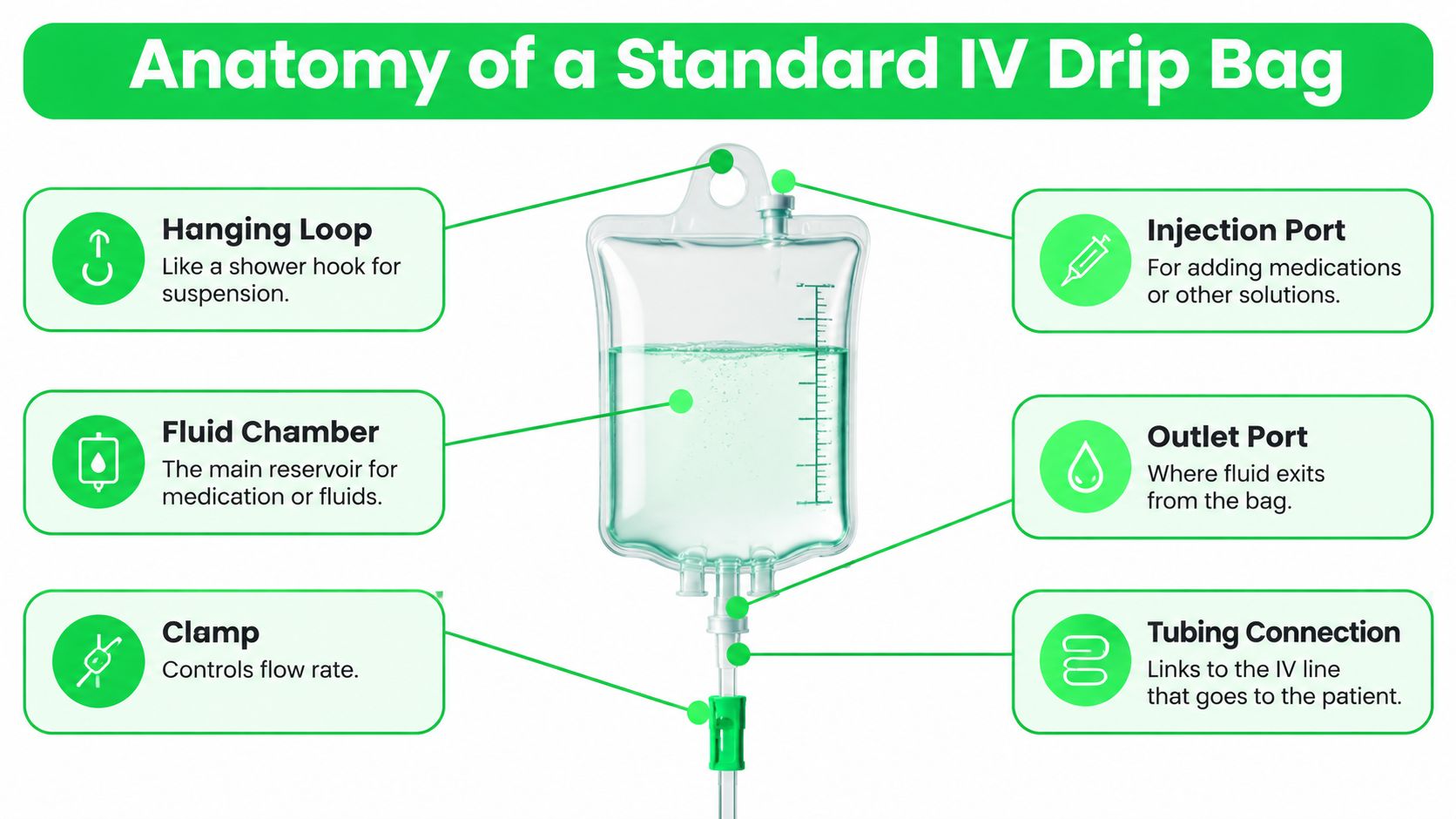
The hanging loop is the reinforced opening at the top of the bag. It anchors the bag to an IV stand or another approved support, keeping the bag above your arm so gravity can move fluid through the line.
The fluid chamber is the flexible main body. It contains the solution and gradually collapses as fluid leaves, helping prevent air from entering the system when the equipment is used correctly. Before connection, the nurse checks the chamber for leaks, particles, cloudiness, or unexpected colour changes. The bag should also remain sealed and clearly identifiable.
Find the ports
At the lower end, you'll usually see an injection port and an outlet port, although their appearance varies by product. The injection port is a sealed entry point. A trained clinician may use it to add an authorised medication or supplement under the treatment order. It is not a general access point for unapproved additives.
The outlet port is where fluid leaves the bag. The nurse connects the tubing set here using sterile technique. A secure connection protects the closed system. If the junction becomes loose or contaminated, treatment may be interrupted and the equipment may no longer remain sterile.
Follow the line
The tubing connection joins the bag to the administration set. Along the line, usually below the bag, a transparent drip chamber lets the nurse observe fluid entering the tubing. During a gravity-controlled infusion, the visible drops help the nurse assess and set the rate. With pump-assisted delivery, the pump regulates the movement through the line.
The clamp changes the opening in the tubing and therefore controls how quickly fluid passes. The prescribed rate depends on the fluid, the patient's condition, the access device, and the clinician's assessment. If a patient closes the clamp because the drip appears too fast, treatment can slow or stop. If they open it without supervision, fluid may run faster than intended. Tell the nurse about a change in flow instead of adjusting the clamp or touching either port.
The bag may look simple, but each component has a defined job. Keep it as one connected sterile system, not a bottle that can be opened, moved, or altered casually.
Common IV Bag Materials and Fluid Categories
The bag material matters because the container sits in direct contact with the infusion for the entire treatment. PVC has long been used for flexible medical packaging, while polyolefin materials are increasingly prominent in healthcare fluid bags. The practical questions are whether the material remains stable, whether it releases unwanted substances, and whether it's compatible with the fluid or medicine inside.
Manufacturers of healthcare polyolefin solutions in the UAE emphasise lower extractables and leachables, aseptic-processing compatibility, purity, compliance, and stability. Borouge describes its healthcare materials as being used in fluid bags and says its UAE-made LDPE healthcare grade is designed to minimise extractables and leachables. Those concerns matter because container chemistry can influence formulation stability, drug adsorption, and contamination control. You can review the clinical context for a specific wellness infusion in this Dubai vitamin C IV drip guide.
Comparing the bag itself
| Feature | PVC Bag | Polyolefin Bag |
|---|---|---|
| Flexibility | Flexible and familiar in clinical packaging | Flexible, with material properties selected for healthcare use |
| Chemical considerations | Compatibility must be assessed for the specific formulation | Manufacturers emphasise lower extractables and leachables |
| Aseptic processing | Suitable products depend on validated manufacturing | Healthcare programmes emphasise compatibility with aseptic processing |
| Patient question | “Is this bag suitable for the prescribed fluid?” | “Is this material and product approved for this infusion?” |
| What matters most | The exact product, formulation, and manufacturer instructions | The exact product, formulation, and manufacturer instructions |
A material name alone doesn't prove that a bag is appropriate. The provider must use a registered, traceable product and match it to the ordered fluid or medicine.
What may be inside
Crystalloids include fluids such as saline and Ringer's-type solutions. They're clear solutions containing water and dissolved salts or electrolytes, and clinicians select them according to the patient's needs.
Vitamin and mineral blends are prepared for a specific treatment plan. Their ingredients and concentrations should appear on the label or treatment documentation. A colourful marketing name isn't enough to establish what the bag contains.
Specialty medications require the greatest attention to prescription, compatibility, preparation, and monitoring. Some medicines are supplied in a bag, while others may be added by an authorised clinician under a documented order.
The safest question isn't “Which bag looks better?” It's “What is this product, who prepared it, how was it verified, and is the container compatible with the prescribed contents?”
Reading the Label Like a Clinician
Small print carries a large part of the bag's safety information. Before the nurse connects the line, the label should tell you what the product is, how much it contains, what concentration applies, and whether the package remains within its approved use period.
Read from identity to traceability
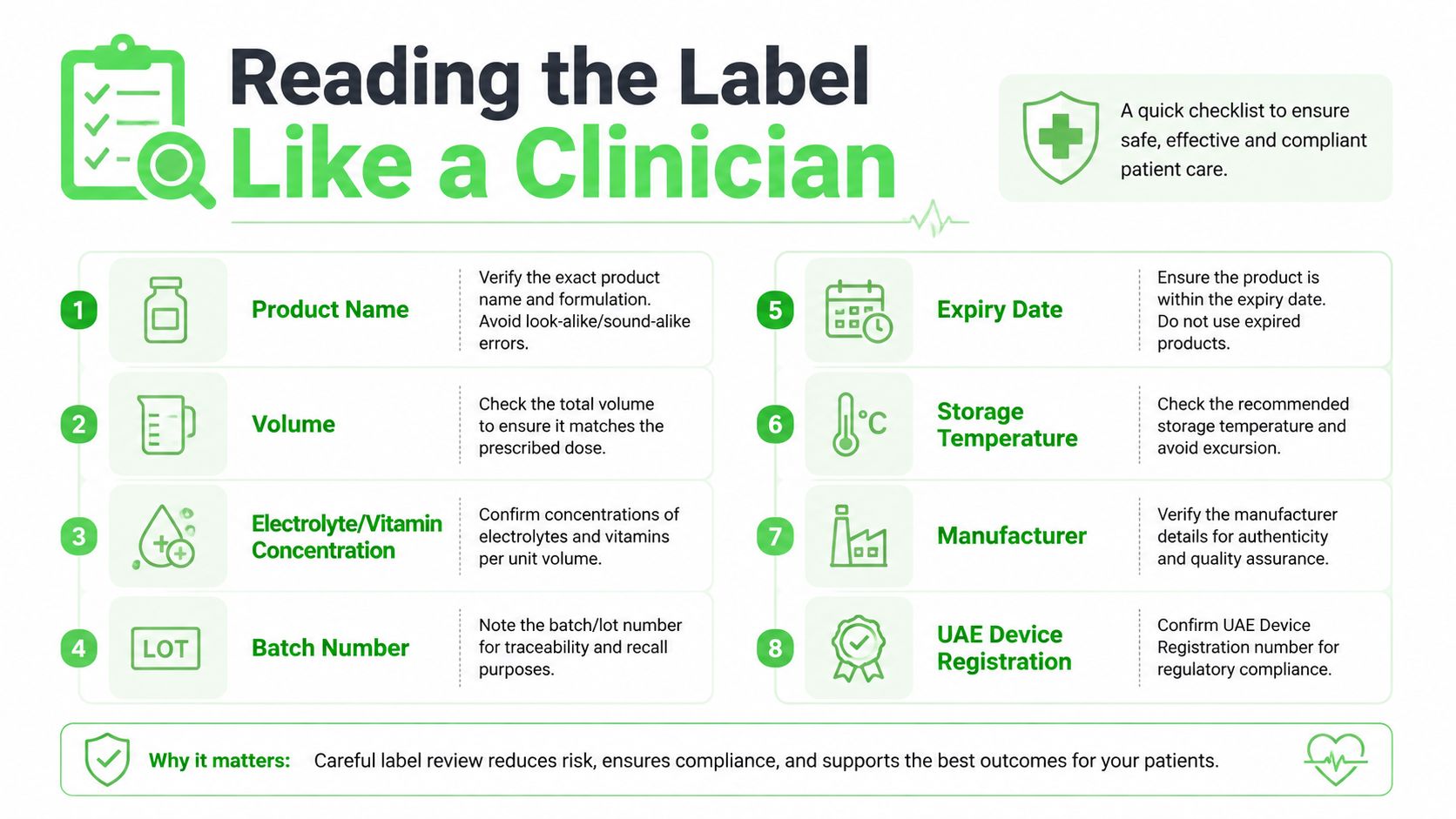
Start with the product name. It should match the nurse's treatment sheet and your explanation of what you're receiving. Next, check the volume, which tells you how much fluid the chamber holds. The electrolyte or vitamin concentration identifies the strength of ingredients, so don't rely on a product nickname alone.
The batch number links that individual bag to the manufacturer's production record. The expiry date tells the nurse whether the product remains within its authorised period. An expired product may no longer have the intended stability, and changes in formulation properties can affect its suitability.
The storage temperature gives the handling conditions the manufacturer expects. The manufacturer's name helps establish accountability and makes it easier to trace the product if a question arises.
Finally, look for the UAE device registration information or mark where applicable. Medical-device registration and traceability are important because infusion bags and sets sit within a regulated product pathway, not an informal wellness supply chain. The UAE framework places medical products and devices under the Emirates Drug Establishment, as outlined in this regional medical-device guide.
Before the infusion begins, check: product name, volume, concentration, batch number, expiry date, storage instructions, manufacturer, and UAE device registration information.
Match the label to the order
Ask the nurse to show you the treatment sheet or explain the order in plain language. The bag's identity, concentration, and volume should make sense alongside the planned infusion. If the nurse has added an ingredient, the added product should be documented and explained.
A missing, torn, unreadable, or inconsistent label deserves attention. Don't accept a bag just because it looks sealed. You can also compare the clinical process with the information in this Dubai home IV hydration service guide, but your nurse's assessment and the documented order remain the immediate reference points.
Storage and Handling Rules for Home Infusions
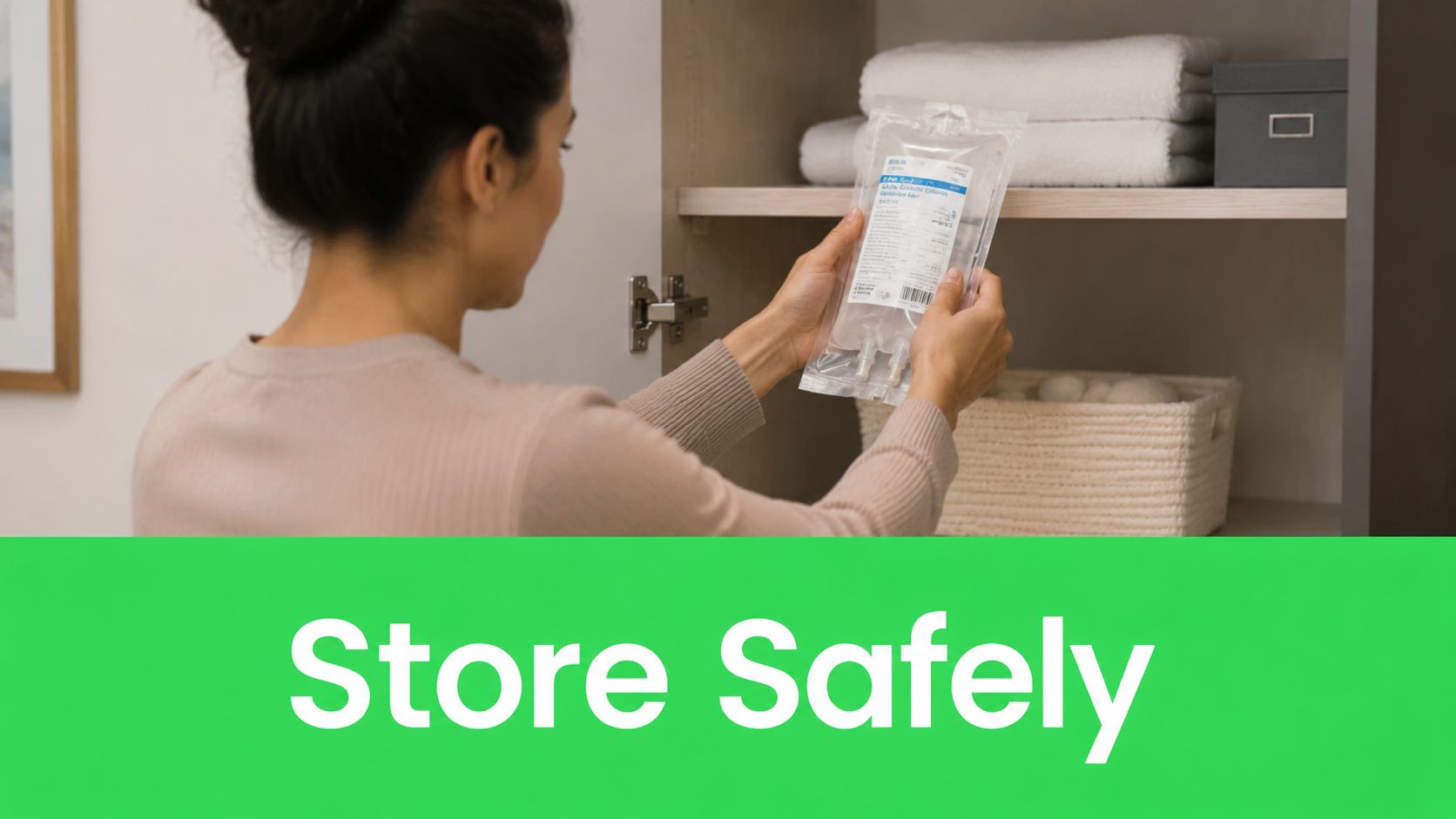
The bag may be hanging beside your bed later, but storage starts before the nurse arrives. Keep an IV drip bag in its original packaging in a clean, dry place, away from direct sunlight, heat, food preparation areas, children, and pets. Follow the storage instructions printed on the label rather than assuming ordinary room temperature is suitable.
Protect the bag before the visit
Keep the bag flat, or position it as the packaging recommends. Do not place heavy items on it. Never freeze an IV fluid bag unless the manufacturer specifically states that the product is designed for freezing. Ice can damage the container and may change the solution.
Heat and direct sunlight can affect the bag, its ports, and the formulation inside. If it arrives in a protective wrapper, leave the wrapper intact until the nurse examines it. A hotel mini-fridge is not automatically appropriate. Some products require particular temperatures, while unnecessary chilling may also be unsuitable.
Inspect without opening
If you handle the outer packaging, wash your hands first. The nurse should inspect the bag and seal using clean technique before connecting it. Check for:
- Leaks or damp packaging: Liquid outside the bag may mean the container is damaged.
- Cloudiness or particles: The solution should have the appearance expected for that product.
- Unusual colour: Any unexpected change requires clinical review.
- Damaged ports: A cracked or punctured port can affect sterility.
- Broken packaging or seal: Evidence of tampering means the product should not be used.
- Unclear labelling: The bag must remain identifiable and traceable.
A sealed appearance alone does not confirm that the bag is suitable.
Know what the nurse does
The clinician confirms the treatment order, checks your identity and relevant health information, and prepares the administration set. The tubing is primed to remove air, then connected with sterile technique. The drip rate is set according to the clinical plan, and the nurse monitors both you and the access site during treatment.
If the bag fails inspection, it should not be used. A provider offering a coordinated IV home service can arrange the clinical visit, equipment, and follow-up process. Tell the nurse immediately about swelling, pain, burning, leakage, breathing difficulty, or any sudden change in how you feel.
Safe Disposal After the Drip Ends
An empty IV drip bag may look harmless, but it has been part of a clinical procedure. The bag, tubing, connectors, and any attached needle or cannula can carry biological contamination or medication residue. They shouldn't go into a general household bin because the visible fluid has gone.
The provider should manage the waste chain
A trained nurse separates the equipment at the end of treatment and handles sharps with care. Needles and other sharp components go into a puncture-resistant sharps container, while the used bag and tubing are placed in an appropriate clinical or biohazard waste bag. The licensed facility then manages transport and final treatment according to its waste procedures, which may include incineration.
The patient's role is usually limited to keeping the treatment area clear and allowing the clinician to remove the equipment safely. Don't attempt to cut the tubing, recap a needle yourself, rinse the bag, or sort components into household recycling.
Used equipment remains clinical waste even when the bag looks empty.
A simple aftercare checklist
- Leave removal to the nurse. Keep your hand still while the cannula and dressing are managed.
- Check the room. Make sure no needle, connector, or tubing piece remains under furniture or bedding.
- Ask about collection. Confirm that the provider has taken the used bag and all related equipment.
- If a leak appears later, isolate it. Keep people and pets away, avoid touching the fluid, and contact the provider for instructions.
- Report an injury promptly. A needle-stick or contact with leaked clinical material needs immediate medical advice.
This approach protects you, household members, hotel staff, cleaners, and the wider waste system. Proper disposal is part of competent IV care, not an optional courtesy after the treatment has finished.
Choosing a Compliant Home IV Provider in Dubai
在家中、酒店或辦公室接受 IV 輸注時,掛在床邊的袋子只是整個服務的一部分。提供者是否合規,會影響醫護人員的資格、輸注前評估、袋身標籤核對,以及出現反應時的處理。Dubai Health Authority(DHA)負責監管酋長國內的醫療服務。持牌輸注服務應符合感染控制、設備處理、醫護培訓及緊急應變方面的要求。
DHA 的 Standards for Home Healthcare Services 於 February 19, 2025 生效,為包括 IV administration 在內的家居醫療服務提供正式框架。預約前,要求服務商提供其設施的 DHA licence number,並在 DHA 的公開查詢系統核對名稱及狀態。也要確認到訪護士目前持有有效的 DHA staff registration。Dubai-focused safety guidance 亦指出,mobile IV services 屬於受設施牌照及 DHA 人員註冊要求約束的醫療服務,可參考這份 Dubai home-care licensing and safety guidance。
市場選擇增加後,患者更需要把廣告內容與可核實的資格分開。預約前先問清楚,服務由哪一間持牌設施提供,醫護人員是否由該設施安排,以及誰會在輸注前評估你的病史、用藥和當日狀況。
用具體問題核對服務
評價可以協助你了解溝通和到訪體驗,但不能證明 DHA licence 有效,也不能確認掛在你身旁的 IV drip bag 是否適合或可追溯。要求服務商逐項回答:
- 設施牌照: 可否提供設施名稱及 DHA licence number,讓你在 DHA 網站核對?
- 人員資格: 到訪護士是否目前已 DHA registered?
- 臨床評估: 醫生或合資格臨床人員會否先評估輸注是否適合?
- 袋身追溯: 可否在使用前查看 IV drip bag 的產品名稱、成分、批號、expiry date 及 registration information?
- 完整性檢查: 袋子是否密封完整,溶液是否清澈,外袋、port 和 tubing 是否為 sterile single-use equipment?
- 儲存運送: 服務商如何保存及運送藥液,若袋身受熱、破損或標籤不清會怎樣處理?
- 緊急安排: 若出現過敏反應、呼吸不適、胸口不適或病情惡化,誰會處理及如何升級?
- 費用與保障: 是否先提供清楚報價,並可開具 invoice 供 insurance enquiry 使用?
一般 elective vitamin drips 多為自費。保險保障通常較集中於醫生處方的醫療情況,例如 dehydration 或 iron deficiency,並可能需要 prior approval。Dubai IV drip safety and coverage guidance 亦提醒,健康人士使用一般 IV 的證據有限,腎病、心臟問題或糖尿病患者尤其應先取得臨床建議。
報價差異可能來自醫生評估、護士到訪、袋內成分、設備及後續支援。這份 Dubai IV drip pricing guide 可協助你整理報價前要問的問題。Vitals Healthcare Doctor On Call 提供 DHA-licensed doctor and nurse visits to homes, hotels, and offices in Dubai,服務包括 IV hydration 及 multivitamin therapy,並由持牌專業人員執行。
預約時,請要求到訪團隊逐一解釋袋身標籤、儲存檢查、輸注計劃及完成後的處理方式。若臨床評估顯示 IV infusion 不適合,可靠的服務商也應說明其他下一步,而不是只按原定療程開始。
如需在家中、酒店或辦公室接受有臨床監督的 IV drip bag 服務,可向 Vitals Healthcare Doctor On Call 預約,並在開始前核對設施牌照、人員註冊及袋身資料。其 24/7 home-care service 亦提供 doctor assessments、nursing care、diagnostics 及 follow-up。