



A parent comes home from a Dubai hospital with a discharge summary, fresh dressing, new medicines, and a family that isn't sure what happens next. The wound needs checking, the medication schedule is unfamiliar, and another clinic journey may be unsafe or exhausting. In a different situation, a hotel guest may need an injection, a visitor may require hydration support, or an older resident may need help managing daily care without leaving home.
That's where Dubai home nursing can make sense. But the important question isn't whether a provider can send someone quickly. You need to know whether the person arriving is a DHA-licensed clinician, whether the service is clinical nursing or companionship, and whether the provider has a safe process for consent, documentation, escalation, and follow-up.
This distinction matters whether you're arranging a single wound-care visit, post-operative support, elderly care, or a longer care plan. Even practical details around recovery, such as keeping suitable drinking water available at home, should be organised in advance. Families can review Oxy Plus Water delivery options alongside their clinical arrangements, particularly when a patient has limited mobility and regular supplies need to reach the residence.
Table of Contents
- When Home Nursing Becomes the Right Call in Dubai
- How DHA Licensing Protects Patients at Home
- Core Services You Can Receive at Home
- Arranging 24/7 or Post-Operative Home Care
- Response Times, Coverage Areas, and Capacity
- Safety Benchmarks That Separate Real Providers from the Rest
- Costs, Payments, and Insurance Reimbursement
- Choosing the Right Setting for Your Situation
When Home Nursing Becomes the Right Call in Dubai
A family often books home nursing after a discharge because the patient looks stable, but the care plan is not simple. A parent may need a surgical wound reviewed, medicines given at the correct times, mobility observed, and warning signs reported to the operating team. Travelling to a clinic for every task adds strain and may expose gaps between visits.
The same need appears in less predictable settings. A tourist in a hotel room may require a prescribed injection or an assessment after feeling unwell. A person with limited mobility may need a nurse to visit rather than rely on a relative to move them into a car. An older adult may need daily-living assistance combined with clinical observation, not just someone providing company.
Clinical care is different from companionship
Home healthcare is clinical. A DHA-licensed nurse, doctor, or physiotherapist may provide wound care, injections, medication support, vital-sign monitoring, rehabilitation, or post-operative observation within their professional scope.
Companionship and personal support are different services. A caregiver may assist with meals, bathing, dressing, mobility, and company, but that doesn't automatically authorise clinical procedures. A person who is helpful around the home isn't necessarily qualified to assess a wound, administer medication, or recognise a deteriorating patient.
Practical rule: Match the task to the licence. If the request involves a treatment, medication, wound, device, vital signs, or clinical deterioration, ask for a registered healthcare professional.
Dubai's regulated framework recognises home nursing as more than basic assistance. DHA quality indicators cover patient-safety incidents, emergency-room visits after home-care delivery, hospital-free days, discharge to the community without readmission, documented treatment consent, and telehealth use. That means a proper service should have systems for assessment, risk management, escalation, continuity, and outcome monitoring, not just a person who arrives at the door. DHA's Home Healthcare Services standards provide the relevant regulatory reference.
Before booking, decide what outcome you need. A single planned procedure, a nurse after surgery, a rotating team for continuous support, and a caregiver for daily routines are not interchangeable. Families who need help separating these options can use this guide to choose the right type of home healthcare service in Dubai.
How DHA Licensing Protects Patients at Home
A provider promises a nurse within hours after discharge. Before you share the patient's details or accept the booking, verify two separate permissions: the facility must be authorised to provide home healthcare, and each clinician sent to your home must hold the appropriate DHA registration.
Dubai's revised Home Healthcare Standards took effect on 3 September 2025. They set requirements for facilities providing home healthcare, including DHA licensing and administrative procedures. Use The revised DHA Home Healthcare Standards to compare a provider's claims with its regulatory obligations.
Run this verification before you book
Ask the coordinator for specific evidence, not general reassurance.
-
Confirm the facility. Request the provider's DHA permission or facility licence details. A social-media page, business registration, or “medical” wording does not authorise clinical care.
-
Confirm the clinician. Obtain the visiting nurse's full name and DHA registration details. Verify any doctor or physiotherapist separately. A licensed facility may still send only individually registered professionals.
-
Identify clinical accountability. Ask who serves as medical director or supervising clinician, who reviews the care plan, and whom you contact if the patient deteriorates. The provider should answer before the first visit.
-
Ask about equipment and infection control. DHA inspection requirements include an infection-control programme, equipment approved by the UAE Ministry of Health and Prevention, and an emergency kit where applicable. Ask which equipment the clinician will bring for the planned procedure.
-
Clarify consent and records. The provider should verify identity, document consent, record the intervention, and explain follow-up. These records create a clear clinical trail if care changes or concerns arise.
The DHA checklist also sets expectations for a physician, a registered nurse, staffing that can support facility and home-based demand, and documented review of emergency incidents. Use The DHA Home Healthcare Checklist to turn those requirements into questions during your call.
A “24/7” badge proves availability only as a marketing claim. Ask who is actually on duty, who supervises the visit, and how escalation works outside routine hours. Keep this home nurse verification guide open while comparing providers.
Core Services You Can Receive at Home
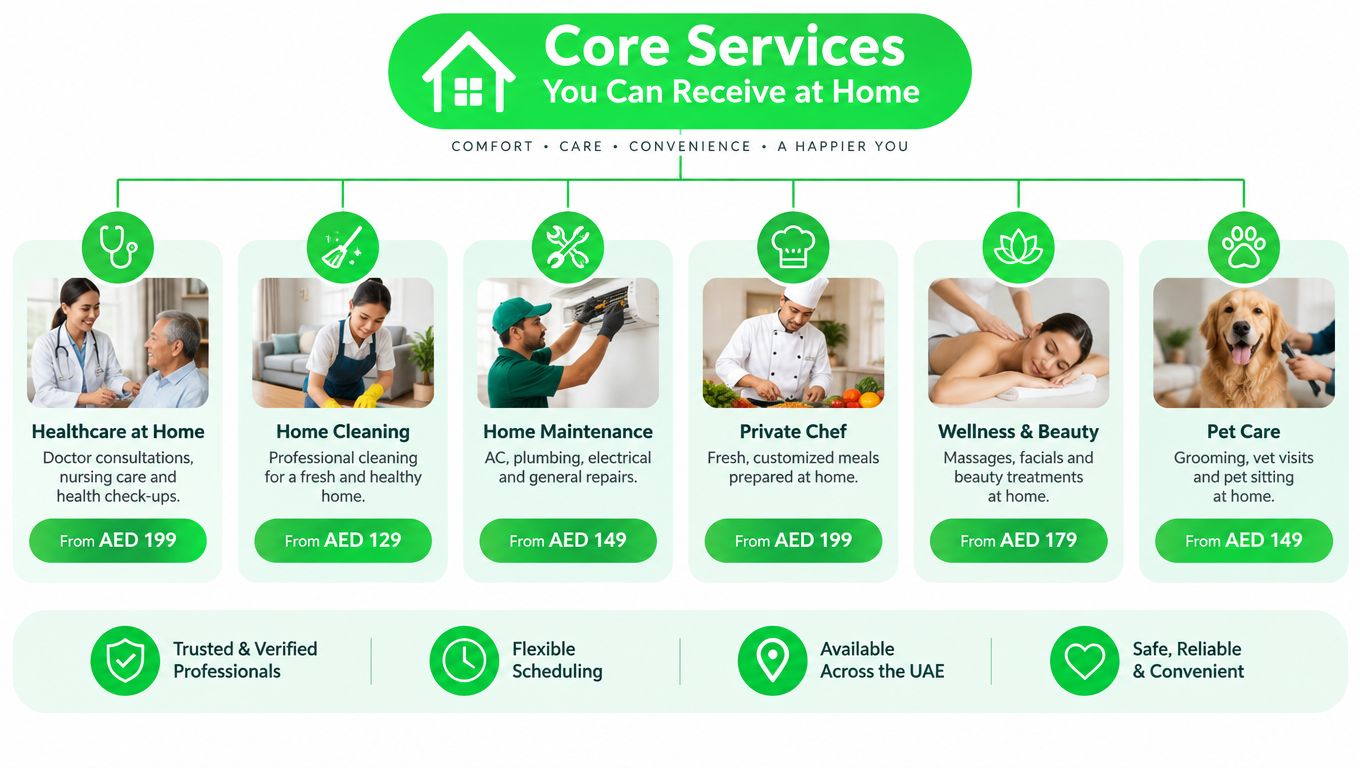
The right clinician depends on the job. A registered nurse may handle prescribed injections, wound dressing, medication support, observations, and routine post-operative checks. A doctor may need to assess a new symptom, review a complex condition, prescribe within the appropriate clinical process, or decide whether the patient needs a hospital. A physiotherapist is the appropriate professional for mobility, rehabilitation, and movement planning.
Match the service to the clinical need
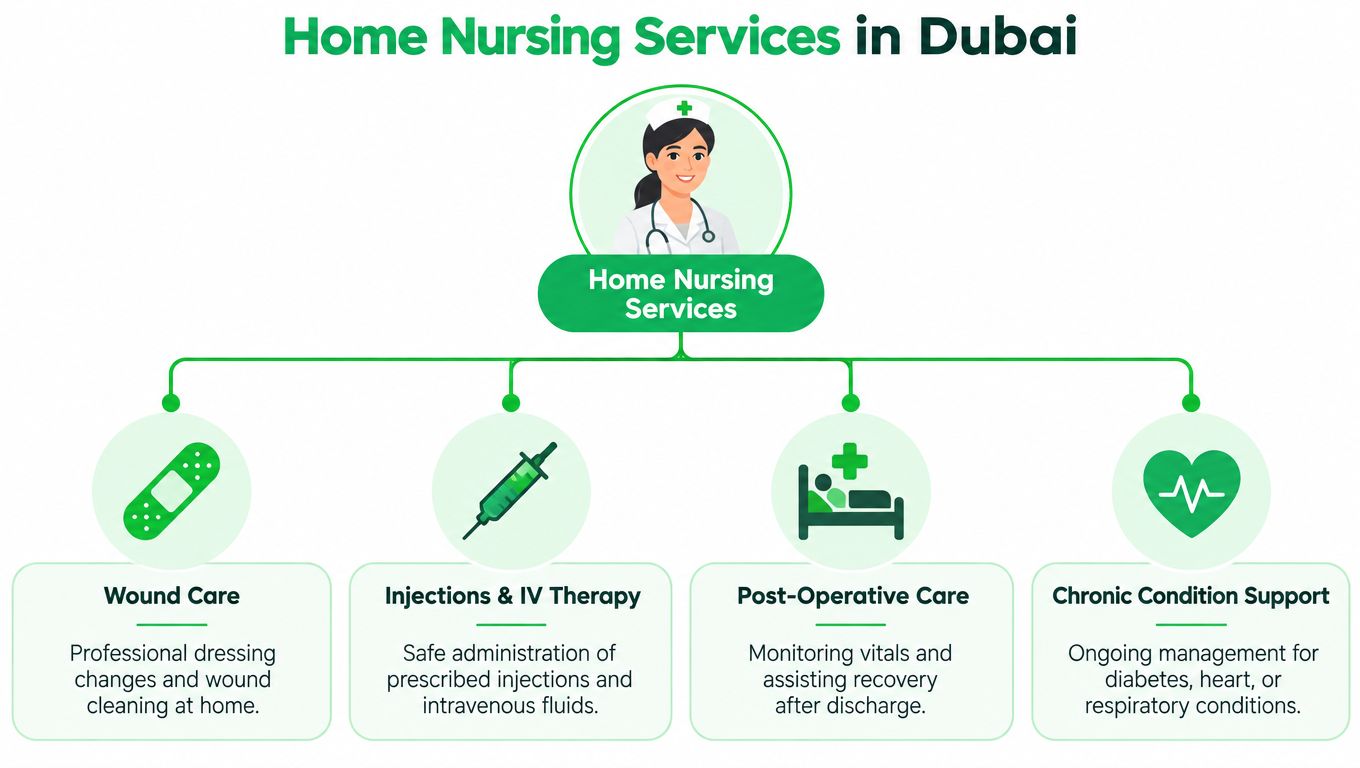
Wound care includes dressing changes, wound cleaning within the prescribed plan, observation for concerning changes, and communication with the treating team. A surgical wound review after discharge may be planned, but increasing pain, spreading redness, heavy bleeding, or other acute concerns require prompt clinical escalation rather than routine dressing alone.
Injections and IV therapy must follow an appropriate prescription and clinical assessment. A diabetic visitor may need a prescribed injection, while someone recovering from travel may ask about hydration support. The provider should confirm the treatment, patient identity, allergies, relevant history, and monitoring requirements before administration.
Post-operative nursing can include checking vital signs, supporting medicines, observing mobility, and managing dressings or devices when the nurse is trained and the plan permits it. Drain, catheter, or complex wound care should be assigned to staff with the right experience, with a defined route back to the surgeon.
Medication support is not just handing over tablets. A nurse may check the discharge instructions, help maintain the schedule, record what was administered, and report confusion, missed doses, side effects, or deterioration. Never ask an unverified caregiver to alter a dose or make a clinical decision.
Where elderly and chronic support fit
Elderly care often combines two layers. A caregiver may assist with bathing, meals, dressing, transfers, and companionship. A nurse adds clinical observation, medication support, vital-sign checks, wound care, and escalation when the patient's condition changes. Families should ask which tasks each worker is authorised and trained to perform.
Chronic-condition support may involve scheduled monitoring for diabetes, heart conditions, or respiratory problems, alongside a clinician-led plan. Physiotherapy can support recovery after knee surgery, pain management, balance work, and safe movement, but it doesn't replace medical review when symptoms indicate a complication.
A home nurse isn't a substitute for emergency services or hospital treatment. Chest pain, severe breathing difficulty, signs of stroke, uncontrolled bleeding, or any life-threatening change needs emergency response. Home visits are best for planned clinical care, assessment, monitoring, and support that can be safely delivered outside a facility.
For a realistic view of the process, read what happens during a home nurse visit before the clinician arrives.
Arranging 24/7 or Post-Operative Home Care
Start with a clinical briefing, not just a location and preferred arrival time. Tell the coordinator why care is needed, when the patient was discharged, what procedure took place, what symptoms are present, and whether the patient has drains, catheters, mobility restrictions, allergies, or complex medicines.
Have these items ready:
- Patient identification: Keep the patient's ID and contact details available.
- Clinical documents: Share the discharge summary, prescriptions, treatment plan, and recent reports.
- Medication information: List current medicines, doses, allergies, and the last doses taken.
- Access details: Provide the building name, apartment or room number, parking instructions, security requirements, and a family contact.
- Insurance information: Give the policy details early if you intend to request reimbursement.
A responsible provider should ask screening questions before confirming a visit. The coordinator should establish whether the request is routine, urgent, or beyond home-care scope. For continuous care, ask how the rota works, how nurses hand over notes, who supervises the team, and how a clinician is reached outside the scheduled shift.

What post-operative care should look like
During the early recovery period, the nurse should work from the surgeon's instructions. The visit may include wound inspection, medication support, mobility checks, observation of drains or catheters when applicable, and a report to the surgical team if findings fall outside the plan. The family should receive a clear record of what was observed and what to do next.
Hotel care needs the same clinical discipline. The coordinator may need the guest's room details, front-desk access process, passport or insurance information, and a private space for assessment. For families coordinating several relatives, tools such as these family safety apps can help share arrival updates and emergency contacts, but they don't replace clinical handover or a documented escalation plan.
Don't accept a continuous-care arrangement that depends on one exhausted nurse or informal verbal updates. A safe package needs suitable staffing, written handover, supervision, and a clear route to a doctor or hospital when the patient's condition changes. This guide to finding a trusted home nurse in Dubai can help you test the provider's process before the first shift.
Response Times, Coverage Areas, and Capacity
Dubai home nursing availability varies by urgency, district, traffic, clinician type, and demand at the time of booking. A provider may be able to dispatch a nurse quickly for a straightforward planned visit, while a doctor, complex post-operative assessment, or restricted-access location may require different coordination.
The right way to request urgency is to describe the clinical problem clearly. “We need a nurse quickly” is less useful than “the patient has a new dressing problem after surgery, is experiencing increasing pain, and has these discharge instructions.” The coordinator can then decide whether to send a nurse, doctor, physiotherapist, or emergency referral.
Common coverage discussions include Dubai Marina, Jumeirah Lakes Towers, Downtown Dubai, Palm Jumeirah, Business Bay, Jumeirah Village Circle, Umm Suqeim, Al Garhoud, and Arabian Ranches. Remote communities, gated developments, hotel security, parking, and building access can affect arrival planning.
| District type | Typical urgent response | Key factors |
|---|---|---|
| Central and well-connected areas | Often suitable for rapid dispatch when a clinician is available | Traffic, parking, lift access, and clinical matching |
| Residential communities | Same-day or urgent visits may be arranged | Distance, route, demand, and gate procedures |
| Remote or access-restricted locations | Confirm timing before booking | Security clearance, road conditions, parking, and handover details |
| Hotels and short-stay accommodation | Coordinate through the front desk | Guest privacy, room access, identification, and insurance |
Dubai's wider healthcare capacity supports a growing home-care ecosystem. DHA investment material reports 22,645 nurses and midwives in the emirate's healthcare workforce, as recorded in Dubai's healthcare investment material. A Dubai government update reported approximately 5,800 licensed healthcare facilities in 2025, up from 5,340 in 2024, and identified 222 home healthcare centres among the licensed facilities. The same update reported a private-healthcare workforce of more than 69,400 professionals in 2025, compared with 64,100 in 2024. These figures describe system capacity, not a guarantee that a particular provider can arrive immediately.
Safety Benchmarks That Separate Real Providers from the Rest
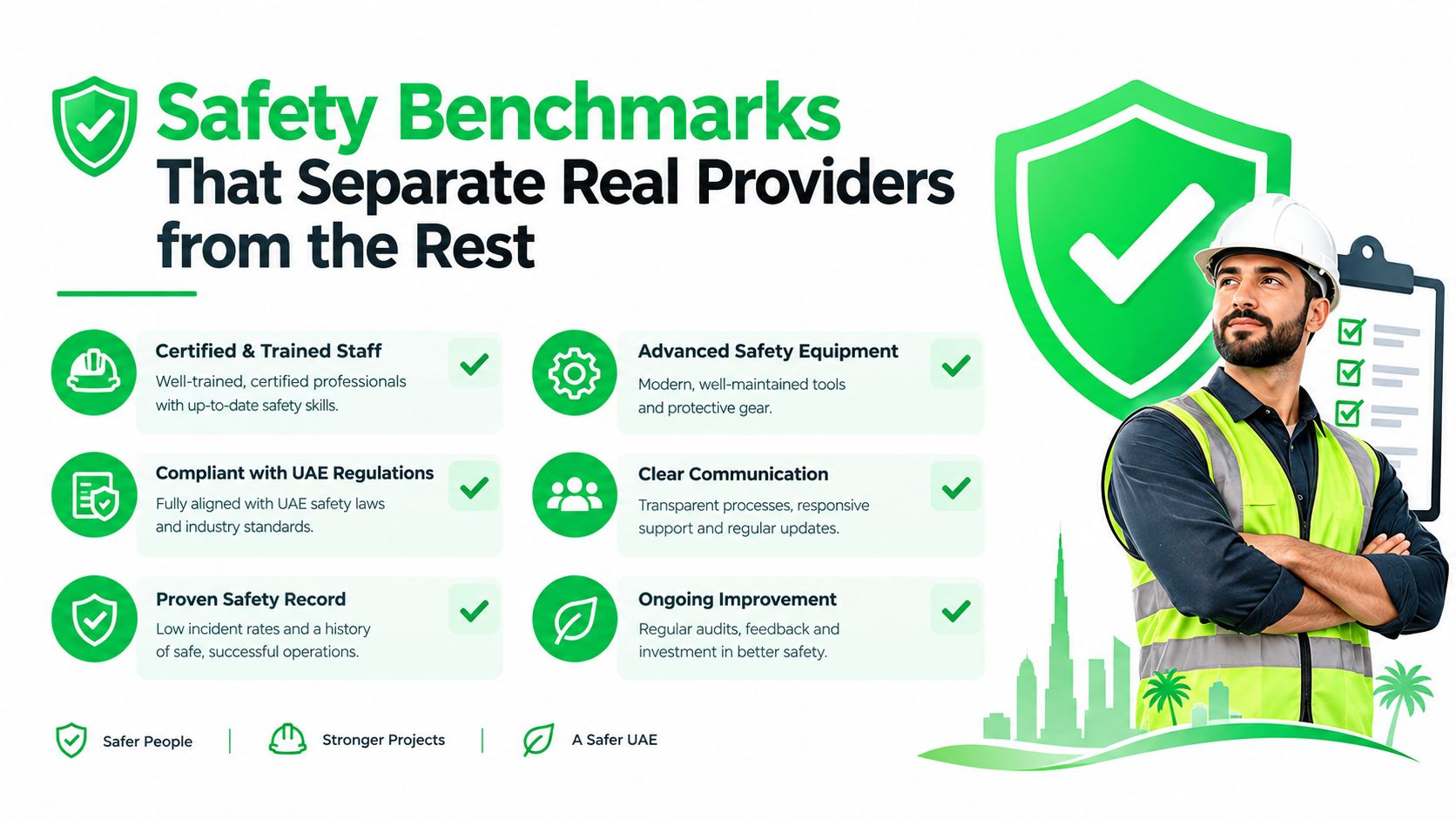
A DHA licence is the starting point, not the complete safety test. After hospital discharge, the first visit should show whether the provider can connect assessment, treatment, documentation, and escalation. The clinician should confirm the patient's identity, review the discharge instructions, and explain who remains responsible for clinical decisions.
What the family should see
Before treatment begins, the nurse should verify the patient's identity and confirm consent with the patient or authorised representative. The assessment should cover current symptoms, allergies, relevant medical history, medicines, and signs that require escalation.
Infection prevention must be visible, not a promise in a sales call. Look for hand hygiene, suitable protective equipment, clean supplies, and safe waste handling. Equipment should suit the procedure, be maintained, and meet applicable UAE requirements. If the service involves a foreseeable emergency, ask what equipment and escalation process are available.
The provider should also separate clinical care from companionship. A companion may help with meals, mobility, or observation, but that does not make the person a nurse. Confirm the clinician's DHA registration, the supervising clinician, and the tasks the assigned worker is authorised to perform. A “24/7” package should identify who covers each shift, how handovers occur, and what happens when the regular worker is unavailable.
Documentation is part of the care
Ask for a written report after every clinically significant visit. A useful post-visit example would record the patient's condition on arrival, relevant observations, the wound or treatment site, medicines or procedures provided, the patient's response, advice given, and the next review date. It should also state the warning signs that require urgent contact and name the escalation contact.
For wound care, a description or photograph may be appropriate when clinically permitted and authorised. For an injection or IV treatment, the record should identify what was administered, the relevant timing, and how the patient responded. The family should receive a secure summary that the next clinician can understand without relying on a vague “all good” message.
The red flags are operational: no clinician DHA details, no consent record, no named supervisor, no clear infection-control process, no suitable equipment, and no written follow-up.
Use the DHA inspection checklist as a question list, not as a substitute for checking the actual visit. A provider that arrives quickly but cannot explain accountability, documentation, incident review, or escalation leaves the family carrying avoidable risk. Ask these questions while the clinician is present.
Costs, Payments, and Insurance Reimbursement
Dubai home nursing prices depend on the clinician, visit length, clinical complexity, timing, number of visits, and whether you need an ongoing package. Overnight coverage, complex post-operative care, IV therapy, and repeated daily visits usually require a different quotation from a simple planned nursing task.
Ask for an itemised estimate before confirming. It should identify the provider, facility details, clinician type, visit or shift duration, procedure, supplies, and any additional charges. Keep the invoice, payment receipt, clinical report, prescription, discharge summary, and referral correspondence together.
Payment may be arranged by card, cash, online payment link, or bank transfer, depending on the provider. Don't assume that a payment method confirms insurance eligibility. Ask both parties:
- Provider: Can you issue an itemised invoice and clinical report?
- Insurer: Is home nursing covered under this policy?
- Insurer: Is pre-authorisation required?
- Family: Does the policy distinguish emergency care from elective or planned support?
- Everyone: Which documents and provider details must accompany the claim?
Coverage differs between policies, especially for long-term support, personal care, hotel visits, and post-operative arrangements. Confirm reimbursement in writing before the first visit where possible. Families planning extended elderly support can also review these financial tips for long-term elderly care before agreeing to a recurring schedule.
Choosing the Right Setting for Your Situation
A Dubai resident recovering from surgery usually needs a planned home package linked to the discharge instructions. Prioritise a DHA-licensed nurse, surgeon communication, wound and medication documentation, mobility support, and a clear escalation route. If the patient develops serious or rapidly worsening symptoms, home care may no longer be the appropriate setting.
A tourist in a hotel needs a more focused arrangement. Confirm that the clinician can access the room, review the visitor's documents and insurance, provide the requested clinical service, and explain what happens if the problem needs hospital care. A discreet hotel visit can be practical for a stable, defined need, but it shouldn't delay emergency treatment.
An older family member needing ongoing help may require two coordinated services. A caregiver can support daily living and companionship, while a nurse provides clinical monitoring and treatment within scope. Agree who handles medicines, mobility, meals, appointments, and changes in condition. A caregiver coordination tool such as this Tribulys caregiver app guide may help relatives organise updates, but it doesn't replace licensed clinical supervision.
Keep this checklist beside your phone:
- Licence: Is the facility authorised by DHA?
- Clinician: Is the individual nurse or doctor DHA-registered?
- Scope: Is this nursing, medical care, physiotherapy, or companionship?
- Plan: Has someone reviewed the discharge summary and current medicines?
- Safety: Will the clinician verify identity, consent, infection control, equipment, and escalation?
- Record: Will you receive a written report and follow-up instructions?
- Setting: Is home or hotel care safe, or does the patient need a clinic or hospital?
Vitals Healthcare Doctor On Call offers DHA-licensed doctor visits, nursing care, physiotherapy, lab testing, IV therapy, and hotel or home support across Dubai, with coordination by phone or WhatsApp. If you need to arrange a nurse after discharge, assess a hotel guest, or organise elderly support, contact Vitals Healthcare Doctor On Call and ask for the clinician, scope, documentation, and escalation plan before booking.