


If you're treating IV vitamin therapy at home like a spa add-on, you're asking the wrong question. In Dubai, the key question is simple, do you need an IV, or do you need a clinician to rule out something more serious first?
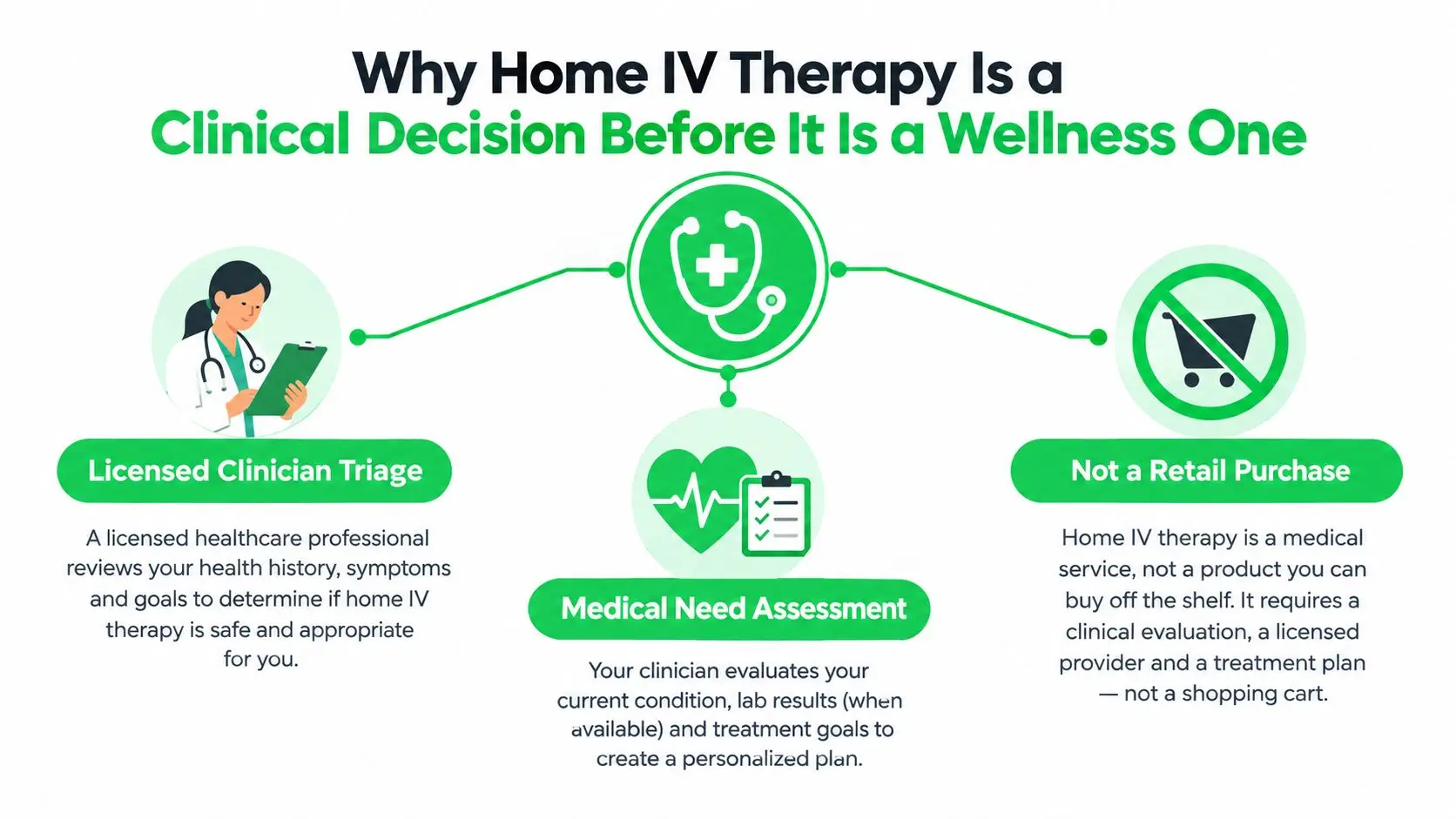
That matters because home IV therapy is not a retail purchase. Dubai's home-healthcare framework requires authorization, licensed professionals, consent, documentation, monitoring, and escalation when symptoms go beyond home treatment capacity, and the DHA's standards explicitly include intravenous lines as a regulated clinical procedure (Dubai Healthcare System overview, DHA home healthcare standards). A patient who is mildly dehydrated after travel may be appropriate for a home infusion, while someone with chest tightness or severe symptoms belongs in emergency care, not on a sofa with a drip.
Practical rule: convenience comes second. If the symptom story is unclear, the answer is triage, not infusion.
The clinic-style mindset is the only sensible one here. If you want a primer on the marketing claims people usually hear before they book, this overview of 9 real benefits of vitamin IV therapy you need to know in 2025 is useful, but don't confuse claimed benefits with a medical indication. In practice, a doctor or nurse should decide whether you need fluids, labs, oral rehydration, a clinic visit, or an emergency transfer before anyone reaches for a cannula.
Table of Contents
- Why Home IV Therapy Is a Clinical Decision Before It Is a Wellness One
- What Actually Goes Into an At-Home IV Vitamin Drip
- The Pre-Infusion Triage Clinicians Should Run in Your Living Room
- Who Is a Good Candidate and Who Should Be Screened Out
- Safety, Side Effects, and When to Stop the Drip or Call for Help
- What to Expect During an At-Home Visit in Dubai
- Booking, Preparation, and Questions to Ask Your Provider
- Follow-Up, Red Flags, and the Rule That Should Guide Every Booking
Why Home IV Therapy Is a Clinical Decision Before It Is a Wellness One
Booking an IV drip before establishing the problem reverses the proper order of care. IV therapy changes the route of delivery, which raises the screening burden, alters the risk profile, and demands appropriate clinical oversight. As the DHA home-healthcare standards cited earlier require, providers need licensed professionals, facility authorisation, medical-director supervision, and formal processes for consent and escalation.
Dubai's home-care sector is now an established part of the healthcare system. Earlier reporting identified 417 home-healthcare agencies among 4,482 private-sector medical facilities in 2022, with 45% growth over five years. That expansion supports a practical conclusion: home treatment belongs within regulated medical services, and an infusion delivered in a residence or hotel room requires the same discipline as other mobile care.
What triage should answer first
Before anyone prepares a bag, a clinician should determine whether the patient is suitable for home treatment. Mild travel fatigue, straightforward dehydration, and stable observations may support a home visit. Chest pain, shortness of breath, severe dehydration, or signs of systemic illness require a higher level of assessment and may call for emergency care.
No-nonsense point: a wellness request does not remove the duty to assess medical risk.
The setting and the story both matter. A hotel guest who feels depleted after a desert excursion may be suitable if observations are stable and the medical history raises no concern. A resident with chest tightness and dizziness needs urgent assessment, even if the original booking was for convenience. A responsible clinician assesses medical suitability before discussing infusion at all.
Marketing can describe proposed benefits, but it cannot establish an indication. This overview of claimed vitamin IV therapy benefits may explain common promotional arguments; it does not replace triage. The clinician should decide whether the appropriate response is fluids, oral rehydration, laboratory testing, a clinic visit, or emergency transfer before inserting a cannula.
What Actually Goes Into an At-Home IV Vitamin Drip
A proper IV vitamin therapy at home session isn't a mystery potion. It's a prescribed fluid plan, usually built around a carrier solution, selected vitamins, and sometimes mineral or electrolyte additives, all checked and prepared by a licensed clinician before administration. The difference between a responsible infusion and a reckless one is not the brochure, it's the dose, the indication, and the patient screening.
The bag is the prescription, not a cocktail
At a minimum, the clinician needs to know what is being infused and why. In practice, that means a carrier fluid, such as saline, plus selected ingredients like vitamin B12, B-complex, vitamin C, magnesium, and, where appropriate, electrolytes. The formulation should reflect the patient's history, not a fixed menu of “boosters.”
If you want a plain-language explainer on one common nutrient people ask about, Vitamin Planet's guide to vitamin C benefits and best sources is a useful background read, but oral nutrition advice is not the same thing as intravenous dosing. The key point is that IV use bypasses digestion, so the clinician has to be much stricter about indication and compatibility.
For a broader comparison of hydration approaches, see IV hydration vs energy drinks, which works better. The answer depends on the problem, but a drink is not a substitute for a clinical assessment when someone is unwell.
What a sensible formulation looks like in Dubai
A Dubai resident calling for home treatment after a long flight shouldn't expect a random blend. The clinician should review the reason for the visit, then prepare a formulation that fits the situation and the patient's screening results. A simple hydration-focused drip may be enough for one person, while someone else may need a different plan or no infusion at all.
Think of it like a prescription fill, not a juice bar order. The contents matter, the dose matters, and the person receiving it matters even more.
That's also why the line between “vitamin drip” and “medical procedure” matters. IV access, preparation, and administration belong with trained staff, not attendants following a sales script. If a provider can't explain what's in the bag, why it's there, and what will happen if the patient worsens, walk away.
The Pre-Infusion Triage Clinicians Should Run in Your Living Room
A safe home visit starts with a decision, not a cannula. The clinician should verify your identity, ask why you booked the service, and confirm that your condition suits home care. If the problem cannot be assessed or managed safely in a living room, the correct response is referral, not immediate line insertion.
The questions that should come before the cannula
The pre-infusion review should cover allergies, current medicines, recent illness, pregnancy status where relevant, kidney and heart history, and the symptoms that prompted the booking. The clinician should also record baseline observations. An unstable patient needs medical assessment in an appropriate facility.
Consent is part of the clinical process. The DHA home healthcare consent and procedures document treats IV therapy as a specialised service requiring dedicated documentation. The DHA standards cited earlier also set the context for regulated home healthcare. Before treatment, the clinician should explain the formulation, intended benefit, possible risks, alternatives, and your right to refuse. A rushed signature without that discussion is poor practice.
What separates clinical judgement from salesmanship
Safe administration requires a clear record of the product, dose, start and finish times, cannula-site checks, and any adverse reaction. That documentation gives the next clinician a usable account if symptoms develop after the visit. It also shows whether the provider is following a process rather than improvising.
The same discipline applies to other healthcare delivered outside a clinic. See this guide on how to collect blood samples for home lab tests without errors for a practical example. Process first, convenience second.
A healthy adult with mild dehydration after travel may pass this review and proceed. Someone with uncontrolled heart failure should be screened out and referred for appropriate care. The decision must follow the patient's condition, not the package selected during booking.
Who Is a Good Candidate and Who Should Be Screened Out
A home IV drip is appropriate only after triage shows a stable patient, a clear indication, and a reasonable route for supervised hydration or replacement. Mild symptoms and an uncomplicated medical history support consideration. Unclear symptoms, significant comorbidities, or possible instability require a different level of care.
Candidacy at a glance
| Scenario | Likely fit for home IV | Action if not a fit |
|---|---|---|
| Mild dehydration after travel | Yes, if screening is clean | Oral rehydration or clinic review |
| Jet lag with fatigue only | Sometimes, if no red flags | Rest, fluids, or medical review |
| Recovery after a stomach illness | Sometimes, if symptoms are mild and stable | Facility-based care if worsening |
| Post-training rehydration | Yes, for a stable adult | Delay treatment if symptoms are concerning |
| Chest pain or breathing difficulty | No | Emergency assessment |
| Suspected severe dehydration | No | Facility management, not home care |
The people who need extra caution
Pregnant women, people taking multiple medicines, and anyone with kidney disease or heart failure need a tighter clinical screen. The clinician must consider fluid tolerance, electrolyte risks, medication interactions, and whether the proposed infusion addresses a genuine need. A booking form cannot replace that assessment.
Dubai's telehealth guidance places moderate-to-severe hypovolemia in a face-to-face facility setting rather than a routine home visit (DHA telehealth guidance). Someone who is very unwell needs escalation, not a more comfortable venue. Chest pain, breathing difficulty, suspected severe dehydration, confusion, or rapid deterioration should end the home-care pathway.
Use oral fluids and rest when they can safely manage the problem. Book an IV only when a clinician identifies a sound indication and confirms that home treatment is suitable. Declining an unsuitable patient is clinical common sense, not stubbornness.
Safety, Side Effects, and When to Stop the Drip or Call for Help
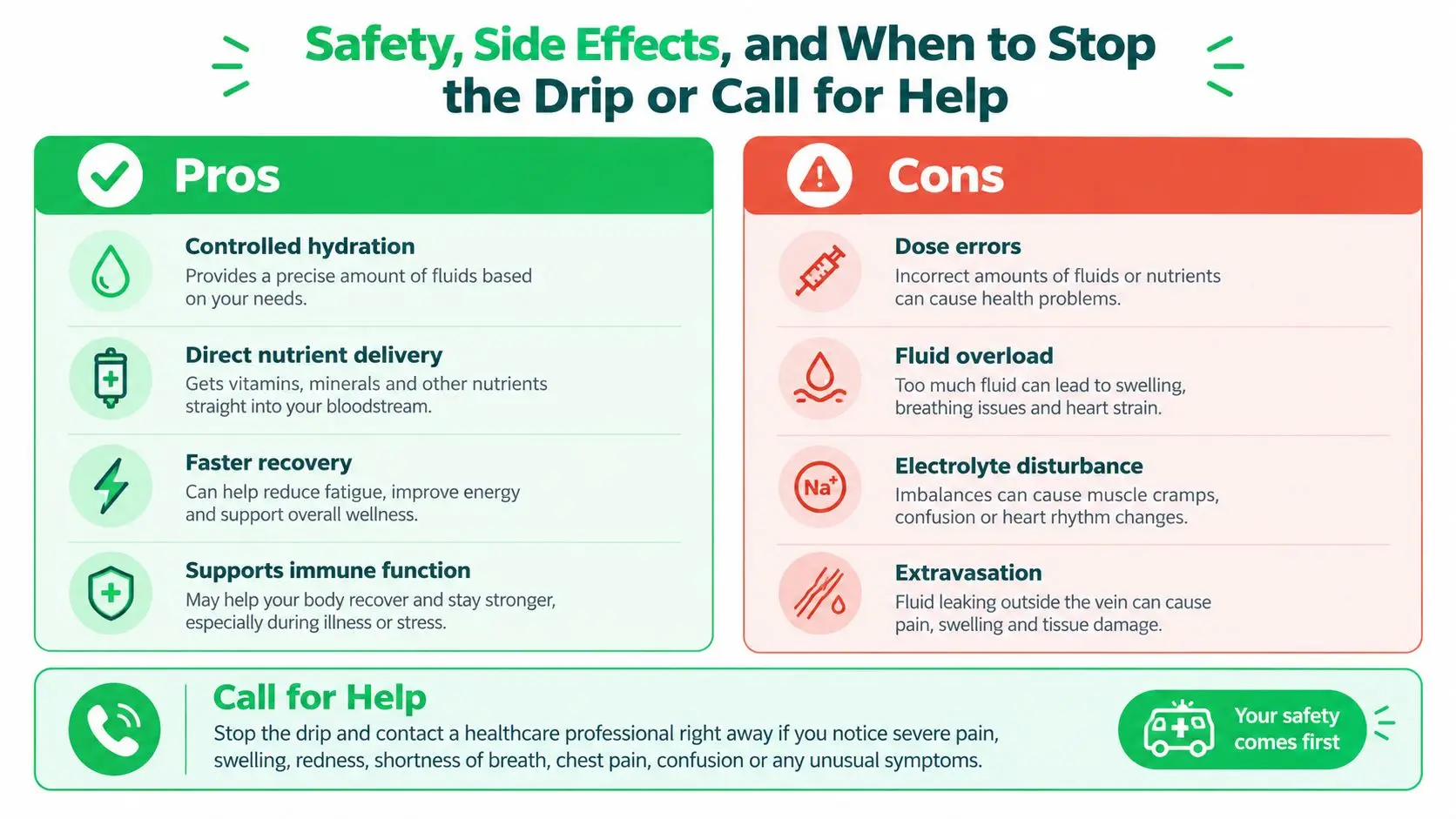
IV delivery is not a stronger version of an oral supplement. It bypasses the gut and puts the substance directly into circulation, so dose errors, fluid overload, electrolyte disturbance, extravasation, infection, and hypersensitivity can develop quickly. Treat the infusion as a clinical procedure, not a wellness purchase.
Warning signs that should stop the infusion
If the patient develops rash, wheeze, chest symptoms, severe pain at the cannula site, dizziness, or abnormal vital signs, stop the drip. The clinician should reassess immediately, check the patient's observations, and decide whether home care remains appropriate. Continuing despite these signs is poor practice.
A Dubai study of supplement users reported an adverse event rate of 2.9%. The events were generally mild to moderate and resolved after the supplement was stopped, but the finding concerns oral products, not IV treatment. Oral supplements are not risk-free, and intravenous administration demands closer screening and monitoring.
When home care becomes the wrong setting
A home infusion is unsuitable when the patient needs assessment beyond what can be safely provided at home. Moderate-to-severe dehydration, suspected heart failure, kidney disease, pregnancy-related concerns, or a systemic illness should prompt facility-based review rather than an attempt to complete the drip.
Transfer should happen when symptoms worsen or the clinician cannot establish a safe treatment plan. Travellers who may require escalation beyond local home care can review this medical evacuation and repatriation guide.
For anyone considering glutathione IV treatment, the same rule applies. The ingredient does not remove the need for a proper indication, medical history, consent, and monitoring. Stop the infusion first when warning signs appear, then decide whether the patient needs urgent facility care.
What to Expect During an At-Home Visit in Dubai
A good visit starts before the clinician reaches the door. You'll usually confirm the booking, share symptoms, and be asked about medicines or allergies, because the provider should already be screening for whether the infusion belongs at home. A home visit that skips that step is already behind.

How the appointment should unfold
On arrival, the clinician should verify identity, confirm the indication, review consent, and check the plan one more time. Then comes the cannula insertion, baseline observation, and monitoring while the drip runs. If something changes, the visit changes with it.
That's exactly why citywide home coverage matters for unwell patients in places like Downtown or a hotel room on Palm Jumeirah. The point isn't luxury, it's timely clinical access when a person feels too rough to travel.
For a fuller picture of a mobile visit workflow, inside a home nurse visit, what really happens and what to expect is a useful companion read. A professional home infusion should leave a brief handover note with the product used, the key observations, and what to do if symptoms worsen.
What the time on site usually feels like
The room should look clinical, not theatrical. Supplies are opened, the line is checked, and the patient is watched during the infusion, not left to “call if needed.” If the clinician leaves before the patient is stable and the handover is clear, that's not a proper visit.
You should expect the experience to feel controlled and unhurried, even if it's happening in a hotel bedroom or a city apartment. Calm care is a good sign. Chaos is not.
Booking, Preparation, and Questions to Ask Your Provider
Start with the obvious question, is the provider authorised to deliver home healthcare in Dubai? Then ask who will come to the visit and whether that person is licensed and registered with DHA. If the answer is vague, the booking isn't ready.
Provider vetting checklist
| Check | What to ask or look for | Why it matters |
|---|---|---|
| DHA authorisation | Ask whether the service is licensed for home healthcare | Regulated care should be authorised |
| Clinician credentials | Confirm the visiting clinician's licence and role | IV access is a clinical skill, not a sales add-on |
| IV-specific consent | Ask for consent that names IV therapy specifically | The patient should understand risks and alternatives |
| Dosing plan | Request the intended fluid and ingredients | Prevents fixed, one-size-fits-all infusions |
| Monitoring plan | Ask how vital signs and site checks are handled | Home care needs active observation |
| Escalation pathway | Ask what happens if symptoms worsen | Unsafe patients need referral, not delay |
| Documentation | Ask for a note or invoice after the visit | Useful for continuity and insurance claims |
Get your space and paperwork ready
Have a clear seating or bed area, a reachable phone number, and a medication list ready. If you've had recent tests or a recent doctor visit, keep those details close. That makes the clinician's job faster and safer.
Vitals Healthcare Doctor On Call offers doctor visits, nursing support, and IV hydration and multivitamin therapy at homes, hotels, and offices across Dubai. If you want a provider that can combine clinical assessment with on-site treatment and follow-up guidance, visit Vitals Healthcare Doctor On Call and ask the hard questions before you book.
Follow-Up, Red Flags, and the Rule That Should Guide Every Booking
After the clinician leaves, the important question is not “did I get an IV?” It's did my symptoms improve in a sensible way, and did anything new appear that needs review. Mild soreness at the site can happen, but chest symptoms, rash, breathing trouble, severe pain, or worsening dizziness are not normal and need immediate attention.
The rule is simple. Triage first, infuse second. If the booking is about convenience only, the answer may still be no. If the story suggests dehydration, illness, medication effects, or something more serious, the clinical decision comes before the drip every time.
If you want IV vitamin therapy at home in Dubai done the right way, use a provider that treats it as a medical decision, not a beauty add-on. Vitals Healthcare Doctor On Call can assess you at home, at a hotel, or in an office, and can decide whether IV therapy, another treatment, or escalation is the safer choice. Visit Vitals Healthcare Doctor On Call and book only after the triage is clear.