
You've just arrived in Dubai after a long flight, the room is cool but your mouth is dry, and the water bottle beside the bed is still empty. Or you're in JLT with a dehydration headache after a stomach bug, while the child asleep in the next room makes a clinic trip feel unrealistic. Searching for IV drips at home in Dubai can seem like the quickest route to relief.
Convenience matters, but home IV therapy isn't just a wellness product delivered by car. In Dubai, it sits within a DHA-regulated home healthcare model, with rules around licensing, clinical assessment, consent, sterile technique, monitoring, and escalation. This guide explains what the service is, who may qualify, what happens during a visit, how reviews can help you judge providers, and when a hospital is the safer choice.
Table of Contents
- A Familiar Dubai Moment That Leads to an IV Drip at Home
- What At-Home IV Drips Actually Are in Dubai
- The DHA Licensing Layer Behind Every Home IV Visit
- Clinical Indications and Safety Boundaries
- How the Visit Unfolds From Booking to Discharge
- What Dubai Patients Actually Say in Reviews
- Coverage Areas, Booking, and Payment in Dubai
- Honest Answers to the Questions Readers Ask First
A Familiar Dubai Moment That Leads to an IV Drip at Home
A hotel guest near Sheikh Zayed Road wakes after a long-haul flight with a heavy head, dry lips, and no appetite. The empty bottle on the nightstand is a small detail, but it tells the story. There's a meeting later, the hotel gym has been missed, and the idea of finding a clinic, arranging transport, and waiting in a reception area feels harder than just staying in bed.
A Marina resident might reach the same decision after a stomach illness. They've tried sipping water, but nausea keeps interrupting every attempt. In another flat, a JLT executive has cancelled meetings because standing up brings on dizziness. A mobile clinician appears attractive because the assessment can happen in familiar surroundings rather than during a difficult journey.

The important distinction is what happens before the fluid starts. A legitimate service doesn't treat every tired traveller as an automatic candidate. A clinician should review symptoms, medical history, medicines, allergies, and warning signs before deciding whether home care is suitable. If your condition may need imaging, blood tests, continuous observation, or rapid hospital treatment, a doctor home visit or emergency service is more appropriate than an elective drip. A doctor-on-call assessment can help establish that first clinical decision.
Practical rule: A comfortable bedroom can be an appropriate care setting, but it must never replace clinical triage.
The rest of this guide treats the service as medical care delivered at your location, not as a guaranteed energy shortcut. That approach makes the potential convenience easier to understand and the safety boundaries much clearer.
What At-Home IV Drips Actually Are in Dubai
An at-home IV drip is an infusion administered by a qualified clinician at your home, hotel, or office. The clinician assesses you, confirms the prescribed treatment, inserts a peripheral cannula into a vein, connects the fluid and any authorised additives, and monitors you while the infusion runs. Depending on the formulation and your response, the full visit may take roughly 45 to 90 minutes, although the infusion itself can be shorter.
A useful analogy is a hospital outpatient hydration bay transported to your bedroom. The setting changes, but the clinical act doesn't. You still need an assessment, a suitable prescription, sterile single-use equipment, informed consent, observation, and a plan for what happens if your condition worsens.
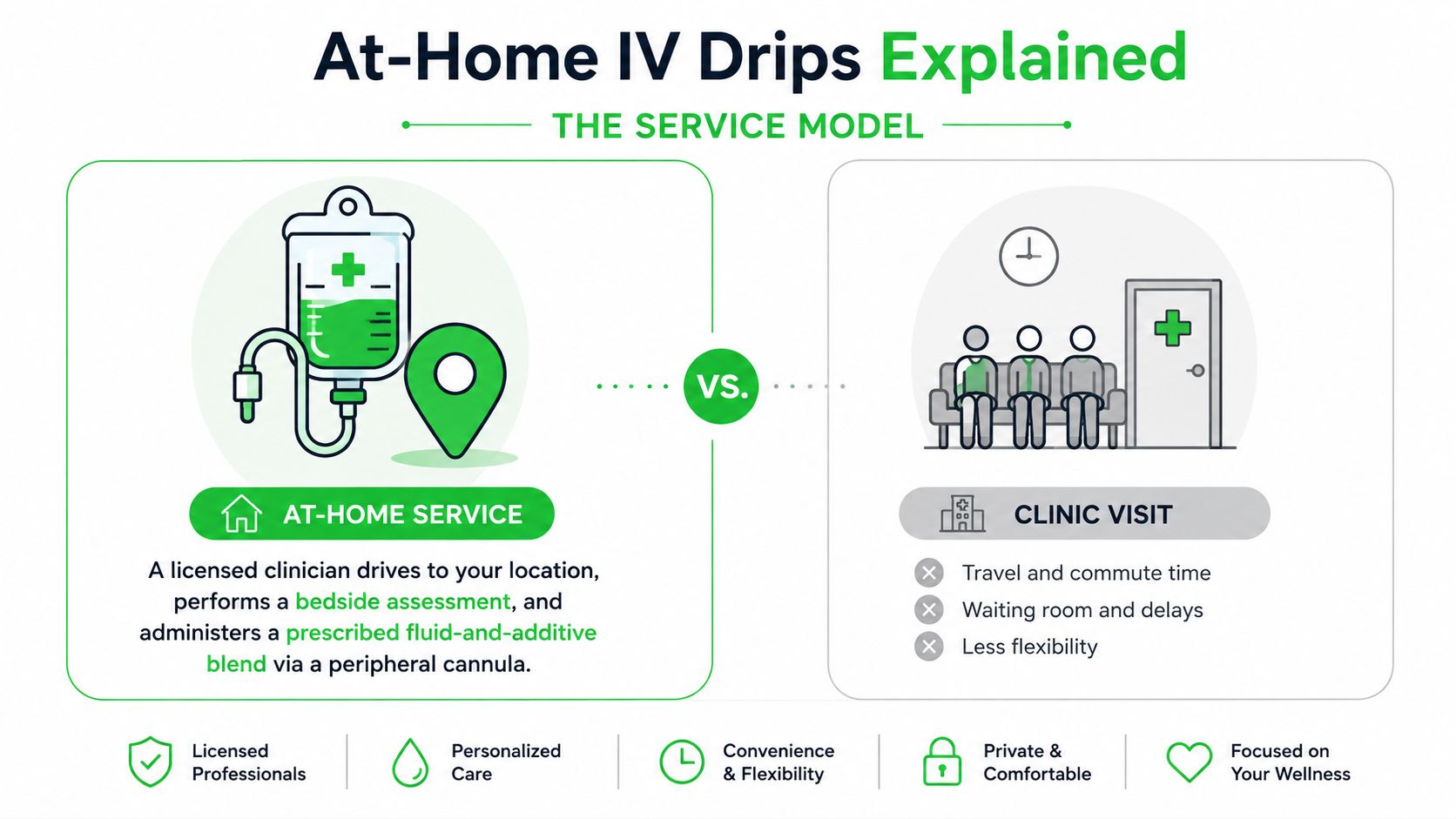
A prescribed blend might contain a fluid such as normal saline, with additives selected for a specific clinical reason. B-complex, glutathione, or an antiemetic may be considered in some protocols, but the name of a popular “cocktail” doesn't make it suitable for every patient. The clinician must match the contents and rate of administration to your symptoms, physiology, medicines, and relevant conditions.
The DHA framework is what separates clinical home IV therapy from an influencer-style “vitamin boost”. A licensed facility and DHA-registered practitioner operate within a regulated service model. A casual provider that lets customers choose a drip from a social-media menu without medical screening isn't offering the same level of care.
For readers comparing providers, ask three simple questions before booking:
- Who is responsible clinically? Confirm the facility licence and the registration of the doctor or nurse attending.
- What assessment happens first? A proper service should ask about symptoms, medicines, allergies, pregnancy where relevant, and existing heart, kidney, or metabolic conditions.
- What happens if something goes wrong? The team should explain its monitoring and transfer process rather than promising that complications can't occur.
You can also review information about the contents and purpose of an IV drip bag before agreeing to treatment. The practical takeaway is straightforward: in Dubai, a home drip should look and feel like a clinical visit that happens outside the clinic.
The DHA Licensing Layer Behind Every Home IV Visit
Dubai's home healthcare rules create the foundation for legitimate in-home IV treatment. The DHA home healthcare standards require an independent home healthcare facility in Dubai to hold a DHA licence. The framework applies across governmental, semi-governmental, private, and free-zone health facilities, and an already licensed facility that wants to add home healthcare must seek permission through the Sheryan platform.
That matters because IV therapy at home falls within a clinical home healthcare scope. It isn't an informal service that can be added to a beauty business because a nurse is available. The provider needs governance around patient selection, records, treatment, infection control, and escalation.
What a compliant visit should contain
The exact workflow can differ by patient and formulation, but the safety architecture should be recognisable:
- Pre-arrival triage gathers your location, symptoms, medical history, allergies, current medicines, and relevant risk factors.
- Bedside assessment includes vital signs and a focused review of whether your problem can safely be managed at home.
- Informed consent records that the clinician explained the proposed treatment, alternatives, and possible risks.
- Aseptic cannulation uses sterile technique and single-use equipment to reduce infection and line-related complications.
- Active observation allows the clinician to identify pain, swelling, allergy symptoms, breathing difficulty, fluid intolerance, or other changes.
- Escalation planning defines when the clinician will stop the infusion, contact a doctor, or arrange transfer to a hospital.
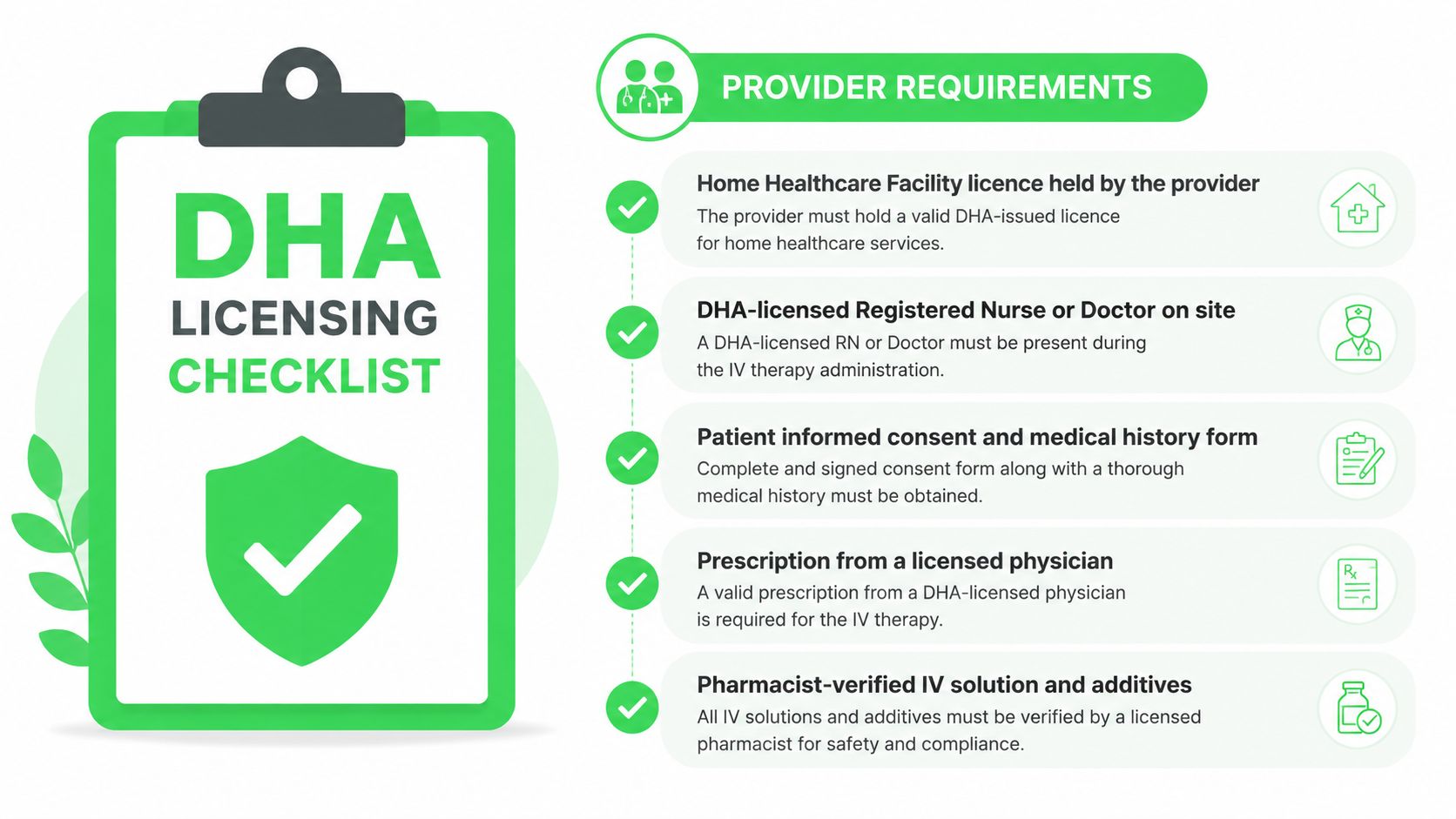
The provider's licence is only one part of the picture. The administering doctor or nurse must also be DHA-registered, and the service must operate with clinical oversight rather than treating the bag as the main product. Before booking, ask for the facility's licence details and the attending clinician's professional credentials. You can also ask how the provider verifies prescriptions, records consent, checks allergies, and documents the visit.
A licence is the regulatory floor, not a promise that every formulation is appropriate for you.
If you're considering a DHA-aware IV drip therapy service, look for evidence that the provider follows the full process, not just evidence that it advertises mobile treatment. A careful team will be comfortable answering operational questions because those safeguards are part of normal care.
Clinical Indications and Safety Boundaries
At-home IV therapy should be understood as a clinical delivery channel, not a spa menu. The strongest rationale is usually a situation in which fluid or prescribed medicine is needed and oral intake is inadequate, unsuitable, or too slow for the patient's immediate clinical needs. Even then, the clinician must decide whether home treatment is safe.
The table below separates stronger medical reasons from uses where the expected benefit may be limited or mainly symptomatic.
| Indication Category | Examples | Appropriate Setting | Key Safety Note |
|---|---|---|---|
| More clearly clinically justified | Acute dehydration linked to gastroenteritis, heat illness, post-operative fluid depletion, migraine that hasn't responded to oral treatment, or prescribed antibiotics when the oral route fails | Home may be suitable after assessment, but a clinic or hospital may be needed for complex illness | The underlying cause still needs evaluation, and deterioration requires escalation |
| Situational and symptom-focused | Jet-lag discomfort, hangover symptoms, or athletic recovery | Home only after screening and a clear clinical rationale | Relief may be temporary, and an IV shouldn't be used to disguise a serious condition |
| Weakly supported wellness use | Unexplained chronic fatigue, general “immune boosting”, or weight-loss infusions | Medical assessment first, with treatment of the underlying issue rather than automatic infusion | A marketing label doesn't establish medical necessity |
Local guidance highlights that some IV use can be appropriate for acute dehydration or deficiency states, while wellness-focused use in otherwise healthy people has weaker clinical support. That distinction is why a clinician should ask what is causing your symptoms instead of selecting a formula based on a desired outcome. Understanding IV drip side effects also means recognising that a procedure can create harm even when the ingredients sound familiar.
The risks the DHA-style safeguards are designed to control include:
- Infection, if the skin, cannula, line, or equipment isn't handled aseptically.
- Electrolyte disturbance, if the fluid or additive is unsuitable or administered too quickly.
- Extravasation injury, when fluid leaves the vein and enters surrounding tissue.
- Medication interactions or allergies, especially when the patient hasn't disclosed every medicine or supplement.
- Fluid overload, which is particularly important in people with heart or kidney disease.
- Delayed escalation, when a serious illness is mistaken for simple dehydration.
Go to an emergency department rather than arranging a routine home drip if you have severe breathing difficulty, chest pain, collapse, confusion, signs of a serious allergic reaction, uncontrolled vomiting, severe abdominal pain, or rapidly worsening symptoms. Patients with significant kidney disease, heart disease, diabetes complications, pregnancy concerns, or complex medical histories need clinician-led screening, and may be safer in a facility with immediate diagnostic and resuscitation support.
How the Visit Unfolds From Booking to Discharge
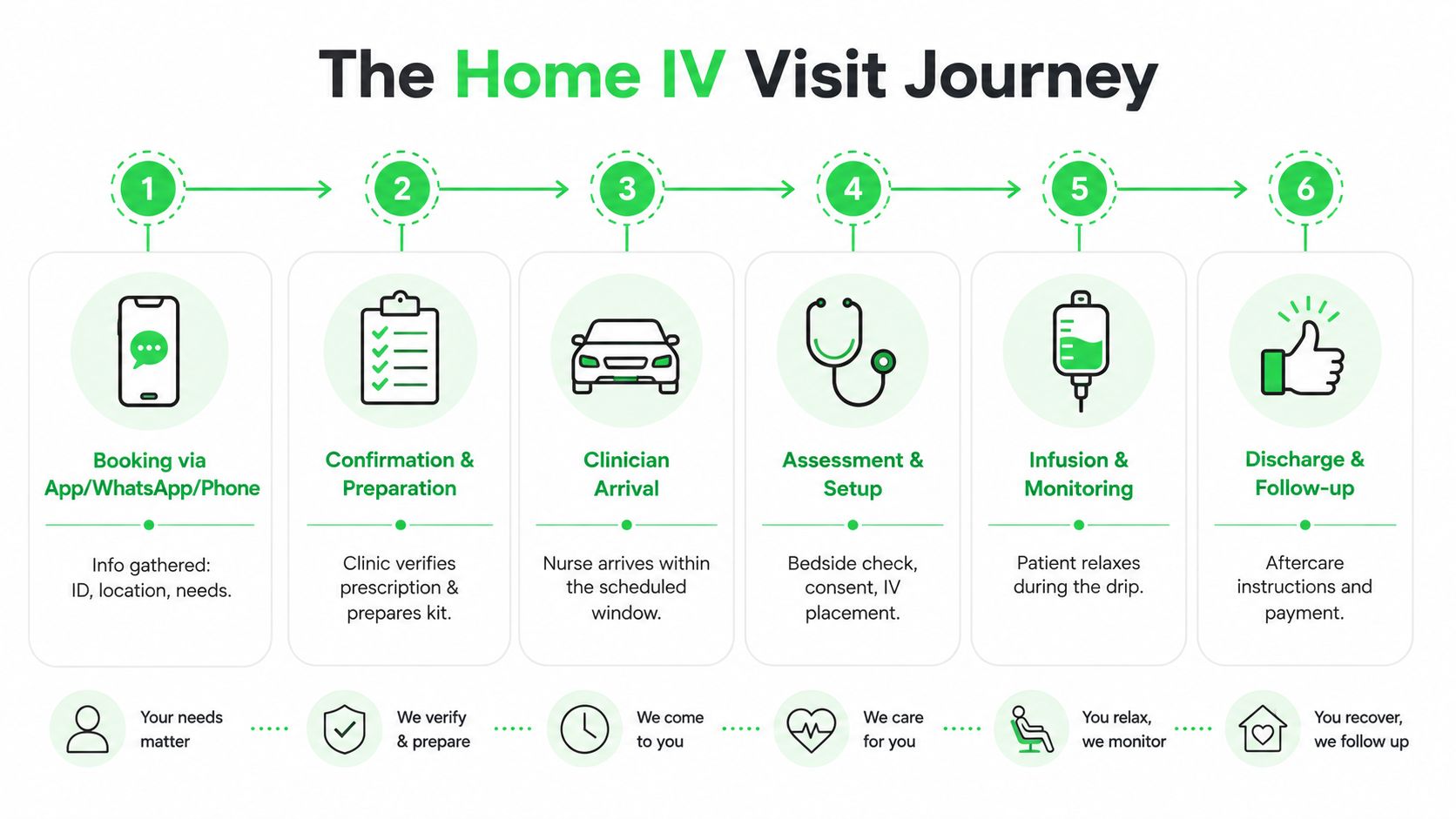
A properly organised visit begins before anyone rings your doorbell. You may contact a provider through an app, WhatsApp, or telephone, but the booking channel shouldn't replace medical triage. The coordinator will usually need your identification details, exact location, symptoms, current medicines, allergies, and information about relevant conditions.
Once the request is reviewed, the provider confirms whether the area is covered and whether a clinician can attend. Some Dubai services describe an arrival window of around 30 minutes, but actual timing depends on location, traffic, demand, and the urgency of the case. The team should also confirm the treatment price, what it includes, and whether the clinician may recommend referral instead of infusion.
The clinical sequence
At arrival, the nurse or doctor should introduce themselves, confirm your identity, and explain the proposed plan. Don't feel pressured to proceed just because the team has arrived. The clinician's assessment can change the plan.
Before cannulation, expect vital-sign checks, a focused history, allergy questions, medication review, and written consent. The clinician should make a go-or-no-go decision based on your condition, not on a pre-selected package. If your symptoms suggest a serious illness or require tests unavailable at home, the correct outcome is referral.
During line placement, a peripheral cannula is inserted, often in the forearm where practical. The clinician checks the site and secures the line before connecting the prescribed fluid. Gravity administration or a pump may be used depending on the solution and the patient's needs.
During infusion, you should be observed rather than left alone. The clinician watches for pain, swelling, flushing, nausea, dizziness, breathing problems, or changes in your general condition, and repeats observations where appropriate. The infusion and monitoring period varies by formulation and patient response.
At discharge, the cannula is removed, the site is dressed, and you receive aftercare advice. A proper handover should include a written clinical note, the treatment given, symptoms that require urgent help, hydration guidance, and instructions for follow-up. Repeat sessions should be based on a clinical plan, not an automatic subscription.
You can review the practical details of a home IV service before contacting a provider, then ask what part of the process is included in the quoted visit. The best booking experience is predictable, but it still leaves room for the clinician to stop or redirect treatment when safety demands it.
What Dubai Patients Actually Say in Reviews
Reviews can't replace licensing checks or medical assessment, but they can reveal how a provider behaves at the bedside. Dubai-based patient feedback commonly focuses on punctuality, professionalism, comfort, and perceived symptom improvement, rather than on technical descriptions of every ingredient.
One Dubai IV therapy review page includes feedback describing arrival in about 30 minutes, feeling more hydrated and alert, and finding the nurse professional and gentle. Those comments are useful because they address the patient experience directly: whether the clinician arrived as promised, explained the process, and handled cannulation comfortably.
A separate SKIN111 @ Home review listing shows a patient rating of 4.99 out of 5 from 133 reviews. The excerpts praise timely service, professionalism, and effective in-home IV treatment. Another Dubai home healthcare listing includes provider entries with review signals such as 633 reviews and a 5.0 rating, which shows that consumers can find high-volume feedback in this market.
Read those figures as signals, not proof that a drip is medically suitable for you. A rating can tell you about reliability or communication, but it can't confirm that a formula was indicated, that a prescription was appropriate, or that emergency procedures were sound.
How to read reviews critically
Look for detailed comments about:
- Clinician conduct, including identification, explanations, and respectful communication.
- Arrival reliability, especially whether the provider handles delays transparently.
- Comfort and privacy, including careful cannulation and a calm approach in homes or hotels.
- Clinical boundaries, such as whether the team refers patients when home treatment isn't appropriate.
Also watch for complaints about unexplained add-on charges, aggressive upselling, unclear ingredient lists, or clinicians who arrive without visible credentials. Reviews consistently favour providers who behave like healthcare professionals and distrust those that market every drip as a universal solution. That distinction should shape how you assess advertisements, package names, and promises of instant transformation.
Coverage Areas, Booking, and Payment in Dubai
Licensed providers commonly dispatch to major Dubai communities, including Downtown, Dubai Marina, JBR, Palm Jumeirah, Jumeirah Beach Residence, Business Bay, DIFC, Dubai Hills, Arabian Ranches, and hotel clusters along Sheikh Zayed Road. Coverage isn't guaranteed just because a district appears on a website, so confirm your building, hotel, or office location before accepting a booking.
Outer areas, including Dubai Investments Park or Al Warqa, may involve different availability or a travel surcharge. Ask for the total cost before the clinician is dispatched, and request an itemised explanation if the quote changes after assessment.
Choosing a booking channel
WhatsApp often works well for initial triage, especially when you need to share your location, prescription, or a photo of a recent report. It should still lead to a proper clinical review.
An app may provide a clearer booking trail, including appointment details, clinician information, and payment records. That can be useful when you want written confirmation rather than a series of messages.
A phone call is preferable for complex histories, particularly when you have several medicines, previous infusion reactions, heart or kidney disease, pregnancy-related concerns, or uncertainty about whether you need home care at all.
Payment options vary. Providers may accept card on file, Apple Pay, cash on arrival, or instalment services such as Tabby, but don't assume every option is available for every treatment. Insurance reimbursement also varies. Medically indicated care may require pre-authorisation and supporting documentation, while wellness-oriented treatments may be excluded.
Before confirming, ask:
- What is the provider's DHA facility licence information?
- Which DHA-registered clinician will attend?
- What does the quoted price include?
- How are the solution and additives verified and recorded?
- Will I receive a written post-visit summary?
- What is the referral process if the clinician decides not to infuse?
Clear answers are more valuable than a glossy menu.
Honest Answers to the Questions Readers Ask First
Can I qualify if I'm not homebound? Possibly, but eligibility isn't automatic. A clinician must screen your condition and decide whether a home setting is clinically appropriate, particularly because DHA home healthcare rules are designed around regulated delivery and patient suitability rather than unrestricted convenience.
Will a nurse or a doctor attend? It depends on the formulation, your history, and the provider's clinical model. The attending professional should be DHA-registered, and the service should explain who is responsible for assessment, prescription, cannulation, and monitoring.
What should I prepare? Keep your identification, current medicine list, allergy information, recent medical reports, and prescription available. You can prepare a comfortable space and oral fluids if advised, but don't eat or drink anything that conflicts with your symptoms or medical instructions.
Does pregnancy change eligibility? Yes, it calls for cautious, consultant-led decision-making. Don't book a promotional infusion without disclosing pregnancy or the possibility of pregnancy during the clinical review.
How long does the visit take? Allow roughly 45 to 90 minutes for assessment, preparation, infusion, observation, and discharge. The timing depends on the prescribed treatment and your response.
Are repeat sessions discounted? Some providers may offer packages, but a discount shouldn't determine whether you need another infusion. Ask for the clinical reason, total price, and review point before agreeing to repeat care.
What happens if I react during the drip? The clinician should stop or adjust treatment, assess you, and follow the provider's DHA-aligned escalation pathway. Ask before treatment what emergency equipment is available and how transfer to a hospital would be arranged.
Can a family member or hotel staff member stay? Yes, with your consent and subject to privacy. Their presence can help with communication, but it doesn't replace the clinician's assessment or monitoring.
Vitals Healthcare Doctor On Call offers DHA-licensed doctor and nurse home visits, including IV hydration and multivitamin therapy for suitable patients at homes, hotels, and offices across Dubai. To arrange a clinically assessed visit or discuss whether home care fits your situation, visit Vitals Healthcare Doctor On Call .