

You've just checked in. Your suitcase is open on the luggage rack, the keycard is on the desk, and the welcome letter is competing for attention with restaurant menus, Wi-Fi instructions, and messages from home. Then the headache starts, your stomach turns, or you realise the room is colder, noisier, or less private than expected.
A hotel room in Dubai can be a comfortable base for business, shopping, beaches, or a short stopover, but the right choice depends on more than a star rating. You need to judge the room against your itinerary, understand what the area will cost you in travel time, and know what to do if illness interrupts your stay. This guide gives you that decision path, including when a Doctor On Call At Hotel visit makes sense and when you should go directly to hospital care.
Table of Contents
- Planning Your Stay in a Hotel Room in Dubai
- Understanding Dubai Hotel Room Types
- Choosing the Right Area and Booking Strategy
- Standard and Premium In-Room Amenities
- Comfort, Air Quality, and Sleep in Dubai Rooms
- When a Doctor Visit at Your Hotel Room Makes Sense
- How a Doctor On Call at Your Hotel Works in Dubai
- Your Pre-Trip and In-Stay Checklist for a Smooth Stay
- Suggested Internal Links
- Suggested External Sources
- Image Suggestions and Alt Text
- FAQ
- Can I get a Doctor On Call At Hotel visit in Dubai?
- Is a hotel doctor suitable for every illness?
- How quickly can a doctor reach my hotel?
- Will the hotel arrange the medical visit?
- What should I prepare for the visit?
- Can I claim the visit through travel insurance?
- Is a suite always better for a Dubai hotel stay?
- How can I make a Dubai hotel room more comfortable for sleep?
Planning Your Stay in a Hotel Room in Dubai
The first hour after arrival is when small decisions prevent large annoyances. Start with the room itself. If you're travelling for work, a proper desk, dependable Wi-Fi, quiet surroundings, and a bathroom layout that gives you privacy matter more than a dramatic view. If you're on a short leisure break, a balcony, beach access, or a convenient skyline may justify paying more, but only if you'll use it.
Next, test the location against your daily plan. A Downtown room can be excellent for Burj Khalifa and Dubai Mall visits, yet a hotel across town can turn a supposedly convenient itinerary into repeated car journeys. Marina and JBR work better for beach-focused stays, while Palm Jumeirah suits guests who want the resort to be the destination rather than a base between excursions.
The five decisions to make early
Room category: Choose enough space for your luggage, work, children, or recovery needs. Don't pay for a suite just because the upgrade sounds impressive.
Neighbourhood: Put your most important daily activity first. Location usually matters more than a famous hotel name.
Paid amenities: Club access, a kitchenette, balcony, or sea view can be worthwhile, but only when they fit your routine.
Climate comfort: Dubai rooms depend heavily on air conditioning. Temperature, humidity, noise, and blackout curtains can affect sleep more than décor.
Health support: Save the front desk number and decide how you'd access medical care before you need it. A guide to why Doctor On Call services matter for tourists in Dubai is useful background if you're visiting from the UK, the United States, Russia, or elsewhere.
Dubai's hotel market is large and still expanding. The Dubai Department of Economy and Tourism hotel-market data recorded 154,016 rooms across 832 establishments at the end of 2024, compared with 150,291 rooms in 2023. That scale gives visitors plenty of choice, but it also means room labels, service levels, and locations vary widely.
The sections ahead focus on practical trade-offs. You'll see how room categories differ, why a Marina view isn't always worth the premium, how to check comfort before unpacking, and how to make a sensible call when illness appears during your stay.
Understanding Dubai Hotel Room Types
Dubai hotels use familiar category names, but the labels aren't fully standardised. One chain's “Premier” room may resemble another property's “Deluxe”, while a “Sea View” room can offer anything from a broad open outlook to a narrow glimpse between buildings. Treat the category as a starting point, then verify the actual floor area, bed arrangement, balcony, bathroom, and view direction.
The market's scale makes these tiers fairly predictable, particularly across established four- and five-star properties. You're generally paying for a combination of space, outlook, access, and flexibility rather than a single feature.
Dubai Hotel Room Categories at a Glance
| Room Category | Typical Size (sqm) | Typical View | Best For | Key Trade-off |
|---|---|---|---|---|
| Standard | 20–30 | City, internal, or limited outlook | Solo travellers and short business stays | Efficient, but limited luggage and seating space |
| Deluxe | 30–45 | City, canal, or partial skyline | Couples and short leisure breaks | Better comfort without suite pricing |
| Premium or Sea View | 35–50 | Gulf, Marina, Palm, or skyline | Guests spending time in the room | View premium may matter less on an activity-heavy trip |
| Executive or Lounge Access | 30–45 | Varies by hotel | Business travellers and guests who value breakfast or private working space | Access benefits depend on lounge quality and opening hours |
| Junior Suite | 45–65 | City, water, or skyline | Couples wanting a sitting area | The extra lounge space may be underused |
| One-Bedroom Suite | 60–100 | Often stronger outlook | Families, longer stays, and entertaining | Higher rate for separation and additional space |
| Two-Bedroom Suite | 100+ | Premium city, sea, or resort view | Families or groups needing privacy | Cost rises quickly, and the layout varies substantially |
| Serviced Apartment | Varies widely | City or residential outlook | Long-stay guests and families needing a kitchen | Hotel-style service may be less immediate or extensive |
These are planning ranges, not guaranteed specifications. Always check the individual property's room page before paying. Bed size also matters. A king bed can suit a couple, while twin beds may be the better choice for colleagues or older children. Families should confirm whether a sofa bed is suitable for sleeping, not merely described as additional seating.
Match the room to your itinerary
For a one- or two-night stay packed with meetings, excursions, and dining reservations, a well-located Deluxe room often makes more sense than an oversized suite. You'll use the bed, shower, storage, and work surface more than a separate lounge.
A couple staying several nights may value a Premium room with a balcony or sea view if mornings and evenings will be spent indoors. Families should prioritise bathroom access, storage, connecting rooms, and a refrigerator or kitchenette over an attractive but impractical outlook.
Room-choice rule: Buy the feature you'll use every day, not the feature that looks impressive during a five-minute room tour.
Executive access deserves careful scrutiny. It can be useful when breakfast, evening refreshments, quiet work, or flexible meetings replace several separate purchases. It's less compelling if you leave early, spend most of the day outside, or choose a property where the lounge is crowded or limited.
A suite premium also needs an honest calculation. Extra space is valuable for families, long stays, and guests recovering from illness, but a short-stay couple may get more from a better location, late checkout, or a quieter room. Ask the hotel whether the upgrade includes separate sleeping space, lounge access, a kitchenette, or a larger room with a sofa.
Choosing the Right Area and Booking Strategy
Dubai is easy to misunderstand from a map. Two properties can appear close, yet daily traffic can make the journey frustrating. Choose the neighbourhood around your single biggest activity, then select the closest well-rated hotel that meets your standards.
Match the area to the trip
Downtown Dubai is the practical choice for first-time visitors focused on Burj Khalifa, Dubai Mall, restaurants, and central sightseeing. It works particularly well for short stays because you can reduce cross-city journeys.
Dubai Marina and JBR suit longer leisure breaks, beach access, waterfront dining, and an evening atmosphere. The area feels more self-contained than many city districts, though road congestion can affect trips beyond the Marina.
Palm Jumeirah is for resort time, private beaches, pools, and privacy. It's a poor choice if you plan to spend every day in Old Dubai, at the airport, or around the creek.
Business Bay offers newer inventory and a central position close to Downtown. It can be a sensible compromise for business travellers and visitors who want modern rooms without paying the highest rate for a flagship address.
Deira and Bur Dubai remain useful for guests prioritising value, the creek, souks, older Dubai, and airport access. These areas offer a different atmosphere from the resort districts and can be more practical for travellers who don't need beach facilities.
Dubai South and airport hotels are logistics choices. Use them for a transit night, an early departure, or a specific event nearby, not as a default base for sightseeing across the city.
Book for flexibility, not just headline price
Dubai's busiest travel periods generally create more pressure on availability and pricing, especially during the cooler part of the year and major events. The Dubai Shopping Festival and high-profile sporting periods can make a preferred hotel expensive or unavailable. Shoulder periods can offer better value, but room comfort becomes more important as humidity rises.
Compare the complete booking terms, not just the nightly rate. Check cancellation rules, taxes and fees, breakfast, resort charges where applicable, parking, extra-bed terms, and whether the room category is refundable. A discounted non-refundable booking can cost more if your flight, meeting, or family plans change.
Booking directly with the hotel or through a reputable GDS-connected agent usually gives you clearer support when plans move. Opaque third-party deals can create problems with room descriptions, amendments, and inclusions. If you want practical ideas for how experienced travellers unlock VIP hotel perks, use them as a supplement to checking the hotel's own terms, not as a substitute for reading them.
My Dubai rule: Anchor the area to the activity you'll repeat most, then choose convenience over prestige. A famous hotel across the city is rarely a bargain once you add travel time and transport.
Standard and Premium In-Room Amenities
A Dubai hotel room normally gives you the essentials: air conditioning, a private bathroom, bedding, storage, lighting, television, drinking water, and internet access. The quality varies, but the presence of an amenity doesn't tell you whether it will work well for your needs.
Before arrival, ask specific questions. “Does the room have Wi-Fi?” is less useful than “Is the Wi-Fi suitable for video calls, and is the desk near a power socket?” Likewise, “Does it have a bathroom?” doesn't clarify whether you'll get a walk-in shower, a tub, or an open-plan arrangement with limited privacy.
What usually matters more than the marketing language
| Amenity Category | Standard Room, typical | Premium Room or Upgrade, typical |
|---|---|---|
| Climate control | Individual thermostat and central or fan-coil air conditioning | More effective zoning, quieter equipment, or better control |
| Bathroom | Walk-in shower or shower over bath | Separate bath and shower, larger vanity, improved privacy |
| Bedding | King or twin configuration with standard pillows | Better mattress specification, pillow choices, additional seating |
| Connectivity | Wi-Fi and basic charging points | More convenient sockets, stronger work setup, sometimes enhanced connectivity |
| Storage | Wardrobe, safe, luggage space | Larger wardrobe, dressing area, additional drawers |
| View | City, internal, or limited outlook | Sea, Marina, Palm, canal, or skyline orientation |
| Refreshments | Water, tea, coffee, kettle, and sometimes a minibar | Expanded machine, snacks, lounge access, or kitchenette |
| Housekeeping | Daily cleaning, with timing varying by property | More frequent attention or turndown in selected categories |
The four details I'd verify before paying for an upgrade are blackout performance, air-conditioning noise, bathroom configuration, and workspace. A beautiful room with weak curtains can ruin sleep. A room with a tub but no walk-in shower can be inconvenient for older guests or anyone with mobility limitations. A premium view won't help if construction noise makes calls impossible.
Add-ons that can earn their price
Club lounge access is valuable for business travellers who use breakfast, quiet seating, and refreshments. A sea-view balcony makes sense for guests who plan to spend time in the room. A kitchenette is a strong choice for families, long stays, or guests managing dietary needs.
Pillow menus and upgraded coffee equipment are personal preferences, not automatic reasons to pay more. The same applies to a minibar. If you're interested in the operational details behind compact in-room refrigeration, this overview of mini bar fridges for hotel and hospitality use gives useful context, but the guest question is simpler: does the fridge hold medication or food at a suitable temperature?
If you expect fatigue, dehydration, or a demanding schedule, arrange appropriate care rather than treating premium amenities as a medical solution. Vitals' IV vitamin therapy information explains one service option, but any treatment should follow a clinician's assessment.
Send this before arrival:
“Please confirm the bed configuration, room size, walk-in shower or bath arrangement, balcony, blackout curtains, desk and power sockets, air-conditioning controls, Wi-Fi suitability for video calls, and whether the room is near lifts, nightlife, or service areas.”
Comfort, Air Quality, and Sleep in Dubai Rooms
Dubai hotel rooms are sealed, cooled environments. Outdoor heat, humidity, fine dust, cleaning products, and the constant operation of air-conditioning all influence how the room feels. You may experience a dry throat at night, a stuffy sensation after showering, or a room that feels cold while still seeming humid.
Don't chase the lowest thermostat setting. A practical starting point is 22–24°C, then adjust bedding and fan speed rather than repeatedly forcing the system colder. If the air feels damp, lowering the temperature may not solve the underlying moisture problem.
Make the room easier to sleep in
Request a non-carpeted room if dust or odours bother you. Use the bathroom exhaust during and after a shower, keep the bathroom door open afterwards when practical, and avoid placing luggage directly over air vents. Higher floors may feel less exposed to street-level dust, but they won't eliminate indoor irritants or mechanical noise.
Check whether the air-conditioning unit cycles loudly. A steady low sound can be easier to sleep through than a fan that repeatedly starts and stops. If the room faces a road, pool deck, nightclub, or service entrance, ask for a quieter orientation before unpacking.
Dubai Municipality's indoor air quality technical guidance gives occupied spaces a practical comfort band of 22.5–25.5°C and 20–60% relative humidity, with air velocity around 0.2–0.3 m/s and an 8-hour measurement basis for compliance testing. The guidance also calls for IAQ testing before occupancy and testing by an EIAC-accredited provider with submission to Dubai Municipality.
Sleep adjustment: Fix noise, light, and humidity before assuming the mattress is the problem.
Guests with nasal irritation may also benefit from avoiding heavy room fragrance and asking housekeeping which cleaning products were used. For persistent sinus symptoms, don't assume the room is solely responsible. Clinical assessment may be more useful than repeatedly changing the thermostat, and sinus infection treatment options can help you understand when medical advice is appropriate.
A Dubai hospitality engineering case study describes outdoor air arriving at 34°C dry-bulb and 32°C wet-bulb, then being dehumidified to about 12.5°C/12°C before reheating mixed return air to 20–22°C for room supply. The design reported HVAC energy savings of up to 30%, as detailed by the CIBSE Journal case study of Jumeirah Marsa Al Arab. The guest takeaway is straightforward: Dubai comfort depends on moisture control as much as temperature control.
When a Doctor Visit at Your Hotel Room Makes Sense
A hotel doctor isn't the right answer to every uncomfortable night. Mild fatigue after a flight, a minor headache, jet lag, or a hangover can often be managed with rest, fluids, food, and observation if no warning signs appear.
An in-room clinician becomes more appropriate when symptoms persist, worsen, or are difficult to manage safely on your own. Examples include fever above 38°C, dehydration, traveller's stomach, sinus symptoms that continue, urinary discomfort, or a medication refill problem. The clinician can assess you where you are and decide whether room-based care is reasonable.
Use a three-tier triage rule
Self-care in the room
Mild fatigue: Rest, hydrate, and avoid intense heat or exercise.
Minor headache: Consider sleep, food, fluids, and your usual safe measures.
Jet lag or hangover: Reduce stimulation and monitor whether symptoms improve.
Request a Doctor On Call visit
Persistent fever: A temperature above 38°C needs more attention, particularly if it continues or comes with other symptoms.
Dehydration: Heat exposure, vomiting, or diarrhoea can make a bedside assessment sensible.
Traveller's stomach: In-room evaluation can help distinguish manageable illness from symptoms needing escalation.
Sinus or urinary symptoms: A clinician can assess severity and discuss treatment.
Medication needs: A prescription review or refill may be safer than trying to improvise while travelling.
Go directly to emergency care
Chest pain or breathing difficulty
Severe abdominal pain
Head injury or suspected fracture
Heatstroke
Fainting
Any rapidly worsening or severe symptom
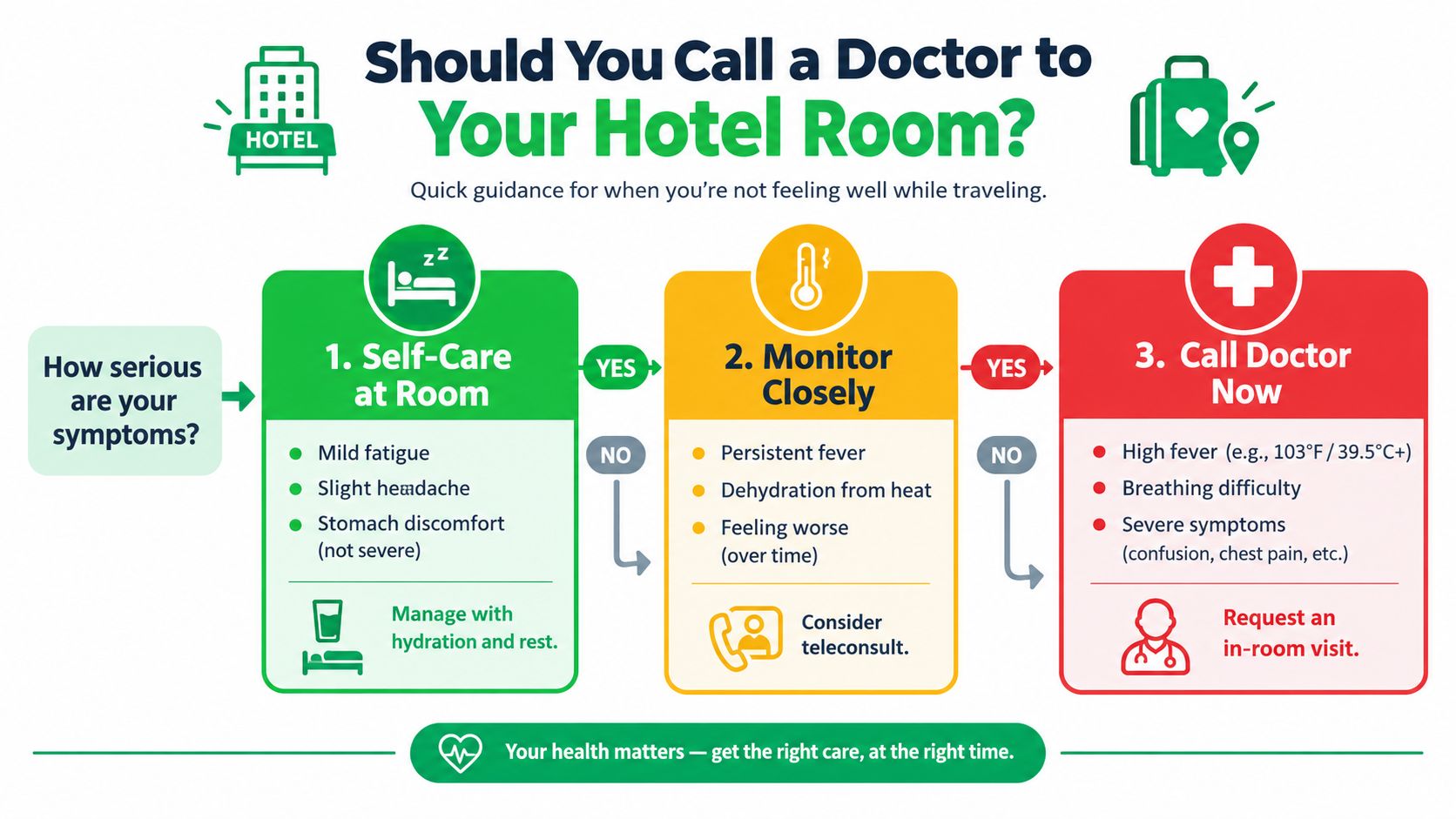
Ask yourself: Is this urgent, worsening, or something I can't self-treat safely overnight? If the answer is yes to two of those three questions, an in-room visit is a sensible middle path. If even one red-flag symptom is present, bypass the hotel visit and seek hospital care.
This distinction matters clinically and financially. An in-room clinician can evaluate a moderate problem without making you travel while unwell, but a hotel room isn't equipped for emergency diagnostics or advanced treatment. Dubai's visitor economy makes accessible care important. The Dubai Government Media Office reported hotel occupancy of 80.7% in 2025, 44.85 million room nights, and average stays of 3.7 nights, so many guests have limited time to make a clear decision.
For a broader overview of common presentations, see medical conditions treated by Doctor On Call services in Dubai. Use it for orientation, not diagnosis.
How a Doctor On Call at Your Hotel Works in Dubai
The process should feel organised, private, and clinically clear. Start with the hotel front desk, the in-room directory, or a direct phone or WhatsApp contact for a licensed provider. Give the coordinator the hotel name, room number, your symptoms, and any urgent warning signs. The hotel may help with lift access, visitor registration, or directions to the room.
Response time depends on location, demand, time of day, traffic, and the clinician's availability. Vitals Healthcare states that arrival is typically around 30 minutes, subject to location and demand. Other providers may quote a different window, so ask before confirming.
What to prepare before the clinician arrives
Have these details ready:
Identity and contact information: Keep your ID or passport available if requested.
Symptom timeline: Note when the problem started and whether it is improving or worsening.
Medication list: Include regular medicines, allergies, and anything taken during the stay.
Temperature and fluids: Share recent readings and whether you can keep fluids down.
Insurance details: Ask whether the provider issues an invoice or medical report for reimbursement.
Dubai Health Authority licensing matters. DHA rules require an independent home healthcare facility to obtain a licence, and a licensed health facility must also receive DHA approval to provide home healthcare services, as set out in the DHA home healthcare facility regulation. DHA's 2025 home healthcare standards define the service provider as an organisation authorised and licensed by DHA to deliver medical, therapeutic, and personal care services in patients' homes. Licensed facilities apply through the Sheryan platform to add home healthcare services, according to the DHA Home Healthcare Services standards.
What happens at the bedside
The clinician will usually take a symptom history, check vital signs, examine the relevant body systems, and decide whether basic point-of-care testing is appropriate. The important outcome isn't only receiving treatment. It's understanding whether the illness fits safe in-room management or requires a clinic, hospital, imaging, or further testing.
Possible costs vary by provider and service. Ask for the consultation fee before dispatch, then clarify add-ons such as IV fluids, rapid tests, medication, delivery, or follow-up. Don't assume travel, supplies, or prescriptions are included. Ask whether you'll receive a receipt, invoice, and clinical report suitable for an insurance claim.
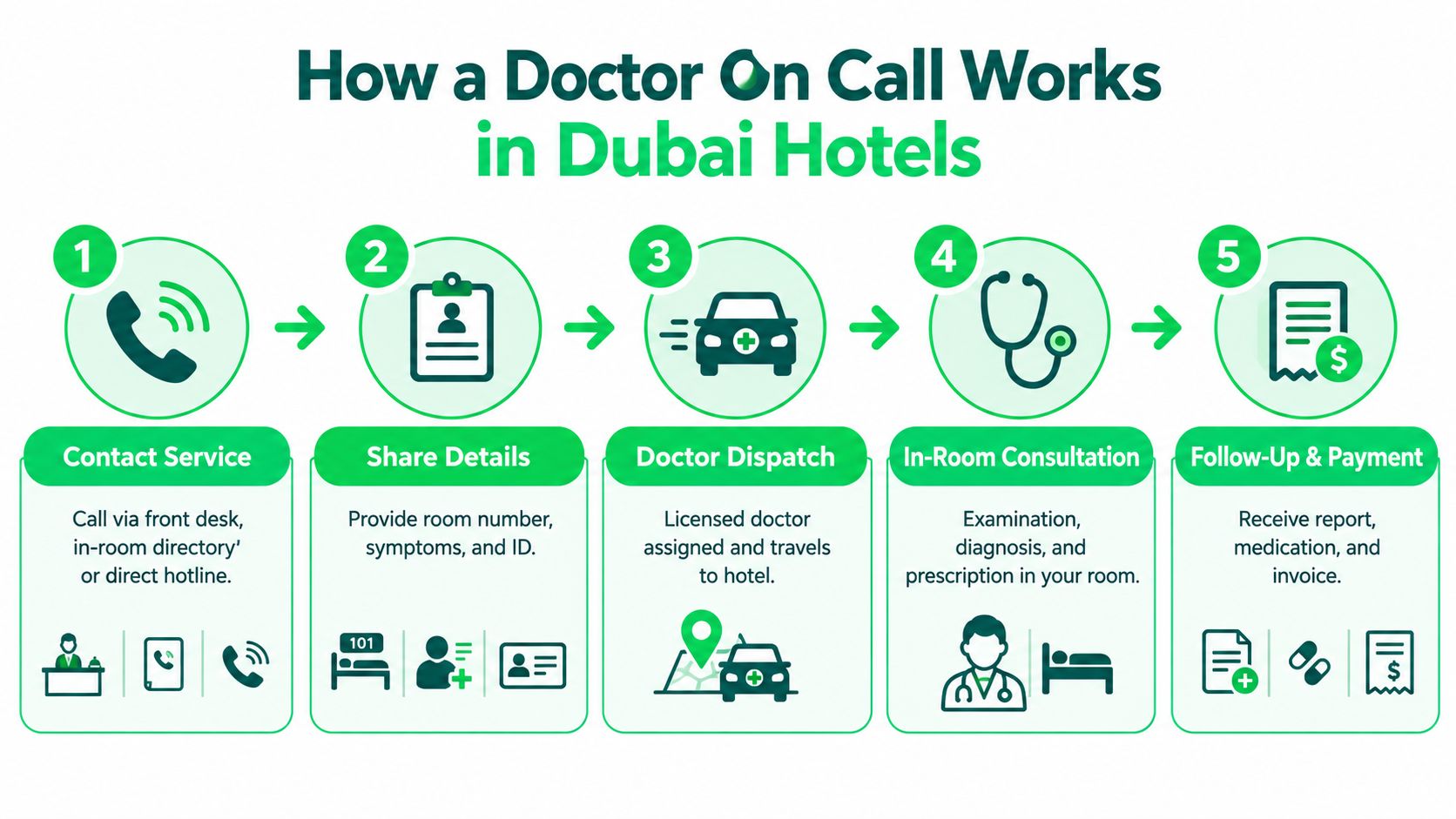
Follow-up should be explicit. Ask what symptoms require another call, whether medication can be delivered, whether you should cancel an excursion, and whether hospital assessment remains advisable despite initial treatment. For a practical overview of hotel visits, see professional Doctor On Call care in your Dubai room.
Dubai has a substantial medical tourism market. The WAM report on international health tourists recorded more than 691,000 international health tourists in 2023, with collective healthcare spending exceeding AED 1.03 billion. Earlier Dubai Health Authority data recorded 630,000 international health tourists in 2021 and spending of nearly AED 730 million. Those figures show an established care ecosystem, but they don't change the basic rule: emergency symptoms need emergency services.
Your Pre-Trip and In-Stay Checklist for a Smooth Stay
A good Dubai stay is easier when you separate decisions made before departure from checks made after arrival. The first list protects your budget and mobility. The second protects your comfort and gives you a clear response if your health changes.
Before you travel
Choose the room for the trip purpose: Business guests need a quiet work setup. Couples may prefer a view or balcony. Families need storage, bathroom access, and suitable sleeping arrangements.
Select the area around your itinerary: Downtown suits central sightseeing. Marina and JBR suit beach-led plans. Palm Jumeirah suits resort time. Deira and Bur Dubai suit guests focused on the creek, souks, and value.
Compare the complete rate: Check cancellation terms, inclusions, taxes, parking, breakfast, and extra-bed conditions.
Ask about accessibility: Confirm step-free access, lift dimensions where relevant, shower type, grab rails, seating, and distance from the lift.
Save essential contacts: Store the hotel front desk, your insurer, travel companions, and a licensed Doctor On Call provider.
Pack your clinical information: Bring regular medicines in their original packaging, allergy details, and relevant insurance documents.
Plan for privacy: If you may need a hotel medical visit, ask the front desk how visitors are registered and whether a clinician can come discreetly to the room.
After you arrive
Inspect before unpacking: Check the lock, windows, smoke detector, bathroom, water pressure, lighting, and obvious maintenance issues.
Set the room deliberately: Start the air conditioning within the Dubai Municipality comfort guidance, then adjust for sleep rather than choosing the coldest setting.
Control light and sound: Test blackout curtains, identify lift or service noise, and request a room move early if the disturbance is unacceptable.
Hydrate intelligently: Keep water available, especially after outdoor activity, flights, or time in strong sun. Don't treat thirst as the only sign that you need fluids.
Use amenities safely: Ask the hotel about refrigerator temperatures before storing medication or food. Don't assume a minibar is designed for clinical storage.
Protect your schedule: Leave recovery time after long flights and avoid arranging strenuous outdoor activities immediately after arrival.
Apply the triage rule: Mild symptoms can justify rest and monitoring. Persistent or worsening problems may justify an in-room clinician. Chest pain, breathing difficulty, fainting, severe pain, heatstroke, head injury, or suspected fracture should bypass hotel care for emergency assessment.
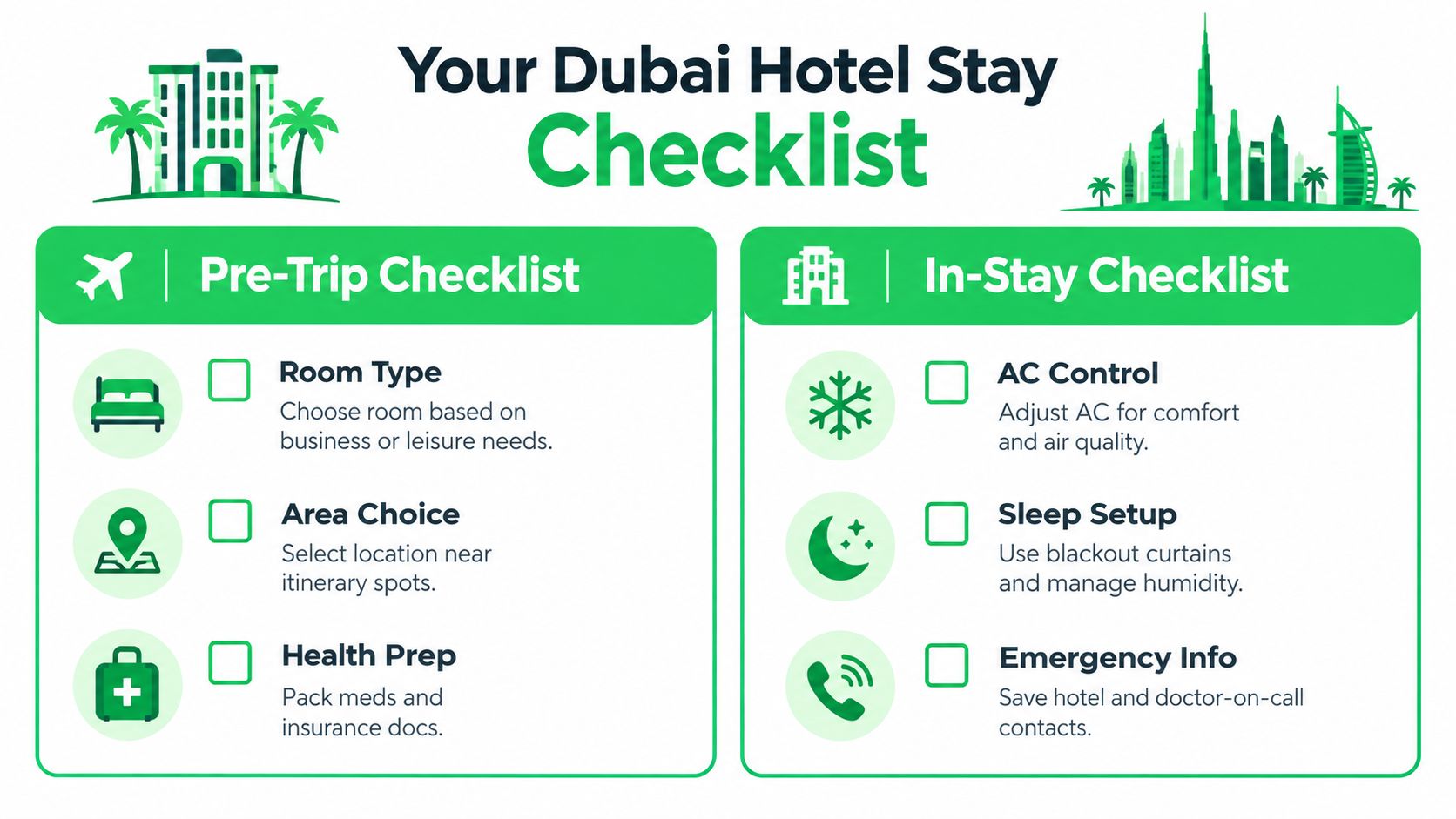
Your next action is simple. Before leaving for Dubai, save the hotel contact, check your room requirements against your itinerary, and keep a short symptom and medication note on your phone. If illness interrupts your stay and the problem is urgent, worsening, or unsafe to manage overnight, contact a licensed clinician rather than waiting until morning.
Vitals Healthcare Doctor On Call offers DHA-licensed clinicians for 24/7 medical visits to homes, hotels, and offices in Dubai, with bedside assessment, treatment support, reports, and follow-up guidance. If you need discreet medical attention without leaving your room, visit Vitals Healthcare Doctor On Call and arrange the appropriate next step.
Suggested Internal Links
Suggested External Sources
Dubai Department of Economy and Tourism hotel-market information
Dubai Health Authority home healthcare regulation
Image Suggestions and Alt Text
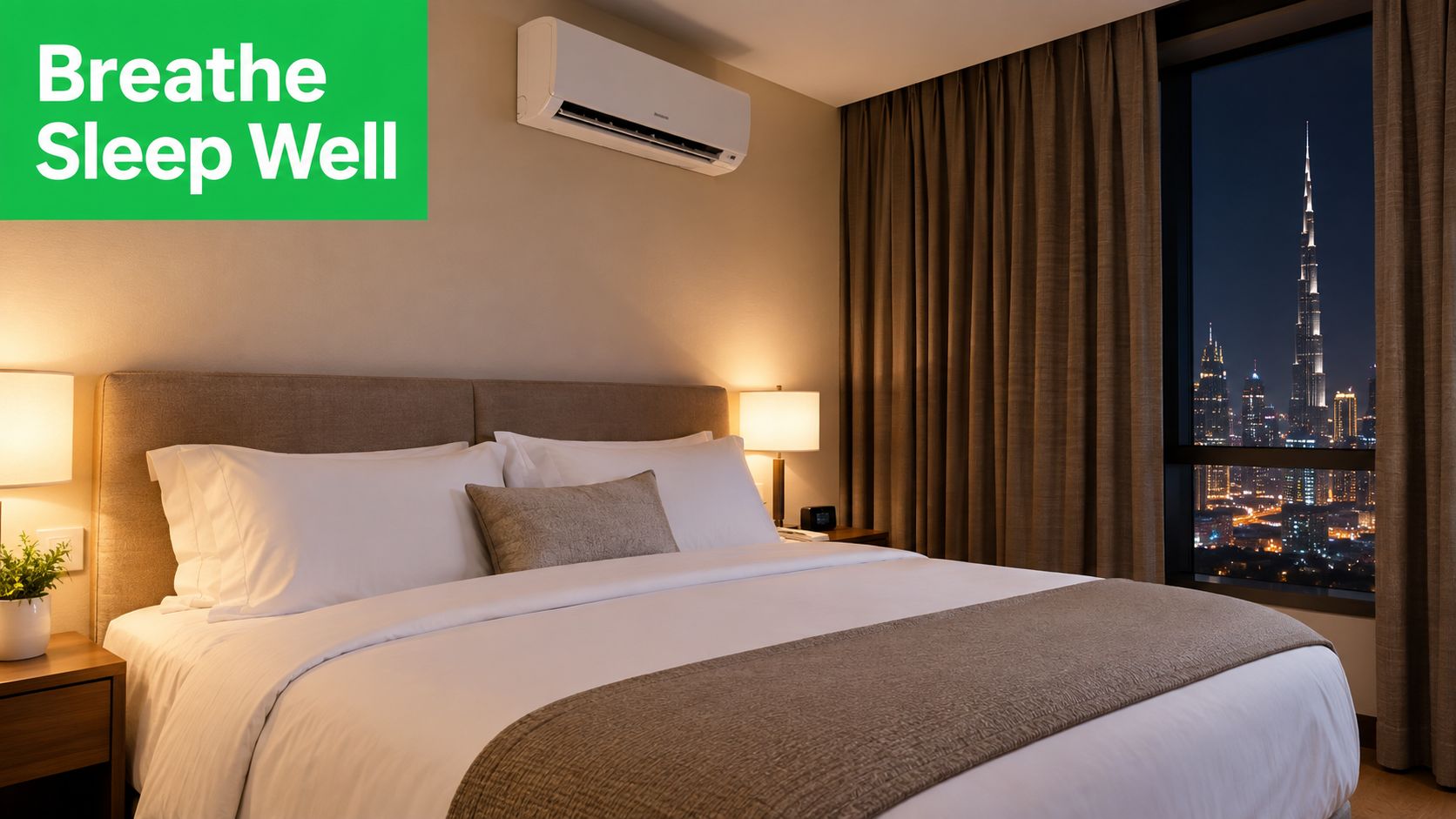
Modern hotel bedroom: Place in the comfort and sleep section. Alt text: “A modern hotel bedroom at night featuring a comfortable king-size bed with a view of the Burj Khalifa.”
Medical triage flow chart: Place in the hotel-room care decision section. Alt text: “A flow chart explaining when to practise self-care, monitor symptoms, or call a doctor while staying in hotels.”
Doctor On Call process graphic: Place in the service-mechanics section. Alt text: “A five-step infographic showing how a Doctor On Call service works for hotel guests in Dubai.”
Dubai hotel stay checklist: Place in the checklist section. Alt text: “An infographic titled Your Dubai Hotel Stay Checklist featuring pre-trip and in-stay tips for travellers.”
FAQ
Can I get a Doctor On Call At Hotel visit in Dubai?
Yes, hotel guests can request an in-room medical visit through a hotel-approved provider, the front desk, a direct phone number, or WhatsApp. Share the hotel name, room number, symptoms, and any urgent warning signs so the provider can assess the request.
Is a hotel doctor suitable for every illness?
No. In-room care is suited to problems that need clinical assessment but don't show emergency red flags, such as persistent fever, dehydration, traveller's stomach, sinus symptoms, urinary discomfort, or medication concerns. Chest pain, breathing difficulty, fainting, severe pain, heatstroke, head injury, and suspected fractures need emergency care.
How quickly can a doctor reach my hotel?
Arrival depends on the hotel location, traffic, time, demand, and clinician availability. Vitals Healthcare states that arrival is typically around 30 minutes, subject to location and demand. Confirm the expected arrival window when booking.
Will the hotel arrange the medical visit?
Some hotels can contact an approved provider or help with room access, but you shouldn't assume every property offers the same service. Ask the front desk whether it has an approved medical partner, or contact a licensed provider directly.
What should I prepare for the visit?
Keep your ID, medication list, allergy information, symptom timeline, temperature readings, insurance details, and payment method available. Tell the clinician whether symptoms are improving, worsening, or preventing you from drinking, walking, sleeping, or breathing normally.
Can I claim the visit through travel insurance?
Possibly, depending on your policy. Ask the provider for a detailed invoice and medical report, then check whether your insurer requires pre-authorisation, specific documentation, or treatment at an approved facility.
Is a suite always better for a Dubai hotel stay?
No. A suite is better when you need separated sleeping and living areas, more storage, a kitchenette, or room to recover. For a short stay with a busy itinerary, a well-located Deluxe or Premium room may be the more sensible choice.
How can I make a Dubai hotel room more comfortable for sleep?
Test the air-conditioning noise, set a moderate temperature, use blackout curtains, request a quieter room orientation, and ask for non-carpeted accommodation if dust or odours concern you. If symptoms persist despite room adjustments, seek clinical advice rather than assuming the room environment is the only cause.