
You wake up in a Dubai hotel with a pounding head, a dry mouth, and that heavy, slightly shaky feeling that makes even standing up seem like effort. Or you're fasting during Ramadan, trying to push through the afternoon heat, then by evening you feel dizzy, nauseated, and too drained to drink enough. Or you've spent the day outdoors between meetings, beaches, taxis, and air-conditioned malls, and only later realise you barely had any fluids.
This is the point where many people search for IV therapy for dehydration. They want one answer, but there are really three different paths. Sometimes you need oral rehydration and rest. Sometimes a same-day home IV visit may be clinically appropriate. Sometimes the safest option is to go straight to emergency care.
That distinction matters in Dubai. Heat exposure, long travel days, fasting, and reduced fluid intake can all push dehydration from inconvenient to medically important quite quickly. In the UAE, one hospital report cited a 30 to 35% increase in people seeking emergency-room IV drips during Ramadan for fasting-related problems including severe dehydration and gastritis, and the same report noted that IV drips are generally used when rapid rehydration is needed, especially in more serious dehydration rather than for routine wellness use (regional Ramadan dehydration context).
Table of Contents
- Introduction to IV Therapy for Dehydration in Dubai
- How Dehydration Happens and How IV Rehydration Works
- When Oral Rehydration Is Enough and When IV Therapy Is Indicated
- Benefits Risks and Who Should Avoid IV Therapy
- What to Expect During At-Home IV Therapy With Vitals Healthcare
- Costs Turnaround Times and Guidance for Travellers and Hotel Guests
- Making the Right Choice for Safe Rehydration
Introduction to IV Therapy for Dehydration in Dubai
A resident may finish an outdoor workout in Dubai Marina, feel washed out, and recover with water, oral rehydration salts, shade, and rest. A traveller with vomiting after a suspected food-related illness may be unable to keep even small sips down. A person fasting through a hot day may become dizzy by late afternoon, then struggle to catch up after sunset because the fluid deficit has built over many hours.
Each of these situations calls for a different treatment route.
Ask what level of care your symptoms need
The safest starting question is: What level of care matches my symptoms right now?
That matters because IV therapy for dehydration should be approached as a clinical decision, not a convenience service. An IV can replace fluid quickly when the body cannot catch up by mouth. It does not fix every cause of dizziness, fatigue, or nausea, and it should not delay emergency assessment when warning signs are present.
A practical first check is simple:
- Can you drink and keep fluids down? If yes, oral rehydration is often enough.
- Are warning signs appearing? Confusion, repeated vomiting, fainting, marked weakness, or very low blood pressure point away from routine home care.
- Do you have medical conditions that change fluid safety? Heart failure, significant kidney disease, and some chronic illnesses can make IV fluids unsafe without closer assessment.
Practical rule: Mild dehydration usually responds best to the gut. If drinking is failing or symptoms are becoming more serious, the choice needs medical judgement.
Why Dubai changes the decision
Dubai adds pressure to the problem. Heat increases sweat loss. Long flights, outdoor activity, diarrhoea, alcohol, fever, and fasting can lower fluid intake or increase losses at the same time. Air-conditioned malls and hotels can hide how much water the body has already lost, much like a phone battery that drops in the background until the warning appears all at once.
That is why rehydration in Dubai should be viewed through the lens of triage. Oral fluids are enough for some people. A same-day home IV may suit others. A smaller group needs emergency care without delay, especially if heat illness, severe dehydration, infection, chest symptoms, or collapse could be part of the picture.
How Dehydration Happens and How IV Rehydration Works
Think of your circulation like a building's water system. Your heart is the pump. Your blood vessels are the pipes. Your blood carries not only fluid but also dissolved salts, including electrolytes, which help nerves and muscles work properly. If you want a simple patient-friendly explainer, this guide on how electrolytes support muscle function is a useful companion to the basics.
When you lose too much fluid through sweat, vomiting, diarrhoea, fever, fasting, or poor intake, the “pressure” in that system starts to fall. Less circulating volume means the body has to work harder to maintain blood flow to the brain, kidneys, and muscles.
What dehydration actually does inside the body
At first, dehydration may feel simple. Thirst. Dry mouth. Darker urine. Fatigue.
As it progresses, the body starts compensating. Heart rate may rise. Standing can make you dizzy. Urine output drops. In more serious cases, thinking becomes foggy, weakness becomes obvious, and the person may not be able to drink enough to reverse the problem.
That's where readers often get confused. They assume dehydration is just “low water”. It isn't only that. It also affects the balance of salts and the way fluid moves between the bloodstream and tissues.
Why IV fluids work differently
Drinking works through the digestive tract. That's normally ideal. But if someone is vomiting, very nauseated, exhausted, or too unwell to keep drinking, the gut becomes an unreliable delivery route.
IV rehydration places fluid directly into the bloodstream through a vein. That gives clinicians a controlled way to restore circulating volume without waiting for the stomach and intestines to catch up.
For clinically dehydrated patients, UAE-aligned guidance uses isotonic crystalloids as the standard first-line fluids. 0.9% saline is commonly used for initial volume expansion, with typical resuscitation doses of 10 to 20 mL/kg over 1 to 2 hours, followed by deficit replacement over at least 4 to 6 hours using 0.9% saline or Ringer's acetate (UAE-aligned rehydration protocol details).
Why the fluid is given in stages
Fast doesn't mean careless.
Clinicians don't just hang a bag and hope for the best. They choose fluid type and rate for a reason. The aim is to restore blood volume while avoiding sudden electrolyte shifts or fluid overload. If you're curious how hydration drips are often framed in patient-facing language, this overview of electrolyte IV drip support can help connect the bedside process to the underlying physiology.
IV fluids are a tool for restoring circulation safely. They are not a substitute for diagnosing why the dehydration happened.
When Oral Rehydration Is Enough and When IV Therapy Is Indicated
Most dehydration does not need an IV. That's the safest place to start.
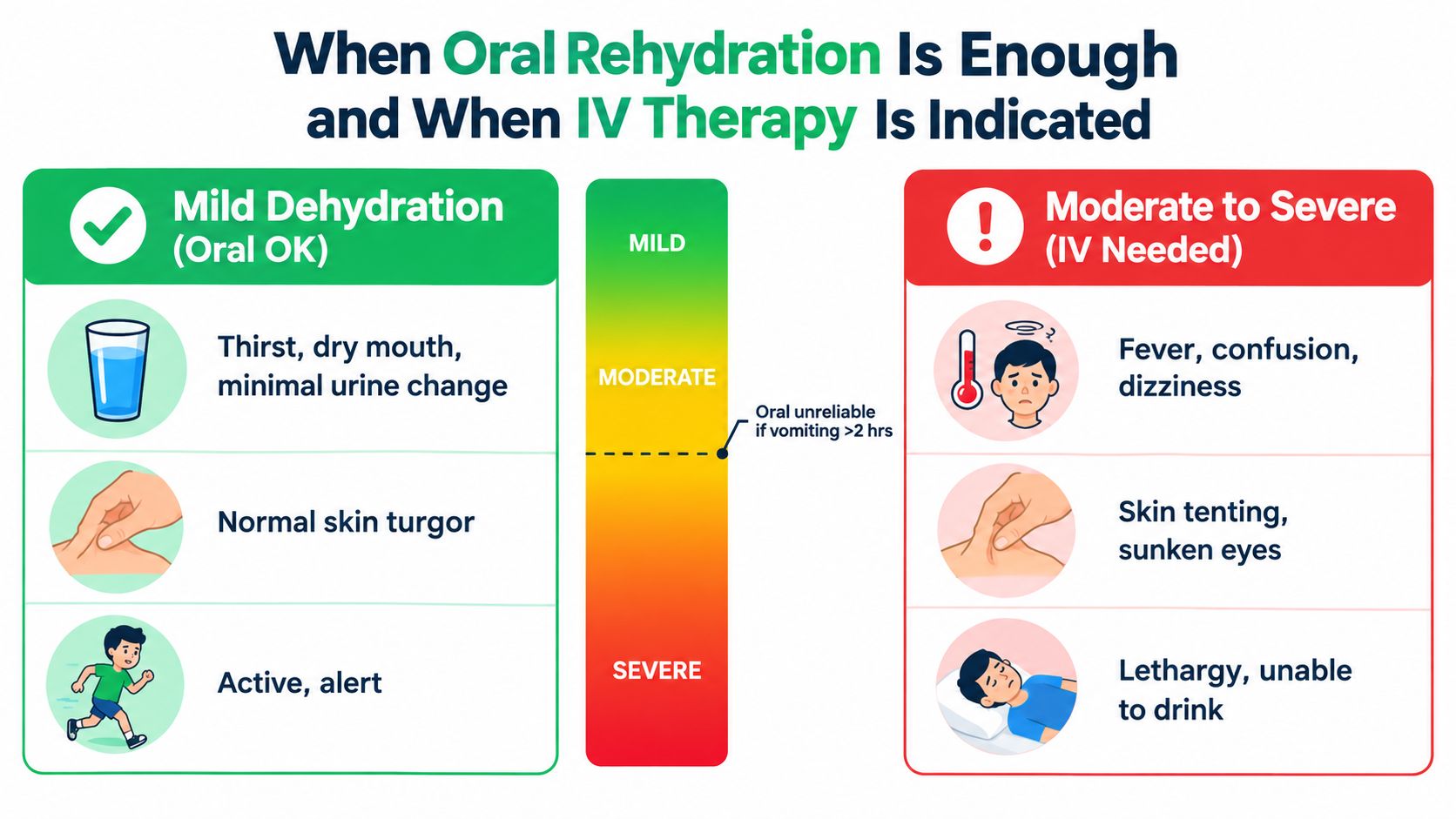
If you're alert, can sip normally, and your symptoms are mild, oral rehydration is usually the first choice. Water is helpful, but if you've lost more than plain fluid through sweat, vomiting, or diarrhoea, an oral rehydration solution may make more sense than plain water alone.
The harder cases are the middle ground. People know when they feel a bit thirsty. They usually know when someone is collapsing. What they don't know is when they've crossed from “annoying but manageable” into “drinking is no longer a reliable treatment”.
Signs that often still fit oral rehydration
These usually point to mild dehydration:
- You're thirsty but functional. You can speak, walk, and think clearly.
- Your mouth feels dry. But you can drink without nausea or repeated vomiting.
- Urine is reduced but still present. The body is conserving fluid, but not shutting down intake.
- Symptoms improve after rest and fluids. That trend matters.
In those cases, cool down, sip regularly, use oral rehydration solution if needed, and avoid jumping to a drip because it seems faster.
Signs that push toward IV assessment
Independent UAE-linked guidance says IV hydration should generally be reserved for moderate-to-severe dehydration or when oral intake isn't reliable, such as persistent vomiting, confusion, very low blood pressure, or inability to drink fluids. The same discussion matters more in summer because local reporting in 2025 described rising heat-related dehydration and heatstroke presentations, and another UAE report cited a 30 to 40% surge in summer heat-related emergency visits (Dubai IV drip safety and red-flag guidance).
That means the decision is less about comfort and more about failure of the oral route plus the presence of red flags.
Oral Rehydration vs IV Therapy Decision Guide
| Symptom Level | Best Option | Action |
|---|---|---|
| Mild thirst, dry mouth, still alert, able to drink | Oral rehydration | Rest in a cool place, take fluids slowly, monitor urine and dizziness |
| Nausea but tolerating small sips, no confusion, no collapse | Oral rehydration with closer observation | Try frequent small amounts, stop exertion, seek medical advice if worsening |
| Ongoing vomiting, worsening dizziness, unable to drink enough | IV assessment | Contact a licensed medical provider for evaluation |
| Confusion, severe weakness, very low blood pressure, fainting, suspected heatstroke | Emergency care | Go directly to emergency services |
A useful way to think about it
Oral rehydration is like topping up a tank through its usual inlet.
IV treatment is like using a direct line when the usual inlet isn't working.
That doesn't make the direct line “better”. It makes it appropriate in selected cases.
For readers comparing quick fixes, this patient-facing discussion of IV hydration versus energy drinks is helpful because it highlights that symptom relief and true rehydration aren't always the same thing.
If you can drink, absorb, and improve, start there. If you can't, the decision needs clinical judgement.
Benefits Risks and Who Should Avoid IV Therapy
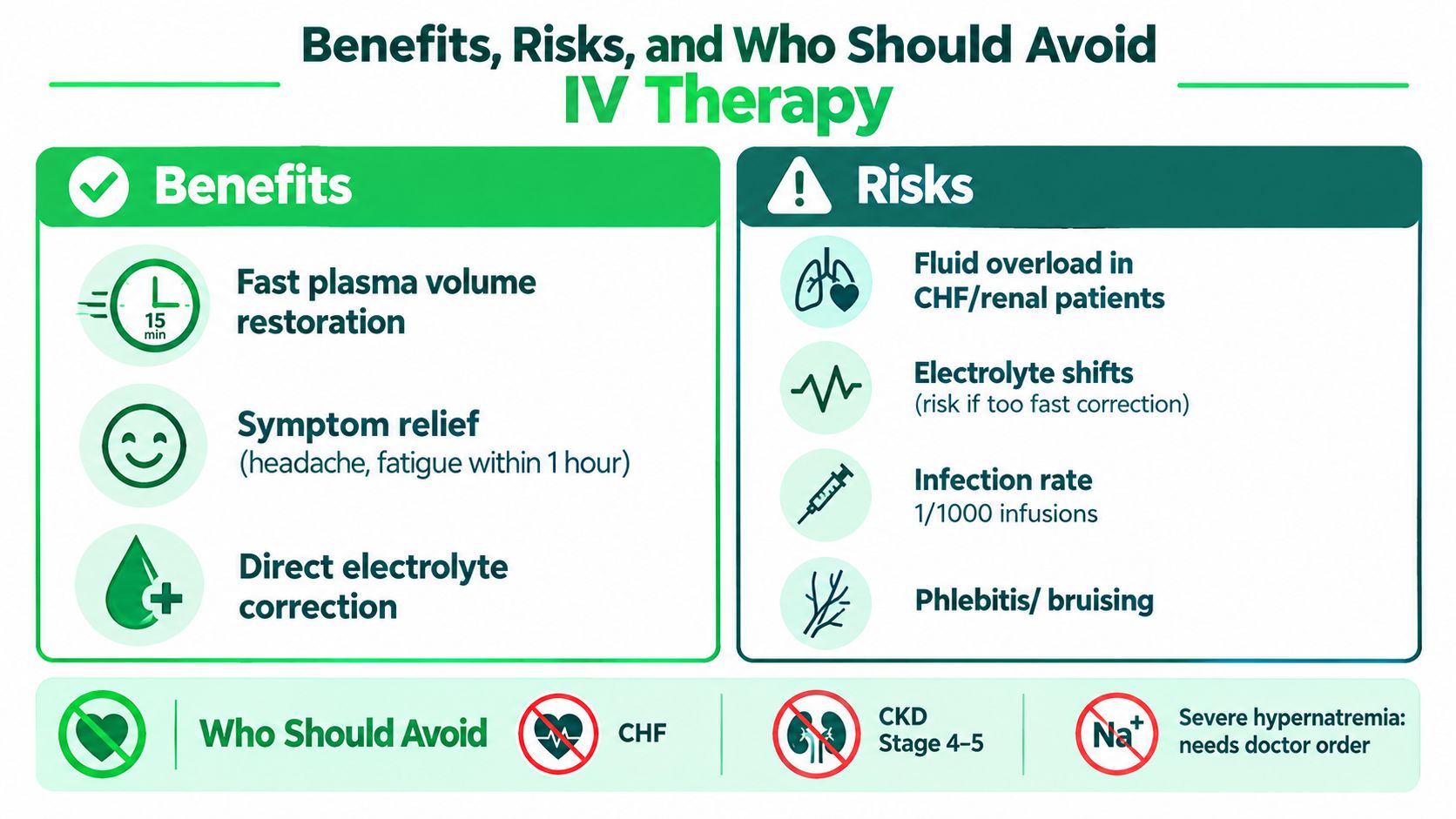
The main benefit of IV therapy for dehydration is straightforward. It gives clinicians a way to restore fluid directly into the bloodstream when the person can't reliably rehydrate by mouth or needs a more controlled response.
That can matter for a traveller with repeated vomiting, an older adult who has become weak and dizzy in the heat, or a fasting patient who has become clinically dry and symptomatic. It can also help when clinicians need to observe the person during treatment rather than advise them to drink and wait.
The benefits are real, but they're not universal
An IV may offer:
- Direct fluid delivery. Useful when the stomach isn't cooperating.
- Controlled administration. The clinician can choose the fluid and rate rather than relying on guesswork.
- Observation during treatment. Symptoms, pulse, blood pressure, and tolerance can be checked during the visit.
The risk is assuming that because a drip can be useful, it's harmless or suitable for everyone. It isn't.
The main safety concerns
IV therapy is still a medical procedure. Risks can include bruising, vein irritation, infection at the cannula site, fluid overload, and electrolyte problems if treatment is poorly selected or given too quickly. Screening matters especially for people with heart failure, kidney disease, significant blood pressure problems, or complex medical histories.
That's why provider standards matter more than lounge aesthetics. If someone is evaluating non-hospital options, this directory can help them find data-driven wellness centers, but the key questions should stay clinical: Who is assessing you, what is being infused, what monitoring is done, and what happens if you deteriorate?
Who should pause before saying yes
People who should be particularly cautious include:
- Those with heart failure because extra fluid may be hard to tolerate.
- Those with significant kidney disease because fluid and electrolyte handling may be impaired.
- Those with unexplained severe symptoms because the problem may be infection, heatstroke, low blood pressure, or another urgent condition rather than “just dehydration”.
A practical patient explainer on possible IV drip side effects can help readers ask better questions before treatment.
Home IV care should begin with assessment and consent, not a menu.
What to Expect During At-Home IV Therapy With Vitals Healthcare
A home IV visit should feel organised and clinical, not casual. The process starts before any needle appears. The first task is deciding whether the person in front of the clinician is suitable for treatment at home at all.
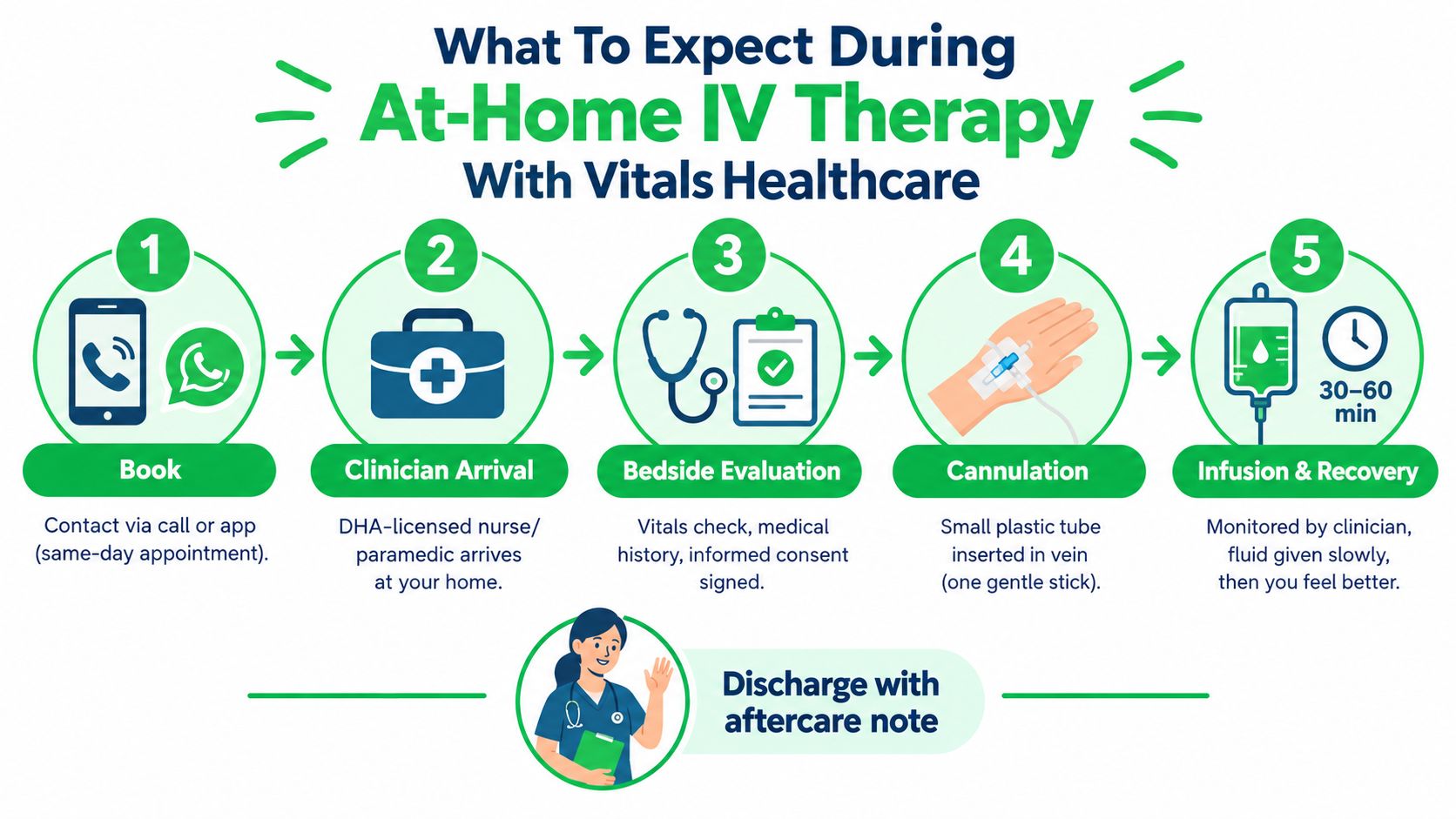
With Dubai home care services, the workflow is usually designed around speed plus screening. According to the provider information for Vitals Healthcare, visits are coordinated by phone or WhatsApp, with typical arrival in approximately 30 minutes, subject to location and demand, and coverage includes areas such as Dubai Marina, JLT, Downtown, Palm Jumeirah, Business Bay, Jumeirah Village Circle, Umm Suqeim, Al Garhoud, and Arabian Ranches.
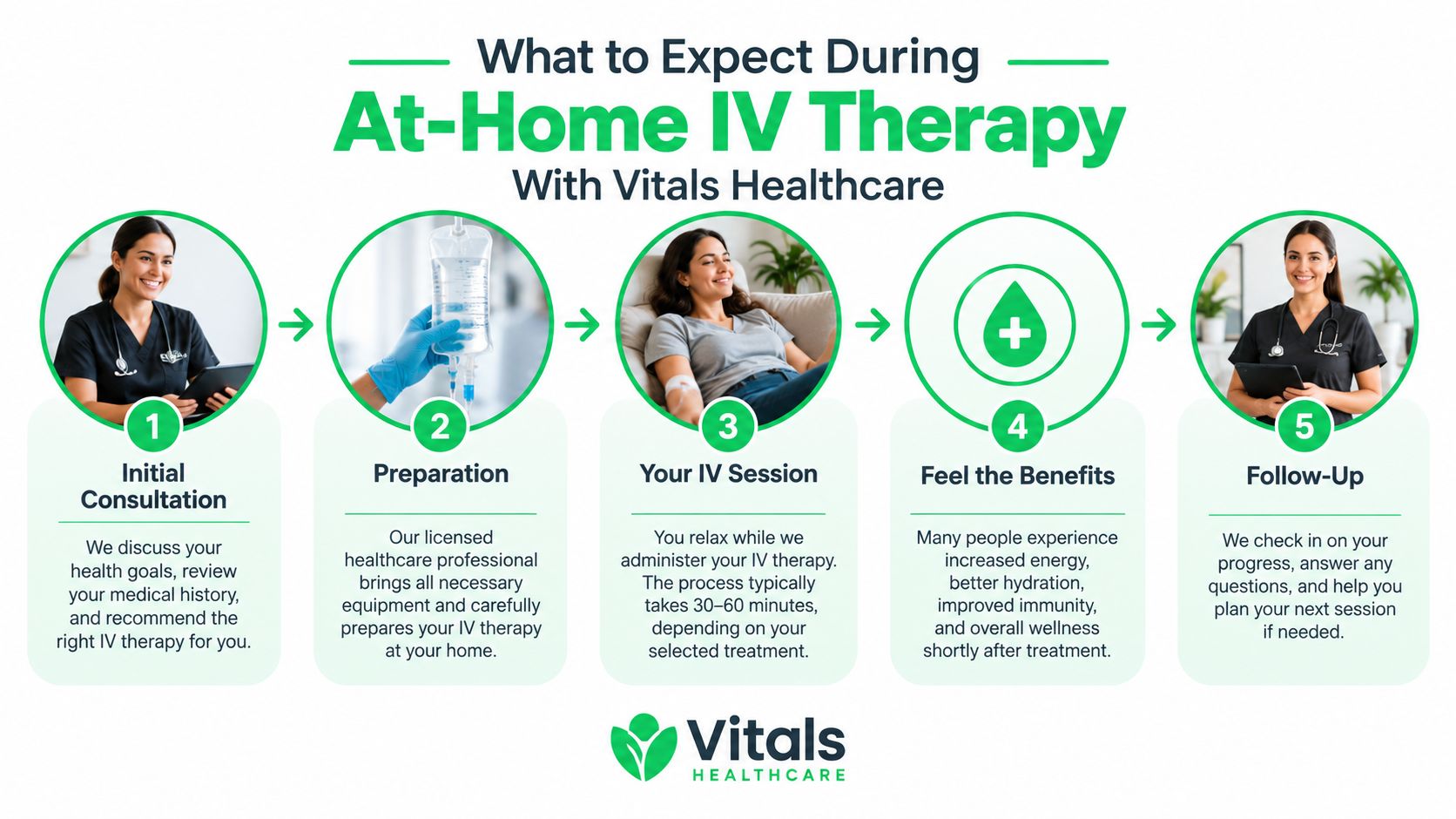
Step one to three at home
Booking comes first. The patient or family describes symptoms, location, age, and any major health conditions. This helps identify obvious red flags before dispatch.
Clinician arrival is not the treatment. It's the start of the medical assessment. A DHA-licensed nurse or paramedic arrives, confirms history, checks vital signs, and asks the questions that determine whether home care is appropriate.
Consent follows assessment. If the patient appears suitable, the clinician explains the plan, what fluid is being used, what the patient may feel, and what warning signs would stop the infusion.
What happens during the infusion
Cannulation usually means placing a small plastic tube into a vein in the hand or arm. A brief pinch is felt, then pressure or very little at all. The fluid is then given gradually while the clinician observes the patient.
During this period, they may check:
- General appearance such as alertness, colour, and sweating
- Symptoms including dizziness, nausea, headache, and weakness
- Tolerance of the IV site such as pain, swelling, or leaking
- Response to treatment such as whether the patient feels clearer or more stable
What patients should prepare
A little preparation makes the visit smoother:
- Keep your ID and medication list ready. This reduces delays and helps avoid mistakes.
- Mention chronic conditions early. Heart, kidney, endocrine, and pregnancy-related details matter.
- Stay somewhere cool and accessible. Hotel guests should tell reception if a medical visitor is arriving.
- Don't hide severe symptoms. If you're fainting, confused, or unable to stay awake, say so immediately.
For readers looking at the service pathway itself, this overview of IV home service in Dubai outlines what mobile care typically includes.
One factual point is worth keeping in view here. A home IV visit is still medical care at your location, not a replacement for an emergency department. If the bedside evaluation suggests heatstroke, shock, severe infection, or another unstable condition, transfer to higher-level care is the right outcome.
Costs Turnaround Times and Guidance for Travellers and Hotel Guests
Residents often ask about convenience. Travellers usually ask two different questions: how quickly someone can come, and whether the visit can happen discreetly in a hotel room. Both are practical concerns, especially when someone is weak, jet-lagged, vomiting, or trying not to spend hours in a waiting room.
The timing side is easier to answer than the cost side. Turnaround depends on clinician availability, traffic, distance, and whether the case is suitable for home treatment. A same-day visit may make sense for moderate symptoms in a stable patient. Red-flag symptoms should bypass that process and go straight to emergency care.
What shapes access in Dubai
Home-delivered care has grown visibly in the UAE. One market study estimated that UAE IV hydration therapy revenue was USD 13.0 million in 2025 and projected USD 25.4 million by 2033, implying a 9% CAGR from 2026 to 2033, while reporting that energy-booster infusions accounted for 27.69% of revenue in 2025. The same source also noted broader home-care uptake in the region, stating that medicine home deliveries rose 189%, from 37,724 in 2022 to nearly 109,000 in 2024, while home medical visits increased 68%, from 23,277 to 39,114 (UAE IV hydration market and home-care uptake).
Those figures help explain why travellers in Dubai can now often arrange assessment and treatment at a home, office, or hotel rather than automatically attending a clinic.
How to think about cost without guessing
The exact price of a home IV visit varies by provider, timing, formulation, distance, and whether the patient needs broader medical assessment. Since pricing changes and package details are provider-specific, the safest approach is to review the current IV hydration therapy cost information directly before booking.
For hotel guests, practical points usually matter more than the invoice:
- Discretion often means the clinician meets you in-room with minimal disruption.
- Payment options may include cash, card, or online payment depending on the provider.
- Insurance claims often depend on whether the provider can issue a usable invoice.
When travellers should skip the home visit route
Travellers sometimes wait too long because they don't want to disrupt plans. Don't delay if there is:
- Confusion or altered behaviour
- Collapse, fainting, or inability to stand
- Chest pain or breathing difficulty
- Suspected heatstroke or severe heat illness
- Persistent inability to drink at all
A hotel room is a fine place for stable treatment. It is not the right place for an unstable patient.
Making the Right Choice for Safe Rehydration
The safest way to think about dehydration is simple. Match the treatment route to the severity of the problem.
If you're mildly dehydrated and can drink, start with oral fluids and cooling down. If symptoms are stronger and the oral route isn't working, an IV may be appropriate after clinical assessment. If there are red flags such as confusion, collapse, very low blood pressure, or suspected heat illness, go to emergency care.
A short checklist helps:
- Can I drink and keep fluids down?
- Am I alert, oriented, and passing urine?
- Are symptoms improving or worsening?
- Do I have heart, kidney, or other conditions that change fluid safety?
- Is this dehydration, or could it be something more serious?
For Dubai residents and travellers, prevention still matters most. Drink early rather than late, respect heat exposure, plan around fasting, and don't ignore the first signs of dizziness and dry mouth. The earlier the correction, the less likely you are to need a drip at all.
If you need assessment for dehydration at home, in a hotel, or at the office, Vitals Healthcare Doctor On Call offers DHA-licensed mobile care across Dubai, including doctor visits, nursing support, and IV therapy when clinically appropriate. If you want to check service availability, what to expect, or whether a home visit fits your symptoms, visit Vitals Healthcare Doctor On Call .