

After a long flight into Dubai, you may feel dehydrated, tired, and tempted by the promise of a quick multivitamin IV drip in your hotel room. A mobile service offering an appointment later that day can sound convenient, especially when you have meetings, family plans, or another flight to catch.
The important question isn't whether the treatment sounds appealing. It's whether an IV infusion is clinically appropriate for you, whether the formula matches your needs, and whether a properly licensed team will assess and monitor you. In Dubai, this isn't just a wellness menu item. It's a regulated medical service.
Table of Contents
- Why People in Dubai Are Talking About Multivitamin IV Drips
- What a Multivitamin IV Drip Actually Is
- Potential Benefits and Where the Evidence Stands
- How the Procedure Works From Screening to Aftercare
- Who Should and Should Not Get a Multivitamin IV Drip
- Safety, Regulation, and DHA Licensing in Dubai
- Clinic Versus In-Home and In-Hotel IV Delivery
- Making an Informed Decision and Booking Safely
Why People in Dubai Are Talking About Multivitamin IV Drips
Interest in vitamin infusions has grown alongside Dubai's busy travel, hospitality, and professional lifestyle. Residents may be managing long working hours, visitors may be recovering from air travel, and hotel guests may prefer medical care in their room rather than a journey to a clinic. These circumstances make an in-home or in-hotel service attractive, but convenience doesn't replace clinical judgement.
Regional nutrient concerns also help explain the conversation. A historically cited Dubai-based report stated that 78% of the UAE population, including locals and expatriates, had vitamin D deficiency. That figure comes from regional reporting on vitamin injections and vitamin D deficiency, and it should be treated as historical context rather than a diagnosis for any individual. Vitamin D deficiency isn't the same as a need for a multivitamin IV drip, but it shows why micronutrient assessment has attracted attention in the UAE.
A useful way to think about the treatment
A drip may be relevant when a clinician identifies dehydration, poor absorption, or a documented deficiency. It may be less useful when someone is already eating well, absorbing nutrients normally, and is seeking a general energy lift without investigating the cause of fatigue.
That distinction will guide the rest of this article. First, you'll learn what the infusion contains and how it differs from an oral supplement. Then we'll examine what the evidence supports, how screening and administration work, who should defer treatment, and what DHA licensing means for home delivery.
Practical rule: A post-flight appointment should begin with medical triage, not with choosing a flavour or an attractive treatment name.
The safest Dubai model is clinic-grade care outside the clinic. A licensed facility, DHA-registered clinicians, documented consent, appropriate infection control, and a clear emergency pathway matter whether the infusion takes place in a medical centre, a villa, an office, or a hotel suite.
What a Multivitamin IV Drip Actually Is
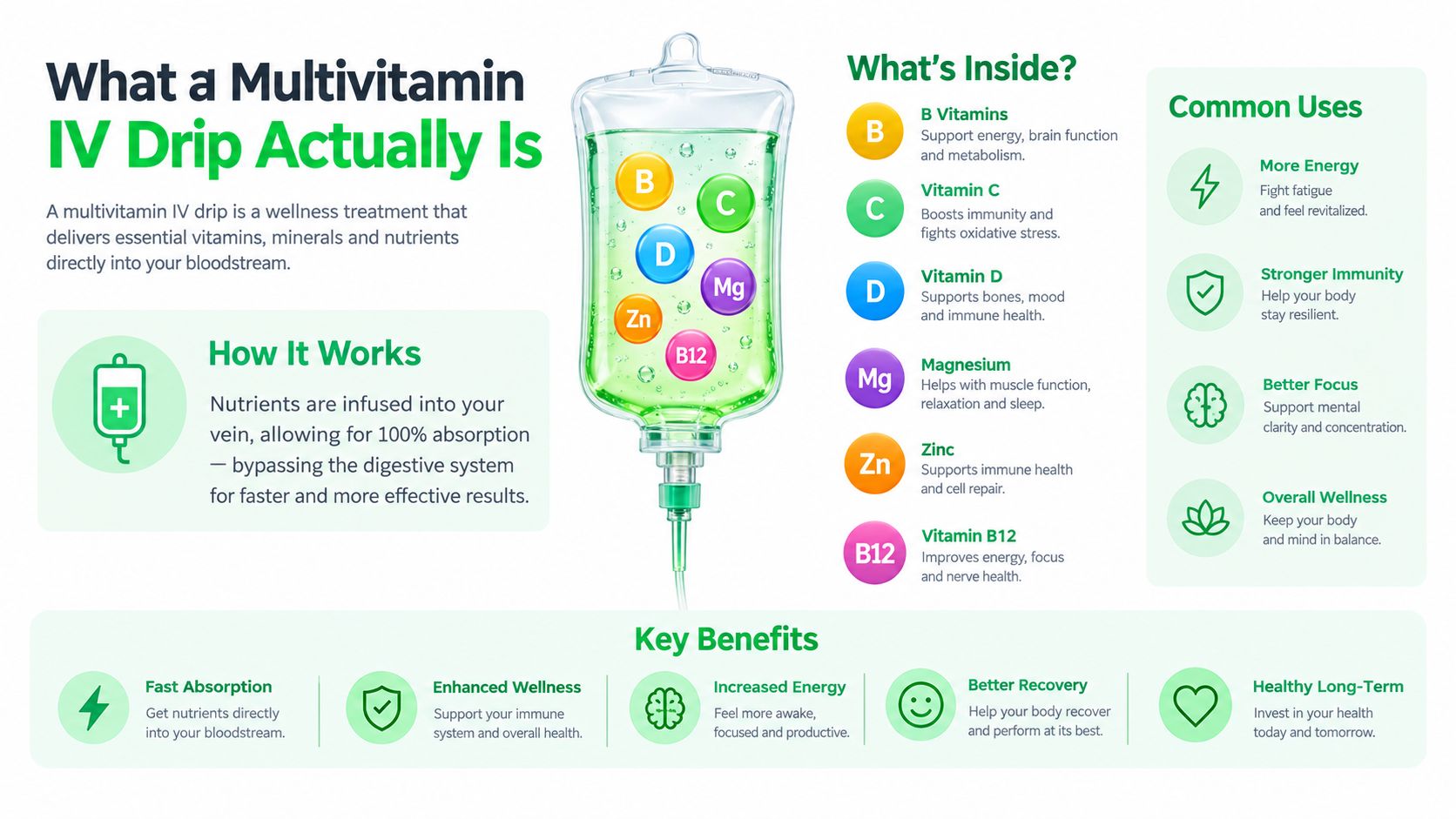
A multivitamin IV drip is an infusion of fluid containing selected vitamins, minerals, and sometimes electrolytes. A clinician connects the sterile fluid bag to a small cannula placed in a vein, allowing the solution to enter the bloodstream directly. Commonly discussed ingredients include B-complex vitamins, vitamin B12, vitamin C, magnesium, electrolytes, and, depending on the prescription, trace minerals.
The key difference from an oral supplement is the route of delivery. Oral nutrients pass through the digestive system before entering circulation. An IV infusion bypasses the gut, which can matter when a patient has malabsorption, severe nausea, or another reason that oral intake isn't working adequately. It doesn't automatically make the treatment necessary or better for someone whose digestive system is absorbing nutrients normally.
A simple analogy helps. An oral supplement is like sending a parcel through a sorting centre, where several stages affect what arrives. An IV infusion sends the contents directly into the circulation, so the clinician must be more careful about the contents, dose, rate, and patient's medical history.
Terms that often cause confusion
You may hear Myers cocktail used to describe a particular style of vitamin and mineral infusion. The exact ingredients and amounts can vary, so the name alone doesn't tell you whether a formula is appropriate. “IV vitamin therapy” is the broader category.
That category can include a multivitamin infusion, a hydration-focused drip, NAD+ infusions, or high-dose vitamin C protocols. These aren't interchangeable. Each has different ingredients, potential indications, and screening requirements. If you want to understand why digestion affects nutrient availability, a plain-language guide to gut health can provide useful background before you discuss IV treatment with a clinician.
Potential Benefits and Where the Evidence Stands
The strongest rationale for intravenous micronutrients is a defined medical need, not a generic promise of feeling better. Clinicians may consider IV delivery when a patient has severe dehydration, malabsorption, or a documented deficiency and oral replacement isn't suitable or sufficient. In those situations, the infusion supports a specific care plan.
Hydration is a common reason people ask about drips after travel, illness, heat exposure, or vomiting. Fluids can address dehydration when a person can't maintain oral intake, but an IV bag shouldn't be treated as a universal cure for jet lag. Jet lag also involves disrupted sleep and circadian timing, which vitamins alone won't necessarily correct.
Fatigue requires similar caution. A B-vitamin-containing formula may be relevant when a deficiency contributes to symptoms, but tiredness can also result from anaemia, thyroid disease, infection, poor sleep, medication effects, or psychological strain. Reading about energy vitamins for gut health may help explain the role of oral nutrition, but it shouldn't replace an assessment of persistent fatigue.
Matching popular claims to clinical reasoning
- Energy support: A deficiency-directed infusion may help correct a nutritional problem. Evidence is much less convincing for a noticeable energy benefit in an already well-nourished adult.
- Immune support: Nutrients are involved in normal immune function, but that doesn't prove that a routine multivitamin drip prevents infection or “boosts” immunity beyond correcting a deficiency.
- Skin radiance: Hydration can affect how someone feels and looks temporarily, while aesthetic claims about vitamin infusions remain limited and formulation-dependent.
- Athletic recovery: Fluids and electrolytes may have a role in selected situations, but an infusion isn't a substitute for sleep, food, training adjustments, or evaluation of an injury.
- Hangover relief: A drip may be considered when dehydration is clinically significant, but it doesn't remove alcohol-related risks or repair sleep loss.
- Documented deficiency: This is the clearest use case, provided testing and clinical assessment support the prescription.
Dubai's history of attention to vitamin D deficiency gives micronutrient therapy legitimate regional relevance. It doesn't, however, turn every wellness claim into an evidence-based indication. Readers can also review the discussion of vitamin IV therapy benefits while keeping the central question in view: what problem is the infusion treating?
How the Procedure Works From Screening to Aftercare
A safe appointment begins before the nurse arrives. During a phone or telehealth conversation, the clinician should ask about your symptoms, medicines, allergies, previous reactions, pregnancy or breastfeeding, kidney and heart history, and the reason you're considering an infusion. A request for a specific “cocktail” shouldn't bypass that review.
Four stages of a clinical pathway
1. Assessment and consent. The clinician reviews the proposed formula, explains expected benefits and limitations, discusses alternatives, and obtains informed consent. Vital signs and vein suitability should be checked, and the indication should be documented rather than assumed.
2. Preparation. The team verifies the prescription, checks the ingredients, prepares a clean treatment area, and uses sterile, single-use equipment. A DHA-licensed nurse places the cannula or butterfly line, usually in an arm vein, and controls the flow by gravity or pump according to the prescription.
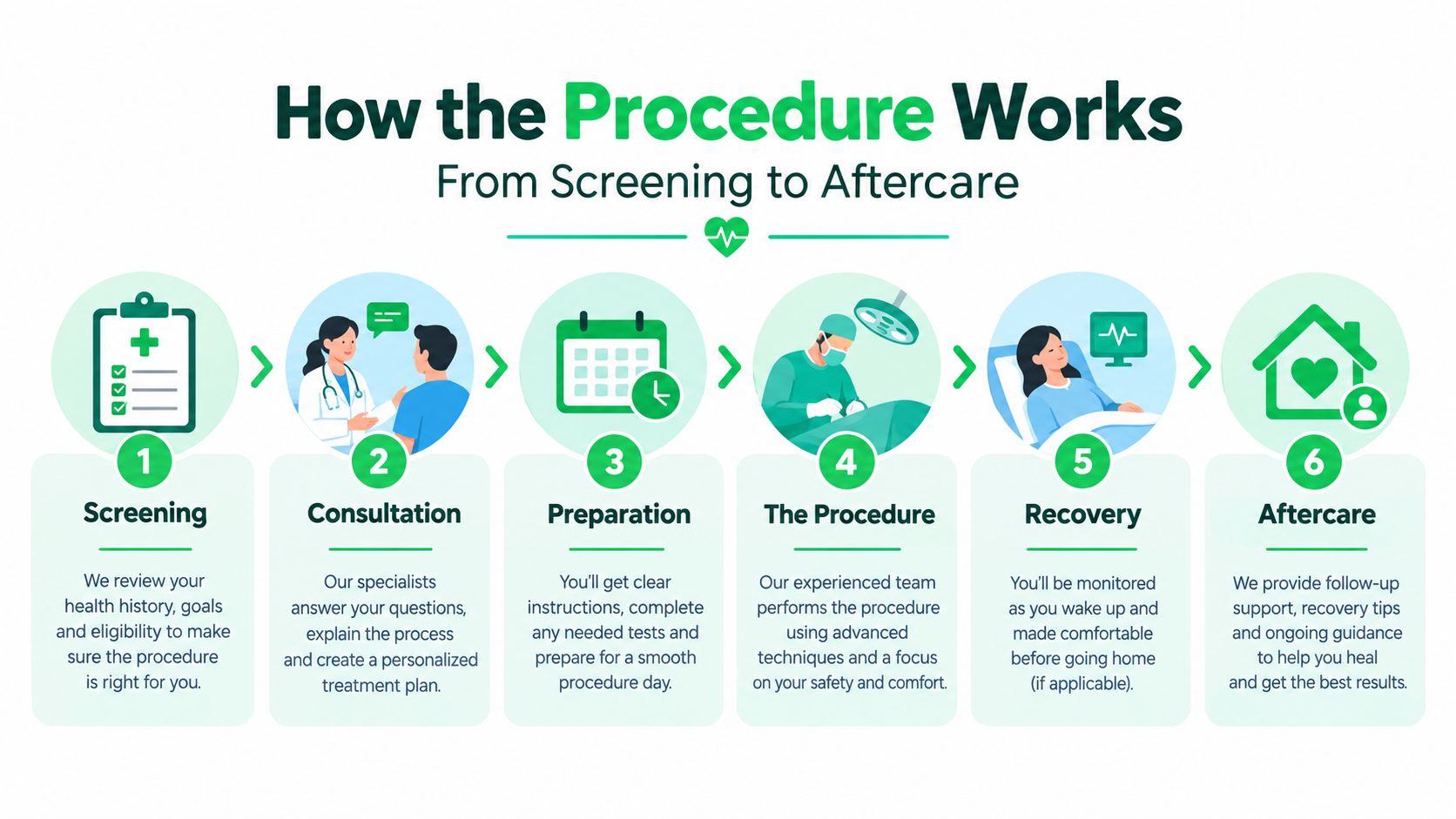
3. Infusion and observation. Many infusions take roughly 30 to 60 minutes, although the duration depends on the formulation and clinical decision. You may notice the needle prick, pressure at the insertion site, or a temporary warm or cool sensation. Tell the nurse immediately about dizziness, flushing, pain, swelling, breathlessness, or feeling unwell.
4. Removal and follow-up. The clinician removes the line, applies a dressing, records the medication and response, and explains what to watch for. A repeat infusion shouldn't be scheduled automatically. If treatment was linked to a suspected deficiency, follow-up bloodwork may be more useful than repeated empiric dosing. Home testing and sample collection can be discussed through blood tests at home in Dubai.
The aftercare advice should be individualised. Ask when to remove the dressing, which activities to avoid, how to manage a sore insertion site, and whom to contact if symptoms develop. If you experience severe breathlessness, collapse, widespread swelling, or signs of a serious allergic reaction, seek urgent medical help rather than waiting for a routine callback.
Who Should and Should Not Get a Multivitamin IV Drip
The best candidate is not just someone who feels tired. It's a patient whose history, examination, and, when appropriate, blood tests give the clinician a defensible reason to consider intravenous replacement.
That may include a person with a documented micronutrient deficiency, clinically significant dehydration, or a condition that limits absorption. Patients recovering from illness or surgery may sometimes need nutritional support, but the infusion should fit into the wider medical plan. Severe morning sickness and post-bariatric or coeliac-related malabsorption require particular clinical oversight rather than an elective wellness booking.
Situations that require caution
Some people should avoid or defer an elective infusion until a clinician has cleared it. High-dose vitamin C preparations require special attention in people with G6PD deficiency, because an undiagnosed deficiency can lead to haemolysis. Kidney disease can affect how fluids and nutrients are handled, while heart failure can make additional fluid volume unsafe.
Pregnancy and breastfeeding require explicit clinician review, especially for elective formulas. A history of allergy, current chemotherapy, uncontrolled blood pressure, or significant heart disease also needs disclosure. Children and older adults may need age-specific assessment, dosing, and monitoring. Recent oral supplements can make an infusion unnecessary or increase the risk of excessive intake, even when they don't create an immediate emergency.
| Likely Candidates | Avoid or Defer Until Cleared |
|---|---|
| Patients with a documented deficiency | People with G6PD deficiency when high-dose vitamin C is proposed |
| Patients with clinically assessed dehydration | People with active or chronic kidney disease |
| Patients with malabsorption under medical care | People with heart failure or significant fluid restrictions |
| Selected post-illness or post-surgical patients | Pregnancy or breastfeeding without clinician approval |
| Patients whose symptoms have been medically evaluated | Known ingredient hypersensitivity or unreviewed chemotherapy |
A useful decision rule is simple: identify the indication, disclose the risks, verify the formula, and accept treatment only after a clinician has cleared it. The potential side effects of IV drips deserve as much attention as the advertised benefits.
Safety, Regulation, and DHA Licensing in Dubai
Dubai treats IV vitamin therapy as a medical infusion. Under the regulatory framework described by the Dubai IV vitamin therapy guidance, the Dubai Health Authority is the emirate's sole healthcare regulator under Law No. 6 of 2018. A lawful provider must hold a valid DHA facility licence, and the clinicians administering the treatment must be DHA-registered.
That requirement matters because a mobile appointment is still healthcare. The setting changes, but the duty to assess, obtain consent, control infection risk, document medications, and prepare for escalation remains. Dubai Municipality separately regulates the registration and licensing of health supplements in the market, which is not the same as authorising a clinician to administer an IV infusion.
What licensing should mean for the patient
A compliant provider should be able to explain:
- Facility status: Which licensed healthcare facility is responsible for the service?
- Clinician credentials: Is the prescribing or administering professional DHA-registered?
- Clinical review: Who assesses contraindications before the nurse starts?
- Traceability: Are the ingredients, prescription, batch details, and administration recorded?
- Emergency readiness: What happens if the patient develops a severe reaction or becomes unstable?
- Infection control: Are cannulas, dressings, and other supplies sterile and single-use?
Informal services may present IV therapy as a casual convenience product without showing who prescribed it, how the ingredients were prepared, or how complications would be managed. That creates avoidable risks, including poor traceability and delayed escalation. A regulated service should be able to show how home care remains connected to clinical supervision.
A patient considering IV treatment in Dubai should use licensing as the first filter. Price, branding, hotel availability, and a long treatment menu come later.
For pregnancy, readers may also encounter products such as prenatal DHA supplements. An oral prenatal product isn't equivalent to an IV formula, so pregnancy-related nutrition should be reviewed with the responsible obstetric clinician rather than selected from a general drip menu.
Clinic Versus In-Home and In-Hotel IV Delivery
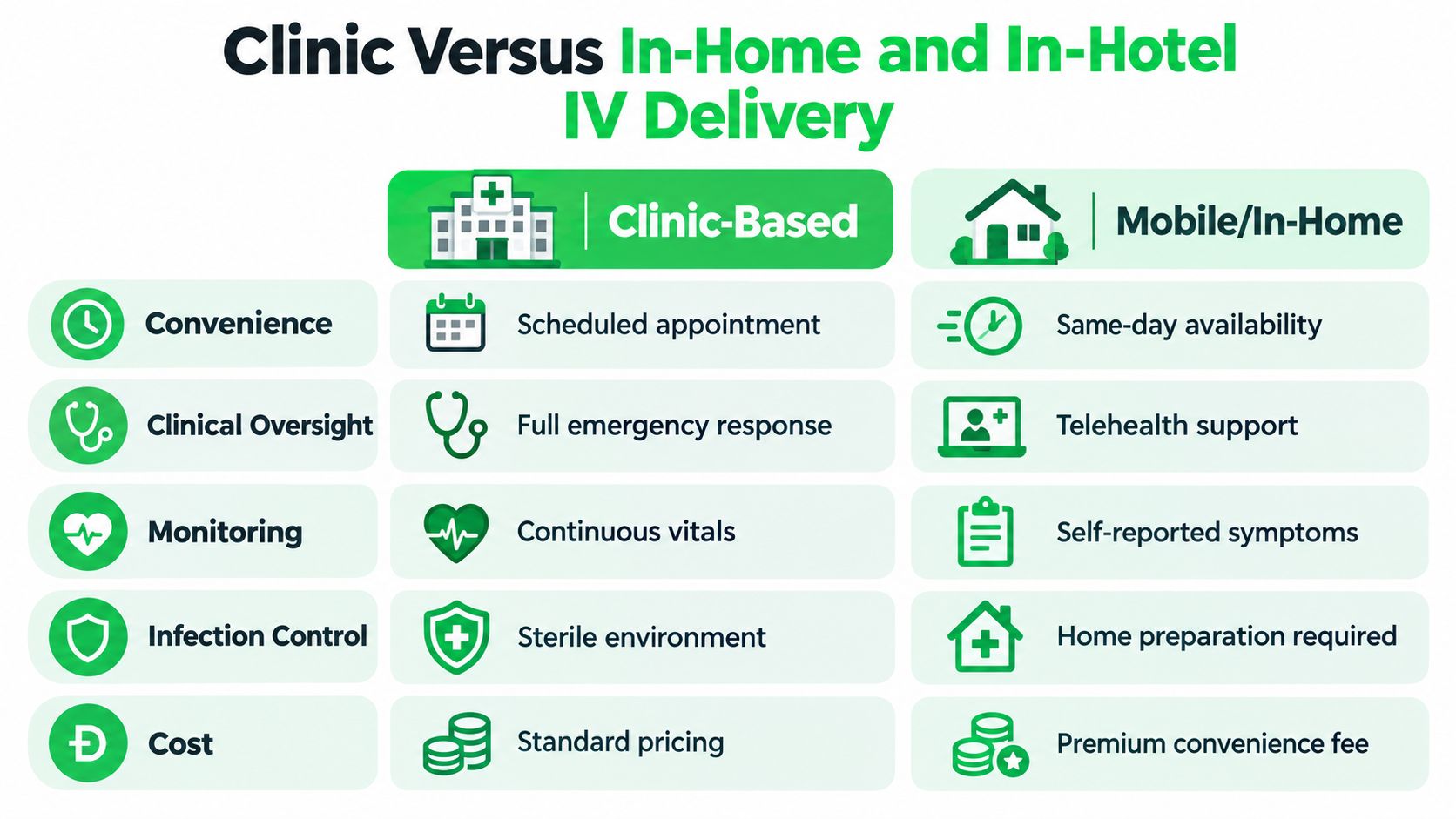
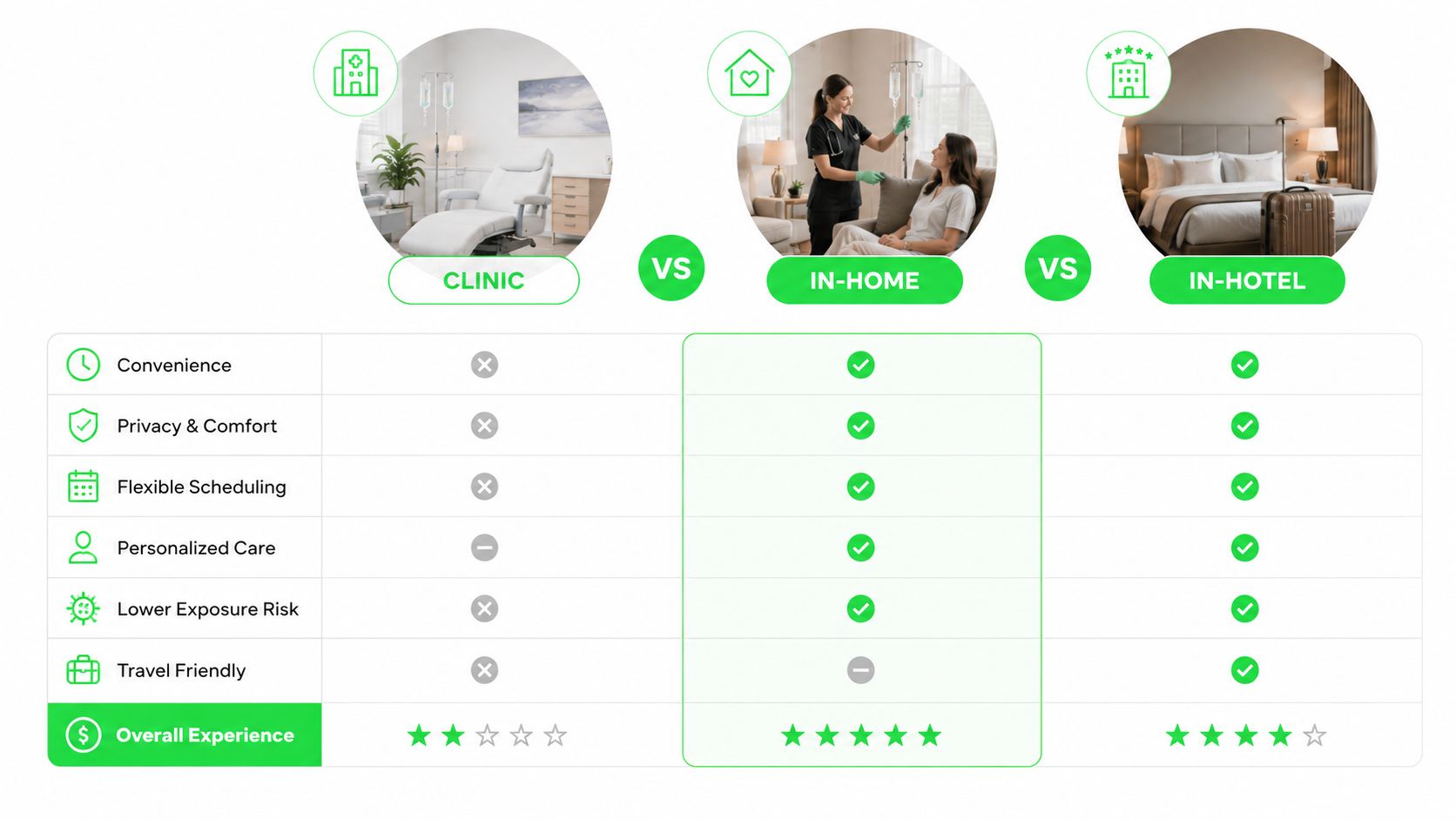
A clinic usually offers the most controlled environment for a first infusion, a complex medical history, or a situation where laboratory testing and broader assessment may be needed. Staff, equipment, and escalation pathways are already located in one place. That can make a clinic the sensible choice even when a home visit would be more convenient.
In-home and in-hotel delivery can be appropriate after screening has established that the patient is suitable. It may help a traveller who has difficulty leaving a hotel, a person with limited mobility, or a busy professional who needs care at an apartment or office. The destination still needs to be assessed, and the team should know how to access the building and arrange emergency support if required.
The practical comparison
| Consideration | Clinic-based care | In-home or in-hotel care |
|---|---|---|
| Convenience | The patient travels to a scheduled appointment | The clinical team travels to the patient |
| Oversight | Broader on-site clinical resources may be available | Remote physician support and mobile protocols should be established |
| Monitoring | A controlled treatment environment | Monitoring takes place in the prepared room |
| Infection control | The facility controls the treatment area | The team must create a clean area using sterile supplies |
| Best fit | First-time, complex, or higher-risk assessments | Cleared patients who need location-based convenience |
Traffic, parking, building access, and hotel privacy can affect the experience in Dubai, whether the destination is an apartment in Downtown, a villa in Emirates Hills, or a hotel suite in Marina or Business Bay. Those logistical details matter, but they shouldn't decide whether treatment is medically appropriate.
A DHA-licensed mobile team should carry appropriate emergency equipment, use sterile single-use supplies, document the infusion, and maintain access to physician oversight. The patient should still report symptoms promptly instead of assuming that a home visit is less serious than a clinic appointment.
For eligible patients, IV home service in Dubai can reduce travel without removing the need for screening. The choice is medical first and logistical second.
Making an Informed Decision and Booking Safely
Before booking, write down the reason you want an infusion in one sentence. “I'm recovering from medically assessed dehydration” is more useful than “I want a wellness boost.” If fatigue, dizziness, weakness, or poor concentration has persisted, ask whether you need an assessment for an underlying cause rather than an immediate drip.
Questions to ask before consent
- What is the indication? Ask what problem the infusion is intended to address and whether testing or an examination is needed first.
- What is in the bag? Request the ingredient list, prescribed amounts, and an explanation of why each component is included.
- Who is responsible? Confirm the facility licence and the DHA registration of the clinician who assesses and administers treatment.
- How are risks managed? Ask about allergy screening, infection control, observation during the infusion, and emergency escalation.
- What happens afterwards? Clarify the record you'll receive, follow-up advice, and whether repeat bloodwork is appropriate.
Routine weekly drips shouldn't become an automatic habit without clinical justification. Repeated exposure can increase formulation and dosing concerns, particularly when fat-soluble vitamins such as A, D, E, and K may accumulate in tissue. The Dubai IV drip safety guidance emphasises that safe treatment depends on patient screening, dose selection, ingredient choice, and medical supervision.
A safe booking workflow is therefore straightforward. Complete the pre-screening thoroughly, provide a full medication and supplement list, disclose kidney or heart problems, mention pregnancy or breastfeeding, and ask whether G6PD testing is needed for the proposed formula. Don't let a same-day appointment pressure you into skipping consent or accepting an unexplained ingredient blend.
Vitals Healthcare offers DHA-licensed clinicians for home healthcare, including doctor visits, lab collection, nursing, and IV hydration or multivitamin therapy at homes, hotels, and offices in Dubai. Consider any provider by the same standards: verified credentials, clear clinical responsibility, documented screening, sterile equipment, monitoring, and a credible escalation plan.
Use this final checklist before confirming:
- Indication: Do I understand why I'm being offered the infusion?
- Formula: Have I reviewed every ingredient with a clinician?
- History: Have I disclosed allergies, medicines, pregnancy status, kidney and heart conditions?
- Credentials: Is the facility licensed and is the clinician DHA-registered?
- Follow-up: Do I know what to do if symptoms develop?
If you're considering a multivitamin IV drip in Dubai, Vitals Healthcare Doctor On Call offers DHA-licensed doctor assessments and home, hotel, or office IV therapy after clinical screening. Visit Vitals Healthcare Doctor On Call to request an assessment and discuss whether location-based care is appropriate for your situation.