
IV hydration is highly effective and beneficial for clinically significant dehydration or when oral intake is impossible, with an initial approach sometimes using approximately 10–20 mL/kg over 1–2 hours. It isn't a necessary or risk-free wellness treatment for mild dehydration in a healthy person who can drink safely.
That distinction matters in Dubai, where a drip can be marketed as a quick answer to fatigue, jet lag, a hangover, or "low energy". Intravenous fluid is not enhanced water. It enters the bloodstream directly, bypassing the body's normal gastrointestinal controls, so the fluid type, volume, additives, and infusion rate must match a clinical need.
The right question isn't only, “Does IV hydration work?” It is, “What is causing the symptoms, and is intravenous treatment safer or more appropriate than drinking?” A DHA-licensed clinician should assess that before cannulation, particularly when heat exposure, vomiting, diarrhoea, medical conditions, or medication use may be involved.
Table of Contents
- The Clinical Reality Behind the IV Hydration Trend
- When Intravenous Fluids Are Medically Necessary
- Oral Rehydration Versus Intravenous Therapy
- Safety Risks and Contraindications of IV Drips
- Recognising Red Flags That Require Urgent Care
- What to Expect from a Licensed Home IV Therapy Visit
- Frequently Asked Questions About IV Hydration
The Clinical Reality Behind the IV Hydration Trend
Social media often presents IV drips as a flawless shortcut to better health. A person feels tired, receives fluids mixed with vitamins, and leaves believing that the infusion has “reset” the body. That story overlooks an important clinical fact: intravenous treatment is an invasive medical intervention, not a harmless lifestyle accessory.
Fluids delivered through a vein avoid the digestive system and reach the circulation directly. That can be valuable when the body needs rapid fluid replacement or when the patient can't keep fluids down. It also means that an inappropriate volume or formulation can create problems that wouldn't occur from drinking an appropriate amount of fluid.
Dubai's regulatory context reinforces this distinction. The Dubai Health Authority regulatory framework requires healthcare facilities and clinicians providing healthcare services to operate within appropriate licensing and registration arrangements. DHA guidance also indicates that IV access should be established only when IV treatment is clinically required.
What the drip can and cannot do
IV hydration can help when dehydration is clinically significant, oral fluids can't be tolerated or absorbed, or rapid replacement is medically necessary. Persistent vomiting, diarrhoea, or heat-related illness may create circumstances in which a clinician needs to restore circulating volume while monitoring the patient's response.
It doesn't automatically improve health merely because the bag contains vitamins or electrolytes. If a healthy person has mild thirst and can drink without difficulty, an infusion adds the risks of venous access and fluid administration without a clear clinical advantage. Symptoms may also improve because the person rests, stops losing fluid, or recovers naturally, not necessarily because of a vitamin additive.
Clinical rule: A drip should answer a medical problem. It shouldn't be used to create the appearance of a medical solution where assessment shows that oral fluids are sufficient.
Patients considering whether IV drips are worth it should therefore look beyond convenience and ask who will assess them, who will administer the treatment, and what safety plan is in place if symptoms suggest something more serious.
When Intravenous Fluids Are Medically Necessary
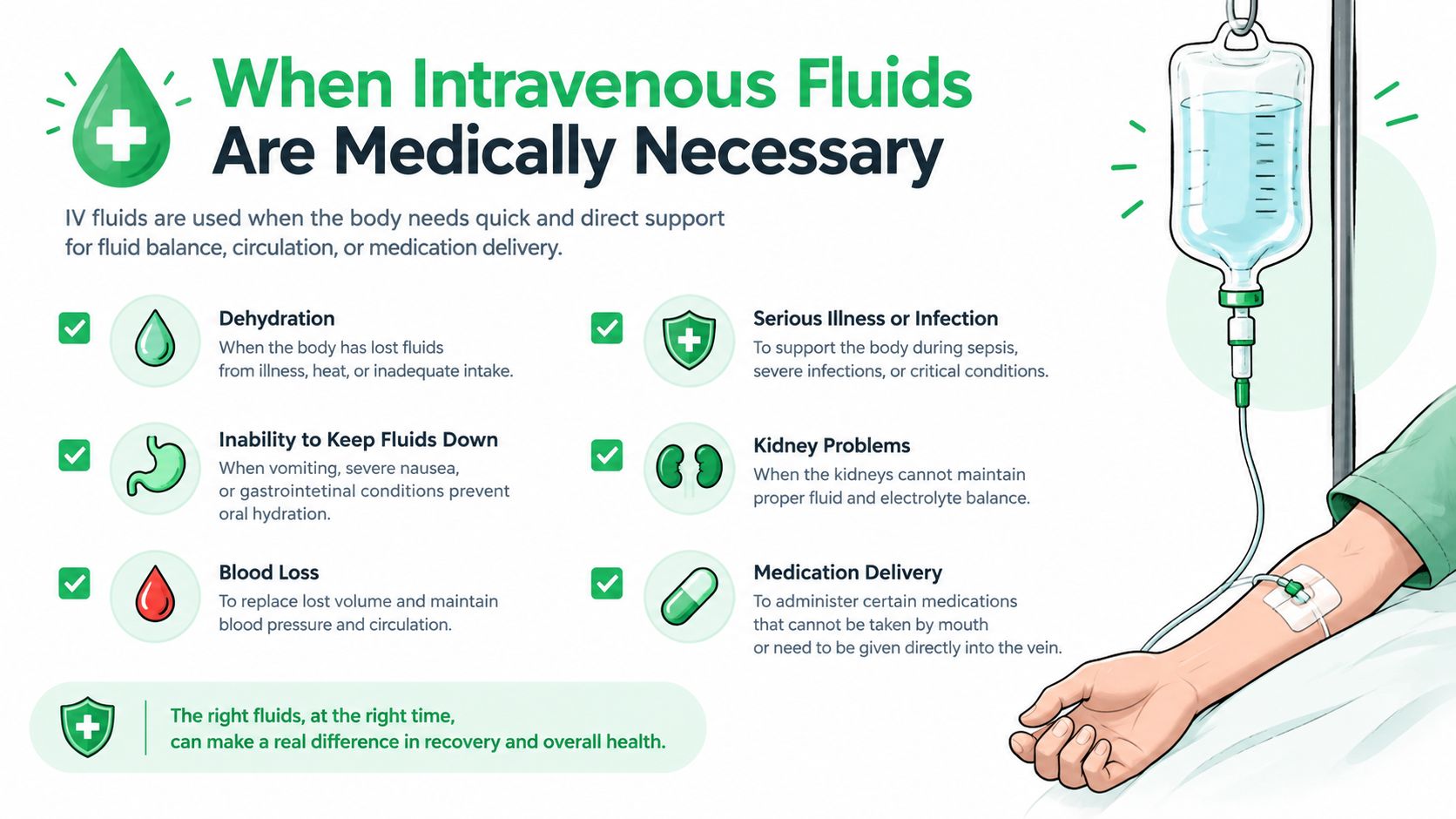
IV fluids are medically necessary only when assessment shows that oral replacement is unsafe, ineffective, or too slow for the patient's condition. An alert person who can swallow and retain fluids may often be managed with oral fluids or an appropriate oral rehydration solution. Ongoing losses, impaired intake, or signs of circulatory compromise may require a clinician to consider intravenous access.
This is a clinical decision, not a choice from a fixed wellness menu. A DHA-licensed clinician should assess symptoms, hydration status, blood pressure, heart rate, urine output, body weight, medical history, medications, and the likely cause of fluid loss before selecting a fluid and administration rate.
Situations that may justify IV treatment
- Persistent vomiting: Repeated vomiting can prevent oral fluids from staying down long enough to restore hydration. The clinician must investigate the cause rather than treating the infusion as the complete solution.
- Significant diarrhoea: Continued gastrointestinal losses can reduce circulating volume and disrupt electrolytes. IV therapy may be considered when oral replacement cannot keep pace or is not tolerated.
- Inability to drink: Reduced consciousness, severe nausea, marked weakness, or another condition can make oral intake unsafe or ineffective. Reduced consciousness may require emergency escalation, not a routine home infusion.
- Heat-related illness: Dubai's heat can cause substantial fluid loss. Confusion, collapse, or severe systemic symptoms require urgent evaluation rather than a wellness drip. Dubai-specific service considerations are outlined in Dubai IV treatment guidance.
- Clinically significant dehydration: IV fluids may be appropriate when dehydration affects circulation or oral replacement has failed. The patient's response must be checked throughout treatment.
Why isotonic fluids are commonly considered
For volume replacement, clinicians generally use isotonic crystalloids, including 0.9% saline or Ringer's-type solutions. Their composition is closer to plasma, supporting intravascular volume expansion without the rapid osmotic shifts associated with hypotonic fluids.
The UAE-aligned starting range introduced earlier is only a starting point. Heart failure, kidney impairment, abnormal electrolytes, pregnancy, age, medications, and the cause of fluid loss can all change the appropriate fluid and rate. Further clinical context is available in IV therapy for dehydration, but no general protocol replaces individual assessment.
Reassessment determines whether treatment is working. The clinician should check blood pressure, symptoms, urine output, and overall condition during and after administration. If these do not improve, the patient may need diagnostic tests, treatment for the underlying illness, or hospital care.
Oral Rehydration Versus Intravenous Therapy
For mild dehydration, drinking is usually the safer starting point when the person is alert and able to swallow. The gastrointestinal tract regulates the absorption of fluid and electrolytes, while oral rehydration solutions provide a structured way to replace both when plain water alone may not address fluid losses adequately.
IV treatment bypasses that process. This makes it useful when oral intake fails, but bypassing the gut isn't automatically an advantage. It removes a layer of physiological control and introduces a needle, a fluid line, and the possibility of administering the wrong amount or composition.
The comparison below provides a practical starting framework. It isn't a substitute for assessment, especially when symptoms are severe, unusual, or worsening.
Oral Rehydration vs IV Therapy Decision Matrix
| Clinical Indicator | Oral Rehydration | Intravenous Therapy |
|---|---|---|
| Alert and able to drink safely | Usually the first option. Take fluids gradually and consider an appropriate oral rehydration solution when fluid and electrolyte losses are present. | Usually unnecessary unless a clinician identifies another indication. |
| Mild thirst or mild dehydration | Appropriate for many otherwise healthy people who can retain fluids. | Adds cannulation and fluid-administration risks without an automatic benefit. |
| Nausea but able to keep small amounts down | Small, frequent sips may be reasonable, with clinical advice if symptoms persist. | May be considered if oral intake fails or dehydration becomes clinically significant. |
| Persistent vomiting or substantial diarrhoea | May be inadequate if losses continue or fluids cannot be retained. | A clinician may recommend IV replacement while assessing the cause and severity. |
| Confusion, collapse, or suspected serious heat illness | Not a situation for self-treatment with drinks alone. | Requires urgent medical escalation. IV fluids may form part of broader emergency care. |
| Heart failure, severe renal impairment, or electrolyte concerns | Still requires personalised medical guidance about fluid intake. | Requires careful screening and individualised prescribing because excess fluid can cause harm. |
Choosing the least invasive effective option
If you can drink safely, oral fluids avoid venous-access complications such as infiltration, phlebitis, and local infection. They also allow the body to regulate absorption rather than receiving a prescribed volume directly into circulation.
An IV drip with electrolytes may be appropriate when the clinical assessment shows that oral replacement is not feasible or hasn't worked. It shouldn't be selected just because it feels faster or more premium.
A useful decision sequence is straightforward:
- Check safety first. Are you alert, able to swallow, and keeping fluids down?
- Consider the losses. Are vomiting, diarrhoea, heat exposure, or another illness continuing?
- Look for severity. Are there signs of poor circulation, confusion, collapse, or severe weakness?
- Escalate appropriately. If red flags are present, seek urgent care instead of arranging a convenience infusion.
Safety Risks and Contraindications of IV Drips
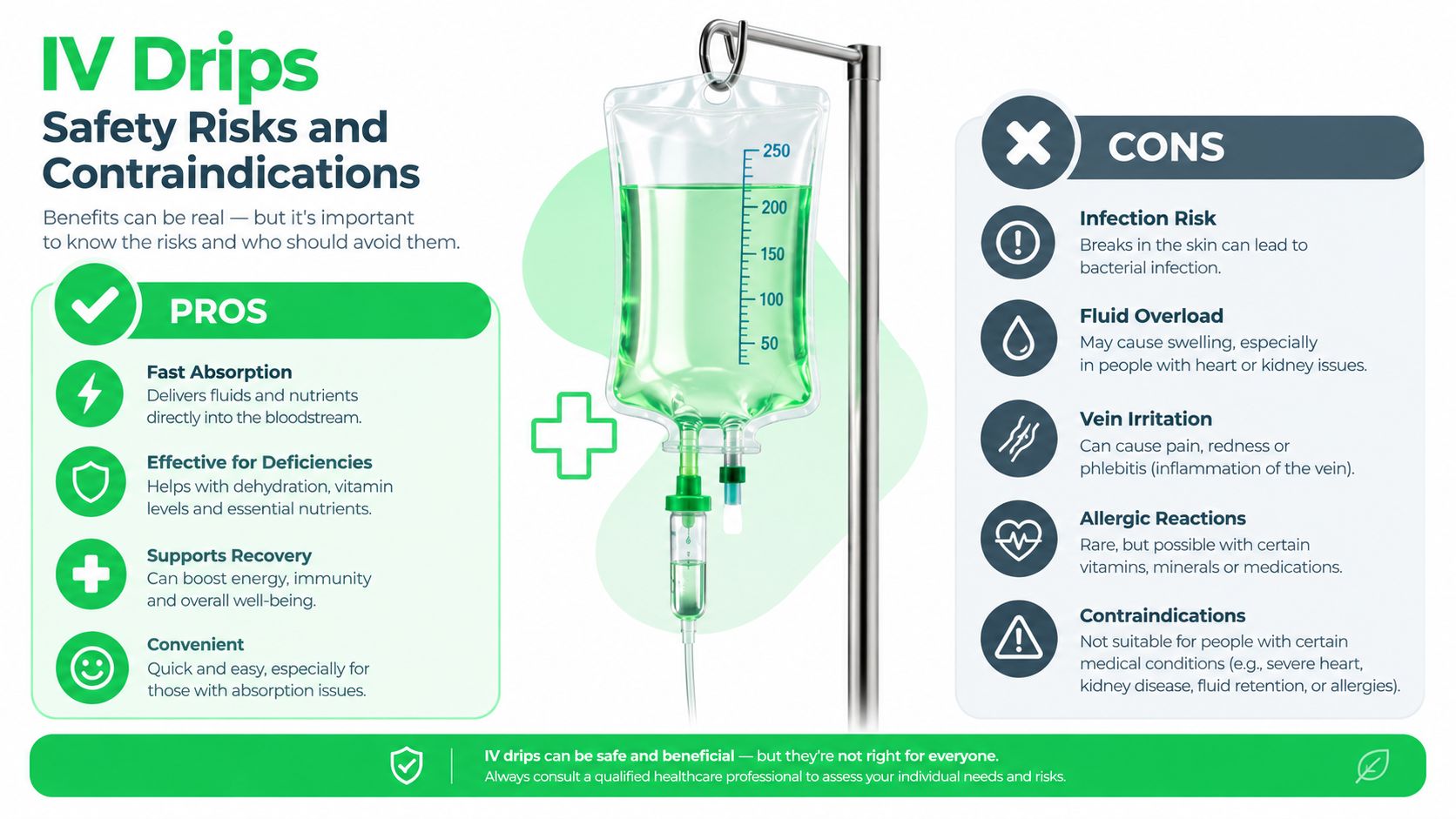
The main safety concern is direct delivery into the circulation. If the volume, composition, or rate is wrong, the patient cannot stop absorption in the way they can stop drinking. This is why a legitimate service begins with a clinical assessment, not with a choice from a colourful drip menu.
Fluid overload is particularly important for people with heart failure or severe renal impairment, because their bodies may not handle additional fluid normally. Electrolyte disturbances can also worsen when a formulation is given without considering existing laboratory abnormalities, medication interactions, or the underlying cause of dehydration.
Screening must come before cannulation
Before treatment, a DHA-licensed clinician should document:
- The indication: Why is IV treatment being considered, and what has made oral replacement unsuitable?
- Medical history: This should include cardiovascular and renal conditions, known electrolyte abnormalities, pregnancy status, and relevant chronic illnesses.
- Medicines and allergies: Prescribed medicines, supplements, previous reactions, and allergies can affect the choice of fluid or additive.
- Baseline observations: Blood pressure, heart rate, temperature where relevant, symptoms, and general hydration status help establish a safe starting point.
- The escalation plan: The team should know what will happen if the patient deteriorates, develops a reaction, or fails to improve.
Vitamin additives need the same caution as the fluid itself. High-dose vitamin C raises specific concerns in people with G6PD deficiency or impaired kidney function. “More” isn't synonymous with “better”, and an additive should have a clinically defensible reason for inclusion.
Procedure-related complications
Even a correctly prescribed infusion carries local risks. Infiltration occurs when fluid leaves the vein and enters surrounding tissue. Phlebitis is inflammation of the vein, while local infection can develop if skin preparation or catheter care is inadequate. Allergic reactions are possible, and rare anaphylaxis requires immediate emergency response.
During treatment, staff should record the fluid type, volume, flow rate, observations, and escalation instructions. The clinician should also watch the cannula site and ask about discomfort, swelling, breathlessness, chest symptoms, or other changes.
The potential side effects of IV drips aren't a reason to reject necessary treatment. They are a reason to ensure that treatment is clinically indicated, prescribed appropriately, administered by licensed personnel, and monitored from beginning to end.
Recognising Red Flags That Require Urgent Care
A home IV visit isn't the right destination for every dehydrated patient. Confusion, collapse, very low blood pressure, and suspected heat illness can indicate a condition that needs emergency assessment, diagnostic testing, active cooling, or hospital-level monitoring. A drip delivered in a hotel room or living room shouldn't delay that escalation.
Travel fatigue, a headache after a flight, and a mild hangover can feel unpleasant without representing severe dehydration. The symptoms can overlap, however, so the patient's overall condition matters more than the label they have given it.

Leave the wellness pathway when these signs appear
- Confusion or altered awareness: New confusion, unusual drowsiness, or reduced responsiveness needs urgent assessment. Don't assume the person only needs fluids.
- Collapse or inability to stand: Collapse may reflect severe dehydration, heat illness, a cardiovascular problem, bleeding, or another emergency.
- Very low blood pressure or signs of poor circulation: Faintness, marked weakness, cold or clammy skin, or a rapidly worsening condition should prompt urgent care.
- Suspected heat illness: Move the person to a cooler environment if safe, seek emergency help, and don't rely on a standard hydration package.
- Inability to drink safely: A person who can't swallow normally or is repeatedly vomiting may need a higher level of care than a routine mobile infusion.
- Rapid deterioration: Worsening symptoms, severe breathlessness, chest discomfort, or a new severe reaction after treatment require immediate medical attention.
Why a drip can be the wrong response
IV fluid may address one part of a patient's problem, but it doesn't diagnose infection, heat stroke, internal illness, electrolyte disturbance, or a cardiac event. Treating a dangerous presentation as a hangover or “dehydration” can create a harmful delay.
When red flags are present, call emergency services or attend an emergency department. Tell the clinical team what happened, what the person has been drinking, which medicines they take, and whether any infusion or vitamin product has already been administered.
What to Expect from a Licensed Home IV Therapy Visit
A regulated home visit should feel convenient without becoming casual. The clinician may arrive at a home, hotel, or office, but the location doesn't change the standard of assessment required before treatment.
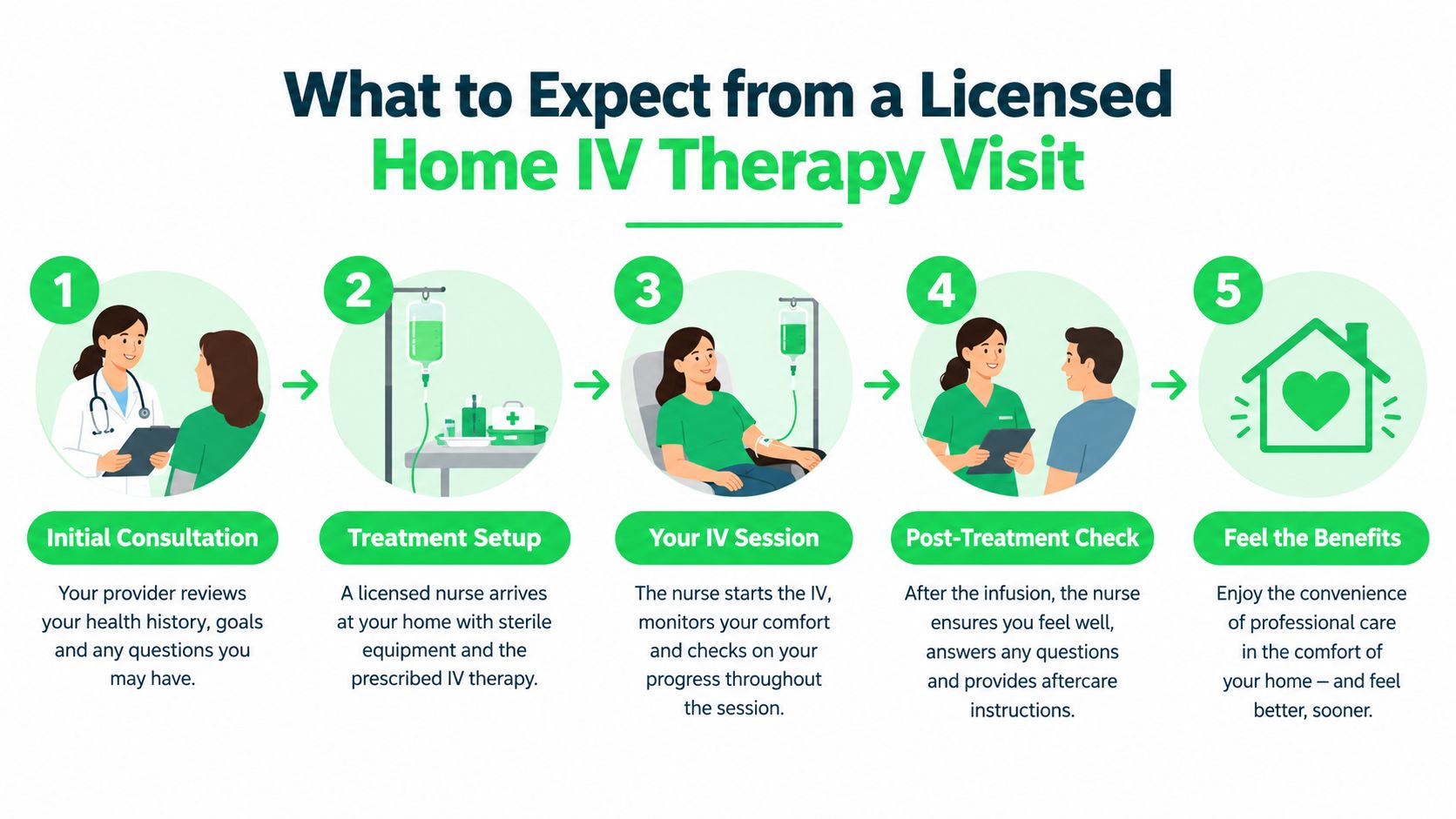
The visit begins with questions, not a bag of fluid. The clinician reviews symptoms, the likely cause of fluid loss, past medical history, medicines, allergies, pregnancy status where relevant, and cardiovascular or renal conditions. They then assess vital signs and decide whether oral hydration, medical review, IV treatment, or emergency referral is the safest route.
The clinical sequence
Assessment comes first. The practitioner confirms the indication and checks whether the patient can safely drink. If the symptoms suggest an underlying condition requiring investigation, the clinician should explain why a wellness infusion isn't an adequate response.
Preparation follows. After selecting an appropriate fluid and prescription, the clinician uses hand hygiene, skin antisepsis, sterile equipment, and a suitable venous-access technique. The patient should be told what is being administered and what sensations or warning signs to report.
Monitoring continues during the infusion. Staff should observe the patient, check comfort and vital signs as clinically appropriate, inspect the cannula site, and adjust or stop treatment if a reaction or complication develops. Documentation should include the fluid type, volume, flow rate, observations, and escalation plan.
Review closes the visit. The clinician assesses the response, removes the cannula safely, provides aftercare advice, and explains when to seek further medical attention. Persistent or worsening symptoms should trigger follow-up or referral rather than repeated infusions without diagnosis.
A service such as IV hydration at home in Dubai should therefore be judged by its clinical process, not just its speed or the number of ingredients offered. A licensed provider should be able to explain who assesses the patient, who prescribes and administers treatment, how complications are handled, and what happens if the patient isn't suitable.
Frequently Asked Questions About IV Hydration
Are vitamin additives necessary?
Usually, hydration and vitamin supplementation are separate clinical questions. Fluids may be appropriate for a significant fluid deficit, but adding vitamins doesn't automatically make the treatment more effective. Vitamin additives should be considered only after reviewing the patient's condition, allergies, medications, kidney function, and relevant risks such as G6PD deficiency.
A person who feels better after an infusion may be responding to fluid replacement, rest, treatment of nausea, or natural recovery. That improvement shouldn't be interpreted as proof that every ingredient in the bag was necessary.
How often should someone receive IV hydration?
There isn't a routine frequency that suits everyone. A licensed clinician should base any repeat treatment on the cause of the problem, the response to previous care, ongoing fluid losses, oral intake, and relevant medical risks.
Repeated drips for unexplained fatigue can mask an underlying issue. Persistent vomiting, diarrhoea, heat intolerance, recurrent dizziness, or ongoing weakness deserves medical evaluation rather than an open-ended wellness schedule.
How quickly should symptoms improve?
Some symptoms may ease after fluid loss is corrected, but the timing depends on the cause and severity of dehydration. An infusion won't necessarily resolve an infection, heat illness, medication effect, electrolyte disorder, or another underlying condition.
If symptoms persist, worsen, or return soon after treatment, contact a healthcare professional. Feeling temporarily better isn't the same as having identified and treated the cause.
Is IV hydration safe for everyone?
No. Heart failure, severe renal impairment, pregnancy, known electrolyte abnormalities, complex medication regimens, allergies, and certain vitamin-related risks require careful screening. A clinician may recommend oral fluids, tests, a different treatment, or referral instead of an IV.
The practical answer to “is IV hydration good for you?” is conditional. It can be an effective medical tool when clinically indicated and properly monitored, but it isn't a risk-free upgrade for a healthy person with mild dehydration who can drink safely.
Vitals Healthcare Doctor On Call offers DHA-licensed doctor visits, nursing care, and clinically assessed IV hydration at homes, hotels, and offices across Dubai. If you need help deciding between oral rehydration, an IV assessment, or urgent referral, visit Vitals Healthcare Doctor On Call for regulated care at your location.