
The most popular advice for tennis elbow is often the least useful: stop using the arm completely and wait for the pain to disappear. That may calm symptoms temporarily, but it doesn't prepare the tendon for the gripping, lifting, typing, driving, serving, or carrying you'll return to. Effective tennis elbow treatment in Dubai is usually about managing load, then rebuilding capacity, not immobilising the arm indefinitely.
The condition can affect a padel player, but it can also affect an office professional using a mouse all day, a hospitality worker carrying trays, or a manual worker repeating forceful wrist movements. A realistic recovery plan must fit around work and daily life while still giving the tendon a progressive reason to adapt.
Table of Contents
- Rethinking Tennis Elbow Beyond the Court
- The Conservative First Approach to Recovery
- Structured Physiotherapy and Loading Programs
- Modifying Daily Activities and Work Ergonomics
- When to Consider Injections or Surgical Options
- Accessing In-Home Physiotherapy Services in Dubai
Rethinking Tennis Elbow Beyond the Court
The name encourages a sports-only diagnosis, but tennis elbow is an overuse tendon disorder caused by repetitive wrist and forearm movements. In Dubai, that pattern is common across office work, hospitality, manual jobs, and sport, not only tennis or padel (Medcare's overview of tennis elbow). The practical issue is a mismatch between repeated demand and the tendon's current tolerance.
Pain usually appears around the outer elbow and may increase with gripping, lifting, twisting, mouse use, or resisted wrist movement. A new padel racket, a heavier gym routine, extended laptop work, or repeated tray handling can raise the load on the wrist extensor tendons. The label identifies the painful region, not necessarily the activity that caused it.
Practical rule: If your job repeatedly loads the arm, rest means reducing the aggravating demand while keeping the arm ready for necessary work.
Why complete rest often disappoints
Complete rest can quiet symptoms while the arm is unloaded. Problems often return when normal activity resumes and the tendon is exposed again to forces it has not rebuilt capacity to manage. A gradual loading plan is more useful than waiting for pain to disappear and then returning immediately to the same workload.
Conservative rehabilitation pathways in Dubai typically combine activity modification, specific physiotherapy, bracing, and shockwave therapy before considering PRP injections. These options serve different purposes. A brace may make a required task more manageable for a short period, while progressive exercise improves the tendon's ability to tolerate that task.
Assessment also matters because outer-elbow pain does not always come from tennis elbow. Radial tunnel syndrome, cervical referral, and medial epicondylitis can produce overlapping symptoms. Pain extending into the hand, numbness, tingling, substantial grip weakness, or symptoms following a fall warrant clinical evaluation instead of repeated self-treatment.
A more useful definition of recovery
Recovery means handling progressively greater demands with less irritation. For a busy Dubai professional, that may involve typing through a workday, using a mouse without a flare, carrying hotel supplies, steering comfortably, or returning to padel without guarding every shot.
The useful question is not only, “How can I reduce today's pain?” It is, “What load can the arm tolerate today, and how can that tolerance increase?” Pain relief has a place, but it should support active load management rather than replace it. Adjusting workstation height, mouse use, racket grip, lifting technique, and work intervals can reduce repeated strain while the tendon is rebuilt.
The Conservative First Approach to Recovery
A flare-up rarely improves because you stop using the arm completely. Relative rest works better: keep comfortable movement, while temporarily reducing the loads that provoke symptoms. For a Dubai office professional, that may mean shorter mouse sessions. For hospitality staff, it may mean changing how trays or supplies are carried. Padel players may need to reduce hard serves and repetitive backhand drills rather than abandon activity altogether.
Start by identifying the task that produces the clearest increase in pain. Reduce its intensity, frequency, or duration, use lighter objects, and avoid repeatedly testing the painful movement. Gentle elbow, wrist, and forearm motion can limit stiffness. A correctly positioned counterforce brace may redistribute load during work or other required tasks, but it should support rehabilitation, not replace it.
Seek an assessment if symptoms persist, grip function declines, or the presentation includes unusual features. Pain around the elbow can involve a tendon, nerve, neck, joint, or another tendon, and the treatment plan depends on identifying the actual source.
The tendon needs enough protection to settle, plus a controlled mechanical stimulus to rebuild capacity. That balance is why conservative care often combines load modification, bracing, and progressive exercise rather than passive treatment alone.
What passive treatment can and can't do
Ice, soft-tissue work, ultrasound, and similar options may make the elbow more comfortable temporarily. That relief can help you move and complete necessary tasks, but it does not automatically increase the tendon's ability to tolerate load. Exercise and activity planning remain the foundation of recovery.
A systematic review indexed by PubMed found midterm benefit from physiotherapy and exercise compared with placebo, with a PRTEE pain mean difference of −4.32, with a 95% confidence interval from −7.58 to −1.07. It did not show short-term superiority over control. In practice, exercise is not an instant pain eraser. Its value comes from a structured process that gradually improves tolerance.
For broader background on tendon loading and symptom management, managing tendonitis in Williamsport explains principles that also apply to Dubai patients, although a general US resource should not replace a local examination.
The programme should fit your job, sport, symptoms, and available time. If you are comparing treatment formats, this guide to which type of physiotherapy is best explains why assessment-led care is more useful than selecting treatment by the machine or modality alone.
Structured Physiotherapy and Loading Programs
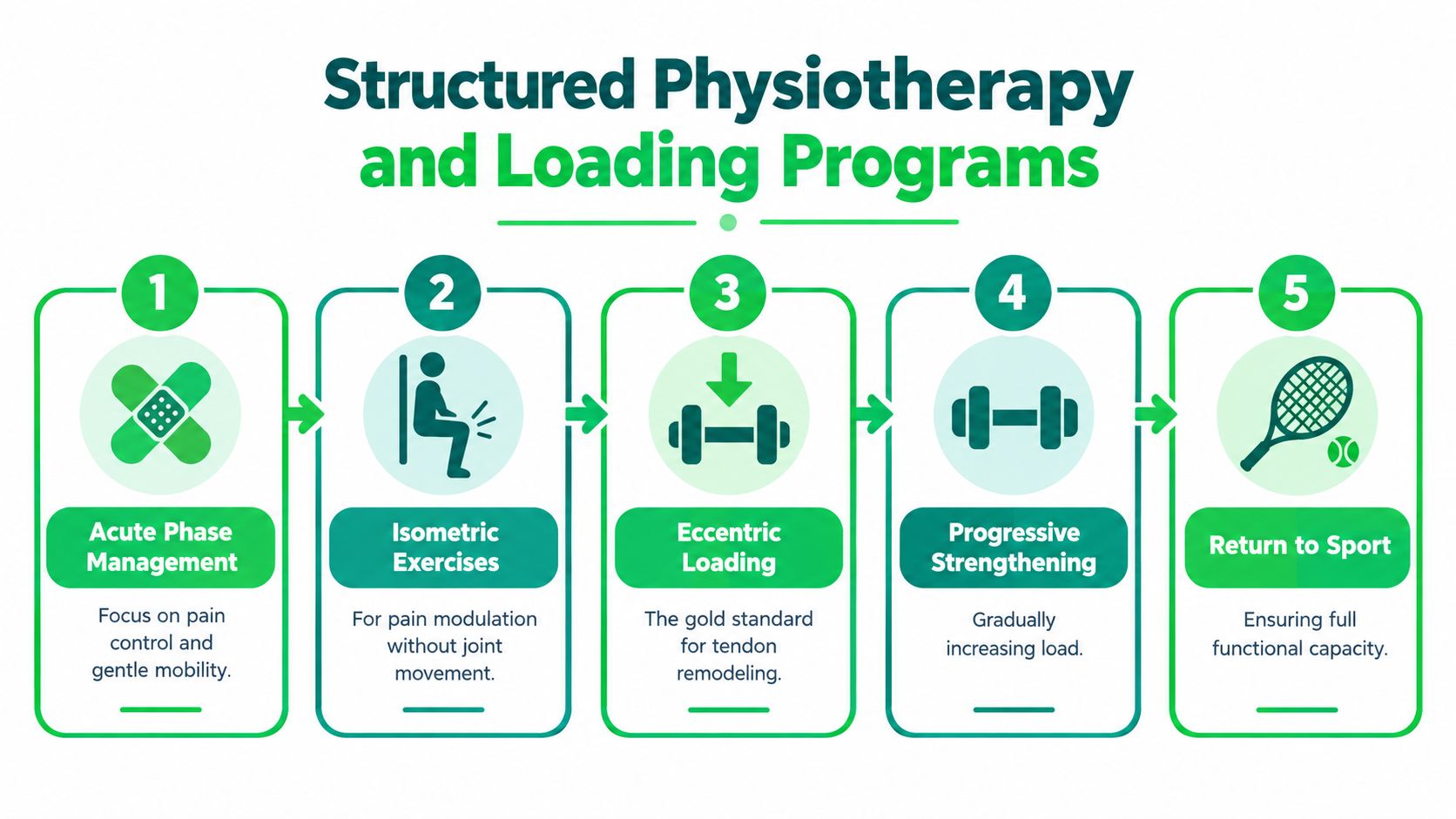
Tennis elbow rehabilitation succeeds through planned loading, not by chasing short-term pain relief. A physiotherapist starts with movements the patient can tolerate, then adjusts resistance, repetitions, range, speed, or task complexity as control improves. The progression should reflect symptoms, strength, work demands, and sport, particularly for Dubai professionals, hospitality staff, and padel players who cannot just stop using the arm.
Isometric and eccentric wrist exercises are central tools because they expose the tendon to force in a controlled way. Isometrics may calm an irritable elbow and maintain muscular engagement while the total workload is adjusted. They are a starting point, not the complete programme. The tendon eventually needs to handle movement, changing force, gripping, and faster tasks.
Isometric work for an irritable elbow
An isometric exercise creates muscle tension without visible joint movement. For tennis elbow, this can involve holding the wrist in a controlled position against resistance while keeping the forearm steady. The aim is to introduce force without repeatedly moving through the range that provokes symptoms.
Early rehabilitation often uses isometrics when gripping or wrist extension feels sensitive. The hold should remain controlled, with the resistance matched to current tolerance. If symptoms remain heightened after the session or affect the following day, the load or duration needs adjustment.
Eccentric loading for capacity
Eccentric loading trains the lowering phase of a movement. For the wrist extensors, the patient may use the other hand to raise the wrist, then lower it slowly against resistance. A small weight is suitable only if the patient can maintain position and tempo without compensating through the shoulder or forearm.
A commonly cited framework uses three sets of 15 eccentric wrist-extension repetitions, twice daily, for six to eight weeks, alongside eight to 12 supervised sessions over six to 12 weeks (Doctors Clinic Dubai's physiotherapy guidance). Treat that dose as a reference, not a prescription. A physiotherapist may reduce it for a reactive elbow, change it around long shifts, or progress it when the patient is tolerating the work consistently.
How progression should work
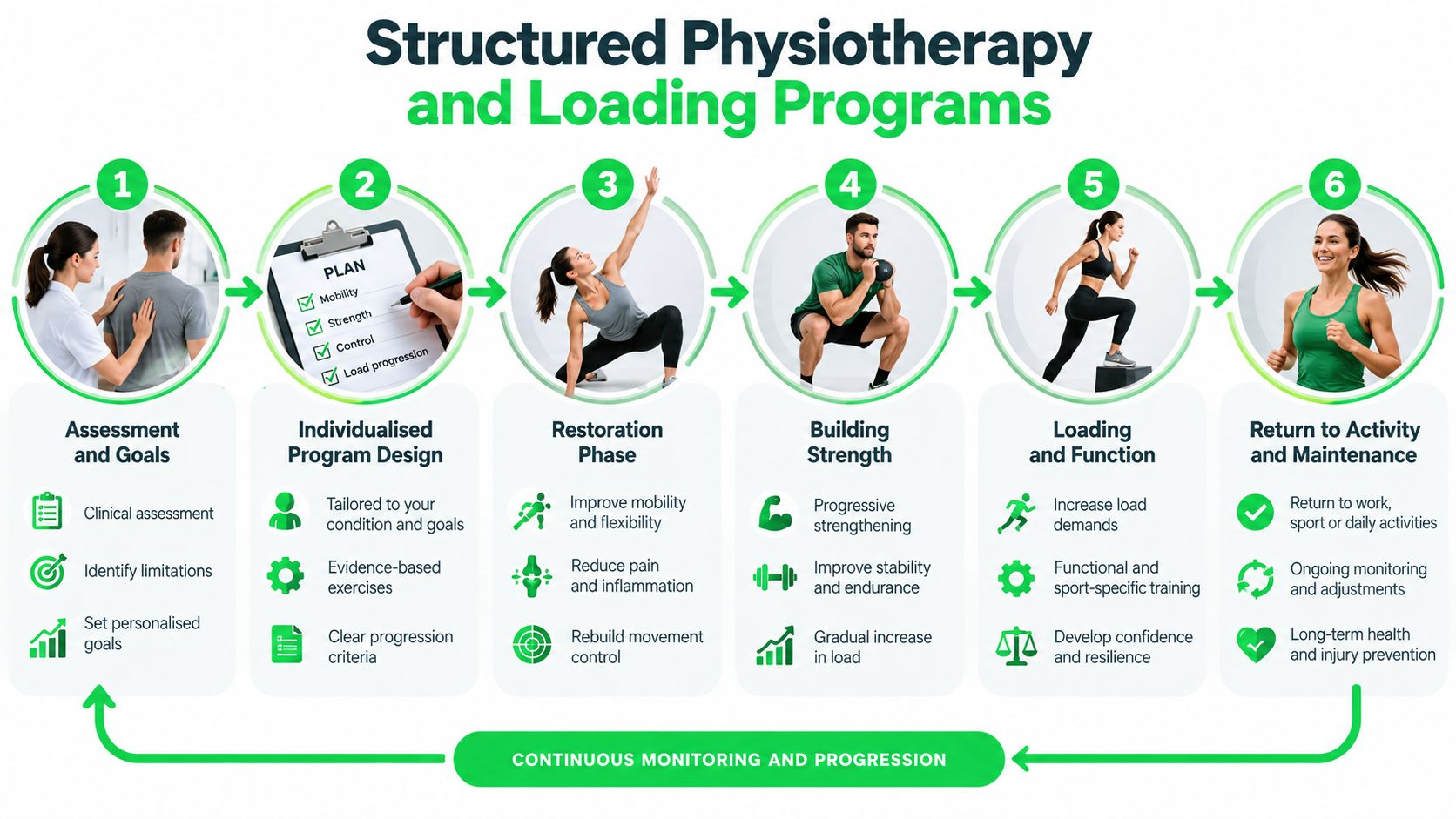
A useful plan moves from controlled loading to the demands of daily life:
- Tolerance: Complete the movement with manageable symptoms and repeatable technique.
- Strength: Add resistance gradually while maintaining wrist and forearm control.
- Function: Practise gripping, lifting, carrying, keyboard work, or racket movements that match the patient's routine.
- Return: Reintroduce faster or heavier tasks in planned doses, rather than testing the elbow during one ambitious padel session.
A mild, short-lived response may be acceptable in some programmes. A strong flare that changes the next day's work, sleep, or grip indicates that the load was too high. Agree on a response rule with the physiotherapist, so symptoms guide the next adjustment rather than stopping rehabilitation completely.
Manual therapy, shockwave therapy, and massage may support comfort or movement, but they do not replace progressive loading. The Thermo Recovery Wear exercise guide offers exercise ideas, although online examples cannot account for diagnosis, technique, or the demands of a desk job, hotel shift, or racket sport.
Patients who struggle to attend appointments can consider sports injury physiotherapy at home in Dubai for supervised progression around work and travel. Consistent practice, measured loading, and practical task changes usually matter more than selecting the most elaborate intervention.
Modifying Daily Activities and Work Ergonomics
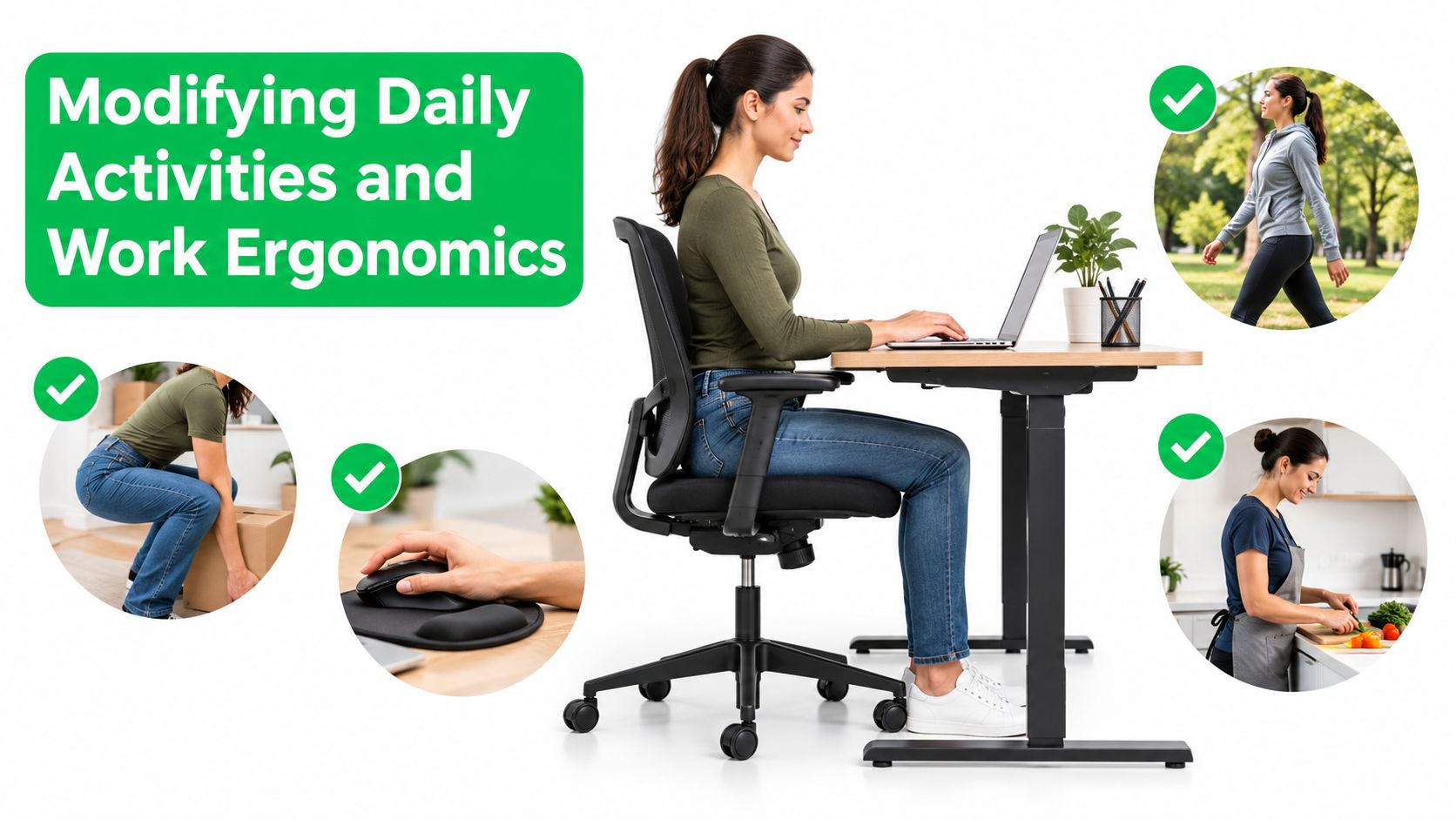
Exercises can be well chosen and still fail if every working day repeatedly overloads the same tendon. The practical target isn't always to stop working. It's to change how much force the arm uses, how often it uses it, and how long it works without a break.
For office professionals
A mouse can create a surprisingly repetitive demand when the wrist stays extended and the forearm remains tense. Keep the mouse close, allow the forearm to rest where possible, avoid squeezing the device, and alternate tasks rather than completing long uninterrupted periods of cursor work.
A keyboard and mouse setup should let the wrist remain relatively neutral. Reduce unnecessary clicking, use keyboard shortcuts where practical, and take brief movement breaks before discomfort becomes intense. The aim isn't to keep the arm perfectly still. It's to avoid accumulating the same irritating load for hours.
For drivers and hospitality staff
Drivers may grip the steering wheel tightly, especially in heavy traffic. Relax the grip when control allows, vary hand position safely, and avoid carrying bags with the painful arm immediately after a long drive.
Hospitality work creates a different challenge because trays, bottles, cookware, and luggage often need to be moved repeatedly. Use both hands for heavier items, keep loads close to the body, and turn the whole body rather than repeatedly twisting through the forearm. Ask whether duties can rotate temporarily while the tendon is being reconditioned.
For manual workers and padel players
Tools with narrow handles often demand more gripping force. Where safe, use a suitable larger or padded handle, keep the wrist aligned with the forearm, and avoid sudden force applied at arm's length. These small changes reduce the torque created at the outer elbow.
Padel players should first examine racket weight, grip size, swing volume, and technique with a qualified coach or physiotherapist. Returning because the elbow feels better after treatment, without rebuilding forearm capacity, is how a manageable tendon problem becomes a repeating cycle.
Home comfort measures can support a broader plan, and this guide to effective home remedies for muscle strain after gym or sports injury covers practical symptom-management ideas. Those measures should complement, not replace, load modification and progressive strengthening.
When to Consider Injections or Surgical Options
Procedures deserve discussion when symptoms remain stubborn, but they should not automatically follow a short period of pain. First confirm that the diagnosis fits and that the tendon has received a consistent loading programme with sensible progression. For a Dubai office professional, hospitality worker, or padel player, the practical aim is to manage necessary arm use while rebuilding capacity, not to chase temporary pain relief.
Conservative care may include physiotherapy, activity modification, bracing, shockwave therapy, and, for selected patients, PRP injections. PRP is not a guaranteed cure. Decisions about any injection should reflect the diagnosis, symptom duration, functional limits, previous rehabilitation, and the patient's understanding that benefits remain uncertain.
Comparing escalation choices
| Option | Potential role | Main limitation |
|---|---|---|
| Brace or counterforce strap | Helps some patients manage necessary activity | Does not rebuild strength on its own |
| PRP injection | May be considered case by case | Evidence does not justify treating it as a guaranteed solution |
| Corticosteroid injection | May change pain in the short term | Relief can encourage premature loading and does not replace rehabilitation |
| Novel procedures | May be marketed for persistent cases | Evidence synthesis and pathway guidance do not show clear benefit over placebo for options such as ultrasonic tenotomy, dextrose prolotherapy, iontophoresis, embolisation, or bone-marrow-related injections (evidence review) |
| Surgery | Reserved for selected, persistent cases after assessment | Requires careful diagnosis and recovery planning |
The same evidence synthesis advises that patients should be told there is no strong evidence that any treatment speeds pain recovery in the short or medium term compared with placebo. Treatment still has a role when it supports function and a structured rehabilitation plan. Claims of rapid, certain procedural cures warrant caution.
When the diagnosis needs revisiting
Arrange specialist review if pain persists despite a properly followed rehabilitation plan, grip strength is falling, or symptoms extend beyond the expected pattern. Numbness, tingling, pain travelling into the hand, neck-related symptoms, substantial loss of function, or pain after trauma may indicate another problem.
Imaging is not automatically necessary for every outer-elbow complaint. It becomes more useful when the examination is unclear, symptoms do not follow the expected course, or another diagnosis needs investigation. If your symptoms continue beyond the expected 12 to 24-week rehabilitation window discussed earlier, arrange a review rather than just changing procedures.
For patients comparing clinic and home options, physiotherapy at home cost information can help with planning. Weigh cost alongside supervision, continuity, diagnostic assessment, and whether the service supports the progressive loading your arm needs.
Accessing In-Home Physiotherapy Services in Dubai
A demanding schedule can undermine a sound rehabilitation plan. Dubai traffic, meetings, travel between sites, and family responsibilities make clinic attendance difficult for many people, especially when the required treatment is repeated exercise rather than a single procedure.
In-home physiotherapy can bring assessment and supervised rehabilitation to a residence, hotel, or office. A DHA-licensed physiotherapist should assess the elbow, wrist, shoulder, and neck as clinically appropriate, identify the loads driving the symptoms, check exercise technique, and adapt the programme to the equipment and space available.
What to arrange before the visit
When booking, describe where the pain is, which activities trigger it, how long it has been present, and whether you have numbness, tingling, trauma, or noticeable weakness. Tell the provider whether the visit is for an office worker, driver, hospitality employee, manual worker, or padel player. That context helps the clinician plan a useful functional assessment rather than focusing only on the painful point.
A home visit may include:
- Clinical assessment: History, movement testing, grip-related assessment, and screening for referred or nerve-related symptoms.
- Exercise instruction: Isometric work, eccentric wrist loading, grip training, and progression appropriate to your tolerance.
- Work-specific advice: Review of a desk, kitchen, driving position, lifting routine, or sporting equipment.
- Follow-up coordination: Digital communication through phone or WhatsApp, with guidance on the next stage of loading.
Vitals Healthcare Doctor On Call offers home, hotel, and office physiotherapy through DHA-licensed clinicians, with assessment, rehabilitation support, digital coordination, and invoices that may assist with insurance claims. You can review the practical booking process for physiotherapy at home in Dubai before arranging a visit.
Home treatment isn't automatically better than clinic treatment. It is useful when the setting reflects the problem, such as assessing a workstation or fitting exercises into a crowded schedule. The essential safeguards remain the same: appropriate licensing, a clear diagnosis, progressive loading, honest discussion of timelines, and review when symptoms don't behave as expected.
If outer-elbow pain is affecting your work, driving, lifting, or padel, Vitals Healthcare Doctor On Call offers DHA-licensed physiotherapy visits at home, in hotels, and at offices across Dubai, with assessment and supervised rehabilitation matched to your daily demands. Visit Vitals Healthcare Doctor On Call to arrange an assessment and start a practical plan without adding a clinic commute to your schedule.